
Property management payments are not just about getting paid for renting out the property. In fact, they are complex payments that involve numerous moving parts and multiple levels through which money flows. When there is only one property, this is simple: the tenant pays the money, and the owner receives it. When multiple properties are involved, the money flows through many levels, such as tenants, managers, owners, and vendors. Money changing so many hands makes it complex to manually track cash, and this is not easy to tackle using a generic payment tool. You need a property management payment processing software to manage these variables efficiently, and also because every level the money flows through has its own set of legal documentation and compliance policies that must be adhered to. This friction is usually different from retail businesses, where there is only one buyer and one seller involved.
One more peculiar thing in property management is that rent is a recurring payment. Every month, it is the same tenant, same manager, and the same owner to whom the rent is going, but the general payment software registers every payment as a new transaction, whereas that transaction was meant to be a scheduled collection. Generic payment processors do not provide options for late fee add-ons, which is a crucial thing in property rent management. Deposits can be confusing in several jurisdictions, as they are often co-mingled with operational funds, which are not legal. Late fees are not optional; they are a defined lease term that should be addressed appropriately. It requires proper documentation to defend it, in case it is disputed in the future. Deposits must be put in separate accounts, trusts, and ledgers that comply with the rules and guidelines of the property jurisdiction.
For property managers who manage rent collection from properties owned by different owners, a dedicated software is needed to manage rent collection, management fees, maintenance charges, and rent distribution to the respective owners. This is barely even possible to manage manually for 3-5 properties, let alone managing 20-30 rental units. Automation and software become a critical part of the property management business as the number of properties increases, because the probability of manual error is high, and no property owner would want their properties to be managed by a lazy and inefficient rent manager. The complexity scales non-linearly — for a framework on choosing software that grows with your portfolio rather than getting outgrown, see our guide on scaling from a few rentals to a portfolio.
Most property owners try a workaround by using multiple software, each specialized in separate functions, but it soon becomes their worst nightmare. Managing and updating spreadsheets and feeding them into a scheduling and alert software, which links to another software to track payment collection, is not only difficult but virtually impossible.

Collecting rent online through software sounds simple — get an app, send it to your tenant, and some details will be logged in, and everything will flow smoothly. In reality, it is a complex process involving multiple parts that operate beneath the hood. Property payment processing software includes payment rails, processing windows, failure modes, late fee add-ons, and tenant UX that reduce friction in payment processes and streamline timely rent payments. Rent collection software provides management dashboards and metrics for the owner, as well as an interface for tenants to pay rent and submit service requests.
ACH is a bank-to-bank transfer, i.e., the funds are transferred from the tenant’s account to the owner’s account. These types of transfers are processed typically within 2 to 5 business days. ACH transfer is the most preferred method for rent collection due to its low cost, with fees ranging from $0.25 to $1.50 on every transaction. ACH transfers can be returned up to 60 days after initiation in cases of dispute for fraud. These types of transaction failures are rare in the case of rent payments, but quite risky as the cash is not guaranteed until two months after payment. In the bank statements, NSF (non-sufficient funds) returns typically show up within 3-5 days from the due date of payment.
Credit or debit card transactions are way faster than ACH transactions, because they are hassle-free and are mostly settled within the same day or the next day. The fees on credit card transactions are much higher, about 2.5% to 3.5% of the amount paid, i.e., for a transaction of $1000, the fees to process it are more than $25. This fee must either be borne by the landlord or paid by the tenant, but that makes this method seem unfair to both parties. This is the reason why most landlords avoid using credit card transactions for rent collection, but some commercial rentals still use them when appropriate.
Payments through digital wallets are among the fastest and most convenient methods for a tenant. Convenient as they are, they should not be handled outside a proper rent collection system. When digital wallets are accepted through a dedicated payment portal or processor, the transactions are properly recorded, receipts can be generated, and the landlord has a clearer documentation trail of the payment that was made.
However, when payments are collected through informal wallet transfers or apps that are not set up for rental operations, recordkeeping can become difficult and dispute handling may be limited. If such transactions are flagged incorrectly or handled outside the proper setup, delays or account issues may arise. Digital wallets can work in professional property management, but they are most reliable when used through a dedicated payment processing software.
Online rent payment has been widely adopted by tenants in recent years. Most tenants prefer to pay their rent through digital payment methods instead of checks. This is because online payment is easier, more comfortable, and can be done at any time. Landlords who switch to online payments see better rent collection. According to statistics, landlords who adopted online methods saw a 20% to 30% decline in the number of late payments in the first few months of adoption, solely because the friction of writing checks was removed.
The biggest advantage of having a dedicated rental billing software is that it completely removes a human from the payment cycle, thus improving the payment psychology.
Recurring billing is not just limited to autopay initiated from the tenant’s side. It involves creating new charges on the ledger every month for rent, parking fees, or pet fees. When the tenant has autopay enabled, these charges are automatically deducted; otherwise, a reminder sequence is activated. Reminder sequences vary according to software and can be customized in some cases. When the rent remains “due” on the ledger beyond the grace period, a late fee is applied automatically.
Late fee automation is a crucial part of billing software. When the rent due exceeds the grace period, a late fee is applied to the due amount, which varies from state to state. Manually handling late fee charges for each tenant is prone to error and inconsistent. Automating the late fee can save hours of manual calculation and avoid unnecessary errors. Late fee automation applies late fees consistently to every “due” in the ledger and sends receipts to the tenant and the landlord. It saves the money of the landlord, too. Let’s suppose a landlord has 20 rentals, with a late fee charge of $75. Missing late fees twice a year, for just 5 tenants, means $750 lost in documented income. To prevent these losses, it is crucial to automate the late fee calculation.
Some landlords allow for partial payment of the rent. It creates various complexities, such as resetting the grace period, complicating evictions, etc. The ledger must also be tracked precisely when partial payments are made. A good billing software should not assume this option to be enabled for every landlord; it should provide an option if the landlord wants to allow partial payment for specific properties or not. Another feature a good software has is lease variable billing. Rent is not fixed or the same for every tenant. It can increase on renewal on lease, so the software must be able to track per-unit, per-lease rent configurations and calculate dues in the ledger according to it.

Deposits are the minefield of property management compliance. A single misstep in managing deposits could mean losing multiple times the deposit amount collected by the landlord. Deposits are not rent; they are a security amount held in trust, so they must be treated accordingly. Most states require a different trust or account to store deposits, and some states are even stricter, requiring the deposit to be stored in an interest-bearing account and transferring the accrued interest to the tenant. It is important that the landlord never mingle the deposit amount with operating funds.
Any deduction from the deposit must be clearly documented. The deposit must be released within the return window, or the landlord might end up paying two or three times the deposit amount in case of disputes. The software must track the return timeline from the move-out date, and also maintain records of any deductions made during tenancy. Itemized deduction statements are required by many states in case any amount is withheld from the deposit for applied damages or other reasons.
Most landlords make mistakes while making deposits. The most common mistake is taking the deposit into the same account as rent. Deposit is security money held in trust and will be returned in the future after eviction, not an operational fund. This is illegal in most states, regardless of whether it was done by accident or not. Another huge problem for landlords is forgetting return deadlines. The security must be returned within the return window specified after the move-out; otherwise, in case of dispute, the landlord may end up paying twice or even thrice the amount of the deposit. When software tracks deposits, it creates a paper trail of documentation of who paid, for what, and to whom. Landlords must also provide an itemized statement of any deductions made from the deposits. In small claims, a paper trail is crucial and enough evidence to defend yourself in disputes common at the end of the lease agreement. Some states explicitly deny “wear and tear charges.” However, some landlords still try to deduct wear & tear charges, which is a huge mistake.
The key thing is to have a move-out workflow that ensures all the checkboxes are ticked, and nothing is left to memory or coincidence. Whenever a tenant vacates the property, conduct a thorough inspection and document the damages through photos and videos. These damages must be properly documented with cost estimates of each attached. The software must calculate the remaining amount to be refunded from the deposit and return an itemized statement of the sum withheld. Keeping these things in mind, the landlord can protect themselves from common mistakes and save themselves hundreds of dollars in potential disputes.
Rent collection is only one part of the payment cycle. The next step for property managers is to manage those funds and distribute them accordingly. Providing owner statements is not just a trust-building tool, but also a professional obligation. An owner statement is a month-end summary of all the rental income, profit/loss, management fees, and repair charges. Owner statements are a critical part of landlord payment processing, as owners use these statements for tax prep, portfolio tracking, and tracking the performance of their properties.
Whenever rent comes in, the property manager (PM) holds the funds in their accounts. They deduct management fees of 8%-12% of the collected rent. PMs deduct the amount for authorized repairs and maintain reserves if approved. Then the net amount left is credited to the owner’s account via ACH or check. This whole process takes about 10 to 15 days, and the funds are settled in the account of the owner by mid-month or month-end.
There are a few things an owner statement must have:
A landlord payment processing software becomes necessary for PMs because using spreadsheets to track such complex and widespread data becomes cumbersome and prone to errors. Inconsistent reports, errors, and delays cause the landlord to lose trust in the PM. Failure to separate the costs of repairs done on various properties decreases transparency and makes it difficult to justify why funds were held. Lastly, if a tenant moves in mid-month, then the ledger can become confusing or even miscalculated. Therefore, it is important for the PM software to manage pro-rated funds appropriately. PMs are required to issue 1099s to vendors who are paid more than $600 annually. Similarly, if the distribution of any owner exceeds $600 annually, the PM must issue a 1099-MISC to the owner, too. Manually tracking them can be chaotic at year’s end when multiple owners and vendors are involved, leading to missed deadlines and forms, or bad reporting.
Traditional property management software charges subscription fees on a monthly basis. This is fine with owners of multiple properties, but for small-scale rentals, the monthly fees alone exceed the operational cost for all the properties combined. So, the landlords prefer to use spreadsheets to “save money”, but end up losing time and mental peace instead.
Old property management software was paid for. The fees of these platforms varied from $1 to $3 per unit per month, and stacked on top of it were setup fees, legacy fees, and add-ons. This resulted in a major cost, which often exceeded what landlords saved operationally from any one of their properties. The landlords preferred to use spreadsheets for this reason, but it was very inconvenient.
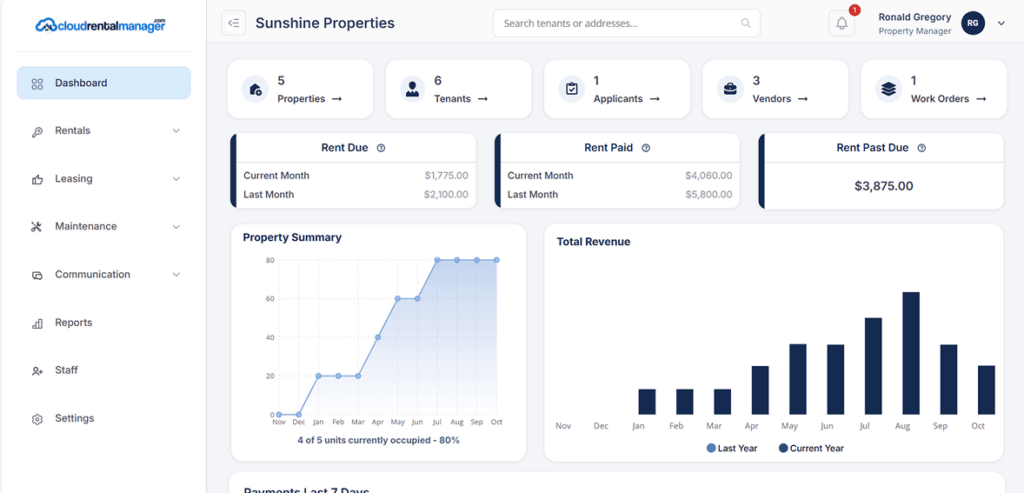
Nowadays, freemium, transaction-based, and truly free software are available in the market. Freemium software provides you with all the basic features, but crucial and advanced management features are often locked behind a paywall. The purpose of the free features is to entice you and give you a taste of how easily management can be done, so you end up paying for the advanced features. This model is often a risk, as the advanced features may not be satisfactory, or turn out to be a bait sold to you. In transaction-based pricing, the platform takes a percentage cut on every rent collected and managed through its app. This aligns incentives for both parties, but is often a cost to the landlord. With the availability of truly free software, it is now much more convenient for a landlord to use this software, because they do not charge money for access, and provide all the features that paid software does. Free software with transaction-based pricing is way cheaper than subscription-based ones. But a truly free software, like the Cloud Rental Manager, has changed the game entirely. You get all the features of paid software, without paying a dime. Tools vary greatly in the free landscape, too — with AI-powered property management platforms emerging as the next layer above traditional automation. The market is full of free software that connects various platforms together, increasing hassle for the landlord. On the other hand, Cloud Rental Manager is different because it integrates all the functions into one combined platform, rather than stitching different platforms together.
With Cloud Rental Manager, you get the following features:
Property management involves multiple moving parts that must operate in sync with each other to efficiently manage rental properties. The three main pillars of rental management are lease management, work orders, and tenant communication. All three of these cannot operate separately; they must be connected to each other. If the management is split into separate silos, it would be necessary to manually track the data and cross-reference it, which would lead to human errors that propagate through every billing cycle. An integrated software piece them together to automate the billing, secure your ledgers, and boost retention.
Leases are the cornerstone that decides the rent of any property. Lease must be translated into the billing software to automate and calculate rent accurately, but most landlords who use spreadsheets to translate a paper lease into formulas end up making minor, unnoticeable errors that compound over time into disastrous outcomes. It is better to have an integrated billing software that has built-in options to calculate dues based on lease terms, rather than trying to make everything from scratch. With integrated payment software, you can have digital signatures of the tenant and landlord, which can help with documentation, automated grace period, and late fee calculation.
Work orders are important in any rental property. When a tenant requests a repair, or when IoT-connected sensors trigger one, the vendor sends the invoice, and in this point-to-point communication, the details are either repeated or lost. It is important for the manager to link the repair requests from the tenant, invoices from the vendor, and approvals from the owner together on one platform. Work orders are a financial event, and should be treated likewise with proper documentation and evidence. Integrating work orders into the billing software makes it easy to maintain accounts of repairs in the ledger and eliminate redundancies.
The job of a rental owner does not end with getting a tenant. The tenant is essentially paying a fee to live at your place, and needs consistent communication and check-ins regarding their needs and comfort. Most tenants who feel ignored leave earlier, and it can cost the owner at least two months’ rent. But, having good communication is about maintaining a balance, as constantly pestering a tenant in the name of checking in can also cause them to leave in frustration and lack of privacy. The best way to communicate with your tenant is through the platform you choose to manage your rentals. Reminders about rent, grace periods, and late fees must be sent on time, and repair requests and proper acknowledgements must be signed by both parties. Leaving things to guesswork is a dealbreaker, as it can risk both sides in case a legal dispute arises.
For a complete property management approach — including emerging priorities like sustainable property management practices — features like recurring billing, partial billing, ledger updation, deposit calculation, documentation, and work order requests are all important. When the number of properties increases, the lack of synchronization that comes with a simple software will become a source of errors in the workflow. While choosing a payment processor, you must opt for a specialized payment processing software that helps you automate and helps you efficiently navigate the specific challenges faced in property management.
If you are tired of ‘SaaS burnout,’ eliminate monthly fees forever. Switch to Cloud Rental Manager: the all-in-one property management solution that gives you robust features and low-cost payment processing for $0 monthly software cost. Lock in your free account today and start managing smarter!
We use cookies to enhance your browsing experience, analyze site traffic, and support our marketing.You can accept all cookies, reject non-essential ones, or manage your preferences below. Learn more in our Privacy Policy.
Manage your cookie preferences below:
Essential cookies enable basic functions and are necessary for the proper function of the website.
These cookies are needed for adding comments on this website.
Google Tag Manager simplifies the management of marketing tags on your website without code changes.
These cookies are used for managing login functionality on this website.
Statistics cookies collect information anonymously. This information helps us understand how visitors use our website.
Google Analytics is a powerful tool that tracks and analyzes website traffic for informed marketing decisions.
Service URL: policies.google.com (opens in a new window)
Marketing cookies are used to follow visitors to websites. The intention is to show ads that are relevant and engaging to the individual user.
Facebook Pixel is a web analytics service that tracks and reports website traffic.
Service URL: www.facebook.com (opens in a new window)
OptinMonster is a powerful lead generation tool that helps businesses convert visitors into subscribers and customers.
Service URL: optinmonster.com (opens in a new window)