Author Archives: hostmerchantservices

How Long Do ACH Payments Take to Process

Top 10 Small Business Growth Strategies

Small business growth strategies are comprehensive plans designed to help a small business achieve its objectives, often boosting revenue, profits, and market share. These strategies involve pinpointing key opportunities such as expanding the product range, investing in effective marketing channels, or tapping into new markets.

Interestingly, 23% of U.S. consumers are planning to start a new business in 2026. To steer your business towards success in 2026, consider these ten expert-recommended growth strategies for small businesses.

23% of U.S. consumers are planning to start a new business in 2024

Source: Intuit

Best Small Business Growth Strategies

1. Know Your Value Proposition

In today’s competitive business environment, it’s easy to get sidetracked by new growth opportunities and lose sight of what makes your business unique. However, it’s crucial to maintain a clear focus on your value proposition, which sets you apart from your competitors and attracts customers. Your value proposition could be based on pricing, quality, value, service, sustainability, or another unique aspect of your business. By staying true to your value proposition, you can establish a strong brand identity and secure a significant position in the market. This not only benefits you but also your customers and employees.

Align each choice with your unique market role to make your value proposition a guiding star for business decisions.

Know Your Value Proposition

2. Go Online!

Everything is going online, and so is small business.

As digital interactions dominate, enhancing your online visibility goes beyond just maintaining a business website. Nowadays when 25% of business is online, where online platforms significantly influence consumer choices, your website must serve as an active, engaging hub for your visitors.

Transform your website into an interactive showcase for your products or services. Incorporate high-quality images, videos, and client testimonials to depict your offer vividly. Design your site to be user-friendly, allowing visitors to easily navigate, access necessary information, and engage with your business through making a purchase, scheduling a service, or reaching out for more details.

Producing and publishing valuable content regularly positions you as a thought leader in your field, enhancing your audience’s trust. This content should be relevant, instructive, and tailored to meet your audience’s needs, whether it’s articles, blog posts, how-to guides, videos, infographics, or social media updates.

By developing a dynamic website, engaging actively on social media, and implementing targeted digital marketing strategies, you can establish a robust online presence that connects you effectively with your ideal customers.

3. Optimize Your Sales Pipeline

A sales pipeline serves as a visual representation of a prospect’s engagement stages with your sales and marketing teams, providing insights into the actions taken by your team to facilitate purchases. Unlike a sales funnel, which primarily tracks conversion rates, a sales pipeline details the specific steps and tasks involved, breaking down larger sales objectives into manageable, trackable components. Typically, a sales pipeline includes five key stages, but customization is essential to maximize its effectiveness.

It is important to regularly evaluate and update your sales pipeline with the help of senior management and sales leaders. This involves updating the buyer personas, targeting new prospects, addressing their specific challenges and pain points, calculating the number of opportunities at each pipeline stage, and initiating lead generation. You should establish clear and measurable targets and KPIs for each stage to monitor progress and effectiveness. You can also assess the viability of each deal and identify actions that can help prospects move to the next stage.

4. Streamline Repetitive Tasks with Automation

Automation offers a practical solution for businesses to optimize repetitive tasks, enabling employees to concentrate on broader strategic goals.

Consider automating any labor-intensive processes currently occupying significant amounts of time for you or your team. Automation enhances the accuracy of tasks such as data entry and reconciliation and liberates your staff to focus on more critical activities, such as business expansion and exploring new markets. Here are some tips before considering automation:

  • Analyze each process in detail before automating. Identify inefficiencies and redundancies to ensure effective streamlining and enhance overall performance.
  • Design automation solutions tailored to specific, problematic processes rather than fitting processes to pre-built automation applications.
  • Evaluate automation’s return on investment (ROI) to ensure that the costs do not outweigh the benefits, making the process more cost- and time-efficient.
  • Plan for the long term when streamlining processes, considering future growth and changes. Focus on strategic changes that yield significant improvements.
  • Leverage existing automated solutions that fit your company’s needs to avoid reinventing the wheel. When possible, use pre-built apps and templates.

5. Improve Your Sales Training Methods and Goals

While many organizations have a basic sales onboarding program, focusing on continuous training for your sales team is crucial.

Go Online!

Source: Qwilr

Research shows that regular training can increase a sales representative’s net sales by up to 50% and significantly boost their motivation—provided the training engages them and adds value. It’s essential to avoid monotonous seminars that fail to contribute meaningfully to their skills.

Start by revisiting your training objectives and establishing clear goals for your training modules, including how their effectiveness will be measured.

Here are some effective strategies for ongoing sales training:

  • Identify and Address Skill Gaps: Set specific training goals to close these gaps and communicate them to your team.
  • Ensure Accessibility and Relevance: Make training sessions affordable, accessible, and tailored to meet the needs of your target audience.
  • Offer Continuous Feedback: Replace annual reviews with regular feedback, making monitoring performance and development more effective.
  • Incorporate Gamification: Introduce elements like badges, challenges, and leaderboards to make learning engaging and enjoyable, enhancing motivation and skill acquisition.
  • Support Personalized Learning Plans: Cater to individual learning styles and needs to maximize training efficacy.
  • Allocate Time for Learning: Ensure employees have designated time within their schedule to focus on training.
  • Encourage Collaboration and Knowledge Sharing: Build an environment where team members can share insights and learn from each other.

6. Introduce Innovative New Products or Services

In a rapidly changing market, one of the most effective strategies for securing a competitive edge is innovation. Developing new products or services that meet the evolving needs of your target audience can set you apart and position you as a leader in your industry.

Creating groundbreaking offerings typically requires more than luck; it demands an in-depth understanding of the market. If you’re aiming to elevate your business, consider leveraging virtual assistants. They can conduct extensive research into market trends, customer needs, and competitive strategies, which are essential for crafting a feasible plan for a new product.

With the help of virtual assistants, you can focus your efforts on what truly matters—perfecting your product. This approach saves you time on market research and ensures that your energy is invested in enhancing the quality and appeal of your new offering.

7. Use the Freemium Model to Attract Early-stage Customers

The term “freemium” combines “free” and “premium” to describe a business strategy in which basic services are offered at no cost while advanced features come at a price. Global software developers widely adopt this model as a robust growth strategy.

Under the freemium model, users can access essential software features for free but must pay for upgrades or premium features. The structure of the freemium plan encourages users to become familiar with and engage regularly with the product.

In fact, the prevalence of freemium apps in the Apple App Store increased from 25% in 2009 to over 80% in 2022. Subscription numbers rose significantly, from 745 million in 2021 to 900 million in 2022.

It’s essential to understand your customers beyond surface-level knowledge. Are your customers technically skilled in your field, or are they novices seeking simple solutions? The freemium model tends to be more effective for the latter group. Consider offering a simplified version of your product; the success of the freemium approach often hinges on this “light” version. This version should be straightforward, requiring minimal training and no sales intervention, allowing users to operate independently.

Plus, it is crucial to differentiate between the free and premium offerings. The free version should be compelling enough to showcase the product’s value. If users need to access all features to recognize the product’s worth, then the freemium model may not be suitable. Packed with comprehensive features, the premium version should solve more complex problems and offer significant added value.

8. Leverage AI and Machine Learning Tools

Numerous experts are advocating for small businesses to adopt advanced technology solutions in 2026. These tools aim to phase out outdated processes and automate routine tasks.

With the widespread shift towards remote and hybrid work environments, robust platforms facilitating communication and promoting collaboration among team members are crucial. Consider utilizing project management software such as Trello, Wrike, or Asana for efficient planning, scheduling, and managing operational tasks. These tools help streamline workflows and improve team productivity.

9. Follow Omnichannel Approach

As mentioned, the online footprint is growing, and the distinctions between online and offline shopping are slowly fading. Consumers now expect a seamless brand interaction regardless of whether they shop online or in-store.

Over 55% of consumers visit physical stores before making online purchases. Another study indicates that 73% of shoppers favor a hybrid shopping model, which integrates in-store experiences with online transactions.

Follow Omnichannel Approach

Source: Intuit

Brands must ensure consistency across all platforms, from websites to physical stores. This includes uniform branding, promotions, and customer service. For example, a discount offered on a mobile app should also be valid in-store, maintaining a consistent brand voice and customer experience regardless of the customer’s touchpoint.

Here are some practical omnichannel strategies:

  • Provide real-time chat support through your app or website, offering assistance similar to what a customer would receive from a sales associate in-store.
  • Prioritize mobile accessibility as more users shop on smartphones and tablets, risking potential sales losses without a mobile-optimized e-commerce site.
  • Using tools like live chat ensures rapid response to customer inquiries to maintain high engagement and satisfaction, which is vital for effective omnichannel communication.
  • Implement marketing automation software to manage your omnichannel strategy efficiently, scale up campaigns, and personalize customer interactions across various platforms.
  • Equip your stores with tablets or interactive kiosks that allow visitors to explore your full catalog, read reviews, and order products unavailable on the shelves.
  • Analyzing demographic data and customer preferences can help you identify your audience’s most effective communication channels and streamline your marketing efforts.
  • Enable customers to order online and pick up their purchases at your physical locations, capitalizing on your online presence and in-store foot traffic.
  • Create loyalty programs that users can access from any channel. Allow customers to earn and redeem rewards whether they shop online or in-store.
  • Utilize customer journey mapping to understand and enhance touchpoints, identifying gaps in your omnichannel marketing strategy to improve customer engagement.
  • Maintain uniformity in customer service quality and tone, whether the interaction happens via X (formerly Twitter), email, or face-to-face.

A well-executed omnichannel strategy ensures that your branding, promotions, and customer service are consistent and effective, enhancing the customer experience across all channels.

10. Avoid Unprofitable Products or Services

While expanding your product line is essential, it’s equally important to phase out services and products that aren’t profitable strategically. Conduct a thorough analysis of the revenues and costs associated with each product to determine which ones are not yielding profits.

It’s only sometimes necessary to immediately discontinue unprofitable items. Consider reevaluating them to see if there are ways to reduce costs and make them viable. In some cases, products that incur slight losses may still be valuable if they lead customers to purchase other high-margin items. However, such scenarios should be cautiously approached and analyzed carefully to ensure they contribute positively to your overall business strategy.

Conclusion

As we move forward in the ever-changing business landscape of 2026, it’s clear that small businesses need to adapt and innovate in order to thrive. It’s important to prioritize growth strategies that are tailored to current market trends in order to achieve long-term success. To achieve this, businesses should focus on developing a clear value proposition, building a strong online presence, optimizing sales pipelines, and streamlining operations through efficient automation. Additionally, investing in ongoing sales training, introducing new and innovative products or services, and leveraging models like freemium can further enhance competitiveness and drive growth.

To meet consumers ‘ changing expectations, businesses must adopt advanced technologies such as AI and machine learning and an omnichannel approach. Additionally, it is crucial to manage product offerings wisely to ensure profitability and strategic alignment. By implementing these top 10 small business growth strategies, businesses can set themselves on a path toward success in 2026 and beyond.


conversion rate in your woocommerce store

How to Increase Conversion Rate in Your WooCommerce Store

Bounce rates and high cart abandonment rates are an inevitable part of the e-commerce experience. There will always be visitors who will leave your WooCommerce store without buying anything. 

That can be a huge problem for your online store’s conversion rate. As a WooCommerce store owner, optimizing conversion rates with the right strategiesis important as the e-Commerce space is getting more competitive every day.

There has been a steady increase in online shopping over the last few years, especially because of the pandemic. As a result, the competition in e-Commerce has become fiercer than ever. If you would like to make a mark and increase sales, you will have to boost your conversion rate.

Although SEO optimization will certainly help, optimizing your WooCommerce store requires a combination of internet expertise and marketing to create an ideal and appealing storefront for your customers.

One of the best ways to increase the sales of your WooCommerce store is to improve and streamline the overall browsing and shopping experience for your customers. This way, customers would like to return for another purchase based on their positive and memorable experience with your online store.

Conversion Rate Defined

Conversion rate is the percentage of visitors who find your e-commerce website through a search engine and then take the desired action, such as completing a form to become a lead. Conversion rate optimizationentails enhancing your e-commerce store to increase the number of leads you generate.

In other words, the conversion rate of your WooCommerce storeis a measure of how many people purchase your services or products out of the total number of visitors.

For example, if 1200 unique visitors go to your WooCommerce store but just 30 unique visitors purchase your products, the conversion rate for purchase action is (the number of customers purchasing ÷ total number of visitors) * 100 = (30÷1200) * 100 = 2.5%.

Tips to Increase WooCommerce Conversion Rate

Here are some practices and tips to help you increase WooCommerce conversions and sales across your store.

Use Plugins Judiciously

Some websites tend to use plugins for nearly every need on WooCommerce, which is not advisable. Mixing and matching these plugins may have an adverse effect on your e-Commerce site.

For example, these plugins could make too many HTTPS requests, slowing down your store, and you don’t want that.

Across your WooCommerce website, make sure that:

  • All your plugins are cross-functional
  • You download and install secure plugins that are verified on the WooCommerce product page in order to minimize the risk of security threats
  • Uninstall all current plugins that you are not usingto free up valuable storage

Personalize and Customize Your Pages

Customers now demand a high level of customization from online stores. Personalizing your pages increase engagement rates. For example, you can use a translation plugin to display content in your target audience’s language. 

Some other tips for personalizing your WooCommerce site include the following:

  • Segment your visitors based on location, age, sex, and past interactions
  • Show related products or items to cross-sell and upsell effectively
  • Align website navigation to reflect visitors’ interests. Show them product pages that they have shown an interest in during prior visits

Optimize Product Descriptions

Another crucial thing is to focus on product descriptions. You must edit a few key areas, including product description areas, metadata, and slugs. While you may include metadata for your product images and keep them fast-loading, make sure that you do not neglect some key aspects of product descriptions to increase conversions.

Long descriptions usually do not win you sales. This is because customers tend to spend only a few seconds on product descriptions. As a result, use simple words and a few sentences to describe the function and benefit of the product.

And you should create relevant,concise, and informativeproduct meta descriptions while making sure that they contain your keyword.

Use High-Quality Images

Your potential customers willlearn about your products from product images and features. So, if your images aren’t good enough, you will find it hardto sell your products regardless of how good they are.

Images not just add life to your e-commerce website, but they make it convert better as well. People don’t liketo browse a website anymore – they want to experience it. And using the right product images can boost your website’s conversions, helping you connect better with your target audience.

Clear, fast-loading product images, contrasting colors, and seamless navigation help sell your products. 

Add a Quick Buy Button / Direct Purchase Button

Did you know that every extra step at check out increases the likelihood that apotential customer will leave? The good news is that WooCommerce has one-page checkouts and simple guest checkouts, so your customers do not need to fill out several pages of information every time they buy products. 

So, a simple way to increase your WooCommerce conversion rate is toadd a quick buy button on all your WooCommerce products. You may add a direct checkout button or link that will take your visitors directly to the checkout page rather than taking them to the cart.

This is important as it makes the purchase process faster. On the other hand, you can also use WooCommerce Direct Checkout or othermeans to integrate a quick checkout button for your customers into all WooCommerce products.

Optimize for Mobile

It is essential tooptimize your WooCommerce store for mobile,given thatmobile e-commerce sales keep increasing each year. You should always test the user interface on mobile and ensure the speed is adequate. Alternatively, you may have a separate desktop and mobile version of your e-commerce website. 

A simple way to optimize your e-commerce store for mobile is toadd a lazy loading feature to your website. You can also create mobile-friendly navigation,like adding a hamburger menu icon and using accelerated mobile pages.

Final Thoughts

In today’s competitive market, if you do not put your customers first, they will likely go to your competitors. However, with these tips, you can easily increase the conversion rate of your WooCommerce website.

liquor store point of sale

Essential Features for a Liquor Store Point of Sale in 2026

liquor store point

Source

Owning the best Point of Sale (POS) system is important to the success and growth of any retail business, and a liquor store business is no different. Over the last few years, the number of liquor stores in the US has grown by 0.9 percent, and the market is thriving.

However, liquor store retailers in the US face unique challenges and issues. For example, your inventory is inherently complicated, and you have to track thousands of cans and bottles of alcohol from different parts of the world.

 Also, you have to comply with regulations and laws and manage inventory and labor so that you can still turn a sizable profit. Moreover, running a sale involves offering several types of promotions simultaneously, which can complicate things.

This is where a reliable liquor store POS system can make running your business simpler by helping manage several aspects of your business, such as your sales, inventory, and staff. However, most importantly, it will help you deliver a seamless and pleasant customer experience, which is important in the hospitality industry.

Liquor Store POS System – Essential Features

A liquor store POS system is important as it does much more than accept payments and ring in sales. The best liquor store POS systems track your inventory and organize vendor orders, ensuring you don’t run out of stock.

Did you know that many also include security integrations and physical inventory counting tools to track potential theft?

Liquor and Bar Inventory Management

How much liquor do you have on hand? What is your profit margin? It is important to have this knowledge at your fingertips. This is the reason inventory management is an important feature of any good liquor store POS system.

The best systems have robust liquor inventory tools that can track your inventory as you sell it, and update your in-house stock in real-time, which is convenient. When it is time to resupply, you can easily create purchase orders using these tools.

Most high-quality POS systems for bars and liquor stores facilitate third-party integration with many powerful inventory management platforms. The best thing is that these programs allow you to track your liquor and beer inventory, suppliers, units, and prices on your device.

Age Verification

Selling age-restricted products should not expose your business to fines and penalties. Unfortunately, employees may forget to check IDs or try to cut corners during peak times by judging a customer’s age from their appearance.

You probably know that the penalty for selling items to underage customers, such as teens, is steep. This is why owners should protect themselves by using a liquor store POS with integrated age verification.

The best systems support several ways to prompt age verification. For example, you can set the POS system to prompt your cashiers to enter a valid date of birth before processing a transaction.

Other systems have functionality that prompts cashiers to scan the buyer’s ID with the system’s barcode scanner and validate their age before proceeding with the transaction.

Some systems add age verification prompts by product sector. This means that you don’t have to assign age restrictions manually to individual products. You just have to ensure that they are categorized correctly in your liquor store POS.

Scanning IDs is valuable as it protects your business by lowering transaction times, ensuring regulatory compliance, and eliminating the margin of error.

Promotional Pricing

A liquor store business is seasonal, with sales peaking at specific times of the year. For example, customers have to stock up on spirits at various times of year—particularly around major sporting events, holidays, or BBQ season.

You can benefit from promotional pricing as it increases sales, especially if your customers already have a couple of bottles in their shopping carts.

People are likely to buy more when they see a sale price on an item. As a result, they just might get a bottle of that dill pickle vodka or cookies and cream whiskey if the price is right.

However, unlike standard retail pricing, liquor store and bar POS should incorporate many types of promotions, such as:

Mix and match: Customers are entitled to receive a discount for purchasing a specific number of bottles. They may mix different kinds of wine and beer and sizes, with some preset restrictions on brands or sizes.

Quantity Pricing: Bulk or discounted pricing should be available for your customers or a large event.

Mobile Accessibility

More bars and liquor store businesses are leveraging cloud technology. As a result, cloud POS adoption is increasing at a significant rate.

A cloud POS system for liquor businesses stores data in the cloud and gives you benefits, such as remote accessibility, real-time data accuracy, and cost savings. Also, make sure that your liquor store POS is mobile-friendly and can be run on any device.

Regulatory and License Tracking

There is no doubt that preventing underage sales is a huge and complex undertaking, and unfortunately, some employees and staff tend to accept under-the-table payments from underage patrons. An excellent POS solution will help you put this practice to an end.

Reporting will quickly and easily show who isn’t conducting proper ID checks at your retail establishment and will allow you to rectify the issue immediately because of advanced alerting abilities.

And that is not all; you will get the ability to track any appropriate licensing that your business must remain compliant with, and prevent late fees, fines, or temporary shutdowns. 

User Access Rights

You will likely have multiple employees. This means your liquor store POS should be able to identify different system users and give them tailored access based on their specific role or designation. 

User access rights are also important as they enable liquor store and bar owners to limit permissions on specific features in their POS.

Multiple Payment Processing Options

Besides traditional payment methods, like cash, and credit card, the POS system should be able to support the latest payment processing options as well.

Final Thoughts – Liquor Store POS 2026

Liquor store POS systems are the need of the hour and can make managing your liquor store business easier and hassle-free. Features like age verification and inventory management make it simpler for employees to ensure your business complies with applicable laws and you never run out of your diverse inventory.

An excellent cloud-based bar POS system also offers insights into your business performance in real-time, from anywhere.

Essential SEO Tips

Essential SEO Tips for E-commerce Stores 2026

While getting more online traffic to your e-commerce website or store is one of the most effective ways to get your brand in front of new customers, growing your online traffic is easier said than done, especially with new search engine feature updates and frequent algorithm changes.

The importance for e-Commerce websites and online stores to rank at the top of various search engines, such asGoogle and Bing, continues to grow.  Although paid searches may lead to quick success, you probably know that they are very expensive, especially in the long run. And this is where search engine optimization (SEO) comes into the picture.

SEO comprises tactics and measures that help e-commerce shops or online stores to appear as high as possible when relevant search terms and phrases are entered on search engines.

Why SEO is Important for E-Commerce Stores

Did you know that 44 percent of people begin their online shopping journey with a Google search? Also, keep in mind thatthe number one result on Google gets more than 31 percent of all clicks. This is why ranking at the top of search engines must be one of the toppriorities if you manage or own an e-Commerce store.

The advantages of e-Commerce SEO are almost endless, from creating brand awareness and helping to drive traffic to boosting sales, an SEO-optimized site can help you achieve your business goals. However, with changing trends and practices, the e-Commerce landscape has evolved.

While you should focus on making your WooCommerce or Shopify-based e-Commerce site aesthetically appealing, you must also focus on e-Commerce store SEO to draw more customers to your website to increase sales. 

Here are a few expert SEO tips to consider when optimizing your online store.

Conduct Comprehensive Keyword Research

You may know that the foundation of any effective and efficient e-Commerce SEO campaign is thorough and savvy keyword use. So, you should start with a round of careful keyword planning and research to get off on the right foot. 

Also, remember that a big part of keyword planning and research is intent. You have to ensure that your keywords and phrases align with what the shopper or buyer truly wants. If you’ve a few primary key terms in mind, use these as a jumping-off point.

However, if you do not, you canstart by listing four or five broad topics that are important to your buyers. It is best to put yourself in your buyer’s shoes and consider the terms and phrases you may use to find products like those listed on your online store. 

Avoid Duplicate Content

Regardless of how you look at it, duplicate content is bad for SEO, including across product pages and categories. 

However, it is one of the common problems in e-Commerce. This is whyit is essential to make sure that your content is as original or unique as possible.

While internal content duplication within a single website is not as big a deal, you do not want your copy to be too similar to anything else on any other website. Did you know that the quality of your content considerably impacts how high your e-Commercewebsite ranks in search engines? Similar or duplicate content reduces your search engine rankings.

 This is particularly true if you tend to use content that’s also found elsewhere, such as manufacturer’s product descriptions. It’s a big no-no that you must avoid. You should always post relevant,unique, andengaging content. Another crucial thing to consider is to make sure that you post other types of high-quality content, like videos and pictures.

And ensure that these pages are adequately optimized for bothusers and robots, with their unique keywords, internal and external links, keyword count, and structure.

Improve Trust by Increasing the Authority of Your Webpage 

Similar to unique content requirements, the trust and authority of your page play an important role in the off-page SEO aspect. Backlinks -links from external pages- are important indicators for search engines that your page is trustworthy and more authoritative than other pages with fewer backlinks.

As trust andauthority of a page impact search rankings, pages with a better backlink structure are usually preferred over pageswith fewer backlinks with comparable content.

Focus More on Your Product Descriptions

Many e-Commerce stores and online merchantsdo not adequately optimize each of their product pages as well as the detailed sections within them. If you make the same mistake, you will end up with boring and dull product pages with uninteresting content that no onewill read.

This is why each product page must have more than merely a price, image, and title. Your product pages should also feature a detailed and engaging description that “sells” the product — to online shoppers and search engines.

By crafting creative, unique, and optimized product descriptions with the right keywords, you will be able to create a more effective and simpler-to-rank product page adequately. This will help you achieve higher rankings, especially for long-tailed keywords, driving qualified online traffic with high commercial intent.

Improve Page Load Speeds

Here is an interesting stat; nearly 70 percent of online consumers claim that page load speeds directly affect their willingness to purchase from a specific online store. And most people are willing to wait about 4 seconds for a webpage to load, but the average loading time is much higher. 

If your e-Commercewebsite speed isn’t up to the mark, you cando the following: 

  • Minify the codes, including CSS,HTML, and Javascript
  • Minimize the number of redirects 
  • Optimize the images or photos on your website 
  • Activate browser cashing 

Refrain from cluttering your online store with too many unnecessary applications, and avoid sliders where possible.

Make Your E-Commerce Site Mobile-friendly

This is essential to any SEO strategy for an e-commerce site. Why?  This is because people love shopping on their smartphones. According to mobile commerce stats, mobile commerce, or m-commerce, is projected to be almost 70 percent of all e-Commerce sales, and mobile payment technology will improve.

As Google is moving towards a “mobile-first” index, all e-commerce websites and online merchants should ensure their websites are optimized for this major change.

Final Thoughts

Streamlining your online store using the above essential SEO tips is a great way to propel your e-commerce store to the top of the SERPs. By following these tips, your e-Commerce website will rank higher in the search engines, generating more prospects for your conversion rate optimization efforts. A fully-optimized and well-maintained online store is the key to boosting conversion rate, winning your customers’ trust, and turning your online brand into a household name

secure payments

How to Know Your Payments are Secure

There are a few different dynamics related to the secured payment environment that are presently shifting simultaneously. The most significant shift that has been in the making for nearly a decade but has recently accelerated is consumer preferences for both eCommerce andmCommerce, short for mobile commerce. This has also resulted in an increase of cashless payments, emphasizing the need for secure payment mechanisms.

The second shift is the unruly environment of cybersecurity. It is believed to be the most significant form of fraud risk that businesses are preparing for. Recently, 38% of companies surveyed are increasing their technology spending for cybersecurity to ensure secure payments. This is especially relevant since the US government recently warned that businesses will be susceptible to cyber-attacks.

As a result of these ongoing changes and new trends, it is essential to know how businesses ensure secure payments. Below we look at how payments are secured and a further review why this is important now.

What are secure payments?

A secure payment is when the payment information used in a transaction is protected via cryptographic encryption while being transmitted for payment processing. The credit card number or the debit card number, expiration date, and the three or four-digit code on the backside of a card are hidden from view and free of unauthorized access throughout the entire process.

A secure payments system ensures that personal and financial information is safe and helps builds trust in the platform on which it is used.

What are ways to ensure your payments are secure?

When customers process payments online on an eCommerce platform or any other site from which they conduct a transaction, those sites have to demonstrate how customers’ financial data is secured.

One form of security measure to check for on a site is SSL, short for Secure Socket Layer. SSL is an encryption method that ensures the security of the financial information that passes between various parties while the transaction is being processed. Customers can check if the website they’re on has an SSL certificate by right-clicking on the payment section of the website and then clicking on Properties and then Details. If the site’s list of encryption certificates has included SSL, then the website is protected by SSL encryption.

Another option would be a next-level proactive filter to detect fraud. These filters let you monitor and set limits of specific transaction thresholds and filter out certain geographical regions culpable of the higher fraudulent activity. An excellent example of one such tool is the Advanced Fraud Detection Suite from Authorize.net.

Finally, there is authentication another layer of security used to verify the cardholder’s identity by having shoppers enter the three or four-digit code on the back of their credit card, known as the Card Code Verification service. (CVV2). An alternative to CVV2 verification is the Address Verification Service (AVS), which will require the cardholder to verify a portion of their address on file with the issuing bank.

Within the authentication process, there is also the popular 3D secure optoin, which all the major card networks have adopted. 3D secure generates a one-time code sent to the cardholder to enter into the payment gateway during a transaction to verify the user’s identity. The 3D Secure protocol is considered to be a strong customer authentication security layer by many regional jurisdictions such as the EU.

Why do you need secure payments?

Security protocols have been applicable to merchants accepting card payments online for nearly two decades. The Payment Card Industry Security Standards Council (PCI SSC) introduced its first security protocol iteration in 2004, including numerous security control mechanisms and data encryption guidance.

Meanwhile, online shopping has been around since the early ‘90s. Consumers’ shopping habits via the web really started to grow over the past decade with the advent of smart devices that let them quickly look, scan, search, find, and pay for items. That adoption has further accelerated during the past couple of years, and just eCommerce alone is now expected to grow to as large as $500 billion globally[MF1] .

However, as the opportunities have grown, so have the risks. Businesses consider cyber-fraud their most significant fraud risk. Even government bodies are more vocal now, identifying the risk cyber-attacks pose to companies. Just the eCommerce industry alone is expected to lose as much as $75 billion between 2019 through 2023 globally, according to Cybersource[MF2] .

According to an American Express Digital Payments Survey, 77% [MF3] of the business surveyed have been a victim of some type of fraud relating to digital payments.

Regardless of the risks posed, consumers are increasingly more comfortable with online payments, feeling it is okay for merchants to store their payment details on their systems, and feel that additional security measures may be too cumbersome. The title theme of the 2021 American Express Digital Payments Survey was “Digital Convenience Is Here to Stay.” The survey results found that merchants are increasingly cognizant of the trends and are looking to draw a balance between that convenience and the need for enhanced security efforts.

We’ve experienced a complete paradigm shift in how we interact, do business, learn, work, shop, and pay in the past couple of years. All of these are not a foreign concepts that were suddenly introduced to us but ones that have accelerated with great intensity during this time.

As a result, the security around these behaviors has become paramount, specifically those that track our identity, finances, and spending habits. Payments is that one domain that intersects all those areas and where we should exercise great caution to ensure that there is a robust mechanism for secured payments. It is essential to understand what secure payments are, how they are achieved, and why they are crucial.


 [MF1]https://www.gartner.com/en/newsroom/press-releases/2022-04-19-gartner-forecasts-worldwide-public-cloud-end-user-spending-to-reach-nearly-500-billion-in-2022#:~:text=Worldwide%20end%2Duser%20spending%20on,to%20reach%20nearly%20%24600%20billion

 [MF2]https://www.cybersource.com/content/dam/documents/en/cybersource-ecommerce-fraud-explained-ebook-2020.pdf

 [MF3]https://network.americanexpress.com/globalnetwork/dam/jcr:09c34553-b4a2-43ca-bf3e-47cbc911ea51/American%20Express%202019%20Digital%20Payments%20Survey_Insights%20Paper.pdf

cryptocurrency payment gateways

Top Cryptocurrency Payment Gateways in 2026

There can be no doubt that 2021 was a fantastic year for cryptocurrencies, with Bitcoin hitting an all-time high, and El Salvador becoming the first country to accept Bitcoin as legal tender.

In light of crypto’s growing popularity across various sectors, merchants may want to set up cryptocurrency payment systems or find a crypto payment processor.

Although crypto payment processing is still in its early phases, this article covers various options for companies interested in engaging with cutting-edge alternative payment technology.

Why Are Companies Accepting Cryptocurrencies?

Several reasons have led to companies accepting crypto as a payment option, from their increased adoption to targeting specific customers. Here’s a more detailed breakdown of these reasons:

  • Several crypto enthusiasts choose to trade to take advantage of the market’s volatility, while others are interested in using the technology to implement payments, non-fungible tokens, and decentralized finance (DeFi). According to a study conducted by the University of Chicago, about 13% of Americans trade cryptocurrency. In the eyes of these people, cryptocurrencies are a valuable investment and infrastructure that will eliminate the need for credit card networks and banks.
  • Crypto users are typically a more avant-garde clientele that values transaction transparency. According to a recent survey, around 40% of crypto buyers are first-time buyers, with their purchase amounts more than twice those of credit card users.

Best Crypto Payment Gateways in 2026

Cryptocurrencies are usually sent peer-to-peer via QR codes or crypto apps using hashes which can be emailed, texted, copied, or pasted. However, payment gateways and similar services provide additional payment processing functionality and efficiency to cryptocurrency transactions. Highlighted below are some of the biggest cryptocurrency payment gateways available now:

Coinbase Commerce

Coinbase is one of the world’s largest cryptocurrency exchanges, and it’s the most popular in the United States. Its large user base enables it to provide users with incredible features that make their lives easier.

For individuals who wish to enter the crypto market, Coinbase serves as an on-ramp and off-ramp, enabling them to buy, sell, and trade crypto in their local currencies. Coinbase offers this service for free for the first $1 million in transactions, after which it charges a 1% merchant fee.

Coinbase also provides a cryptocurrency gateway through which merchants can make sales. WooCommerce and Shopify are both supported by Coinbase Commerce. On the other hand, one of the main drawbacks of the platform is that it is custodial. In other words, merchants will not have complete control over their private keys when holding crypto in a Coinbase account, resulting in the possibility of losing money.

BitPay

While cryptocurrency is still a relatively new technology, BitPay has been involved in cryptocurrency payments for more than a decade.

The cryptocurrency payment gateway technology offered by BitPay relies on an invoicing system based on a simplified QR code. By locking in the currency rate at the time of sale, BitPay protects businesses from market volatility. This process lets you accept a cryptocurrency payment while never having the money pass through your hands unless you don’t want your payments in cryptocurrency.

BitPay business uses the auto conversion feature to receive every cryptocurrency accepted in dollars and euros via direct bank transfer.

With the BitPay cryptocurrency payment gateway solution, you can accept payments using your tablet or laptop. Merchants can deposit funds in the BitPay Wallet, a one-of-a-kind custodial wallet. They can also use their cryptocurrency to make purchases from other cryptocurrency merchants.

CoinGate

Coingate offers an advanced, user-friendly app that enables merchants to set up and manage payments directly from their phones. It also supports 40 other cryptocurrencies, which means that companies may significantly increase the number of payment methods they provide by utilizing this crypto payment gateway.

To make things even more interesting, Coingate offers a range of plugins and even supports the integration of the bitcoin payment button on any website. Coingate charges a 1% fee on all transactions, typically taking roughly an hour.

AlfaCoins

AlfaCoins, unquestionably one of the top bitcoin payment processors, enables users to split payments between cryptocurrency and fiat currency. It is an excellent option for merchants who want to keep some bitcoin from each transaction to profit from rising prices, as it allows them to protect their interests without risking the entire amount of the transaction. 

While AlfaCoins offers a slightly lower transaction charge of 0.99 %, it does not give the $1 million in free transactions as Coinbase does. However, AlfaCoins charges no additional fees to establish the bitcoin payment system and does not require a subscription. Aside from Iran and North Korea, AlfaCoins can be used in any country. It is also possible to withdraw funds in USD or EUR.

NOWPayments

NOWPayments is one of the more basic and uncomplicated crypto gateways on this list with no custodial features. While most crypto gateways provide low rates to businesses, NOWPayments has some of the lowest available, as long as you don’t mind being reimbursed in the same currency you were paid in.

It can process over 50 different coins, which should satisfy most of your needs if you want to expand your payment alternatives beyond the typical suspects. Transaction costs start at 0.5% and drop as your monthly sales volume increases. If you’re going to settle for a currency other than the one you received, you must pay an additional 0.5%. There is also a fixed rate exchange option to protect you from volatility, which increases the base charge to 1%.

GoCoin

GoCoin is popular among developers all around the world. This is because it provides a fundamental and simple API for them to use. GoCoin has a plethora of plugins, allowing it to be utilized on various online shopping platforms, including Shopify.

This cryptocurrency payment gateway’s customer service is well rated. It offers payouts in USD and levies a flat 1% fee on all transactions. It is supported in all but a few nations worldwide, making it a viable option for merchants.

Conclusion

Choosing a cryptocurrency payment processor is one of the first steps on your route to success. While crypto payments are still in their early stages, they can be a low-cost alternative to processing non-cash transactions when credit card transaction rates are increasing. Make sure you choose a provider with a good reputation and affordable rates that will provide you with the desired exposure level to cryptocurrency.

ecommerce product

25 eCommerce Product Ideas to Sell Online in 2026

The eCommerce market has been growing dramatically in the last few years, particularly during the pandemic. According to eMarketer, worldwide eCommerce sales exceeded $5 trillion for the first time in 2022 and are expected to climb past $7 trillion by 2025. Starting a business in 2026 centered around selling eCommerce products is more relevant than ever.

However, succeeding in eCommerce takes more than just selling anything online. You need to choose the right product.

In this article, you’ll learn about 25 eCommerce product ideas that have the potential to be big winners in 2026. In addition, there are also tips for choosing the product that works best for you and suggestions for places to continue looking for more ideas.

Top 25 eCommerce Product Ideas to Start Selling Online

There’s a wide variety of products you can sell that are in great demand. The key areas to target are related to personal care, eco-friendly alternatives, work-from-home solutions, or tech gadgets. Take a look at this product list to find your next eCommerce project:

1.     Home office solutions

Home office solutions

Working from home has never been more popular, possible, or accessible. So naturally, products oriented towards creating your own home offices are in high demand.

In 2022, 16% of all companies have shifted to fully remote work, and 58.6% of the U.S. workforce works remotely. The circumstances of the pandemic caused the vast majority of Americans to switch from in-person jobs to remote work. And this phenomenon was seen all over the world.

Office chairs, seat cushions, and desks are good alternatives to offer comfort at home, while Wi-Fi repeaters and range extenders are great products that improve connectivity.

2.     Home decoration products

home decoration products

With more people than ever working from home, it stands to reason that they’ll be interested in making their personal spaces more appealing, and the data supports this. The home décor market was already trending back in 2020, and it’s forecasted to have a constant growth of 4.8% between 2022 and 2026.

Carpets, beddings, and storage containers are just some of the products you can offer in this space. The benefit of these products is that their appeal is not limited to remote workers, which explains the projected constant growth of the sector.

3.     Candles

Candles

If you are looking for a home décor product that is consumable and can be bought repeatedly by the same customers, candles are a great choice. They fill that desire to beautify your personal space and are easy to dispose of once all the wax has been consumed.

One great thing about candles is that they don’t need to be your entire business. You can easily sell them as part of a more extensive line of products, like beauty or meditation brands.

4.     eLearning courses

elearning courses

Subscription-based products have been on the rise for a while now.In that category, eLearning courses are shining due to their low setup cost, as well as their ability to be sold over and over with little to no additional input. There’s only one significant investment with this product, the time and energy required for the initial creation. Once the course has been created, you don’t need to do anything else other than selling it.

You most likely already know enough about a topic to create your own course; you only need to arrange that information in a digestible package.

5.     Subscription boxes

Subscription boxes

Building on the previous point of subscription services, one popular idea is selling subscription boxes that cater to specific interests. With these products, you get money so long as the customers remain subscribed.

A subscription box can take many forms, from catered snacks to food delivery kits, comics, toys, and even cosmetics. There are a lot of different approaches you can take to this idea, which makes it easier to tailor it for a specific niche.

If you can find one market that hasn’t been tapped by the subscription box craze, you will likely hit a gold mine.

6.     IoT Devices

iot devices

We’ve evolved from smart devices to those that interconnect to create a unified ecosystem of convenience. IoT, which stands for Internet of Things, is the term used to describe these types of devices. More and more people are looking for products that can synergize with those they already own and create a sort of “smart home” that they can control through one device or even their voice.

Smartphones are an obvious one, but there are also smart refrigerators, cars, and air conditioners. If this sounds out of your price range, you could go smaller with smart light bulbs, speakers, or watches.

7.     Smart Lighting

Smart Lighting

Continuing to build on the IoT point, smart lighting is anexcellent choice for a smart product that is budgetfriendly for the seller and the buyer. The market for smart light bulbs has been growing incredibly fast and is expected to continue growing at a rate of 20.4% annually.

It gives customers a way to upgrade their home with a smart device that’s convenient, and even fun, at a reasonable price.

8.     Software as a Service (SaaS)

Vertical Software-as-a-Service

With the increased evolution of our marketplaces and workplaces, businesses have felt the need for software options that are flexible and fulfill a wide variety of requirements, or just concrete ones. Customers, too, have demanded services that some of the current software solutions can’t provide.

That’s where Software as a Service, or SaaS, comes in. For people that have coding skills, selling a software solution that’s created specifically to solve the needs of a business or individual. But SaaS isn’t about a one-and-done deal.It’s about providing continued support to the end-users through tech support and additional changes.

9.     At-Home fitness equipment

home fitness equipment

One of the other trends that you will notice on this list is an increased interest in products oriented towards improving your health and general wellbeing.Within that space, at-home fitness equipment has become particularly popular. Thanks to the ease with which we can look up exercise routines online, it’s easier than ever todo your own workouts at home. Plus, people are flocking to their own in-house gyms,thanks in part due to the effects of the pandemic.

Yoga mats, stationary bikes, and resistance bands are some popular products in the home fitness equipment area. You’ll want to target something that’s convenient, easy to use, and doesn’t require too much space.

10.    Shapewear

Shapewear

Foundation garments, more commonly known as shapewear, havebecome so popular that even Kim Kardashian launched her own line, Skims, back in 2019. What started as a trend for women to look more fashionable has evolved into a culture of empowerment, body positivity, and inclusivity. These products are no longer about looking good but instead feeling good in your own skin. This continues the trend of products targeted at taking care of yourself gaining popularity.

Another similar product is athleisure, a type of hybrid clothing meant to provide comfort while still looking good. Both markets are expected to see continued growth in the future.

11.    Skincare products

The skincare industry has always been popular. It’s been estimated before that the average American spends over $300 on skincare every year. With the increased awareness of physical wellbeing, this is likely to go up.

However, this isn’t an easy industry to get into, as there are a lot of safety regulations and tests to pass. On the other hand, these same barriers make it so competition is more limited than other products on this list.

12.    Air quality appliances

Continuing the healthcare trend is the rise of interest in products that improve air quality. Air humidifiers, dehumidifiers, and purifiers are the main products in this category. These threefocus on different aspects of the air we breathe and, as such, don’t compete directly with each other.

Humidifiers increase the humidity levels in a roomthrough the use of water vapors or steam, while dehumidifiers do the opposite. The former is meant to help with issues like dry throat, nose, and skin, while the latter handlesallergies caused by mold and bacteria.

Lastly, purifiers remove air pollutants like pollen, spores, and pet dander through the use of a filter.

13.    Air Fryers

air fryers

Another product that’s on the rise thanks to increased health consciousness is air fryers. More and more people are looking to lower their use of oil to fry foods, in a bid to lower cholesterol levels. Not only that, but a lot of people find air fryers significantly more convenient, thanks to their “fire and forget” approach to frying.

With the technological advancements in this space, they are easier to use and more energy efficient than ever, which is a great selling point.

14.    Pandemic-related items with longevity

The pandemic saw a meteoric rise in interest formany products. While some of these, like toilet paper, have come back down to reasonable levels, other products continue to remain popular.

For example, oximeters to help keep track of your health and board games to have fun with folks at home.Anything pandemic-related that has use outside of the pandemic is a potential high seller.

15.    Baby products

There are products that will always be popular, such as those targeted at mothers and babies. This is a market that will always exist, but also one that has been growing thanks to increased spending around the world. Parents are more concerned with safety and convenience than ever before, and products that answer those needs can carve their own spot in the market.

Currently, baby carrying straps, bouncers, and breast pumps are particularly popular products. Toys meant to help babies develop can also be a good choice.

16.    Pet Products

Another market that is unlikely to go away anytime soon is that of pet products. The demand for online stores centered around our animal friends has continued to grow. Pet food is one product that will always be needed, but you might find it easier to offer other items like bathing tools, toys, or carriers.

The last item, in particular, has become more popular over time, with people looking for ways to travel with their pets while ensuring their safety and comfort.

17.    Cannabis products

The cannabis industry is absolutely massive, even though its legal status in several countries across the globe remains a touchy subject. The market is projected to grow to $70.6 billion by 2028, and society’s views surrounding its recreational and medical uses are quickly shifting.

In the United States, cannabis is considered legal for medical purposes in Washington D.C. and 35 states. It’s also legal for recreational use in 16 states. In the U.S., CBD products can be legally sold in any state. THC products, however, are not legal in all states yet.

While cannabis is slowly being decriminalized in several other countries, including those in Europe, Africa, and South America, it still carries harsh punishments in many countries.

Make sure you are following your local laws and regulations if you decide to sell this product.

18.    Biodegradable products

Thanks to an increased consciousness of the impact of climate change, eco-friendly and biodegradable products have gained popularity. Products that use environmentally friendly materials, or that are easy to recycle, have gained interest in the eye of a customer base that is more concerned with their ecologicalfootprint.

For example, some vendors are offering laptop sleeves and phone cases made out of compostable materials. There are even compostable yoga mats made out ofcork, which would allow you to tap into two markets simultaneously.

19.    Reusable water bottles

reusable water bottles

Another product idea that targets those worried about the environment is reusable water bottles. It continues to build on the interest in sustainable products that current and upcoming generations have.

One significant aspect of this product is how much personality can be given to it through changes to its shape, color, design, or logo. You can customize your bottle to fit the image of your brand.

20.    Phone accessories

All over the world, smartphones are one of the most common devices people own. And in the world of phones, accessorizing is second nature. It’s estimated that 83.7% of the world owns a smartphone, with 97% of the U.S. having a cellphone of some sort. That’s a gigantic customer base for phone accessories.

There are a lot of different products that you can sell to phone owners, which can help provide better functionality to their phones, make them last longer, or make them more visually appealing. For instance, in the convenience area, you can provide power banks, wireless charging stations, tripods, and wireless headphones.

21.    Car accessories

While working from home is on the rise, people still spend a significant amount of time commuting to work, or just driving around in their cars. Not only that, but thanks to apps like Uber and Lyft, working from your car has turned into a popular job alternative.

And just like people enjoy customizingtheir home offices, they love personalizing their cars. Some of the products for car customization offer additional features or convenience, such as USB chargers, phone holders, or rear cameras.Other products target the comfort aspect, like air fresheners and seat covers.

22.    Drones

The drone market is growing and evolving rapidly. Drones are used extensively in the military for their surveillance capabilities but have also been adopted for commercial and personal use thanks to improvements to the technology, and its price.

The drone market is expected to grow at a compound annual rate of 16% between 2022 and 2026, so the potential for this product is significant.

Nowadays, it’s not uncommon for people to own a drone. This has opened the market to hobbyists that want to have the latest and the best.

23.    Jewelry

In this day and age, personalization is the name of the game. This has been highlighted by several prior entries in this list and can be seen very plainly in the evolution of the jewelry market.

Jewelry has moved from being more of a high-end product to one that’s more accessible to all. Marketplaces like Etsy have given rise to more personalized jewelry items that are still affordable.

24.    Hair scrunchies

hair scrunchies

This might sound out of place with other products on the list, but thanks to a recent comeback, hair scrunchies are a strong candidate for eCommerce product. According to Pinterest, scrunchies outranked all other beauty trends in their platform by 6,309% back in 2020. While they aren’t as popular as during that year, they are still an appealing prospect thanks to their popularity and low cost.

25.    Sex toys

While in the past such a product proposition might have seemed outrageous or out of place, societies changing sensibilities towards sexuality have given rise to increased adoption of sex toys as mainstream purchases. It’s even considered an aspect of self-care.

And the market is evolving with technology, with new toys having more tech-based functionalities and even falling into the area of IoT devices.

How to Find the Right Idea for You

With so many product ideas to choose from, selecting one might seem like an impossible task. However, it’s not one to be taken lightly. While all of the aforementioned products have a lot of market potential, they might not all be the right fit for you. When looking to choose which product to sell, consider the following:

  • Your location and the type of market regulations that you’ll face there
  • The offerings of your current competitors or potential competitors
  • The channel you would use to sell the product
  • Whether you will be drop shipping or wholesaling.

Places to Look for When You Need More Ideas

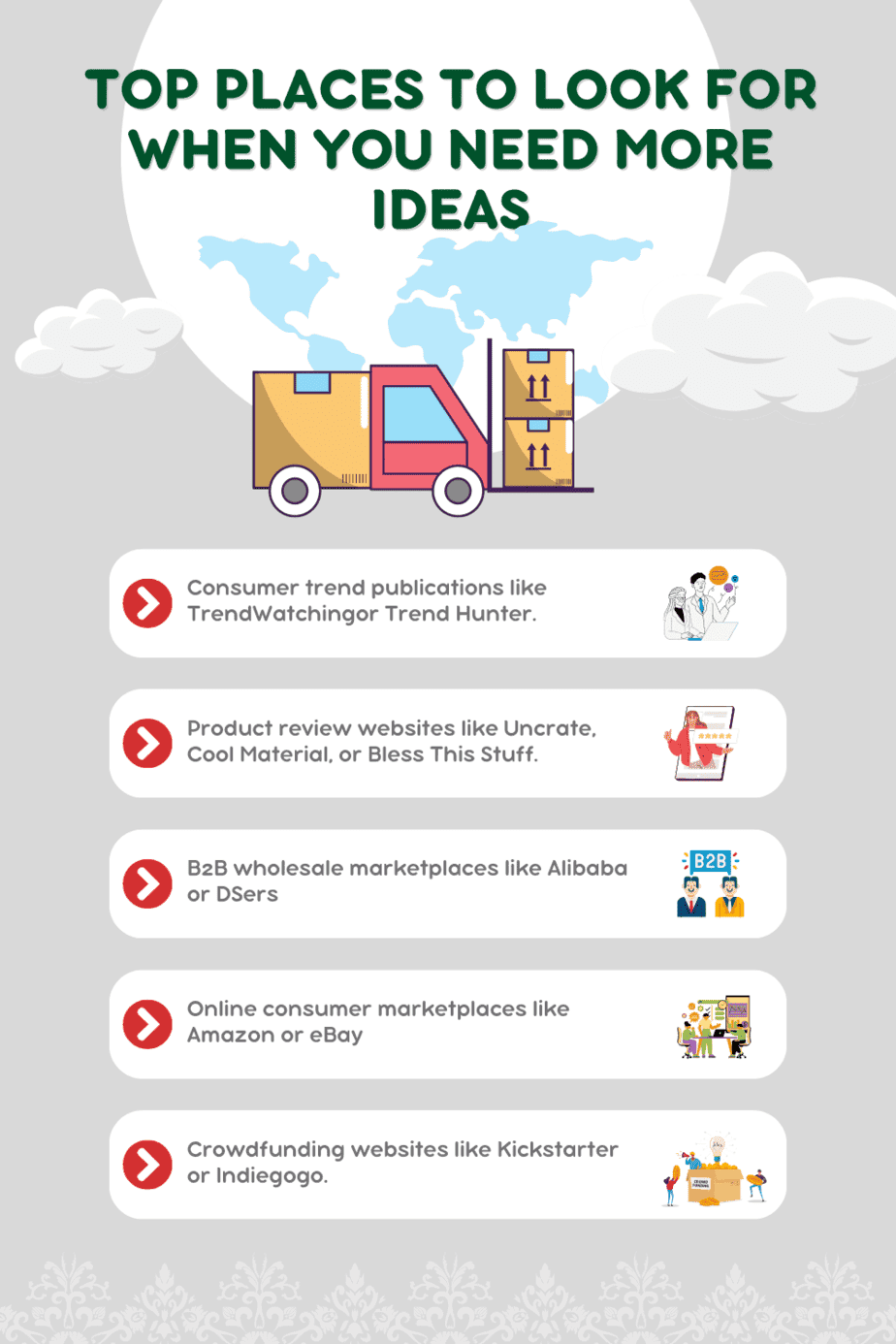
Top Places to Look for When You Need More Ideas

If you didn’t find an idea in this article that resonated with you, you could try looking for inspiration in other places. Here’s a brief list of spaces where you might find inspiration for a new product idea:

  • Consumer trend publications like TrendWatchingor Trend Hunter.
  • Product review websites like Uncrate, Cool Material, or Bless This Stuff.
  • Social curation sites like The Fancy or Wanelo.
  • B2B wholesale marketplaces like Alibaba or DSers
  • Online consumer marketplaces like Amazon or eBay
  • Crowdfunding websites like Kickstarter or Indiegogo.
  • Social media networks like Instagram or Pinterest.
  • Your competitors.

Closing Thoughts

The best time to jump into the eCommerce market was five years ago. The second-best time is now. This market is growing more and more every year, and the business opportunities keep increasing with this growth. If you target products that satisfy the public’s increasing interest in personalizing their spaces or taking care of their health and environment, you will be on the right path, given the current trends.

when will bitcoin hit $100,000

When Will Bitcoin Hit $100,000? Maybe Sooner Than You Think!

Many experts are now growing more confident in their beliefs that Bitcoin will hit $100,000 sooner than people think. Many also strongly believe that it will hit that price point by the end of 2022. These claims are backed by technical and fundamental analysis.

News and Indications

The world of cryptocurrency has recently come about with some potentially bullish news. To start with, President Joe Biden has finally signed the cryptocurrency executive order in March of 2022. The markets had been waiting on this order for months to gauge its potential impact. As a result of this executive order, BTC jumped higher with the removal of uncertainty from the market, however it has recently suffered declines along with the broader market. However the issuance of this executive order did remove the overhang of some uncertainty that had potentially been holding back many crypto assets. Many experts say this executive order may spark other occurrences that help propel Bitcoin to greater heights.

Some analysts agree that the price of each bitcoin could go as high as a million dollars. Out of all of the catalysts that have got bitcoin so far, Walmart just may be the one that pushes it significantly higher. It is now hosting Bitcoin ATMs where you can go in and buy bitcoin with cash.  

In other happenings, you also have the Houston pension funds that are supposed to pay retired firefighters. They have a five billion dollar pension, out of which, they used 25 million dollars to purchase Bitcoin and Ethereum. This is a good indication that big money investments are now starting to enter the crypto space.

Facebook Partners with Coinbase

Facebook is partnering with Coinbase to introduce its wallet. Very soon, people will be able to send cryptocurrencies to each other using the platform. Not to mention, Facebook’s brand reinvention into Metaverse is also a bullish indication for Crypto. Anyone who has not invested in Bitcoin yet may change their minds once Facebook introduces its crypto wallet.

Bitcoin’s Price

The market cap of Bitcoin has reached 1.2 trillion dollars which means that it is very close to surpassing the entire market cap of silver. Despite its rising price, many critics still believe that Bitcoin does not hold long-term value, and this is because its price has fluctuated over many stages and cycles. To get a better perspective on the price of Bitcoin and where it could be headed, it is important to look at the stock-to-flow model.

This model looks at finite limited resources such as gold, diamonds, and other commodities. Looking at these commodities, one can somewhat accurately predict the price of a particular asset sector in the future. Many experts have used the stock-to-flow model and applied it to bitcoin.

Keep in mind that this model only looks at the stock, which refers to the amount of something in existence. It then compares it to the flow, which refers to the rate at which you create, produce, or find something. The stock-to-flow model for bitcoin has been extremely close to following its price, and according to its chart, the price is on the verge of something very big about to happen.

Bitcoin is Backed by Strong Narrative

One of the biggest reasons why bitcoin has been accelerating in value is because of the narrative behind it. Money is on everyone’s mind, and the narrative surrounding bitcoin is getting stronger, which will lead to further adoption. This narrative has to do with how the government is still printing plenty of fiat currency and using it as an easy escape to get rid of their economic shortcomings.

Excessive printing of money is causing high rates of inflation in the country along with other factors. This allows them to use the money to buy up bonds, corporate debt, and other assets. This incentivizes people with money to buy assets which are perceived to be a store of value, like commodities and now also cryptocurrency. All of this has the effect of asset inflation which leaves more dollars in the system competing for the same amount of goods.

This does not mean that your net worth is increasing. Instead, it simply just takes more money to get the same amount of available goods. This narrative of money is very persistent and will set the foundation for bitcoin adoption. 

How Talking Points and Distrust Will be Enough

Inflationary pressures have investors strongly considering alternative asset classes as a way to stay ahead of the curve. Historically investors have looked to perceived “stores of value” like gold and silver to stay ahead of inflation, but cryptocurrency has potential in this area.

For some investors, they may consider putting all of their money into stocks, as a means to outpace inflation. For some, this means putting their money into bitcoin and crypto assets. Many are even labeling bitcoin as the fastest horse in the race of all existing asset classes according to the data. Some models predict that bitcoin is the best hedge against inflation.

Final Thoughts

Overall, gauging bitcoin’s performance will require plenty of patience, and since it is dependent on some external factors like world events, anything can happen in terms of its valuation. Whether or not its price will reach the $100,000 mark by the end of 2022 is very debatable. However, there are more bullish fundamental indicators than bearish ones, which is why you can expect good things from your bitcoin investment.

b2b payments trends

B2B Payments Trends for 2022

Over the last few years, the B2B payments landscape has seen numerous advancements, gaining considerable traction in the business space. A study by Gartner predicts that in the span of the next few years, 80 percent of B2B sales transactions between suppliers and buyers will take place over digital channels. The opportunity to make B2B payments will provide astronomical benefits to all sectors of the market. Keep in mind that about 28 trillion dollars worth of B2B transactions occur on an annual basis. 1.8 trillion of that amount ends up being card payments, while 12 trillion goes through checks. 

B2B Payment Landscape

Many interesting things are happening in the world of B2B eCommerce. Besides the fact that it is a 12.2 trillion dollar market– that’s six times larger than the B2C market! –around half of all sales are recorded through manual processes. Sales reps, purchase orders, and paper-driven business processes are in need of extensive upgrades. 

There is a massive opportunity for innovation in the B2B commerce space. Taking advantage of this opportunity can accelerate companies’ growth, whether they’re already there or are looking to enter the space. Now, new marketplaces, distributors, and industry players are making a big difference in helping the overall market to grow. However, traditional methods are yet to improve when it comes to the payment types within the market. 

You have to think about companies making larger payments to suppliers or vendors. When you are a supplier dealing with a business, remember that they will not pay anyone upfront, so the way you get paid can vary. In this case, knowing B2B payment processing tips can help. 

How Do Payments Affect B2B Commerce? 

B2B companies that are starting to go online, whether they have just started operations or have some eCommerce experience, need to consider payment methods. The speed at which companies conduct business operations is increasing rapidly, and today’s payment processes need to be efficient and solid to support online transactions. In this highly digital world, banks are taking measures to accommodate the speed at which businesses are continuing operations.  

They are working with industry leaders to accelerate business-to-business payments by incorporating modern solutions that meet the demands of the future. The aim of such system integration is to replace checks and invoices with end-to-end automation and technologically advanced solutions. Whether it is invoicing, payments, remittance information, and more, change is inevitable. 

Trends of B2B Payments 

Moving Away from Paper 

Consumers are no longer relying on paper transactions and have decided to move to digital alternatives since they are cheaper, faster, and safer. 59% of users currently use mobile banking, but businesses aren’t catching up. Despite mobile banking being a digital alternative, it is nowhere near the scale of B2B payments that you can use today. Companies will soon realize that a scalable and standard process is well within reach. Implementing and deploying B2B payment methods will mitigate paper processes to a large extent. 

Making B2B payments using manual methods will have its fair share of errors. It is also more costly and time-consuming than digital alternatives. Digital innovations in the B2B payment sector are causing businesses to strategize their processes, ensuring they are more streamlined. Innovations that include these strategies present businesses with the opportunity to re-imagine their current payment system entirely. This maximizes the efficiency of payment processes at every step of the way. 

Transformative Benefits 

Businesses benefit from adopting electronic payments. Automating business processes offers further advantages, which is critical if you wish to survive in today’s economy. These include error reduction, cash management, increased transparency, risk mitigation, and more. 

One of the trends also includes electronic invoices, electronic remittances, and other automatic financial procedures. All of this combines to make payments less manually intensive and quicker. It also frees up employees’ time, so instead of keeping up with payments, they enjoy the peace of mind to perform important tasks that contribute to the business’s growth. 

Digitalization also helps businesses manage cash flow capabilities with real-time data management. Ultimately, decreasing invoice payments can help businesses avoid delayed payments and take advantage of early payment discount programs. Virtual exchange systems of value are much more efficient and reduce any potential for human errors. 

Risk Mitigation 

B2B payment trends that take virtual undertakings are also very low on risk thanks to limited manual processes and a low volume of paper checks, which minimizes the risk of fraud. It will also increase transparency, making cash more manageable. Reports tracking unpaid and paid invoices bring about greater insights that lead to a better automation process. It also makes payments more secure and stable for businesses, which opens up more revenue generation opportunities. 

E-remittance 

The data collected by the E-remittance technology make payment applications faster and more precise. It also improves the accuracy of receivable balances and different accounts. Though the benefits are clear, frameworks for account management may differ in the coming future. Service providers are likely to act as service points to deliver data and information to clients. 

Concluding Words 

B2B payment trends in 2022 will have standards that ensure interoperability, allowing businesses to incorporate a highly compatible payment option that receives payments through various channels. Payment systems in the future will formulate a virtual framework that will help businesses enhance connectivity and value across an expansive cross-border network. Suppliers will likely have to engage with providers and locate access points. All of this will help make payments more accessible for B2B transactions.

Coinbase Registers with the SEC

Coinbase Registers with the SEC

On May 10th, Coinbase announced that it had filed for a registration statement with the Securities Exchange Commission (SEC). The announcement came along with their reports for the first quarter of 2022, where they reported missing the revenue estimates that were previously given by analysts and sending shares down as much as 19%.

In a released statement from Coinbase discussing their registration statement with the SEC, the statement was intended to be used for potential prospective offerings, including the sale of new securities. However, new securities won’t be immediately available.

This statement, and their recent Q1 results, came during a major sell-off in the crypto market which has been referred to by some as a crypto crash, with Bitcoin dropping below $30,000. Coinbase has lost more than 70% of its value since late March.

Coinbase commented on its goals and approach to capital structure over the years, stating that its aim has always been to raise capital at the lowest cost possible to its shareholders. They expect that the shelf registration would speed up the process of issuing securities to a matter of days, which they hoped would allow them to time the market conditions better.

While these are the company’s statements on the matter, the reality is that their decision could have been driven by other factors, such as the uncertainty surrounding crypto assets regarding the U.S. federal securities law, as well as the mounting pressures for crypto regulation.

Coinbase reported, in their filing, that the SEC traditionally doesn’t confirm the status of crypto assets as securities in advance. Since the evolution of crypto assets and their classification is still ongoing, it’s difficult to predict how to classify them. The only crypto assets that the SEC has given a definitive view on are Bitcoin and Ethereum, which they don’t see as securities. However, Coinbase stated that the SEC’s views are not binding for courts, other agencies, or even the SEC itself. Coinbase believes that should the SEC change its approach, it could have a significant impact on the business.

Other crypto assets have yet to be ruled out as securities by the SEC under their current rules, though the company’s analysts argued that none of the assets traded on their platform are considered securities.

For their part, Coinbase gave a warning on their filing for people investing in crypto assets. They warned that should the SEC, or any other regulatory authority be it national or foreign, determine that a crypto asset traded on the platform was a security, Coinbase wouldn’t be able to continue offering said asset until they could do so in a compliant manner.

This statement helps shed light on Coinbase’s decision to file with the SEC, as they seem to be preparing in advance to offer crypto assets on their platform that are considered a security by the SEC or any court.

The registration has more potential benefits for Coinbase, as it would allow them to provide the company’s crypto products and assets on top of those from third parties. As of now, there is regulatory uncertainty regarding the company’s yield-generating activities such as staking and lending. These could eventually be considered securities, but the filing would allow Coinbase to act quickly on that matter.

Coinbase also revealed that it had received investigative subpoenas from the SEC regarding its stable coin and yield-generating product plans. Should these be classified as securities, the registration could help the company keep these services afloat by meeting the necessary compliance measures.

In the last part of their statement, Coinbase mentioned that they believed this shelf registration statement would enhance the company’s flexibility, as well as enable access to other capital markets more efficiently and effectively when market conditions were optimal.