Two rental properties in the same area may have the same price and rental rates. One property can help you grow your wealth while the other can slowly diminish your finances. The answer is not in the property listing photos. The answer is in the numbers.
Smart investors know that they should never fall in love with a property. Instead, they fall in love with the numbers. Three real estate return metrics that help achieve that goal are the cap rate, cash-on-cash return, and the overall rental property ROI. Each of these numbers helps answer a different question. If you learn how to read all three of these metrics together, you will be able to analyze almost any deal in a very short time. To help you, this guide is going to explain all three metrics, the importance of these metrics, the order in which you should prioritize these metrics, and how to do the calculations.
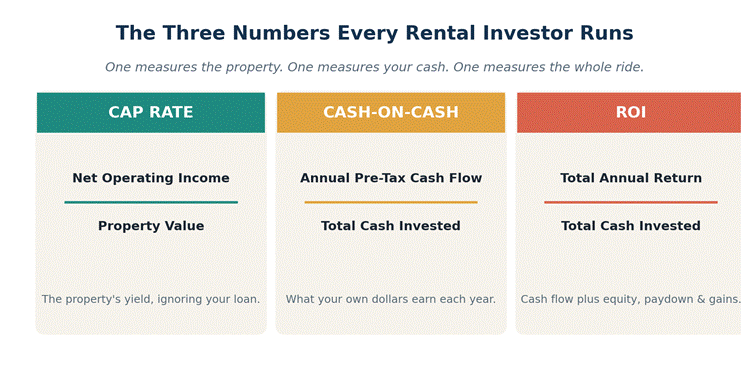
The three core metrics at a glance: one rates the property, one rates your cash, one rates the whole ride.
A rental property operates similarly to a small business. In this case, revenue is rental income. The costs are related to taxes, insurance, and repairs. The return metrics simplify that complex situation and express it in a percentage form. This allows you to evaluate and compare a single duplex in an area to a single fourplex in another area.
They keep you grounded. Your optimism is always a risk when it comes to evaluating your own properties. The marketing brochures that are produced to promote these properties are, of course, very favorable. However, a little bit of math can assist you in evaluating these potential purchases. Each of the three return metrics gives you a snapshot of the deal in a single figure. Capitalization rate examines the property in isolation. Cash-on-Cash return examines the investment and the return you will receive. Return on Investment gives you the figure you are looking for in a broader context.
Cap rate is the abbreviation for capitalization rate, which is arguably the most popular term in all real estate investing. The cap rate of an investment property is the yield that a real estate investor can expect if the property were purchased with an all-cash offer. This is also essentially the annual return the property generates before the consideration of debt.
The value of implementing cap rates on different investment properties is that, when comparing those properties, financing is irrelevant. This is helpful for initial screenings of investment opportunities because, when considering a cap rate, the debt is irrelevant, and therefore the quality of the asset is measured, not the quality of the loan. Generally, the higher the cap rate, the greater the potential return, along with the greater the risk. Conversely, the lower the cap rate, the potentially safer the asset, the lower the return, and typically the investment is considered more market stable.
The formula for calculating cap rate is refreshingly simple. All you do is divide the property’s net operating income (NOI) by the property value (or purchase price), and multiply by one hundred.
Cap Rate = Net Operating Income ÷ Property Value × 100
Consider a small building that brings in an income of $50,000 per year after costs. It is priced at $750,000. If you divide $50,000 by $750,000, you have a cap rate of approximately 6.7%. This one number allows you to compare this investment against any other rental property on the market.
The denominator can either be the current market value of the property or the purchase price. Most investors use the asking price or the appraised price before the property is purchased. However, after the investment is purchased, the current market value gives a more accurate picture of the performance of the investment. The difference in value is more significant than it may appear. The cap rate of a home purchased several years ago at a much lower price will be a very different value depending on which price is used.
Net operating income (NOI) is the cornerstone of the cap rate. NOI is revenue remaining after the operational costs and prior to the mortgage. Start with total rent revenue and deduct the property taxes, insurance, management fees, maintenance, and a reasonable vacancy cost. What you’ve calculated is the NOI.
There are a couple of costs that are intentionally left out of the NOI. The costs for the mortgage (principal and interest) and depreciation are also left out. The main purpose of this is to provide consistency for the potential buyers. NOI is meant to show the potential earning power of the property, and not the buyer’s terms for the loan.
There is a note of caution that should be included. To make a property more attractive for potential buyers, some sellers will use a variety of methods to show a higher NOI, including the use of a zero vacancy rate. It is important to note that very few rental properties are 100% occupied over the course of a year. A vacancy rate of between 5% and 10% is a good and reasonable practice.
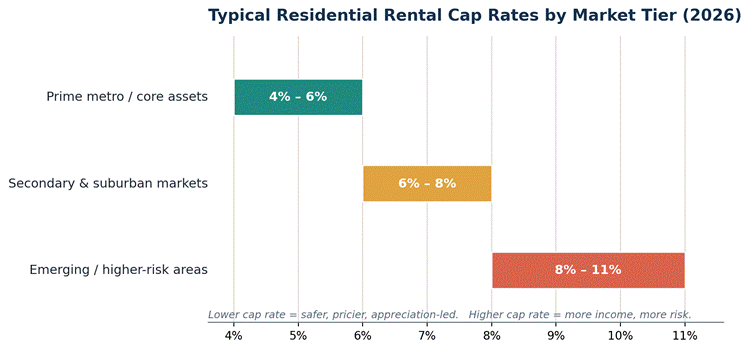
Cap rate ranges shift with market tier and risk; there is no single ideal number.
It is more of an art than a science. It is never simply one number. Because of risk tolerance variance and different markets/property types, the ideal cap rate is never truly singular. Generally, for residential rentals, most investors consider cap rates in the 5-10% range as satisfactory.
Cap rates in the 4-6% range are typical for primary Metro markets. Buyers consider the tradeoff and are willing to pay the price for the stability and expected appreciation of the asset. Typically, the 6-8% range is standard for secondary Metro markets. For emerging markets or high-risk areas, cap rates can exceed 8% and even reach the double digits.
Multifamily cap rates of all classes averaged 5.6% and held steady as we moved closer to 2026. A low cap rate is not necessarily a poor cap rate, and a high cap rate is not necessarily a good cap rate. A 10% cap rate in a poor neighborhood can be a real management challenge, and a trophy asset can have a 4% cap rate.
This is a common question from beginner investors, so let’s clear some things up. The answer is no, cap rate does not include mortgage payments. Cap rate is a metric for a cash purchase, meaning it is an unleveraged metric by definition.
The point of cap rate is to exclude financing and describe the asset on its own. Your mortgage is your mortgage. The next buyer of the property may have used a completely different mortgage, a different down payment, or may have paid cash for the property. If we start to consider financing in cap rate, we would compare properties in a completely subjective way. Mortgage financing is out of the cap rate and comes back into the picture in the next metric.
The cash-on-cash return follows after the cap rate. It actually tracks your investment on an annual basis. It also includes your mortgage, unlike the cap rate. Because most small landlords purchase properties with financing, this is the metric small landlords should keep an eye on the most.
Cash-on-cash return is useful for answering an important question most landlords have after buying a property. This metric will tell landlords if the property is generating a positive cash flow. Unlike cap rate, this metric will consider the leverage and will therefore provide a different number from what you would get if you used cap rate.
This method divides your annual pre-tax cash flow by your total cash invested. Your pre-tax cash flow basically is the remaining rent after all operating expenses and mortgage payments. Your total cash invested includes your down payment, closing costs, and any cash you provided for repairs.
Cash-on-Cash = Annual Pre-Tax Cash Flow ÷ Total Cash Invested × 100
Let’s look at a straightforward example. Say you invest a total of $60,000 of your own cash in a property (down payment, closing costs, and repairs included). After all operating expenses and loan payments, the property generates $4,200 a year. $4,200 divided by $60,000 shows you a cash-on-cash return of 7%.
The lever, in this case, is leverage. If a lower cash outlay is used, the same cash flow generates a higher cash-on-cash return. Because of financing alone, this is the reason very different cash-on-cash returns can be produced by two identical buildings.
In the eyes of most investors, a return between 8% and 12% qualifies as a strong cash-on-cash return. Generally speaking, a cash-on-cash return in the 2026 rate environment is likely to be at the lower end of the spectrum, with a 6.3% to 6.5% mortgage rate. Typically speaking, anything below a 6% cash-on-cash return is not worth the risk, unless you’re betting on a pretty strong appreciation.
A cash-on-cash return over 15% is a cause for celebration, as long as the return is not the result of high risk. A high cash-on-cash return has the potential to hide a lot of ugliness in the real estate deal, such as deferred maintenance, above-market rents, and a rough area. Generally speaking, your cash-on-cash return should be meaningfully over the 4% Treasury yield. Otherwise, the tenant risk and the deal’s illiquidity may not be worth it.
What each metric counts, and what it quietly leaves out.
The two metrics are related but serve different purposes. The cap rate looks at the property’s value and the return you can expect without financing. Since cap rate does not involve financing, it’s great for screening and comparing similar market properties. Cash-on-cash return looks at return with financing for the cash that you actually put in. This metric, in contrast to cap rate, includes the mortgage. Because of this, cash-on-cash return is great for judging a deal with financing.
The cap rate judges the property, whereas cash-on-cash return judges your investment in the property. A property that has a low cap rate and is therefore considered an “expensive” property can still yield a great cash-on-cash return with the right financing. The opposite is also true.
| Question it answers | Cap Rate | Cash-on-Cash Return |
| What it measures | The property’s return on its own value | Your return on the cash you invested |
| Includes the mortgage? | No, it is unleveraged | Yes, financing is baked in |
| Best used for | Screening and comparing properties | Judging a specific financed deal |
| Typical healthy range | 5% to 10% for residential | 8% to 12% in a normal market |
ROI, return on investment, for rental properties takes the widest view of the three metrics. Cap rate and cash-on-cash return both consider only one year. ROI considers the entire investment and encompasses the appreciation of the property, the building of equity as the tenant pays down the mortgage, and the tax benefits of owning real estate.
Cash-on-cash return shows what the property pays you for the year. ROI shows what the property is worth over the years you hold it.
A straightforward method for calculating ROI is to take your total annual return and divide that by your total cash investment. The total return is where the game is won or lost. For one year, add your cash flow, the equity that your tenant paid down, and any appreciation. Then, divide by your cash invested.
For the entire holding period, the most accurate way to calculate your ROI is to include every cash inflow and outflow, plus the sale of the property. This method is called the internal rate of return. When using a good management strategy and positive leverage, it is realistic to achieve a total ROI of 12 to 20 percent on a rental property over a five to ten-year holding period. The goal is not to achieve a great ROI in one year. Instead, the most wealth is achieved through the results of compounding over many years.
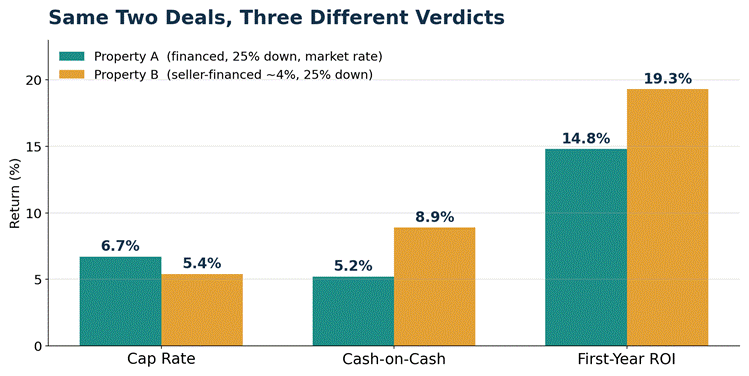
The same two deals reach different conclusions depending on the metric you trust.
Numbers are more reliable than theory, so examine two deals. Property A has an impressive 6.7 percent cap rate. It is a boring, yet stable, solid asset in an average market. Property B’s lower cap rate of 5.4 percent may deter a cash buyer.
Now, consider the financing. Both buyers put 25 percent down, but Property B comes with seller financing at around 4 percent interest-only, giving it a cash-on-cash return of almost 9 percent. Property A, financed at today’s market rate, is left with a return of about 5 percent. Adding in equity paydown and market appreciation, Property B also has the better first year on a total-return basis.
This does not mean one deal is better than the other in every respect. Just because Property A is technically better in some aspects doesn’t mean it is better as a whole. It is always important to look at everything from all aspects, including financing, before deciding on a property.
This is a popular debate topic for investors and is actually contextual. The cap rate is the first filter that allows you to quickly compare and analyze multiple properties. The cap rate levels the playing field for you across all properties, irrespective of leverage. When considering if a financed deal is worth your time today, cash-on-cash return is your best indicator, and many experienced investors consider it first. For the consideration of your long-term wealth, return on investment, or ROI, and the internal rate of return, or IRR, are best suited for your consideration as they take into account the value of your investment at the time of sale.
Analyzing these metrics is the best approach. The best screening method is the cap rate, the best checking method is cash-on-cash return, and the best forecasting method is ROI. One metric is never the complete story, and the best investors understand this.
Reliable benchmarks are essential because a good return only has validity when compared to a reliable benchmark. Two institutions provide the data most investors use.
CBRE publishes a popular Cap Rate Survey that captures pricing by property type and market. Their data reveals that cap rates for most commercial sectors remained stable during the most recent time periods. This illustrates how closely the metric correlates with the fundamentals of the business rather than lending. Typically, when analysts report the level of multifamily cap rates, they use this survey.
Freddie Mac tracks mortgage rates as well as multifamily conditions that affect cash-on-cash math directly. Their data shows a thirty-year fixed rate hovering around 6.3% in early 2026. At this rate, leveraged cash flow will be severely constrained. Your mortgage rate is the single most important factor in cash-on-cash returns, and therefore, this figure has the biggest impact on whether the deal pencils out.
Some errors are unavoidable, even with simple math. The biggest example of this is taking a seller’s numbers as the truth. Some numbers get rounded off in brochures or even omitted. Some use a prior, lower tax rate in order to inflate the NOI, and sometimes full occupancy is even assumed, even though a 0% vacancy rate is definitely not achievable.
Another example is failing to save for major repair work. A roof or furnace replacement is a fairly easy way to erase a year’s profit. A much smaller error that is harder to detect is measuring the cash-on-cash returns with just the down payment instead of the total cash investment. Avoiding these mistakes immediately improves your overall analysis.
As with any investment, numbers define a good rental property. A property’s cap rate shows what it earns on its own. Cash-on-cash return shows what your money earns with the loan. ROI shows the property’s earned value over time.
As you may have guessed, none of the property returns can be seen as the whole truth. Together, they provide a good perspective on whether a property is a good investment vs a bad financial decision, and it takes only a few minutes. Run all three before getting too attached. You’ll be glad you did.
A healthy cap rate for most residential rentals will fall between five and ten percent. Markets that fall within prime metropolitan areas will likely have a cap rate of four to six percent, as buyers are paying for the stability and appreciation. Secondary and suburban areas are typically between six and eight percent. Higher-risk areas will have a cap rate above eight percent. The best number is the cap rate that balances your risk tolerance and your goals.
Best for property comparisons, the cap rate measures the mortgage-excluded, unleveraged return on the property. Cash-on-cash return, however, measures the mortgage-included, leveraged return on the cash invested and is best for evaluating a specific, financed deal. One rates the asset. The other rates your position in it.
To determine the net operating income (NOI) of a property, the first step is to collect all the rental income for the year. Next, to calculate NOI, subtract from the revenue all operating expenses like property taxes, property management fees, insurance, maintenance costs, and a vacancy allowance. What is left after all expenses is the NOI. It’s important to understand that depreciation and mortgage costs are left off calculations, and that is intentional. Leaving them off allows potential buyers to see the property’s income potential with their own mortgage.
No. The cap rate metric completely removes the mortgage. It looks at the deal assuming an all-cash purchase to underwrite the deal based on the property’s intrinsic value. The cost of financing the deal is evaluated based on the cash-on-cash return.
It depends on the decision. The cap rate helps you to analyze and differentiate properties rapidly. The cash-on-cash return tells you whether the deal provides enough return on your investment today. Use return on investment (ROI) and internal rate of return (IRR) to consider the future wealth accumulation and the value of the property at the time of the sale. The best investors use all three metrics together and not any one of them individually.