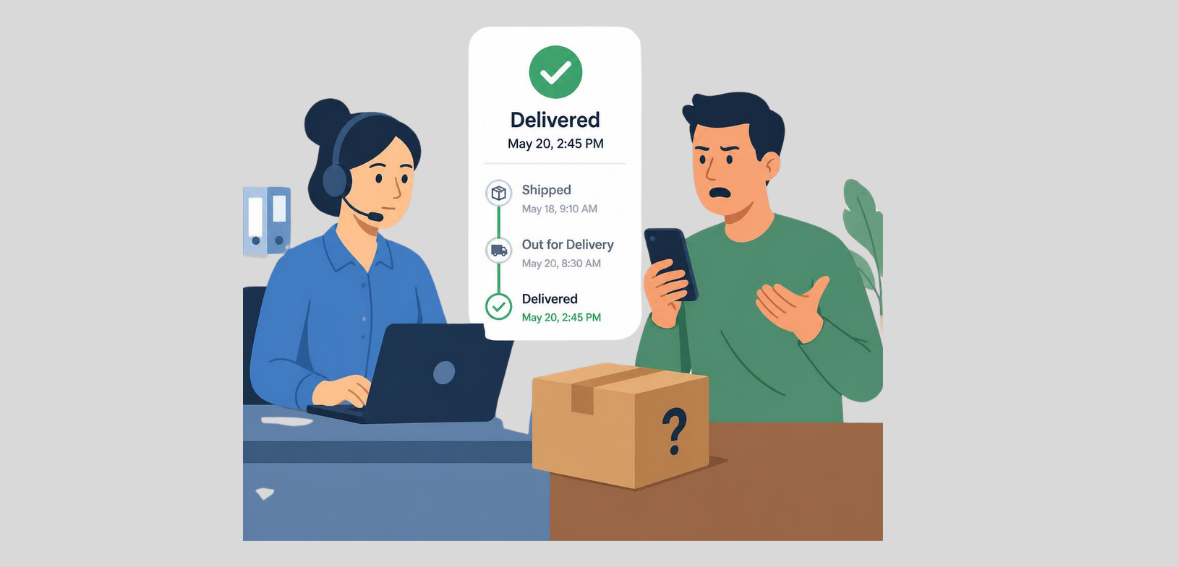
There is one and only one piece of data upon which all online retail depends: the shipping carrier’s delivered scan. That delivered scan closes the shipping loop for a merchant’s operations team, but it opens an even harder loop for the payments team. The item not received (INR) dispute category is one where a seller can lose the product and payment for the same transaction. The customer claims that they never received the package. The shipping record shows that the package was delivered. The payments teams for all businesses doing e-commerce are stuck between these two conflicting claims.
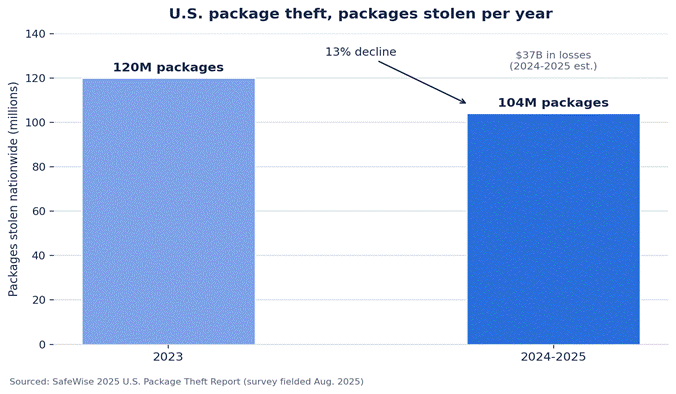
The SafeWise 2025 U.S. Package Theft Report estimates that 104 million packages were stolen, at an estimated total cost of $37 billion. This report claims that the number of packages stolen in 2025 was lower than in SafeWise’s 2023 report, in which they estimated 120 million packages were stolen. Those thefts are grouped under one reason code.
Visa gives this reason code 13.1, Merchandise or Services Not Received, and it replaces Visa’s old code 30 in the Visa Claims Resolution framework. For Mastercard, this reason code fits under 4853, Cardholder Dispute, with a sub-reason stating goods or services were not provided. The old reason code 4855 was removed.
If the package says delivered but not received, a delivered scan doesn’t tell merchants if the customer is lying, the courier was wrong, or someone was a porch pirate. This is the triage work.
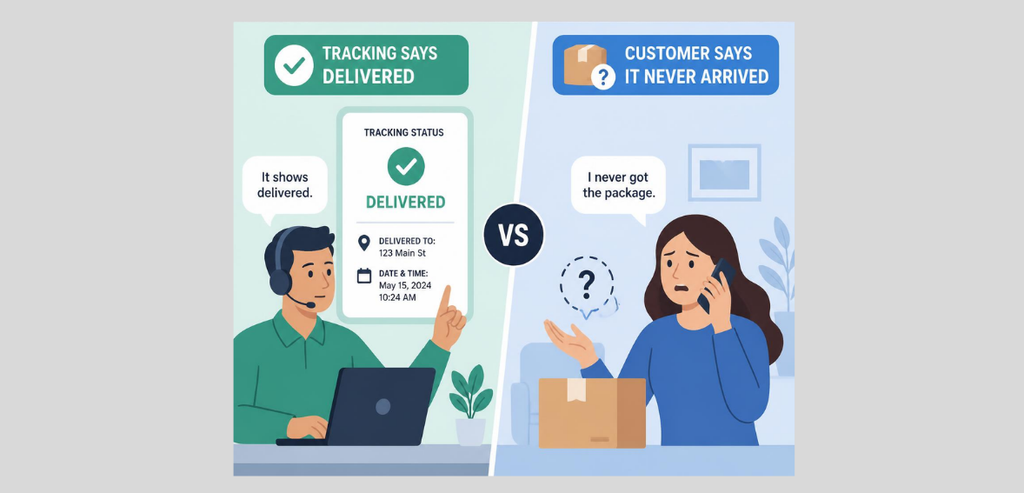
Every new INR claim begins with tracking record investigation in order to see what happened beyond what was delivered. A tracking record contains a timestamp, a facility or route code, and, increasingly, a GPS location that the driver entered into their device at the time of the drop. All three major carriers, USPS, UPS, and FedEx, capture geolocation data of a residential delivery scan on most of the domestic services they offer, and this data can be compared to the shipping address. A scan that happens too early or a driver who marks a batch delivered before actually completing their route results in a GPS coordinate of a sorting facility, or one several blocks away from the shipping address.
Photo-on-delivery is the second data point to review. Almost all of the residential delivery stops by both FedEx and UPS include a time-stamped, geotagged photo. A delivery photo showing the package at the intended door and the corresponding house number resolves much of the ambiguity of a status “delivered” with no photo. A photo that isn’t at the intended delivery address should be a clear indication that the package should be reshipped or refunded, and should not be contested.
The triage process ends with a check of the address history. The shipment order database of most merchants retains all shipments to an address, along with the response from the Address Verification Service (AVS) by the card network. For Visa’s reason code 13.1, Visa states that in the case of a Y or M AVS match and where there is proof of delivery to that address, supporting documents need not have a signature to be considered valid evidence. Address matches therefore become part of the evidentiary documentation, and not an input for a fraud screen.
The three largest U.S. carriers show varying levels of data transparency. USPS tracking provides a confirmation of a delivered status with a timestamp but lacks a time-stamped photo. Signature Confirmation is the add-on that captures a named signer. From there, both UPS and FedEx include GPS coordinates and a delivery photo for many of their residential deliveries at no added fee. This makes a difference to a merchant when deciding, on a case-by-case basis, whether the free tracking data resolves a dispute or whether the paid signature service is the only way to include a signer’s name for the package drop.
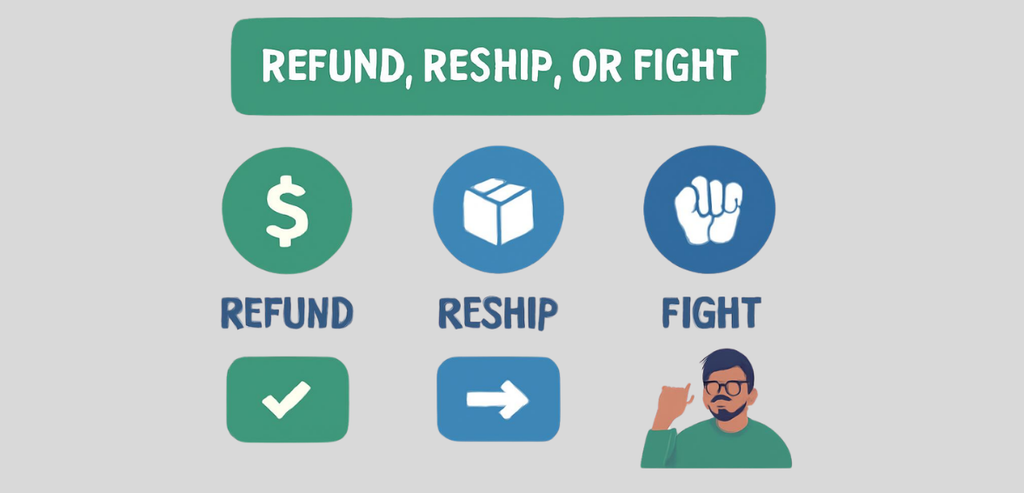
Once the triage data is in, the merchant is left with the three factors of order value, delivery evidence, and customer account history. A high order value with weak or contradictory evidence is a fast refund case, where the cost of the refund is often less than the cost of the goods and the lost dispute and chargeback fee combined. For a claim of a low order value with strong evidence (i.e. matched GPS pins, photos, signed delivery receipts, etc.) it is justified to fight the claim.
This is because even though representment is a low cost defense, training false claimants that such claims are successful is not warranted. Of all the factors, reshipping is in the middle. For a customer with a low order value and delivery evidence that is inconclusive (not contradictory), reshipping is justified because it preserves the customer relationship.
Account history decides the borderline cases. For instance, a customer with prior orders and no disputes or claims gets an automatic reship or refund without any opposition, as the customer has a lifetime value that is greater than the cost of a single order. On the other hand, if a customer has a second or third claim, not received, against higher valued items that have been shipped to multiple addresses, the merchant should fight that claim instead of shipping again, treating the claims as fraudulent, especially if GPS data, photos, and/or signature data was collected during the triage step.
| Order value | Evidence from triage | Recommended action |
| High (above signature threshold) | Weak or contradictory: no photo, GPS mismatch | Refund promptly |
| High (above signature threshold) | Strong: matched signature or photo | Fight the dispute |
| Low to moderate | Inconclusive, first-time customer | Reship |
| Any value | Second or third INR claim on the account | Fight, and require signature going forward |
Decision framework for item-not-received claims. Illustrative: order-value and evidence thresholds should be calibrated to each merchant’s own loss history.
Decisions at different levels of evidence used by card networks mean that merchants sometimes waste time and resources compiling evidence that will likely be of no use. The best evidence regarding reason code 13.1 is a signed delivery confirmation that captures the signature and the name of the person at the time the confirmation is signed. Unlike a normal delivery confirmation, which only contains a delivery receipt, this addresses the claim directly.
Compared to a delivery confirmation that does not contain a signature, a delivery confirmation that contains a signed document at the delivery location is better because it places evidence at that specific location. A bare scanned delivery confirmation is, however, the weakest evidence that a vendor can submit. This generally leads to loss on the vendor’s part as the mere evidentiary log by the carrier does not indicate who received the goods.
Under Visa’s 13.1 representment instruction, documentation that the merchandise cleared the fulfillment process of the vendor will be considered in the absence of evidence regarding the delivery to the final destination. Documentation that the cardholder was employed at the delivery address and that the goods were delivered to that business location will also be considered.
Visa reason code 13.1 is invoked in the Visa Claims Resolution framework. A dispute must be initiated within 120 calendar days from either the transaction date or from the last anticipated date of delivery of the goods or services. However, the last date for dispute resolution is 540 calendar days from the original purchase date. Merchants are allowed a maximum of 30 calendar days to respond to a 13.1 dispute with evidence for representment.
Mastercard‘s 4853 reason code has a similar protocol. To substantiate their position, the merchant must provide evidence that the good/service was delivered to the cardholder, including signed receipts and/or shipping records, or logs of communications (verbal or written, including text) with the cardholder. Neither of the networks requires a signature on every claim. For both networks, a signed receipt is considered the best evidence of the claim, not a requirement. Therefore, the signature requirement is the merchant’s actual control.
Merchants building a bigger defense against card-not-present fraud claims should also look at the evidence standard used in Visa’s Compelling Evidence 3.0.
The main cost concern is the confirmation fee, which is the same for every package confirmed. Therefore, the real question isn’t about security; it’s about cost. The postal rate increase on January 18, 2026, raises USPS Signature Confirmation (quoted by ShipPayLess) to $3.90-$4.15 per package. For 2026, UPS charges $7.70 for standard Signature Required, and $9.35 for Adult Signature Required (quoted by D’Arrigo Consulting). For 2026, FedEx has increased its fee for Direct Signature Required from $7.15 to $10.00 and increased its fee for Adult Signature Required from $8.65 to $10.00 (a 15.6% increase), according to LateShipment.
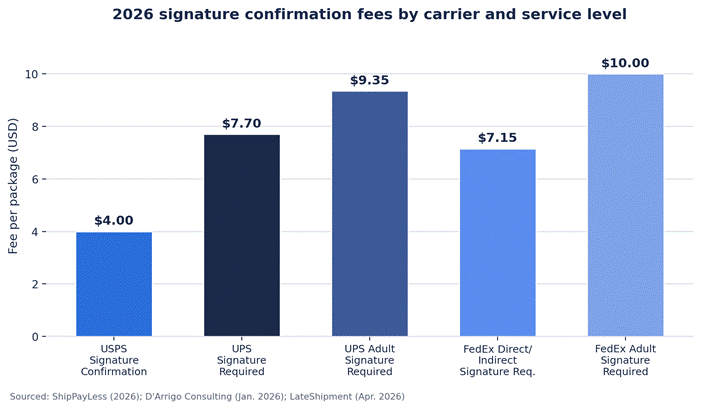
Math favors value-based thresholds over general rules. If a merchant pays $7-$10 signature fees on every order, that merchant will probably lose margin on orders with low value. These orders were going to be low enough that they would not have been disputed. On the other hand, a merchant never requiring a signature on a large order ends up eating the loss on the orders that mattered most.
LateShipment’s advice about removing signature confirmation states that it is usually worth it to remove signature confirmation when a package is worth less than $50, and the merchandise is valued with a low risk of loss.
As the order value increases, the order is no longer worth waiving the signature confirmation. A value-based threshold is set somewhere between $150 and $300. It is up to the merchant to determine where on this spectrum they choose to set their threshold based on how much they value their average order loss.
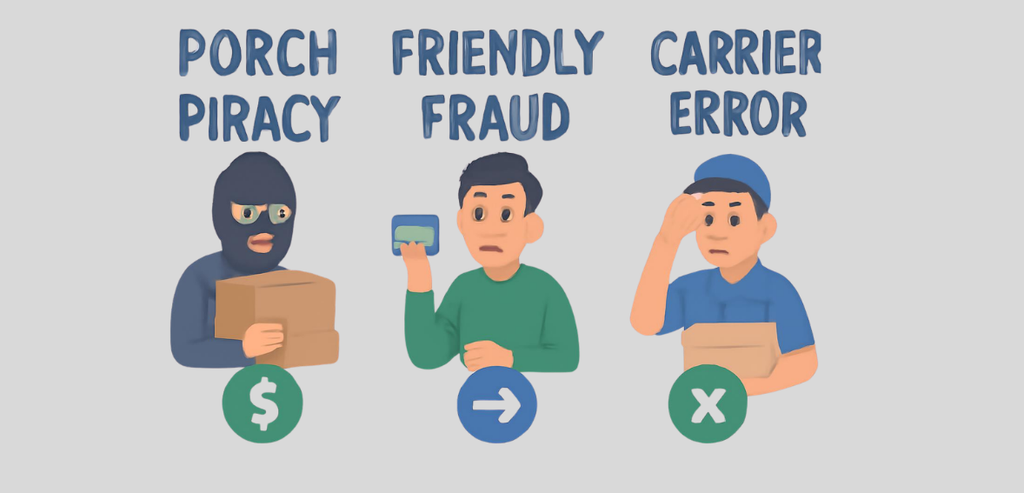
Not all situations in which someone claims “I never got it” have the same cause. They need to be dealt with differently. “Porch piracy” happens when a package, after being properly delivered, is stolen after it is left at the recipient’s door. It is likely that a thief observed the package through a window, decided it was worth stealing, and went to pick it up before the recipient had the chance.
According to SafeWise’s 2025 data, visibility is a direct factor. Based on the Pinkerton analysis used in the Omnisend 2025 porch piracy report, 98% of packages that were stolen were visible from the street and 61% of those packages were located within 25 feet of the street. Much of the problem is therefore the layout of the property and not the shipping process.
The phenomenon known as friendly fraud is distinct. Consumers get the package shipped to them and then dispute the charge. There are various underlying reasons for this behavior. For example, a consumer might dispute the charge because a household member purchased without informing them. The triage evidence catches this type of friendly fraud because it directly contradicts the claim. After reviewing the evidence, merchants quite often find that friendly fraud patterns like triangulation fraud are more prevalent than porch piracy cases.
Carrier error captures a smaller subset of the cases where a package was scanned at the wrong address. For example, a driver finished a route and scanned a bunch of packages as delivered before dropping them, or a driver delivered a package to an address that was not the intended destination.
Typically, this case does not warrant fighting the dispute. In this case, the merchant’s evidence will show that the delivery was not made to the intended address. The reason that merchants either refund every claim or fight every dispute is that they treat carrier error cases, friendly fraud, and theft cases as basically the same.
A support agent needs a written policy for every live call, as the support agent will not work through order-value and history logic on the phone. The policy defines the signature threshold dollar amount, the manner in which triage data is pulled, and how, if at all, refunds will be granted. The policy must also define the number of disputed claims that a customer’s account can have before the merchant is required to get a signature for each order on that account, regardless of the dollar amount.
A written policy also allows the merchant something to cite to the payment processor or acquiring bank when dispute rates increase, as acquirers ask for the process (and not the outcome) when a merchant’s chargeback ratio is reviewed.
INR claims will not disappear, and with over 100 million packages reported stolen in a year, every online seller will have to process an INR claim. The overall workflow for processing many orders or a few is the same. Before making any decisions, obtain the carrier scan, GPS pin, and delivery photo. When verifying the order, check the customer AVS and the order history.
Depending on the value of the order and how the customer has handled similar disputes in the past, determine whether you will issue a refund, ship the order again, or defend against the claim. Knowing the evidence that card networks will credit will help determine the evidence you collect to win the appeal. It is recommended to set signature confirmation by order value, rather than as a blanket rule, to help control the cost of the evidence you collect.
This is largely dependent upon the terms of the merchant’s shipping policy and the standards of the card network’s evidence rules. In most cases, if the delivery record is matched, the loss question shifts to the merchant’s return or reship policy and not to the delivery service provider.
A matched GPS pin certainly helps, but on its own it is not decisive. The issuer looks at the GPS pin, along with the address history, and, if available, a photo or signature.
For customers with no issues in the order history and with no conflicting delivery evidence, it is likely cheaper to process a refund or reship the order than to go through the dispute, as the lost merchandise will also cost you the chargeback fee.
There is no rule in the networks. Merchants typically set the amount where the signature fee is less than their historic order amount loss, which is in the range of $150 to $300.