
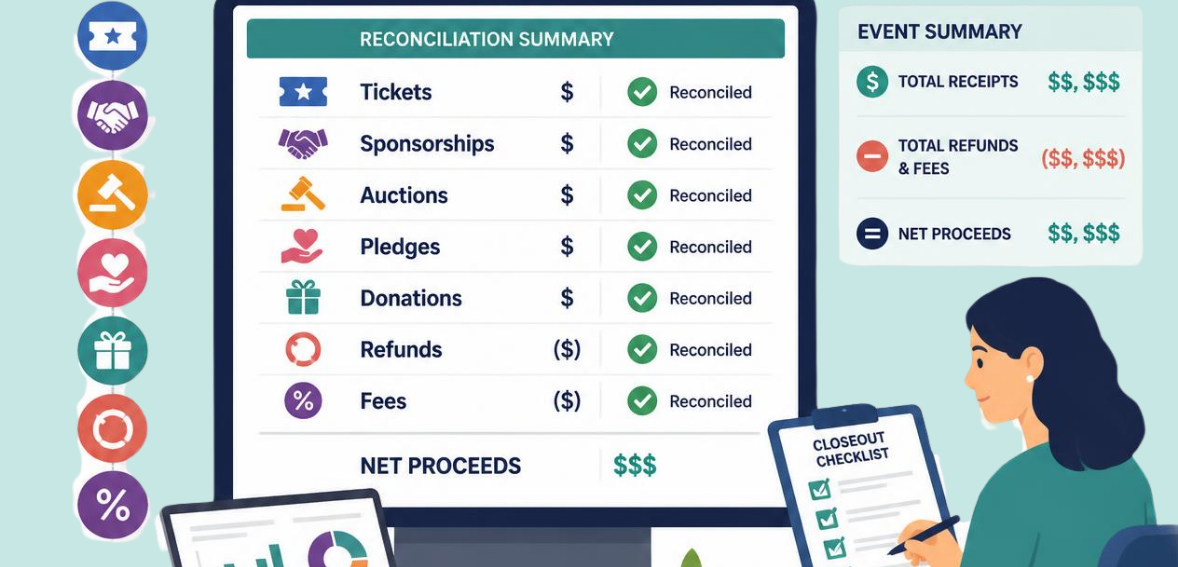
The performance is over, the auction is closed, and the guests have left. The lights in the ballroom are off. The fundraiser gala will enter the most difficult phase, the event reconciliation phase, for the finance team.
One event can entail many different transactions. These can consist of many different entry instruments, invoices, and even systems. There’s a flick of a credit card, invoices to sponsors are created, donations are texted, and pledges are made. Fundraising event reconciliation for a nonprofit is essential to ensure all these transactions are accounted for and done so accurately.
It is healthy for the organization’s finances, and it is done to sustain trust. Reconciling is the practice of ensuring the organization’s finances are accurately and timely reported. The financial standing of the organization is reported, the pledged donations are collected, and the trust is maintained.
This guide will help finance teams and event directors/coordinators to create a repeatable post-event process. This will help to plan for the many transactions associated with an event and to report the donations that were pledged at the event.
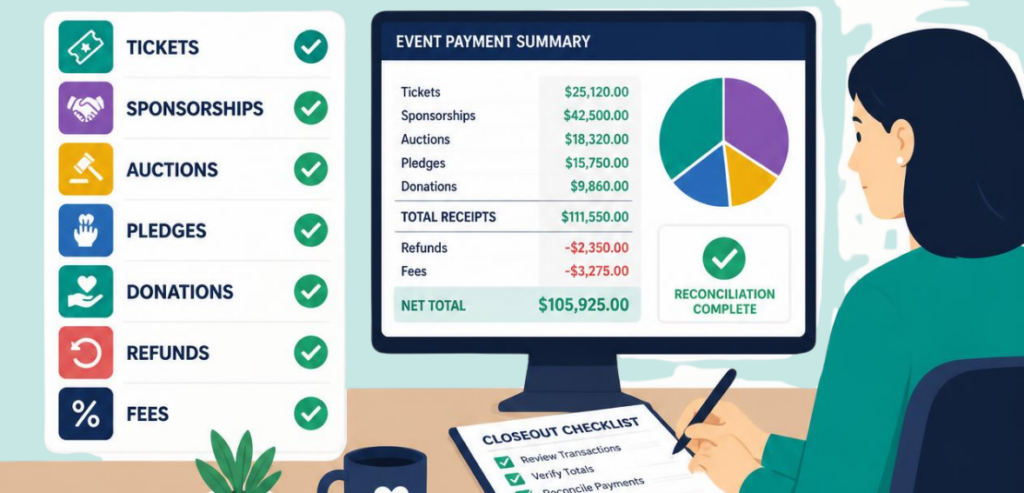
Typically, one form of revenue dominates the income streams of a nonprofit. The online monthly donor is one example. Funds from a grant come via a check in the mail. Revenue from an event is the most unpredictable of all the income streams for a nonprofit. Ticket sales, auction payments, and sponsorship funds can come from a number of different event payment systems. It is not uncommon for a nonprofit gala to employ three or four payment systems, all of which have different time settlement schedules and fee structures.
The timing of payment transactions presents another layer of inconsistency. A guest’s card may be authorized on the night of the event, but the funds sit in limbo for two business days, prior to being deposited to the nonprofit’s account. A sponsorship invoice may be issued in one month, but payment is not realized until the subsequent month. Additionally, pledges made during an event’s paddle raise will not be collected for several weeks after the event.
When a nonprofit is undertaking the complex task of reconciling the activities of the event platform, the donor’s CRM, and the nonprofit’s bank account, there is a high margin of error in making sense of the differences.
The finance team needs to know the sources of funds to perform a proper reconciliation. Considering a typical gala or benefit event, the sources of funds would be sales of gala tickets, sponsorships, donations through auctions, and proceeds from the live and silent auctions. A gala would have a paddle raise or fund-a-need appeal, where a combination of instant payments and pledges filled out on a bid sheet by volunteers are collected.
There have been many events where QR codes and text-to-give donations are added to the mix, allowing funds to be collected without direct interaction. Funds to be collected may include merchandise sales, like t-shirts or tickets to a raffle.
From a gala accounting perspective, each of the above revenue sources needs to be treated differently and accordingly. Sales of tickets and merchandise are considered exchange transactions, as the donor receives something of value in return. Donations, gifts from sponsors, and paddle raise gifts are considered contributions, as there are no exchange transactions. This distinction is important to know to be compliant with tax regulations, as it will dictate the type of receipts and determine the donation classification in the general ledger.
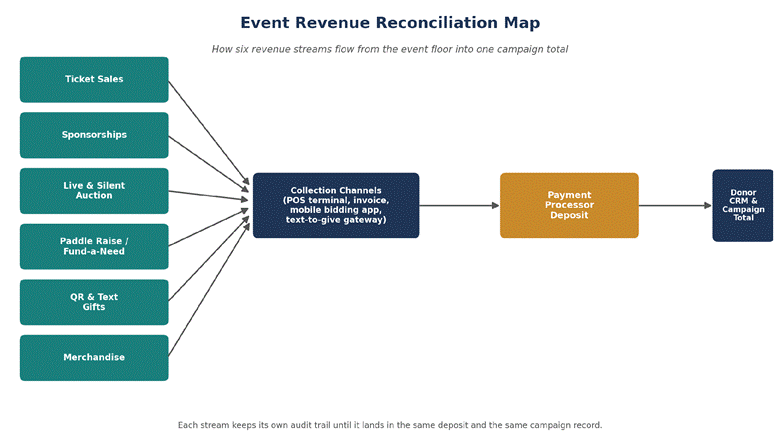
Figure 1: Event revenue reconciliation map, from six revenue streams to one campaign total.
During the financial closeout of a fundraising event, the collection portion must always be segmented from the invoiced portion. Most of the transactions that occur during the event happen in real-time. This can be a quick check-in card swipe, a tap at the auction to pay, or a cash donation given to a volunteer. Most of these transactions are settled and a batch deposit made to the designated account within one to three business days.
Sponsorships are a little more complicated. Many corporations sign on as a sponsor several weeks or even months before the event and expect to receive an invoice with payment terms of thirty or sixty days post-event. Payments may be received prior to the event, after the event, or sometimes not at all until the sponsor determines the appropriate quarter for the transaction to post in their books.
Due to these uncertainties, sponsorship funds must be treated as accounts receivable. To ensure a sponsor doesn’t fall off the radar after ninety days from the event have passed, the reconciliation team must maintain an active list of outstanding sponsorship invoices.
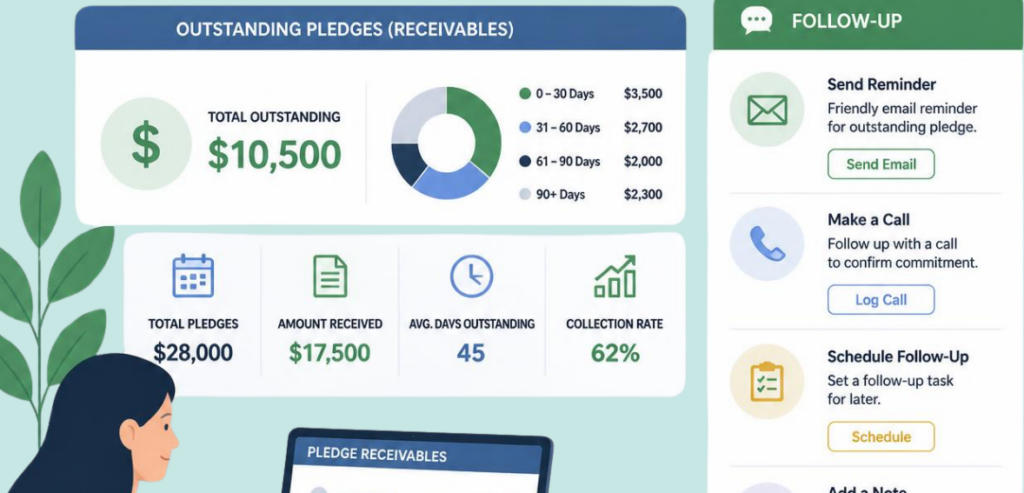
The paddle raise is usually the most exciting part of a gala, and the closeout can be the most chaotic as a result. Volunteers collect most paddle raise donations using bid sheets instead of payment terminals. This means the pledged amount and donor name can remain on paper for several days until someone inputs the data into the system.
Most nonprofit accounting standards require an unconditional promise to give to be documented as a receivable and contribution revenue at the time the promise is made, even if the cash is not expected to be received for some time. A pledge is considered to be unconditional when the only obligation is the passage of time. A pledge is considered to be conditional when the organization is expected to receive a matching gift or some other event is to occur.
A conditional pledge will not be recorded as contribution revenue until the condition is met. This is the main reason pledge tracking is mandatory for almost all nonprofit teams.
Because this area deals with judgment calls on documentation, organizations should discuss how they treat ambiguous pledges with their accounting team and auditors.
Paddle raise reconciliation improves the process mainly because of the follow-up procedures.
The donor database should have all pledges recorded, given a due date, and tracked until payment or until they’re officially written off within a few days of the pledge being made. The longer a pledge is left unrecorded, the less likely it is that it will eventually be collected.
Not everyone who buys a ticket attends the event. Some buy tickets and request refunds. Others do not ask for refunds and just do not attend. These cases should be treated differently. Guests who cancel according to the refund policy of the organization should be refunded through the original payment method. The refund should also be assigned to the guest record so that the ticket revenue reduction is visible in the campaign totals.
A no-show ticket buyer is handled differently. The no-show buyer has ‘purchased’ the right to attend, and the organization has met its obligation. Therefore, the organization has the right to the revenue from the no-show. The revenue does not need to be returned just because the seat was not occupied.
The revenue from no-shows does not need to be returned unless the policy of the organization states that it is an automatic refund for no-shows. Most events do not have this policy. It is important to put this policy in writing to prevent well-intentioned staff from refunding ticket revenue that does not need to be refunded.
Paying for an event isn’t as simple as one might think. Payments made through different methods incur different fees. In general, a check-in table transaction will have a lower fee than an online purchase. Many mobile bidding and text-to-give platforms incur fees in addition to card transaction fees. Recently, some platforms have allowed donors to select a button to cover the transaction fee. While this practice increases an organization’s revenue, the fee adds another item that will need to be reconciled.
Revenue should be recorded at the gross amount and fees recorded as an expense. This is the best, safest practice. If revenue is recorded at the net amount, the expense will also be understated. This practice not only shows the net revenue of an event, it also shows the cost of running the event and why the revenue is so low.
This is the step most closely associated with reconciliation. The processor’s bank deposit is the processor’s record of what cleared, and typically does not match the event platform’s record on a line-by-line basis. One deposit can combine several nights’ worth of sales, check-out of auction items, and text-to-give donations into one single gross deposit.
The reconciliation team has the responsibility to separate the lump and match the sourcing, confirm the withholding fee, and raise any discrepancy with the processor rather than waiting for a routine audit that can take several months to occur.
A processor reconciliation method should be simple in that it can be repeated regularly. The processor’s settlement report can be compared to the event platform’s report to check if the batch date and batch totals match prior to the inspection of any donor records. Any unmatched amounts, be they duplicates, pending transactions, or fee variations, must be adjusted prior to posting revenue.
Lack of attention to detail with small errors that occur on the reconciliation of a small event can lead to much larger errors that will be evident at year-end.
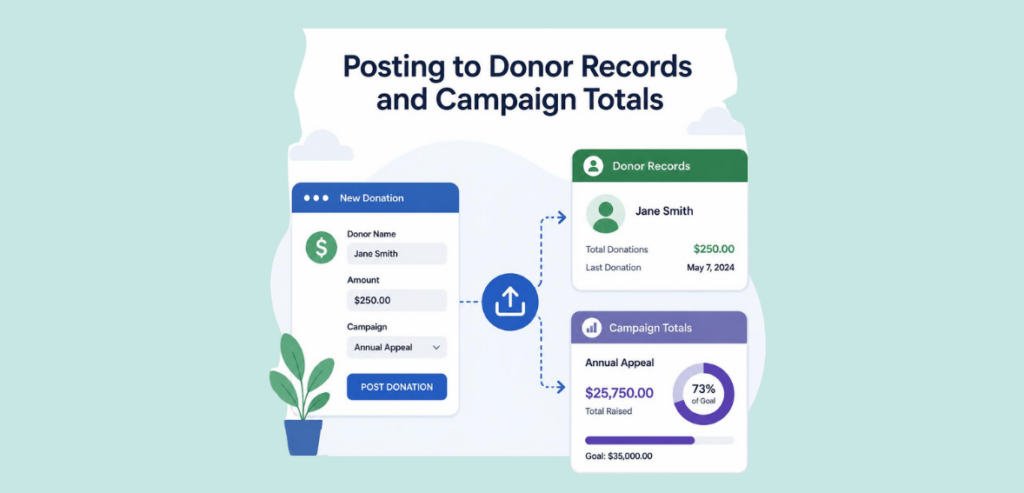
When the deposit has been completely reconciled, the corresponding revenue must be transferred to the donor CRM for attribution. This means all donations must be linked to the respective donor and campaign, and categorized as a contribution or exchange. If the sale price of a ticket, table, or auction item is greater than the fair market value, a quid pro quo disclosure must be given to the donor to inform them of the tax-deductible amount, since only the amount in excess of the fair market value of the goods or services provided is deductible.
Campaign updates to the board occur after this posting step is completed. This report is vastly different from the preliminary report given at the event. This report is completed after pledges are entered into the system as a receivable and after the processing fees are recorded. The reconciled number is included in annual and audit reports.
Basic, do-it-yourself spreadsheets may serve a function for smaller fundraising dinners, but larger events and galas usually employ a variety of event and auction software in order to sort and streamline different revenue channels before the transactions are processed.
Greater Giving, part of Global Payments, prioritizes the night-of-show experience by offering auction registration and badge printing, table assignments, and combined silent and live auction checkouts. To reduce the next-day reconciliation issue, it has integrated card processing with check-in to eliminate the manual data entry rework done at check-in.
OneCause focuses on larger events with auctions and mobile bidding. It features ticketing and live auction and appeal functions. Additionally, it works with the major donor management systems, Salesforce and Blackbaud Raiser’s Edge, to ensure the integrity of the campaign totals after the event data is integrated.
GiveSmart claims to be both integrated and unified. Community Brands is the parent company of GiveSmart. GiveSmart integrates auctions, peer-to-peer fundraising, ticketing, and donor CRM into one platform, which is one of its claims to being integrated. With GiveSmart’s integrated platform, separate systems for auctions, ticketing, and donor records (and the manual post-event data exports and transfers) are no longer necessary.
Confirm the current features and pricing of each vendor’s software, as these are subject to change. Always check directly with vendors before selecting a platform.
Fundraising events may vary in size and scope, but the closeout process for each should be the same. On the day of the event, staff should ensure each Point of Sale (POS) device and each mobile bidding session is closed for the evening. Nothing should be left open overnight at the event venue.
Settlement reports should be pulled for each processor and respective platform within 24 to 48 hours post-event. During the first week, the reports are compared to the bank deposit. Any pledges and invoiced sponsorships are recorded as receivables. By the end of the second week, revenue is recorded in the donor database and assigned to the respective fundraising campaign. 
Figure 2: Timeline of five stages after an event closeout, illustrating the processes from the settlement phase to the stewardship phase.
The last step is stewardship. This step often gets overlooked in the hurry to finalize a project. Once numbers are set in stone, donors need to be recognized. In instances where money was donated in exchange for something, donors need to be given a tax receipt. Sponsors need to be given a report that outlines what their money sponsored. The volunteers who committed to pledging funds should also receive a pledge report substantiating the funds that were pledged as a result of their efforts.
Closing the books and ending with accurate numbers but no stewardship handoff indicates that the accountant has done their job, but the fundraiser has not done their job. The fundraiser has only completed half of the job.
There are many different ways to generate revenue with a fundraising event, and this is what makes the post-event closeout too involved to be done quickly via spreadsheet. Planning for each of the revenue channels – differentiating payments collected on the night of the event from those invoiced later, treating pledges as billable receivables, consistently addressing no-shows and refunds, and honestly accounting for fees, all while balancing the closeout to the cash deposits – is just one unified process. When each of these revenue channels is accounted for, the nonprofit can trust the campaign total and can be confident in the relationship building they hoped to achieve with their participants.
Reconcile all processors and platforms reports with bank deposits. Separate pledges and invoices from cash received. The final reconciled total should be posted to donor records.
There are three things to do when an item is bid on: 1. Recognize the gross winning bid as revenue. 2. Account for the service fee. 3. Record the item’s fair market value for tax receipting for the donor.
A gift refers to giving money or an asset. Conversely, a pledge represents a promise to give something in the future and is recorded as a receivable.
To the guest record, tag the reversal of the payment through the original method of payment. A no-show with no cancellation request will not receive a refund automatically.
Record each donation to the donor’s record for the specific campaign. Issue a quid pro quo receipt if the payment exceeds the fair market value received.