Posted: September 01, 2026 | Updated: September 01, 2026 at 2:12 PM
An error at the federal level rarely impacts transactions at the convenience store counter. But this one might. U.S. Department of Agriculture (USDA) SNAP payment error data is already creating financial exposure for many states. This has added pressure on retailers. Retailers now have to pay more attention when they swipe an EBT card to avoid any issues with the transactions. It is not just a state-level concern but a real concern for store owners.
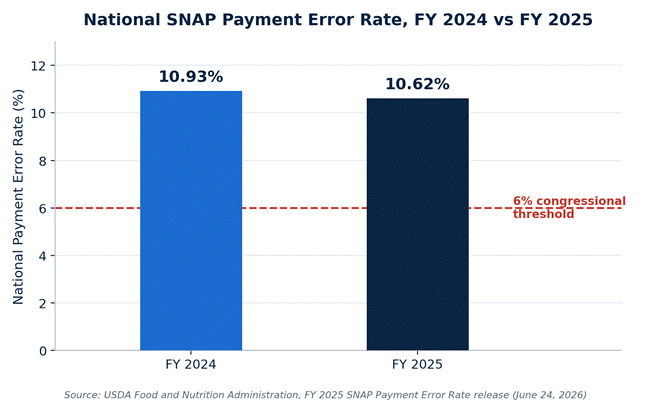
A SNAP payment error rate report was released by USDA for the fiscal year 2025 on June 24, 2026. Nationally, the payment error rate for SNAP decreased from 10.93% in 2024 to 10.62% in 2025. Both figures are well above the 6% payment error rate, which is a benchmark set by Congress. For fiscal year 2025, nationwide, over- and underpayments were roughly $10.1 billion. USDA has moved to launch a multi-pronged, enhanced accountability effort to decrease the payment error rate for SNAP.
This specific payment error rate refers to states’ ability to determine SNAP eligibility and benefit amounts. This payment error rate is not a measure of a cashier’s ability to enter each transaction; the two are separate measurements. In order to determine payment error rates, states are required to complete quality control reviews of sampled cases.
Register-level errors will never appear in that quality control review. From a merchant’s perspective, the payment error rate report is important because new legislation ties state error rates to real dollars. With this exposure now a reality, states are turning to oversight of the money moving through all systems, including at the point of sale.
According to the 2025 reconciliation law, states must begin to share the cost of SNAP benefits beginning in fiscal year 2028 if they have error rates of 6 percent or more. States with error rates between 6 and 8 percent must share 5 percent of the cost. Error rates of 8 to 10 percent mean sharing costs at 10 percent, and costs must be shared at 15 percent for error rates greater than 10 percent. All but ten states had error rates of 6 percent or more in fiscal year 2025.
All of these states now have a financial incentive to improve SNAP program integrity, and increased scrutiny of retail transactions is one of the few levers a state can pull to address integrity concerns quickly.
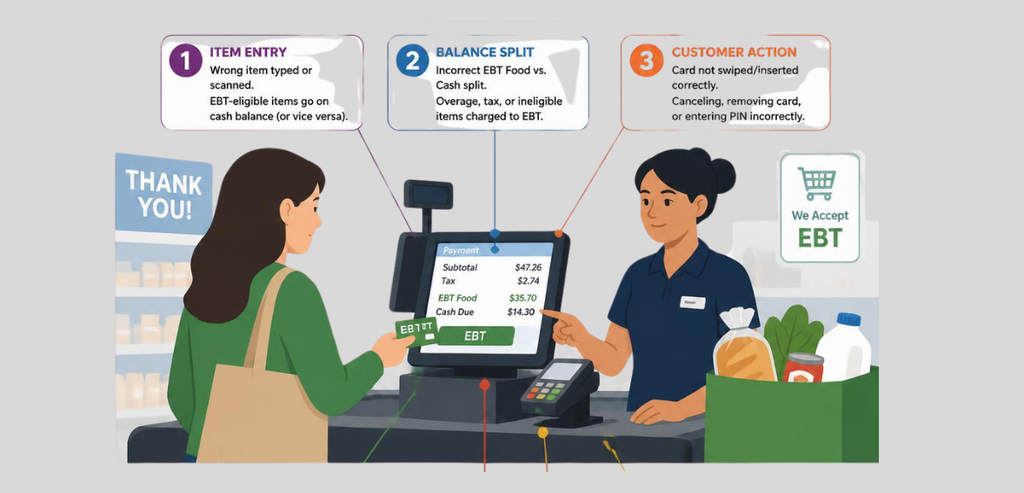
The main problems associated with EBT acceptance at the retailer level rarely fit the profile of the state payment-error-rate issues. EBT issues at a retail level tend to be minor. They might occur repeatedly throughout the checkout process. Scanning a rotisserie chicken is a good example. A cashier may ring up a hot rotisserie chicken as if it were SNAP-eligible, even though hot prepared food is not.
A cashier may enter a split tender in the wrong order. A point-of-sale system may still have a “held” item which may have lost its SNAP eligibility several weeks prior. By themselves, these errors are minor in nature. Thousands of these minor infractions form an identifiable pattern that draws the review of the USDA Food and Nutrition Administration.
The following table displays the most common error classes associated with EBT compliance audits and mystery shopper evaluations at small and medium-sized retailers.
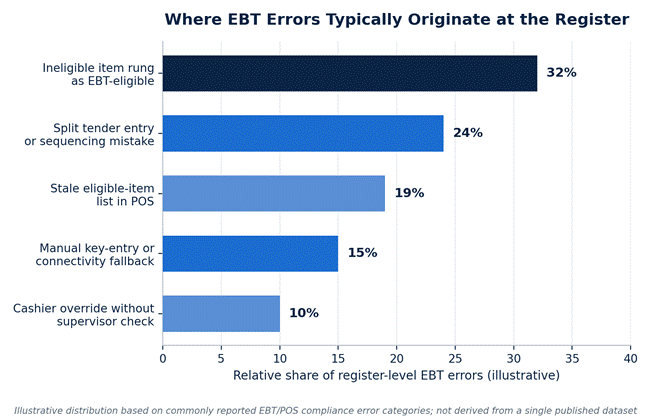
Ineligible items are the single biggest source of errors, and they are also the easiest to fix.
A store’s eligible-item configuration does not maintain itself. New SKUs are added weekly. The UPCs change, seasonal items come and go, and items are mislabeled as eligible. For example, SNAP is intended to purchase food; items like alcohol, tobacco, pet food, vitamins, and hot prepared food should not qualify. However, for a multitude of reasons, including configuration problems, it happens.
To mitigate configuration drift, someone must check the list of eligible items for changes at least once a month. Stores that do not diligently check their items are the ones that most often fail the audit.
With split tender, a customer can pay for part of their groceries with EBT, and then use another payment method to cover the remaining cost, tax, and/or ineligible items and cash back if it is permitted. Split tender is not complicated. The problem is if steps are skipped or done in the wrong order. For instance, using EBT after putting in a credit card payment means that the credit card payment is done first, and then whatever is left is paid for with EBT. This is the reverse of the correct order and can result in an incorrect calculation of the EBT-eligible amount.
Good point-of-sale systems eliminate the ability for cashiers to process in the wrong order. Split tender systems are designed so the cashier just scans everything, the system calculates the EBT-eligible amount and applies the EBT card to it first, and the remaining balance goes to the second tender.

The vast majority of errors in the EBT system are related to poor training. They do not occur through any deliberate fraud. Convenience stores have high cashier turnover. The process for onboarding cashiers is often quick and doesn’t include EBT training. There will be employees who have been told they can’t sell hot food with EBT, but will still sell it because the cash register allows them to.
The best methodology for EBT training is short, repetitive training. It’s better to use a 5-minute training each shift. This will help cover a common training gap. Stores that refresh EBT training whenever schedules or staff change tend to have fewer mistakes. Stores that create an EBT training binder once and consider it done make more mistakes. Management should also review a sample of transactions each week.
Errors caused by hardware and connectivity-related issues form their own category of EBT errors. These errors are different from user errors. An EBT terminal with out-of-date firmware does not contain the latest eligible-item rules. An unstable connection can force a terminal to go into a manual key-entry mode in which automated checks for the items are completely bypassed. Terminals that store transactions and process them later in batches might post a transaction with incorrect information if the connection is lost during the sale.
A terminal’s firmware should be checked every quarter to ensure that it is updated. The same check should confirm that the eligible-item list in the terminal matches the inventory of the store, and that the terminal has available backup connectivity when the primary connection is lost. A single point of connectivity failure can cause a store to conduct a series of transactions that are difficult to reconcile and prone to errors.
Each store’s compliance history is kept independently from the state-level payment error rate. However, each is impacted by the same external events. USDA has issued thousands of stocking and program violations against retailers in recent years. In addition, the new staple-food stocking standards, effective November 4, 2026, will raise the bar further. States that are now under increased financial constraints are even more motivated to support retailer-focused compliance reviews to reduce their error rates.
The consequences of non-compliance can range from a warning and a required correction to complete disqualification from SNAP, with a required waiting period before the store can reapply. Transactions where SNAP-ineligible items are sold are just one example of a pattern of non-compliance. In addition, retailers with a pattern of unrecorded split tenders or manually keyed transactions are also subject to the review process. The USDA has reported that most payment errors at the store level are unintentional, but those errors still carry consequences.
Here are some categories that cover the areas most likely to surface in the compliance review. Also, the table below shows the standards each one should be held to.
| Area | What to Verify |
| Eligible-item list | Reviewed monthly against new SKUs and current USDA guidance |
| Split tender | EBT-eligible amount calculated and applied before other tenders |
| Staff training | Refreshed each quarter, not just at onboarding |
| Equipment | Firmware current, backup connectivity in place |
| Transaction records | Spot-checked weekly for manual-entry or override patterns |
| Reauthorization | Application and stocking standards confirmed ahead of renewal date |
The fiscal year 2025 USDA error rate report is state-specific. However, problems associated with this report will be felt at EBT terminals across the country. States face financial liability if their error rates stay high, and that scrutiny flows downhill to retailers. Stores that draw the least scrutiny will be those with all eligible items posted, split tenders done in the correct sequence, staff trained on a scheduled basis, and equipment properly maintained. These are small things that should be done habitually and offer great protection.
For retail stores, higher state error rates lead to increased scrutiny of the program, which in turn leads to more compliance audits of retailers.
They are primarily caused by ineligible items being scanned, split tenders entered incorrectly, outdated item lists, or workarounds where the cashier enters the information manually.
The first payment method is swiped using the SNAP EBT card, and the second payment method is used to pay the remaining balance.
Yes. There is a great risk of losing the ability to participate in the SNAP program for repeated errors.
Review your eligible-item list monthly, train staff quarterly, verify equipment, and review your reauthorization requirements leading up to the date of expiration.