Posted: September 02, 2026 | Updated: September 22, 2026 at 3:53 PM
A payment fails at 4:50 p.m. on a Friday. In the past, the owner could have gone to the branch less than one mile away and asked a teller for help. Now, that branch may have closed for good. Their sign may have been removed many months ago. The closest person the owner can talk to may be a phone menu, and that menu doesn’t even know the owner by name.
This may not seem real to some people, but it happens regularly to the more than a million small business owners who have come to rely on branches that have begun to close around the country. The most important question is: Where will the small-business payment support go once the branches have closed?
The data is bleak. According to S&P Global Market Intelligence, net closures were 2,126 in 2020, 2,928 in 2021, 1,854 in 2022, 1,409 in 2023, and 2024 continued the declining trend with roughly 965 net closures. The last five years of data show clear evidence that thousands of bank branches have closed, further limiting options for small business owners to interact in person for transactions and deposit cash.
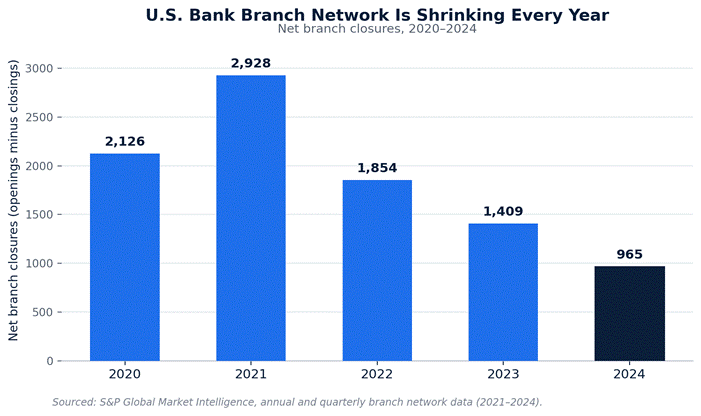
Chart 1: U.S. Net bank branch closures, 2020-2024. Data source: S&P Global Market Intelligence, branch network data consolidated on an annual and quarterly basis.
Though the decline has leveled off and no longer looks like a death spiral, the industry has shrunk from the Federal Deposit Insurance Corporation’s 2012 peak count of roughly 83,000 branches by about 15,000. Now some banks are moving in the reverse direction in select markets. According to federal regulatory filings, the national branch network showed its second consecutive quarterly increase in early 2026, the first back-to-back growth since 2010, with new openings in fast-growing Sun Belt metro areas.
While this reversal is real, it is still concentrated. Branches continue to close in the Rust Belt, the Northeast, and California. The new branches being opened offer fewer teller stations and are staffed with fewer people. This means that even while branches decline in number, the services offered are shifting away from day-to-day teller transactions toward account openings and advice.
For a small business that once solved payment problems at the counter, the impact is the same regardless. The share of transactions managed by in-branch banking continues to decline. Fourth-quarter 2024 data showed an 8% decline, according to Newsweek and Statista, in the share of bank account holders who utilized branch services compared to 2019. The counter still exists, but it is not the default place to get help anymore.
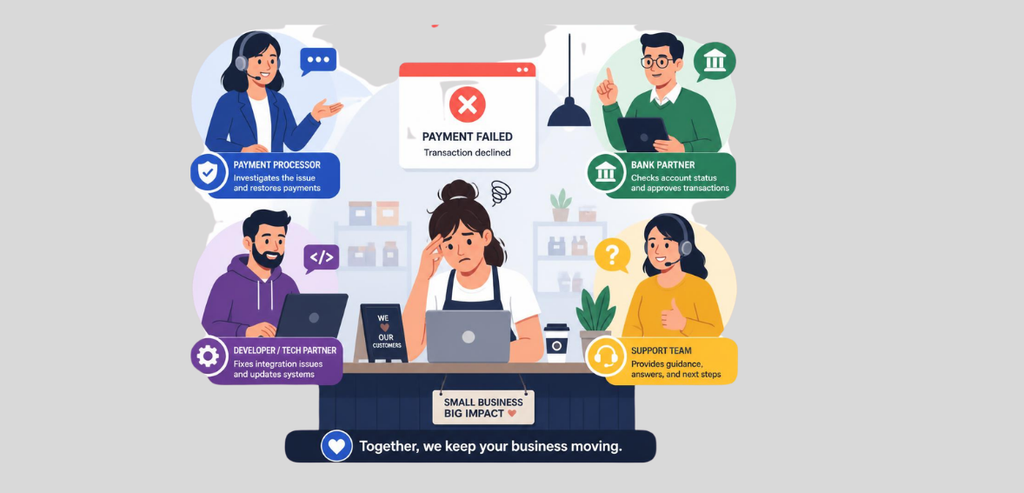
Payment problems occur at the worst possible times. Your card reader stops authorizing transactions when you’re in the middle of a busy lunch hour. The nightly batch does not settle, and your deposit the next business day falls short by that amount. A customer disputes a charge that you made six weeks ago, and as a merchant, you have to provide evidence to your acquirer in the next 48 hours. None of these problems care whether a branch or a teller is nearby.
The owner needs a person. Businesses – small or large – need support, and they have always needed it, but what has changed is that the previously existing channel of lobby support has been replaced with phone, chat, and app support. Some providers take these new support channels seriously, while others haven’t.
This is the gap that matters. Branch closures haven’t created a new need for support. They have taken away the most convenient, most forgiving support channel and have made it clearer which support providers have made serious new channel investments and which have not.
The Federal Reserve Banks’ 2023 Small Business Credit Survey contains valuable data about how small businesses obtain financial services. The survey captures the views of employer firms across the entire country. Among them, 87% have a banking relationship, 26% have a relationship with a nonbank financial company, and 15% have a credit union relationship. Many firms have more than one relationship.
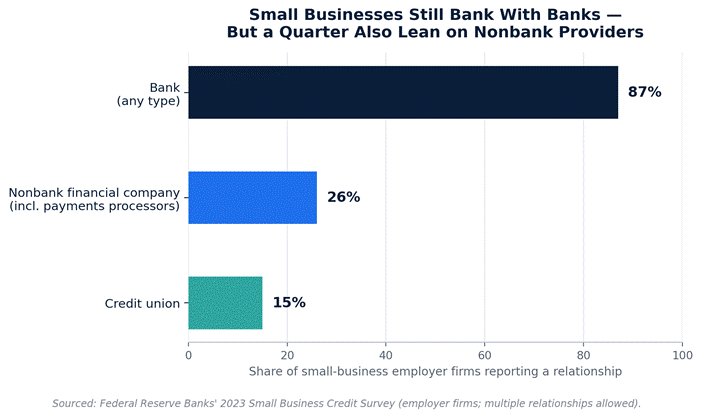
Chart 2: Share of small-business employer firms reporting a financial-services relationship, by provider type. From the 2023 Small Business Credit Survey conducted by the Federal Reserve Banks.
The survey showed something more important than which banks businesses use. The survey asked businesses why they stay with certain banks. Small banks and credit unions kept their customers more with quality customer service and established in-person branches. On the other hand, large banks and non-bank service providers kept their customers mainly with low prices. When banks offer in-person services, quality service is what really builds customer loyalty and price isn’t as important to keeping the relationship.
Rural firms feel the shift first. The same survey revealed rural firms lean on small banks, whose branches are more exposed to closure through consolidation. When an urban branch closes, customers usually have another branch nearby, but when a rural branch closes, the relationship is lost unless the bank offers strong remote support.
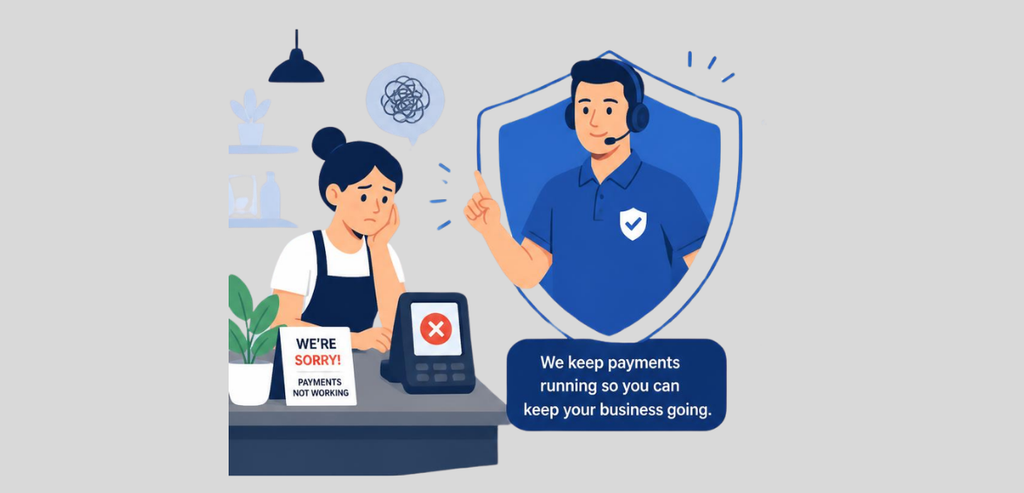
There are quite a few consistent features when payment support is offered on a responsive basis – no matter which payment support provider is offering it. A live person answers your call within minutes. This person is also able to see your transaction history without you having to repeat and explain transactions to them. If the issue is a failed batch settlement or a questionable hold on funds, good support passes the issue directly to someone who can actually resolve it, rather than just logging a callback ticket. Weekend and even after-hours support exists in some form, since many small businesses and restaurants do the majority of their business on a Saturday, exactly when the local bank lobby is closed.
Ease of use and self-explanatory documentation also greatly improve the service. When your payment support provider gives clear explanations of a decline code, reserve hold, or a chargeback timeline, they’ve saved you hours of unneeded explanation and digging. When there is jargon used, and every answer to your question is a generic support article, they are shifting the cost of their confusing support onto you.
Rate. When providers are compared, rates are the easiest element to compare. For each owner, the true cost of accepting a card must be weighed. However, rates are the easiest to offer discounts on for a short period of time. This makes rates a poor indicator of a provider’s long-term value.
Service. Service is quickly getting a solution to a problem as opposed to getting a script. This is the element that is most likely to be tested in a crisis and least likely to come up in a sales pitch. Notably, the Federal Reserve’s survey shows that service is a key factor in whether a business stays with a particular provider.
Continuity. Continuity is what happens to an account when a provider goes through a merger or internal reorganization. Even if a business has a great deal on rates and great service today, it can lose both if the support staff is consolidated or if a new system is put in place without communication. Continuity is a factor that an owner is able to ask about to gain some control over the unexpected.
None of the three factors should be evaluated individually. A processor with the lowest rates but a day-long support queue is not truly cheap once a single, unresolved dispute is taken into consideration. A processor with great service but no apparent continuity plan makes a great first impression while carrying long-term risk.
Some warning signs tend to show up across underserved merchant accounts. For one, support tickets may take more than a business day to receive a reply beyond an ‘automatic reply’. Users only have a support ticket number or a general email, and there is no named person assigned to the account. Users receive statements with fees for which no explanation is provided or codes that support cannot clearly explain. Sometimes statements have fees that are ‘chargebacks’; however, no one notifies the user until it is almost too late.
Probably the biggest sign of an underserved merchant account is an inability to think of anyone who can be called to address a payment dispute. If the answer is a shrug, then the support relationship has failed, even if the account has been fully operational.
Signing up with a payments provider can be a tough decision. To get a clear idea of what support is like, a potential client can ask some direct questions. The table below outlines the things to look out for when asking questions.
| Question | Why it matters |
| Who answers when a terminal or gateway goes down at 6 p.m. or on a weekend? | Payment failures do not follow business hours. A dead-end voicemail costs a night of sales. |
| Is there a named support contact, or only a shared queue? | Continuity depends on someone who already knows the account and its history. |
| What is the average time to reach a live person during a decline spike? | Hold time during a crisis is the real service-level agreement, not the one on paper. |
| How are chargebacks and disputes handled, and who prepares the evidence? | Weak dispute support quietly erodes margin every month, even when nothing looks wrong. |
| Can the provider explain a statement or a rate change in plain language? | Confusing statements often hide the true cost of switching later. |
| What happens to support if the account changes hands through an acquisition? | Processor consolidation can silently replace a known team with an unfamiliar one. |
If a provider is giving specific answers instead of talking about their product using marketing jargon, then that’s a clear sign that they have actually built support into their offerings. If instead, a provider is deflecting or using general answers, signs point to a clear lack of built-in support for their product — even if their product’s ‘day one headline rate’ is very competitive.
Closures of branches will make it clearer to business owners that payment providers are more than just money pipes; they are a business’s only lifeline to human support within the financial system. A small business owner should vet every payment provider they consider partnering with, since they are committing to a relationship that will be their main line of human support. Customer support should be a priority to an owner, not an added cost to a service. Payment providers should make customer support readily available without having customers pay an additional service charge.
The trend of uneven branch closure has not subsided. Not all regions show equal net losses or gains from branch closures and new openings. More significantly, support channels have shifted and will not return to their prior states. Small businesses can no longer rely on the support of a nearby branch to resolve payment challenges. This shift has increased the value of a provider whose support has been designed to operate a business in a branchless world.
The price of a service is important, as is the technology supporting a checkout or payment gateway. Yet, for small businesses with a failed payment batch on a Friday evening, the service provider who is available to take the support call is the service provider that will retain their business.
Banks are profit-driven, and remote banking is becoming increasingly popular, causing physical bank branches to become losing bets. Banks tend to consolidate branches and close physical locations to save money.
Small business owners lose the ability to do quick walk-up deposits and get in-person help to solve problems. In rural areas, banks will sometimes close the only branch in town. If a physical bank location closes, a business owner will have no other choice but to use a branch that is far away.
Payment support should give you a dedicated contact, fast response times, and a fair system for chargebacks/disputes. Payment support should be easy to understand with established processes for resolving disputes/chargebacks.
For most cases, yes. The modest added cost is usually worth it, especially if strong dispute and chargeback support keeps you from losing money and productivity.
Before you do anything else, contact your payment processor’s dedicated merchant support.
You need to contact the support line for the terminal, gateway, or processing account since they control that.