
Posted: September 10, 2026 | Updated: September 22, 2026 at 4:01 PM
A cash-only driver at a Rockford gas station has a $20 bill, but no card. The attendant has the legal right to turn the cash away, but by 2028 in Illinois that will be illegal.
On July 31, 2026, Governor JB Pritzker signed the Retail Cash Payment Act. It was described by the media as a law for “most retailers.” And rightly so. The Illinois New Cash Acceptance law covers any business that takes in-person payments of any kind. Gas stations, grocery stores, and pharmacies are listed, but so is any store with a staffed cash register.
A boutique store is treated the same as a hardware store or an electronics store, so any merchant that sells face-to-face in Illinois must be able to accept cash. The rest of the law describes what needs to be ready by the deadline to meet the requirements of the new law.
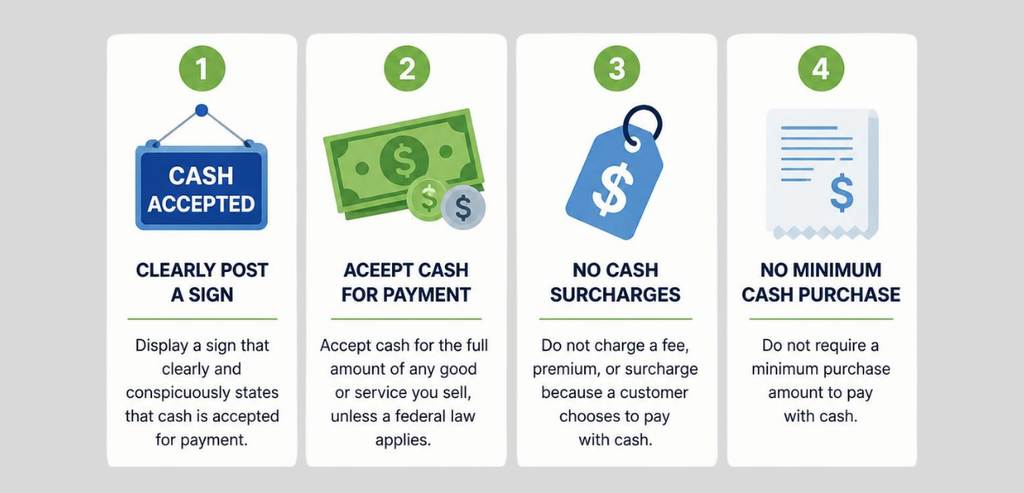
On July 31, 2026, Governor Pritzker signed HB4592, the Retail Cash Payment Act. The Act passed the House in April 2026 with a unanimous vote of 102-0 and was unanimously passed by the Senate. This Act will take effect on January 1, 2028.
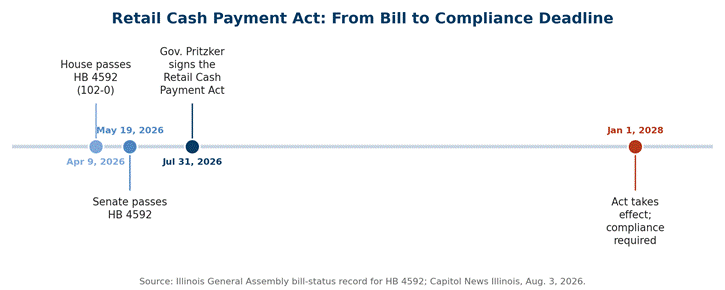
The intention of HB4592 is straightforward. Retail businesses covered by the Act may not refuse cash payments for sales less than $500. The Act prohibits a sign that indicates retail cash is not accepted. No such sign can be legally posted, even if cash is accepted at the cash register.
The Act is not require merchants to accept any bill a customer has. A merchant may refuse any cash bill that is greater than $20. The Act also does not prohibit offering discounts for other payment methods, but a covered business cannot charge a cash-paying customer a higher price than other customers. In Section 10(e) of the Act, payment method incentives and other discounts cannot nullify the intent of the Act.
Competing cash rules will not be allowed for home-rule counties and cities. Section 25 of the Act states that local ordinances are preempted by the Act. This Act states that the only standard that will apply is the state standard when the Act becomes effective, regardless of a city council’s preference.
This is where sloppy reading leads astray. The Retail Cash Payment Act impacts retail mercantile establishments that employ at least one person to accept in-person payments at a physical location to transact the sale of goods or services to the general public. This covers nearly every staffed storefront in the state. A boutique qualifies. A hardware store qualifies. So do an electronics retailer and a furniture showroom as well as the gas stations, grocery stores, pharmacies, and restaurants that the news coverage kept naming.
These named categories are important for a different reason. They are the categories that cash refusals have been happening in and were the examples that lawmakers referenced when discussing the law. A gas station has an obligation on a sale of fuel and any other sale of in-person payment for goods or services under $500 on the same premises, whether it is food sold at the counter or a car wash.
A pharmacy has an obligation on the sale of goods and services transacted at the dispensing counter. A restaurant has an obligation on the sale of goods and services transacted at the cash register. None of these has an obligation on anything greater than what any other staffed retailer has.
How a business sells its goods and services dictates whether it falls under the Act, not the category. A business that has no employees to accept payment in person is outside the Act. The same is true of businesses that have no physical presence and transact sales purely over the phone, internet, or via an application. The exemptions further down carve out the rest.
The test is not as complicated as early summaries suggested. Does the business sell goods or services to the public at retail? If the answer is yes, and employees get in-person payments, then cash must be accepted for sales under $500 as of January 1, 2028, unless one of the following statutory exemptions applies. The law does not apply to the business if the answers are no, e.g. an unstaffed context, or a business that has no in-person sales.
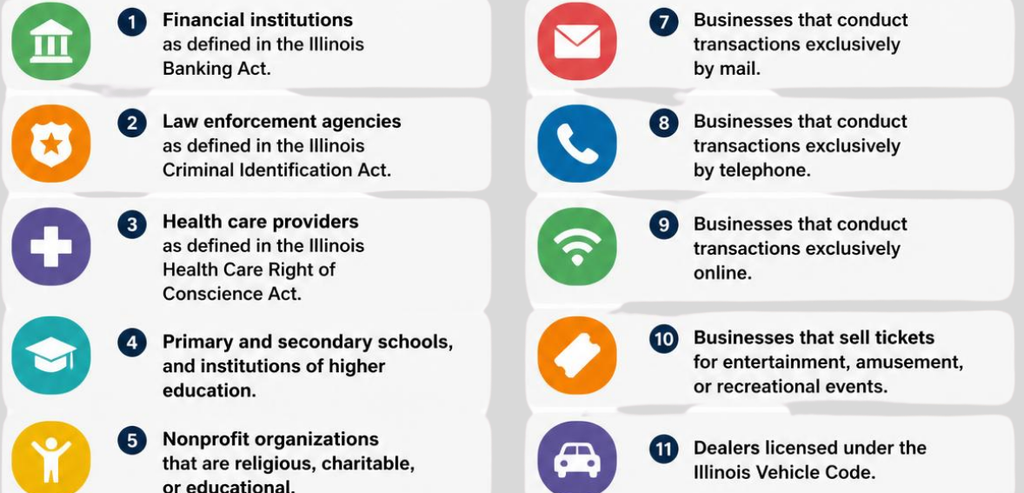
Covered businesses are allowed to refuse cash in certain situations under this law. Section 10(b) describes six exceptions. Section 10(c) provides guidance for the self-checkout option: every self-checkout must accept cash if it is the only option to pay. However, if there is at least one cash checkout lane, the self-checkouts do not have to accept cash.
There are other examples. Cash does not have to be accepted between the hours of 10 p.m. and 6 a.m. This section would pertain to convenience stores, gas stations, and pharmacies that stay open overnight.
It is also an exception if the cash system fails or the business cannot make change. The exception lasts only as long as the failure does.
If a business requires a membership to purchase, that is another exception to the law.
The fifth exemption was the one that early news summaries ignored, and it is important to merchants that are considering a cashless-adjacent offering. A business that provides conversion of cash to a prepaid card onsite does not need to accept cash at checkout. Cash can still be converted to spending value within the merchant, but the conversion will be done by the prepaid card system, not at checkout.
The sixth exemption includes orders placed by phone, internet, or app and picked up in person at a merchant’s premises. A transaction that is not completed in person is not a cash transaction under this statute; therefore a merchant offering ordering by app for a time period of the day is not breaking the law during that time.
Two small provisions are the most confusing for merchants because they deal with less common issues than most of the provisions. First, a business is not obligated to accept bills larger than $20. A customer who cannot pay a $40 tab with smaller bills can be refused service. This is not a violation of the act.
The second confusing provision is the signage rule, which businesses also get wrong. The sign “cards only” or “cash not accepted” is in violation of the act and will still be a violation even if cash is accepted at the register. Therefore, a store that accepts cash at the register and displays the “cards only” sign at the point of sale is also in violation of the act. These signs should be removed voluntarily by the businesses well before January 2028 to avoid an inspection prompted by a complaint.
Preparation begins with classification, and for most operators this is a quick step now: if a location has an employee taking in-person payments, then treat it as covered. A multi-location operator should still confirm this for each location separately, as formats can vary under one brand and one point-of-sale system, and should revisit the answer whenever a location changes format, rather than treat a 2026 review as a one-time classification.
The next step is hardware and staffing. Every covered location must have a point of sale that can process cash, and be staffed. This is the practical requirement for the self-service exemption in Section 10(c) and a fully unstaffed store format will not satisfy the law, even if a person is on the premises and is responsible for stocking or ensuring the security of the store.
Operations that are open on an overnight basis must also have a documented overnight policy. A 24-hour pharmacy or gas station must have a documented policy that provides the 10 p.m. to 6 a.m. carve-out so overnight cash refusals are not in violation of the law.
Signage on all locations must be reviewed. All “no cash” prompts, including signage and/or decals, must be removed prior to the effective date. New signage vendors and/or franchise packages must be verified for compliance.
Any businesses considering utilizing the prepaid card exemption must maintain an on-site conversion mechanism as the exemption’s on-premises language would more than likely not be satisfied by an off-site vendor who processes card loads through an application or call center.
Violations of the Act are petty offenses. The fine schedule is designed to be low initially. There is a $50 fine for the first violation of the Act in a 12-month period. If a violation is committed for a second time during the rolling 12-month period, the fine increases to $100. If the violation is committed three or more times, the fine increases to $500. There is a $5,000 fine cap for each establishment for fines issued within a calendar year. Because there is a repeated violations cap, each establishment has a financial limit for how much they will spend for repeated violations.
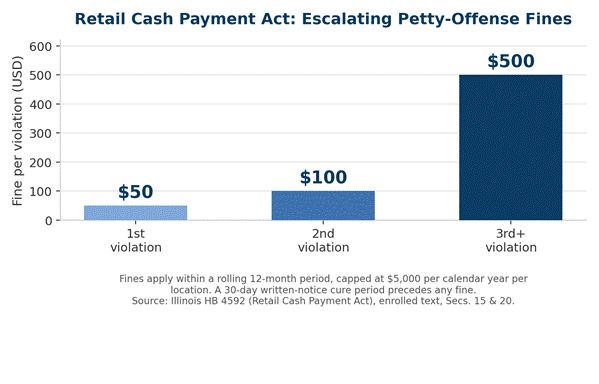
Section 20 of the law gives businesses a 30-day advance written notice for a cure period. Merchants who allegedly break the law are not penalized on the spot. They are required to fix the violation and are subject to penalties after the 30-day cure period. Businesses have the 30-day period to plan for becoming compliant. Since businesses can staff their cash registers, train employees, and audit their signs during the cure period, compliance is not difficult for many businesses.
Local governments do not have the power to pass local laws that go beyond the cash acceptance laws and restrictions that are set at the state level. Section 25 of the Retail Cash Payment Act preempts home-rule municipalities from making local laws. Once that Act is operational, the laws will be the same for the cities of Chicago, Springfield, and Rockford and all other municipalities of Illinois.
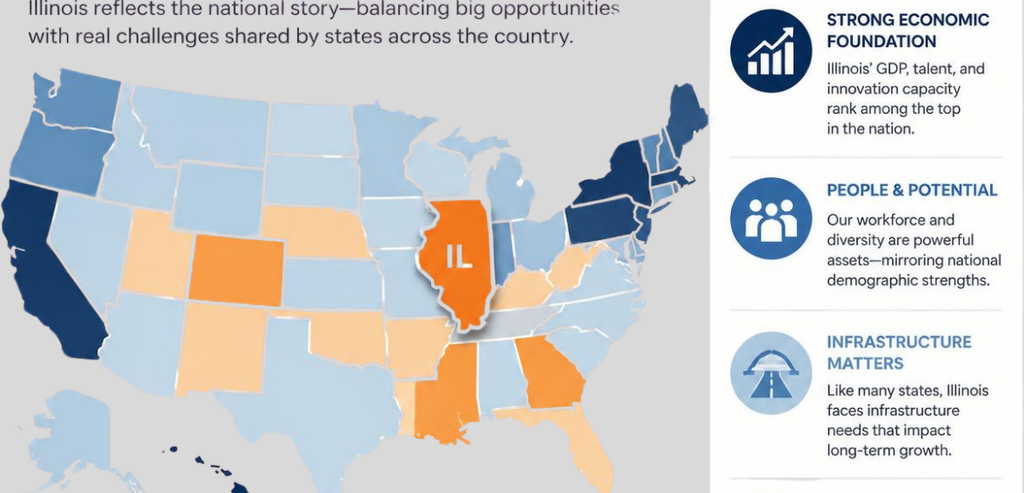
Illinois is not the first nor will it be the last state to implement a cash acceptance policy. Massachusetts was the first in 1978. In the past couple of years, merchants in several other states and cities have been required to accept cash as society began to favor digital payment methods over cash transactions.
States and cities pass consistent laws requiring cash acceptance due to the large number of cash-based households. There are many reasons cash-based transactions still exist, including preference of cash, privacy concerns, and lack of bank accounts. The FDIC survey reports that 4.2% of households in the U.S. do not have banking services of any kind (unbanked), while another 14.2% of households are “underbanked.”
What Illinois retailers need to know is that cash acceptance laws generally stay valid. Just because the Illinois law does not take effect until January 2028, retailers should not assume it will go unenforced or be amended or repealed. Similar laws in other states and cities have demonstrated that cash acceptance stays on the books.
The Retail Cash Payment Act will impact a wide range of businesses, just as the media has reported. The act covers businesses where employees take in-person payments at physical locations. Gas stations, grocery stores, pharmacies, and restaurants are some of the more visible businesses covered by the act, but so are staffed boutiques and hardware stores.
The businesses covered by the act will still maintain a lot of flexibility. The act allows businesses to have a combination of staffed and self-service checkouts, to operate during overnight hours, to have problems with their cash system that last only a short period of time, to perform on-site the conversion of cash to prepaid cards, to operate in membership-only formats, or to encourage customers to order goods for pick up or delivery. The two clear and absolute rules are to have cash payment systems for payments under $500 and to have no signs indicating cash is not accepted.
Covered businesses will have until 2028 to put cash payment systems, staffing, and compliant signage in place. The first infraction penalty is very low, but businesses will face the greater cost of the scramble to change signs and staffing after the implementation deadline, instead of before.
There are exceptions, but the law affects the vast majority of retail businesses. A retail business that employs staff to receive in-person payment transactions must accept cash for any sale that is less than $500.
On July 31, 2026, the Illinois state governor signed the Retail Cash Payment Act. The law will go into effect on January 1, 2028.
Yes, the law states businesses may refuse any single bill larger than twenty dollars.
No, any transaction where the payment is processed remotely does not fall under the law.
It would be considered a violation of the law to place such a sign.
Yes. If every lane is self-service, those lanes must take cash. If at least one staffed checkout lane takes cash, then self-service checkout lanes are not required to take cash.
The first violation would require the business to pay a penalty of $50. The second violation would require a payment of $100; the third violation would require a payment of $500, with fines capped at $5,000 per calendar year, and fines apply only after a 30-day grace period to allow the business to correct the violations.
No. Section 25 preempts home-rule units, meaning that Illinois has the statewide rule.