Posted: September 07, 2026 | Updated: September 22, 2026 at 3:53 PM
Klarna charges US merchants 5.99% plus 30 cents for each purchase. Card transaction processing charges, on average, are around 2.9%. Klarna’s processing charges amount to approximately double the cost of card purchases. “Should I offer Klarna to consumers?” is essentially a question about the size of the purchase and the gross margin.
Merchants with a volume of $5 million or more of annual revenue can negotiate it down to 3.29%, lowering the penalty over card rates to about 40 basis points. Thus, two different merchants selling the same product will have to pay different fees.
With the BNPL competition, Klarna is confident that enough merchants on both sides of that line say yes. In July 2026, it filed with Utah regulators and the FDIC to charter Klarna Bank USA as an industrial bank. This would let Klarna hold deposits and fund its own loans instead of routing through partner banks. It already has a $26 billion forward-flow deal with Nelnet backing US Pay in 4.
Average order value, gross margin, and the customer are three important things on which the merchant depends to decide whether to offer BNPL. Here’s where it works and where it doesn’t.
The growth of Klarna is not quiet. In July of 2026, Klarna filed for a bank charter with the FDIC and the Utah regulators. This would allow Klarna to loan to consumers more efficiently without a partner bank. Klarna has two other deals that show the same sentiment. The first is a forward-flow agreement with Nelnet. This agreement sells newly originated Pay-in-4 loans up to the amount of $26 billion on a rolling basis and keeps them off Klarna’s balance sheet. Klarna also has a partnership with Worldline that extends its reach to Point of Sale merchants.
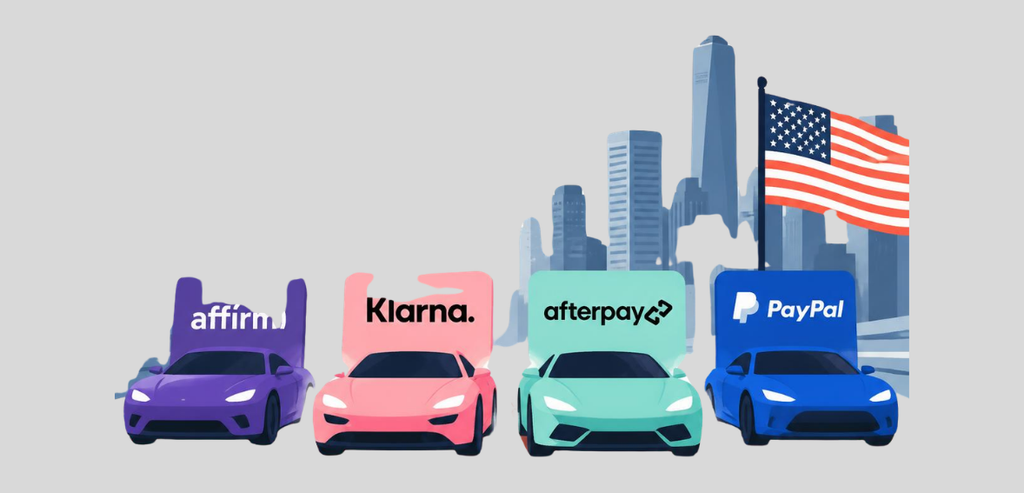
Klarna’s not the only one targeting the checkout button. Affirm, Afterpay, Sezzle, Zip, and PayPal’s Pay in 4 are all competing for the same thing. Klarna leads; however, this is solely based on the metrics that are provided. By one metric, Klarna is far ahead of Afterpay, with Sezzle and Affirm showing single-digit numbers. By another metric, the Federal Reserve puts both Klarna and PayPal at 32% of the market. The following chart breaks down the site presence.
There are two main pillars of Klarna’s US expansion. The first is Pay-in-4, an interest-free, six-week, short-term payment plan. The second is its own banking license to manage direct US deposits and lending. Klarna’s first quarter of 2026 provided revenues of over $1 billion, showing substantial growth from the previous year. With this growth, there is a strong reason for fierce competition.
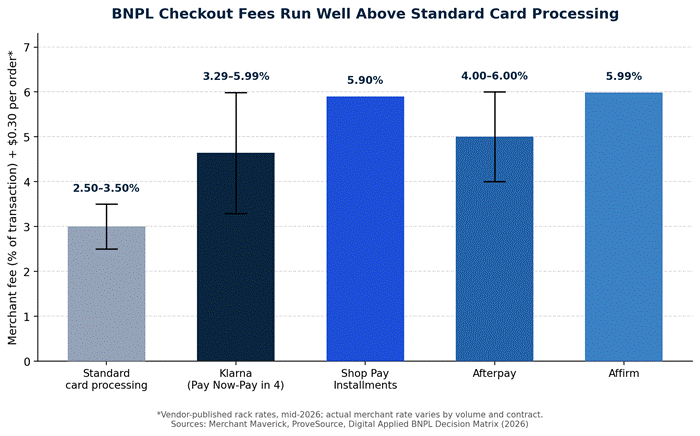
Figure 1: Share of BNPL-enabled merchant websites by provider, early 2026. Source: Capital One Shopping data, cited in Digital Applied BNPL Decision Matrix (2026).
The BNPL system is a beneficial pitch for both merchants and consumers. Merchants enjoy an average selling price increase of 30-50 percent as well as an increase of 20-35 percent in volume of goods sold.
This claim states that BNPL systems have been proven to increase selling price and selling volume, but the claim requires confirmation, as some studies contradict this claim. One study by Stripe tested more than 150,000 payment sessions and inserted a BNPL option for half of those sessions, while the other half had no option. During these sessions, Stripe reported an increase of up to 14 percent. Stripe attributed the increase in revenues to an increase in conversion and size of the shopping cart. Most studies do not include the control group that the BNPL option was hidden from.
The finding that is more significant in this report is cannibalization. Stripe reported that over two-thirds of the purchases made through BNPL were completely new sales; the other third were purchases that would have been made through a credit card, meaning that BNPL systems potentially do not erode sales volume. However, the presence of BNPL systems increases selling cost by 300 basis points.
BNPL isn’t cheap. There’s typically a range of 2.5%-3.5% for every transaction that goes through using a card. BNPL charges well above what is standard. The range of what Klarna charges for commercial businesses is 3.29% to 5.99% per transaction with a $0.30 charge for each order. Affirm’s standard rate for similar marketplace offerings is around 6% with a $0.30 charge.
Afterpay charges between 4% to 6% with a $0.30 charge. Shop Pay Installments, powered by Affirm, has the same rates as Afterpay. Below, you can see where each of these charges sits compared to the range for typical card processing.
Do your calculations first. With a gross margin around 50% and BNPL adding approximately 3.5 percentage points to your processing cost per order, to break even you would need a 7% increase in order volume. If the lift is less than that, BNPL is eroding margin even as it appears to stimulate sales. Additionally, numerous BNPL providers do not refund their cost if the customer returns the item. Be sure to confirm this cost in writing.
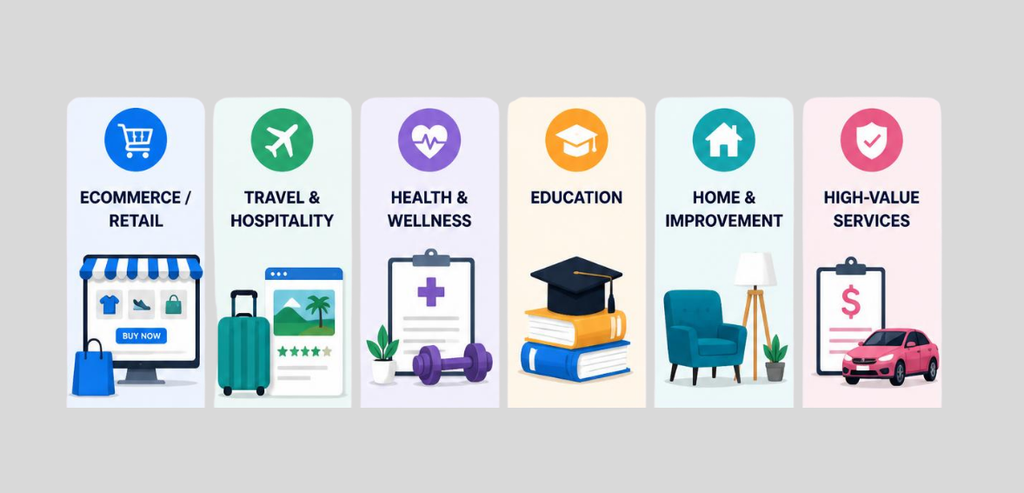
This is BNPL’s strongest home turf. Klarna dominates Shopify Plus apparel and beauty brands. Cart sizes are average, their customers are younger, and Pay-in-4 mirrors this shopper’s budgeting of a purchase.
Higher-price items are better suited to Affirm. For example, on average, Affirm transactions are $276, while Klarna transactions are $101. You can also pay off Affirm purchases in 30 days or as long as 5 years on purchases as high as $30,000. Klarna’s Pay-in-4 plan caps repayment at 6 weeks. So Affirm is best suited to buy larger items.
Via its new partnership with Worldline, Klarna is starting to introduce point-of-sale BNPL solutions. A homeowner faced with a $6,000 repair bill is clearly within the boundaries that justify BNPL solutions, though a $40 tune-up would not.
The clearest no is the low-margin categories. If your margin is already low, a 4-6% fee on an order alone can wipe the margin clean. Raising order quantity also increases the chances of that fee eating into margin. Very low order values are also an issue. A $25 cart that is split into 4 payments would rarely benefit the merchant because a $0.30 fee (fixed cost) will eat into a much larger percentage of the total order value. Subscriptions and recurring billing businesses are a third fit that is considered weak.
BNPL is intended for a one-time buying scenario, not a recurring buying scenario (like subscriptions). Also, forcing BNPL into a subscription flow would create more support tickets than sales. If you’re not able to measure a lift in conversion from a proper test, it’s better to wait. It is not a good practice to introduce a new fee with no way to prove it pays.
Most major platforms provide BNPL as a plug-in, not a total rebuild. Shop Pay Installments by Shopify is one of the plug-ins that Shopify stores can utilize. Klarna or Afterpay can be used as extensions. Both WooCommerce and Magento support Klarna and Affirm through official plugins. Stripe and Adyen can send BNPL options under their respective payment checkouts. The rest of the integrations mentioned here take only a few days, and most providers charge no monthly fee or fee for onboarding.
Iterate gradually. According to one analysis of Shopify Plus stores, most brands use only one BNPL provider, and one BNPL provider covers more than 90% of interested BNPL shoppers. Having two logos in your checkout seldom results in two times the conversion and is almost always counterproductive to having a clean checkout.
The regulatory framework surrounding BNPL has changed. In 2024, the CFPB published an interpretive rule that would consider BNPL providers as credit card issuers under the Truth in Lending Act. This rule would have granted customers the right to dispute and would have required certain disclosures. This rule was withdrawn in May 2025, and the CFPB does not plan to issue a similar rule.
A CFPB study was released that researched the largest BNPL providers and raised concerns about harm to the consumer. However, the study has not resolved the argument surrounding it. Meanwhile, New York’s Department of Financial Services created a framework at the state level for BNPL licensing and supervision.
For merchants, the new frameworks create additional complexity. At the federal level, the frameworks are constantly changing. At the state level, the frameworks can change independently of the federal level. Some BNPL providers install a framework that allows customers to reschedule a payment and avoid late fees.
There is great variability in the terms and conditions of returns and refunds. Merchants should confirm the handling of returns and refunds with the individual BNPL providers instead of assuming that they are the same as a typical card refund. This is a rapidly changing space, so the terms of individual providers should be assumed to change at any point.
Do this if average order value is above $75, gross margin can cover a 3-6 percentage point rise, and the customer base is younger than 40. Wait if you have never done A/B testing on BNPL with a no-BNPL control group, and run the test for 2-4 weeks before adding more budget or marketing. Say no if margins are too slim, average cart is under $30, or your business is a subscription business.
This is not about whether BNPL works, since it clearly works for many stores. This is whether BNPL works for your margin structure and that is only something you can determine for yourself with your numbers.
Klarna’s US expansion will make its way into the minds of many consumers. Prepare for more checkout page clutter. Even though Klarna’s expansions are pressuring stores, this doesn’t always mean stores need to follow. With Buy Now, Pay Later (BNPL), the fee is higher than the cost of processing a credit card, but in some cases, BNPL can increase conversions and increase the average cart value per order. If you are considering using BNPL, run the test and check your own numbers.
It depends mainly on your margins and order size. If your average order size is over $75 and your margins can cover a higher fee, it may be worth trying.
They can, but only when properly A/B tested against a control. Real-world data shows customer orders increase by about 8-15% and conversion rate increases by 2-5%.
Typically 3.29%-6% per transaction, plus a $0.30 charge, compared with standard card processing at about 2.5%-3.5%.
Fashion, beauty, furniture, electronics, home services, and similar types of businesses tend to see the most benefit when they offer BNPL payments for orders of medium to high value.
Most ecommerce platforms like Shopify, WooCommerce, and Magento have plugins that add Klarna, Affirm, or Afterpay to checkout in a matter of days.