Posted: August 06, 2026
Picture a potential sale lost for countless businesses worldwide due to a poorly coordinated checkout. An online shopper from São Paulo builds a cart on your page. Pix is a mobile payment option most commonly used in Brazil. Our shopper will not complete her order if she sees Pix is not an option at checkout. Our shopper closes her tab, and your potential sale is lost. And this happens across countless markets in cross-border commerce. The problem is not the product. It’s the checkout.
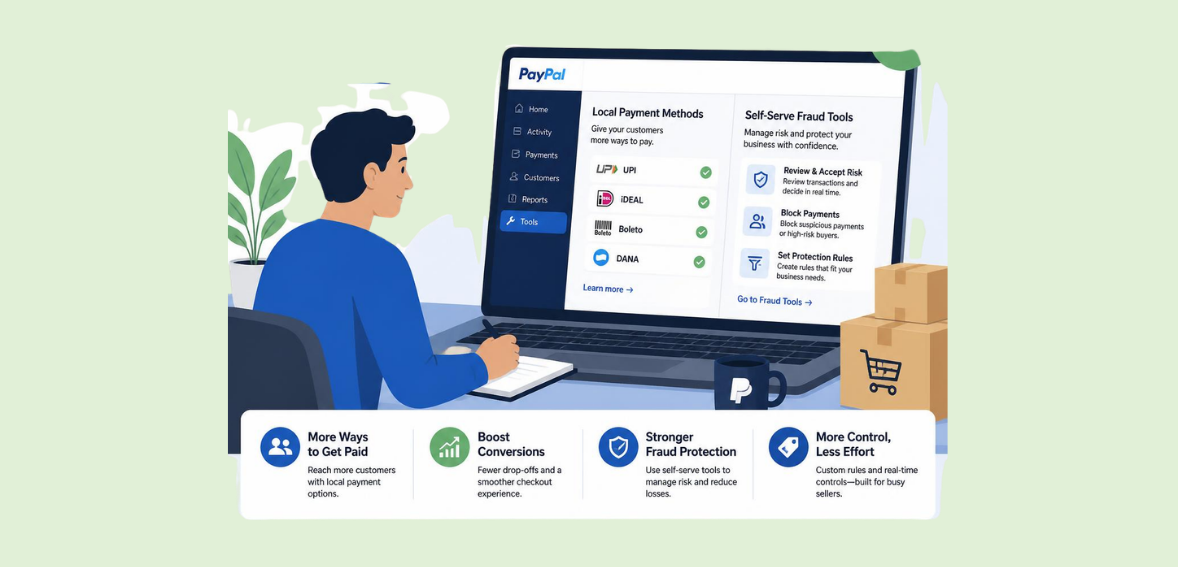
PayPal is taking steps to solve this problem. In their June 2026 update, they offered 30+ localized payment options, and cross-border commerce will now have a payment option for every international customer. PayPal is now offering a self-serve fraud tool. This tool provides more seller-side control, allowing users to accept or decline orders on a case-by-case basis. When looking at the online selling experience, one tool focuses on the selling reach, while the other focuses on the selling control. Together, they impact the two metrics every online seller cares about: conversion and orders that turn out to be fraud.
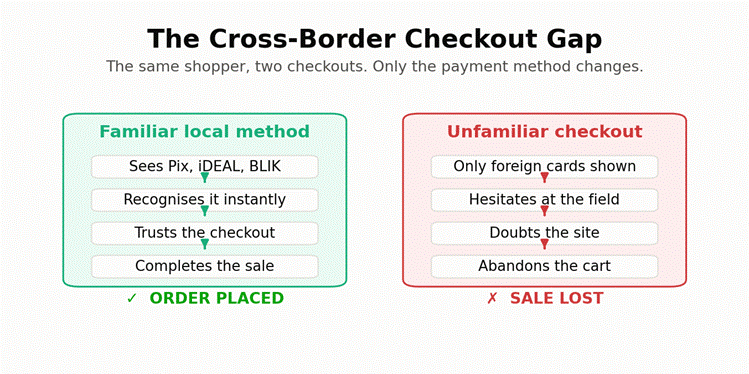
Figure 1. A familiar payment method signals trust; an unfamiliar checkout signals risk, and the shopper leaves.
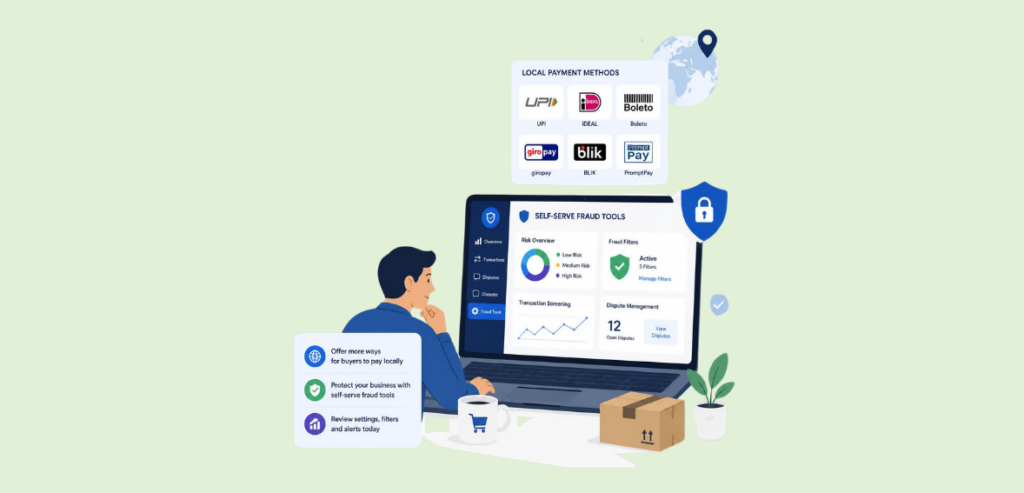
PayPal announced on June 23, 2026, that over thirty new local payment methods would be added to its global platform. The goal is to give foreign consumers the ability to pay exactly how they would if they were purchasing domestically. Without that option, a consumer will go to another platform. With the current update, PayPal allows merchants to offer regional payment options, saving them from the hassle of having to provide payment options for each country individually.
These new payment methods provide foreign consumers with the ability to pay via Swish (Sweden), MB WAY (Portugal), BLIK Pay Later (Poland), and Pix (Brazil). PayPal allows these methods along with the payment options (bank transfers, mobile wallets, and cash-based options) that they’ve already introduced.
Each of these methods is a dominant payment method in the countries they serve. PayPal also stated that adding these payment options would help merchants capitalize on the growing (approximately €359 billion in 2026) cross-border European e-commerce.
The expansion technology is from PPRO, a local payments infrastructure specialist. Because of the importance of their role, they are worth identifying. PPRO uses a single integration to offer many local payment options. Merchants or platforms only need to integrate once and can activate whatever options they prefer. This is advantageous to the traditional method of creating and managing links for every country.
Samba Natarajan, who is in charge of PayPal for Europe, explained that the motive of this partnership is to eliminate friction at checkout and provide access to more customers globally. PPRO CEO Motie Bring bluntly stated that the goal of this partnership is to provide international customers a checkout process that they prefer and trust. Trust is what truly matters in cross-border checkout conversion.
About 70% of all online shopping carts are abandoned. On mobile devices, that number breaches 75%. Not all of that can be attributed to payment systems, but a portion of that certainly can. Approximately 10% of users abandon their shopping in frustration with the inability to pay using their method of choice. Those sales are lost at the click, after investment is made in both acquiring the site visitor and generating the click.
Flipped around, the placement of payment method options in line with shopper preferences has been shown to increase sales and completion of transactions by 12% and 7.4%, respectively. Those gains are explained by the elimination of one of the many barriers to the completion of a sale.
The expectation that a payment method will be offered is substantiated by the results of research studies that show 99% of cross-border shoppers want to pay using their payment method, and 94% of them want to see the price in their local currency. Failure to meet these expectations is the equivalent of asking someone to trust you with their money while refusing to show the price in their own currency.
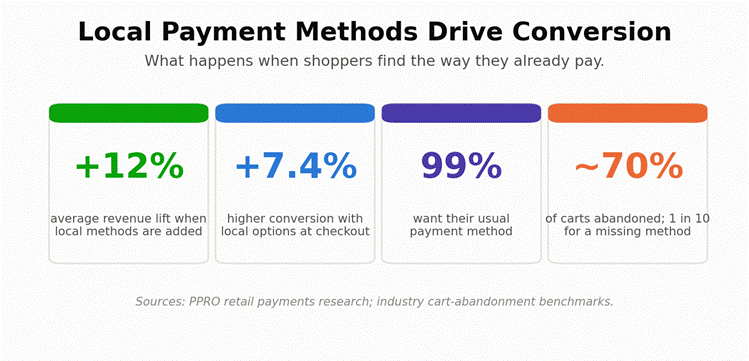
Figure 2. Local payment methods remove one moment of doubt at checkout, and the conversion numbers follow.
The trend line only strengthens the argument. Cards represent a continuously diminishing share of online spend in most regions, currently about 39% of European ecommerce. By 2030, digital wallets and account-to-account methods are expected to dominate global ecommerce payments.
Conducting cross-border transactions with cards is, more or less, the same as conducting cross-border transactions with one hand tied behind your back. Online local and alternative payment methods have fast become the norm in the majority of your high-growth markets.
Reach will generate more orders, some of which will be fake. This is the trade-off that every expanding seller encounters, and this is where automated fraud solutions become valuable. Though the phrase may seem technical, the idea is quite simple. Instead of having to go along with whatever a payment processor chooses, you receive a dashboard where you can implement your own rules to the fraud detection process. You get to decide what you think is safe and what you think is risky and what you think should be reviewed before shipment.
PayPal calls their version Fraud Protection Advanced, and this product is worth a closer look. This product instantly scores each transaction by comparing the buyer to the purchase against millions of previous orders. PayPal’s FPA product uses advanced machine learning. The self-serve aspect of this product comes from the control layer on top. PayPal’s FPA product comes with two hundred plus predefined data points and from there, you can create your own rules.
Custom fields and condition filters can be created to reflect what fraud means to your business. These tools can be used to set velocity checks. For example, you can set a velocity check to flag five orders from a single card in one hour. When a transaction lands in the gray zone, the control layer of PayPal’s FPA product provides a detailed score breakdown, allowing the reviewer to avoid guessing. PayPal’s FPA product enables fraud strategy to no longer be a black box, but rather a customizable tool to fit the needs of your business.
Most sellers activate a fraud prevention tool and then just leave it alone. There’s nothing wrong with using default settings. They tend to err on the side of caution as default settings are designed to protect a vendor that could be selling some random item to just about anyone.
But your shop isn’t generic. Those default rules don’t know that your average order is €40. They don’t know that half of your customers are from Poland. They don’t know a first-time customer placing a €600 order at 3 a.m. is out of the ordinary for you. They don’t know if your business is a boutique or a marketplace.
When you start adjusting rules, you create your own context. As you gather data, you can start to change rules that you find are denying good customers, and get stricter on rules that fraud is slipping through. Perhaps rules that were set to the default are denying too many legitimate orders from countries that you’ve been selling to without issue for years.
Maybe fraud is coming through an order pattern that you’ve been burned by in the past. The beauty of having a self-serve tool is you are able to change the rules and see what happens after. Fraud is a moving target, and so should your rules.
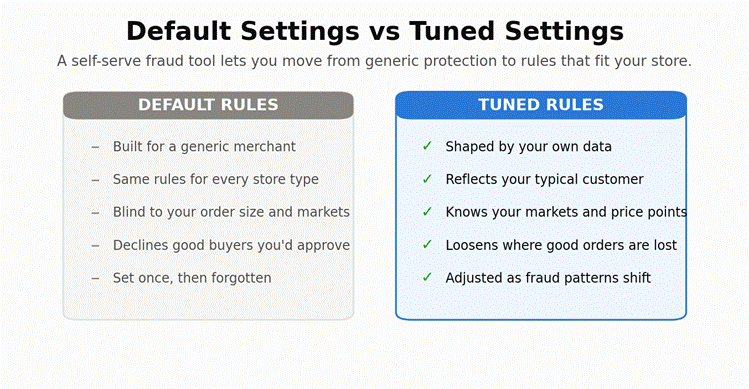
Figure 3. Default rules protect a generic merchant; tuned rules protect your actual customers and catch your actual fraud.
Here is the tension at the center of it all. Each time you tighten fraud controls, you stop more bad orders, but you also stop more good orders. Each time you loosen controls, more good orders get through, but more fraud also gets through. No solution will provide you with everything that you want. The goal is not to stop all fraud, but to find the optimal point where the cost of good orders lost and the cost of fraud is at the lowest point possible.
That balance is easy to get wrong in one direction. A seller hit with a chargeback tightens everything up, and the chargeback rate drops to close to zero. It feels like a win. But approvals fall, good customers are lost, and the revenue that is lost is much greater than the fraud that was avoided.
The opposite is also true. Loose controls provide high approvals until chargebacks come in. A self-service tool allows you to see both numbers at the same time and make adjustments with purpose. The right answer is rarely at the extreme. Rather, it is the balance, and where that balance is located is relative to the growth of your business.
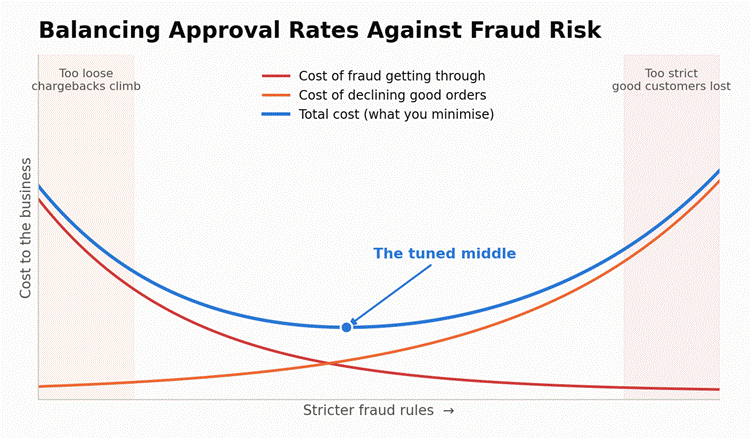
Figure 4. Push too hard on fraud, and you decline good customers; ease off and chargebacks climb. The goal is the tuned middle.
You definitely do not need all thirty new methods. You need the few methods that matter where your customers actually are. The main problem is treating “add local payment methods” as a one-switch problem. In reality, it is a collection of a few small, market-specific decisions, and the data solves most of these problems.
PayPal encourages its users to analyze payment methods. The examples are also telling. BLIK has over 63% payment method market share in Poland. Without the bank transfer payment method, PayPal feels that entering the Dutch market is almost pointless. The payment method that PayPal feels is the most crucial to enter the Brazilian market, Pix, is projected to dominate over 50% of the Brazilian e-commerce market.
The same reasoning applies to the other payment methods, Swish and MB Way, in Sweden and Portugal, respectively. The principle is simple. Use your shipping and traffic data. They should show you which countries are your top customers. Then apply the payment method that is either the most popular or the only one that your prospective customers actually use.
Figure 5. The method to enable is the one that already dominates the market, sending you orders.
Be honest with what you have before enabling anything. A short self-assessment will save you from adding more tools to a broken checkout. Use the information you already have. Your analytics indicate where checkout drop-offs occur by country and directly indicate the lack of local payment methods. Your payment report shows local market order declines, which result in the loss of good orders. Your chargeback report shows where fraud has occurred.
Combining these three views gives you a clearer picture. Strong traffic from a country that converts poorly in the payment step is likely the result of lacking a local payment method. A market with high order declines and shows little to no fraud indicates overly strict rules.
Chargebacks in a particular region for one product indicate that fraud is likely occurring in that particular region. This review requires no cost other than your time and will give you a specific list of changes instead of a generic one to “improve payments.” The review is how you find the gaps, which will give you the most benefit.
Self-serve doesn’t mean solo for life. Many sellers can do the initial tuning for themselves, especially for lower volumes, where the data pattern is easy to identify. But there is a point where the cost of guesswork gets too high. If you’re losing more money to fraud or chargebacks than you’re earning, if one slight change to your rules results in a massive drop in approval rates, or if you’re entering a new market and you’re uncertain of the local fraud patterns, it’s time to get some help.
The right partner does a couple of things at once. They analyze your data and identify good orders that you are inadvertently rejecting and fraud that is slipping through. They also configure your system in such a way that you are maintaining control over your system.
A payments consultant or a fraud risk management team from your payment processor can help you cut out a lot of the guesswork. The tools remain self-serve. You just get a person who has done a lot of configurations of the system to help you find the right tuning. This is a good indicator that the business is running on good operational principles.
PayPal has essentially released two updates under one title. Local Payment Methods focuses on expansion. Though international customers may not know or trust your brand, they’ll be more likely to complete a purchase if they have access to a payment method they are familiar with.
This is the most reliable way to improve international checkout conversion rates. The Self-Service Fraud Tools focus on letting you pick and choose which new (likely fraudulent) orders you want to accept instead of leaving it up to a default that no one customized for your store. If you only have one, you will invite fraud or minimize growth. The goal is to have both.
You won’t have to make any huge changes for this to work. All you have to do is look at your data. Read your checkout drop-off rates by country to see what local payment method would work best. Read your declines and chargebacks to see if your fraud rules are too strict, too lax, or not being used.
Use only one or two local payment methods. Move your fraud settings to the middle and monitor approvals and fraud. If you are still uncertain, call in an expert. The goal of the PayPal update is to let your international customers check out using their familiar payment method, but it also lets you protect your store from fraudulent purchases.
These methods are payment options that shoppers from a particular country know and trust. Payment methods like iDEAL, Pix, and BLIK are the trusted payment methods in their respective countries (Netherlands, Brazil, and Poland), whereas in other countries they may trust a different payment method or payment card. The mentioned payment methods may be the preferred payment methods in that respective country for online transactions.
Yes. Sellers providing online local and alternative payment methods experience, on average, a 12% revenue increase and a 7.4% increase in conversion rate, because fewer shoppers abandon their carts with the payment method of their choice.
They are dashboards that enable users to build custom fraud rules. Instead of accepting a provider’s arbitrary rules, you can tailor your fraud detection features. For example, PayPal’s Fraud Protection Advanced allows users to create custom filters and thresholds to set rules for accepting, reviewing, or declining specific orders.
Instead of instantly tightening everything, slowly add in the rules to align with your own data. Pay attention to the approval rates and fraud simultaneously. Loosen the rules that reject good buyers and place the strict filters for the particular products or areas where fraud actually occurs.
Offer payment methods based on where your sales and traffic come from. Use the payment method most widely used in the country you sell to for optimal sales; adding a payment method that is unused in that country will not help sales.