Posted: August 19, 2026 | Updated: October 06, 2026 at 5:57 PM
The front desk clerk meets the guest for the 6 AM class. The member has not been able to make payment for their class for the past 9 days and has been flagged as blocked. This member has put the front desk staff in a difficult situation. Should they be allowed to check in and offer an apology? Should the front desk staff process the payment using the member’s credit card?
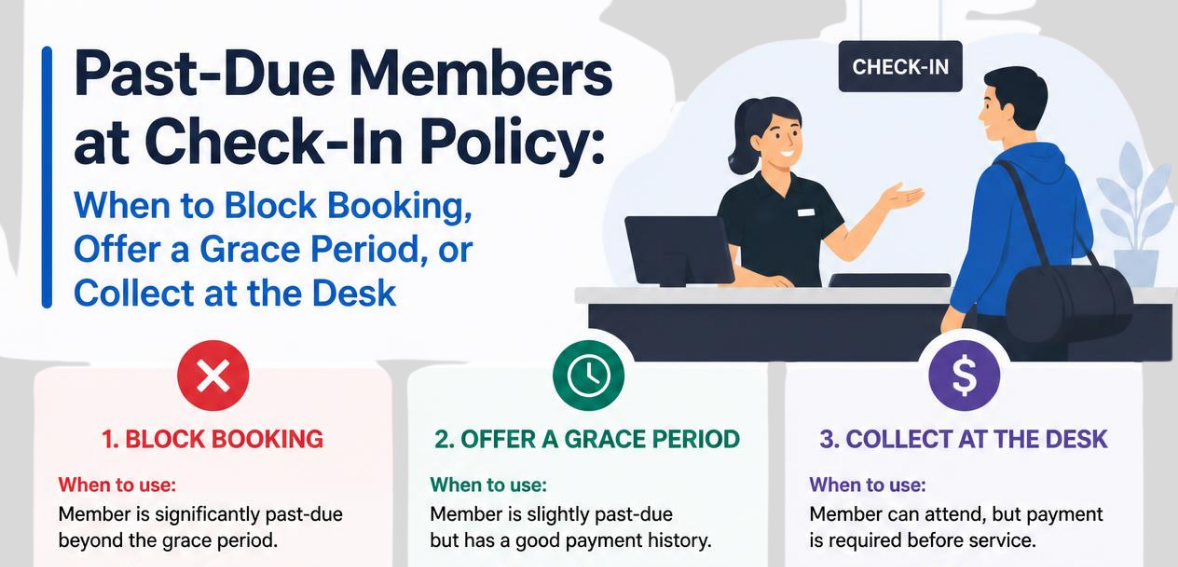
A policy written to address this common issue in the gym/studio industry is largely lacking; thus a majority of the owners have not addressed this situation in their policies. This becomes a member policy with no integrity and a free pass for some members. This policy does not protect the member or the relationship with the member, and it ultimately hurts the business. For the past-due members, the most common and easy-to-incorporate policy to avoid this is built on three concepts: blocked, grace period, and collection at the Front Desk.

The only chance a studio has to engage with a member that has fallen behind is check-in. To some members, a quick thumbs-up after a message or phone call turns into an ‘avoidance’ of a lengthy check-in conversation. When a member stands at the check-in booth with an unpaid balance, there is no way to avoid the conversation.
Check-in is the most difficult and most effective way for a studio to pursue collections. The studio loses thirty seconds, and the member continues to be an active participant in the community with studio-sponsored events. The longer view of the situation is that the studio has to implement a policy of no collections during check-in.
The majority of studios do not implement a no-collections policy at check-in because they know that staff will avoid the collections process. As a result, studios invent new ways to add engagement with unpaid-balance member policies.
When there are no formal policies, staff develop informal policies. One staff member automatically refuses access to a service when a payment fails. Another staff member grants that person access to continue to use the service for 6 weeks. Another staff member allows that person to use the service for free. There are no good or bad policies.
Company policies that are designed by management are interpreted by staff, and staff should follow those policies rather than make legal or collection decisions on their own. When a payment was declined 9 days ago compared to a payment that was declined 90 days ago, the cost of goodwill is apparent to staff and members.
A member who was denied access to a service without any notice to that member, in front of other members, will remember that experience, and will remember that more than the payment. A member who is granted access to the service and not required to pay will get used to this situation, and later on a staff member will have to collect a debt. Inconsistent policies result in members losing trust in staff and management.
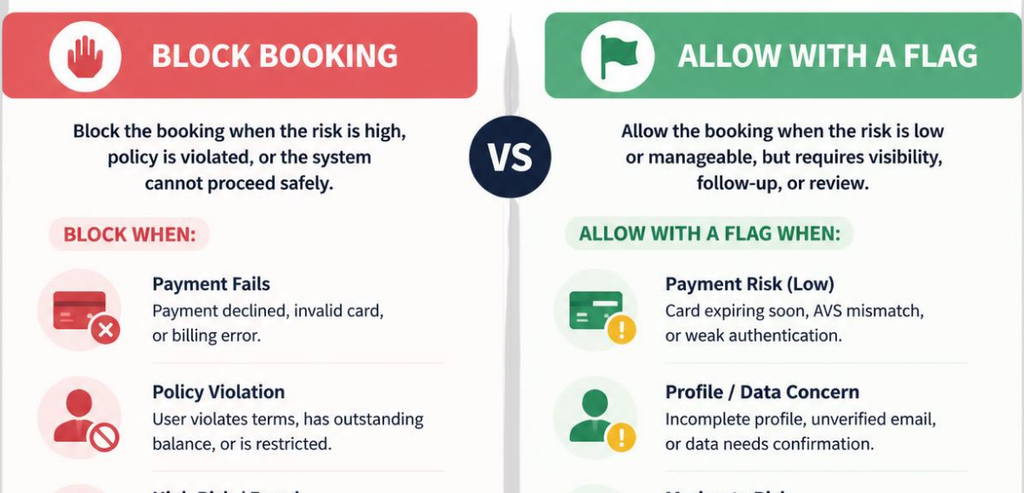
The course of action is contingent on the age of the balance and reason for the decline. For the same-cycle decline, block booking is typically not necessary. If members are not notified of failed payments, blocking access creates friction without first giving them a chance to resolve the balance. For this case, the account should be tagged, and members should be able to log-in to view the balance, and staff should be able to view the tagged accounts.
Blocking a balance means it has crossed a threshold defined by your organization, between 2 to 4 weeks, depending on the price of the membership, and one automated payment reminder has been sent to the member. It is appropriate for hard declines caused by closed or stolen cards, since the member will need to know in order to clear the block, and the payment has been declined. Blocking should only feel like the next appropriate step for members that have been notified. It should be an expected next step and should never be a surprise block at the turnstile.
Decline rates are inconsistent; therefore, grace periods should vary. Using data reporting on declined subscription payments processed by a given vendor, most declines can be addressed in three ways, and a studio should respond. Approximately half of declines are attributed to insufficient funds and will typically clear over the weekend; however, declines may be resolved beyond the studio’s control.
About one-third of declines are risk or fraud flags and usually require that members provide a card. The remaining declines are attributed to lost, stolen, or re-issued cards. Rarely do card updates occur, and the member does not notice.
A grace period would address insufficient fund declines and keep access continually available. A 10-day grace period would allow declines to resolve naturally. Declines would be considered a management issue at the next meeting. The chart shows the distribution of the decline reasons.
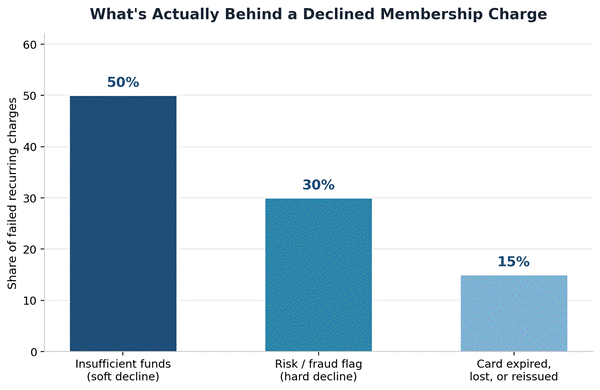
Explanations of decline reasons for recurring payments. These are based on the reason code breakdown for the 2025 edition of Churnkey’s State of Retention Report. This breakdown should give you an idea of what to expect, but the pattern will not likely be the same for your studio.
Grace periods that are either too short or too lenient can create problems for members. A short grace period may not give a member enough time to resolve a recoverable decline. A long grace period can cause members to ignore their responsibility for payment. An ideal grace period reconciles the bank’s control over payment approval with the member’s responsibility to resolve the balance.
The way check-in staff talks about balances is more important than the explanation itself. Better scripts provide ways to resolve the account balance in the future without placing the blame. An example is saying the account has a payment that did not go through and asking the member if they want to update the card on file. This gives the member a quick and easy way to resolve the account balance without the member feeling embarrassed. The framing should not be a message from the system as this reduces emotional connection and increases frustration with the situation.
The easiest way to collect from a member with a balance is to do so at the desk, using a Swipe device, rather than engaging in an unconstrained conversation at the front desk. Staff should never be expected or asked to discuss the amounts owed or explain the club’s billing history. This discussion should always be reserved to a manager, since staff is most likely checking people in to spin classes.
HMS Pay supports a recurring billing workflow that can prompt members to update a payment method after a failed payment. This can reduce the need for staff to collect payment information directly at check-in. Members can instead update the payment method through the member workflow.
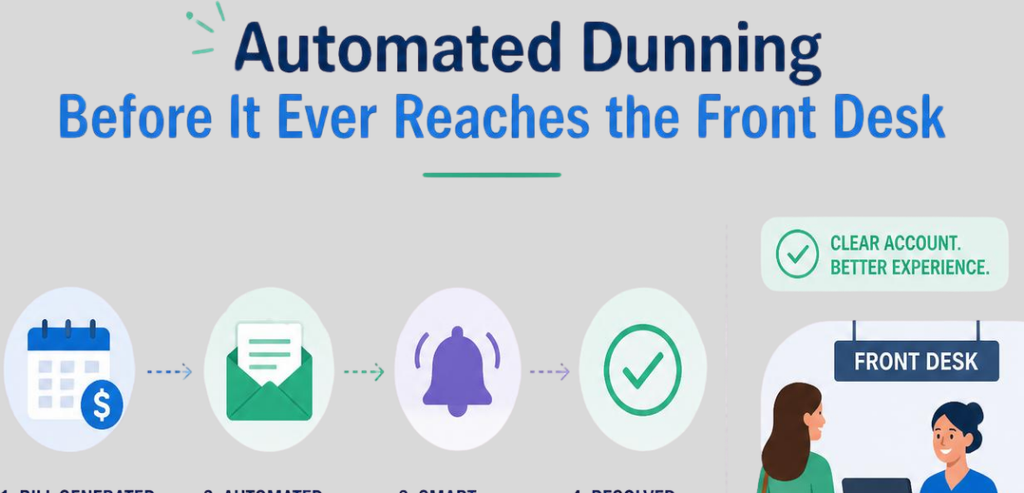
Hopefully, the Collection Conversation will never be necessary. Automated dunning capabilities exist in most systems, allowing multiple attempts to charge members on an automatic basis at a cadence of your choosing. Emails and/or texts triggered by your automated billing system will reach out to members prior to any interaction with staff. All of the card networks have a limit on the number of attempts a merchant can make to collect a charge.
Visa permits up to 15 retries in 30 days for certain recoverable decline categories; some hard decline codes should not be retried. A cost-effective approach could be 2 – 3 attempts on a schedule that is based on when members have come to expect payment and sending an email or text message that includes a self-service link to update their payment information. This would help to cover a significant amount of declines without having staff make multiple calls to each member. There is variability in the recovery benchmarks in the industry, which would affect how this issue would be staffed.
Recovery of overdue balances requires staff to place phone calls and make in-person reminders without any sequence or automation. These recoveries become progressively more difficult. Automated dunning systems help to further close the gap as instead of waiting for staff to make phone calls, they employ reminders immediately. Members now have the option to address the problem at their convenience on their own mobile device, instead of waiting for a staff member to visit them at the desk.
Consistency is important for every company policy. This policy does not include any gray areas beyond the dollar amount and member age of the balance. For the most part, a decision tree helps address whether (1) the system is trying to reach the member, (2) the member checks in normally, (3) the decline is soft and recoverable, (4) the balance has reached or exceeded the limit before no answer (going to hard decline), (5) Staff delivers the script and a manager is called for the member’s unwillingness to comply.
The tree is so simple; you only need to gently articulate the steps to understand it. The Business Requirement is designed to solve many issues with members in the ‘good apology’ category. The ‘good apology’ member is the polite and apologetic member who states that they will pay the balance (and likely do not have a working card on the day the balance is collected). Staff should be able to take a verbal promise and deadline (either same day or next visit) and enter it in the system as a verbal promise.
These additions solve many of the issues that previously required awkward workarounds at the front desk. The improvements add a Staff middle option. If front desk staff is authorized to say “no” to the member and let them leave, or to say “nothing” and let the account continue to run, this is the compromise solution.
It takes staff about a week to learn how to utilize the tree in the training process. Once staff members are trained, they feel as confident as the five-year veteran staff members to reach out to delinquent accounts. The tree uses an out-of-staff-members-control policy system, and staff members just need to “read the flags.”
For a policy to be effective, it must be assessed regularly. One potential metric for assessing a policy related to receivables would be to determine the percentage of flagged adjustments that resulted in revenue being received. For this metric, we would calculate the total flagged adjustments, separate them into flagged adjustments that were written off, flagged adjustments that were resolved at the desk, or flagged adjustments that were resolved automatically, and then do this all every month. When a studio begins tracking this metric for the first time, they may find that some of what they thought was member churn was in fact uncollected revenue.
This metric also shows how effective the studio is in quickly resolving flagged adjustments. A studio wasting resources on collections because of a long grace period would indicate the studio’s grace period is too long. A short grace period with the majority of collections made within the grace period would indicate the policy could be more lenient. This new metric for collections policy has the potential to be a long-term metric as opposed to a one-time policy to improve studio collections.
It is also helpful to differentiate recovered revenue from avoided churn, as the policies will impact these metrics differently. Recovered revenue is the total amount of payment the service receives for the previously unpaid invoice. Avoided churn accounts for the members who would have churned and assumed their membership had lapsed. In these cases, the policy caught a would-be cancellation before it was made.
The first metric allows studios to consider themselves insulated from the effects of the cancellation policy for customer retention. Easy-to-miss customers never filed a cancellation, never returned to the studio, and thus never caused a “hole” in the studio’s customer base.
A member with unpaid check-in balances presents its own challenges. These should be addressed through a consistent policy. It is an event that becomes predictable and consistent and should be addressed as such. It is commonplace for businesses to resolve these issues with the same level of structure and flexibility we expect. Staffing levels are less important than process automation. There are a number of key elements in a process.
A short period of time is given to a member to clear a balance. This is done before we even come into contact with that member. The majority of member contact is done via automation or member interaction with other staff prior to the member meeting a staff member at the front desk. Staff are expected to follow a script during member contact. A consistent process that the member can predict results in goodwill for both the member and the organization. The focus is on the collection of revenue and the members’ goodwill. This system is a simple, yet beneficial, process automation solution.
Probably not. Delinquent members can continue to check in to classes so long as declines are recent and can likely be collected. Only when a member’s balance goes beyond your limit or comes back as a hard decline should the account be banned.
I would probably say around seven or ten days if I were assigning grace periods. This would probably allow for retry cycles to be completed and still qualify as soft declines.
Be polite but cut to the chase. The member should take care of it on their own rather than standing there and waiting to collect at your desk. Get the balance with a card reader or tablet.
Basically, it’s a system of automated reminders and retries for overdue payments. Only hard declines should be approached at the desk, and most of the soft declines are recovered automatically.
Make something like a one-pager based on threshold balances and the types of declines. This would help with consistency in collection, regardless of who is answering the member.
Past-due members at check-in: one piece of running membership billing. The rest of our gym and studio payment guides are in Fitness and Gym Payment Resources.