
Posted: August 18, 2026 | Updated: October 06, 2026 at 5:57 PM
A client books a 6 a.m. appointment and never shows. The instructor waits and the business loses money. The correct response would be to charge the client’s credit card, yet if the client disputes the charge through their banking network, the studio loses money a second time, this time to the chargeback fee.
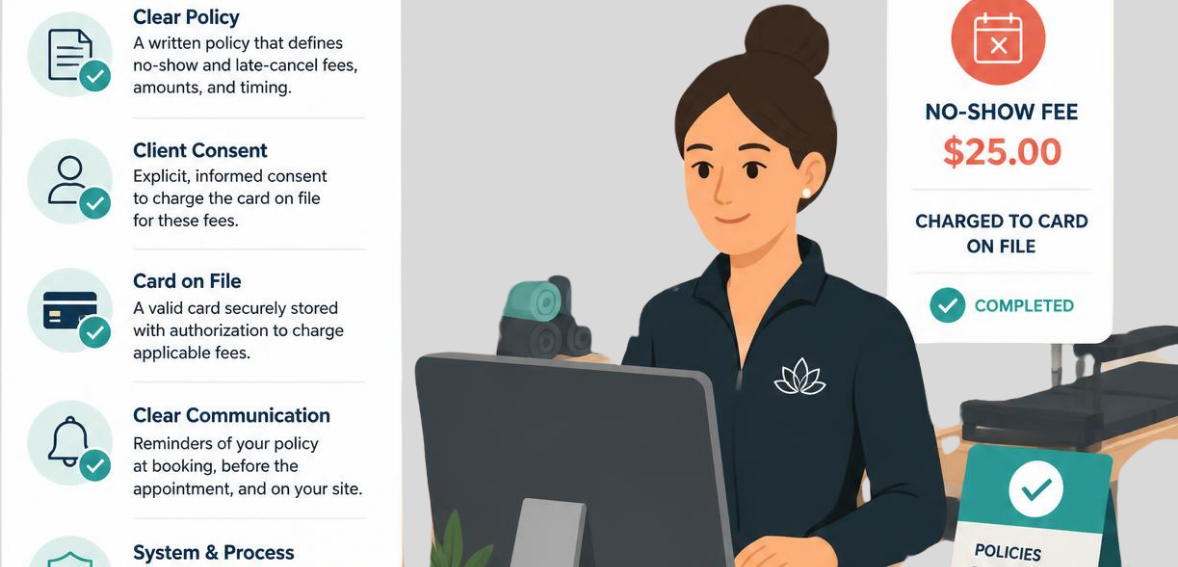
Automatically charging no-shows is not as simple as turning on a feature. Changing the status quo for studios takes documentation, rules, and agreements that will more often than not be disregarded until a dispute forces the studios to review the agreements. This guide outlines no-Show vs late cancellation and what studios must do before they can bill no-shows automatically and what studios should do when members claim they did not consent.
There is a clear distinction between last-minute cancellations and no-shows. Gyms sometimes struggle to differentiate the two financially, but from the scheduling side, they mean different things. A no-show is when a member does not cancel and therefore ruins the attendance sequence. A last-minute cancellation allows the gym to fill the space and is therefore treated differently from a no-show.
Some gyms charge a full attendance class fee for no shows, while last minute cancellations allow the space to be filled and therefore are charged a reduced class fee. There should be a distinction because in case of a dispute the bank will decide for itself whether the no-show fee was justified. A flat fee applied equally to a no-show and a last-minute cancellation is much harder to justify to the cardholder, whereas a fee that is justified by the loss is usually much more acceptable.
When members notice charges on their statements that they did not expect to see, they have a very simple solution: call the bank and dispute the charge. Entire categories have been created by the card networks for this specific situation. Discover uses a services-not-rendered reason code for these disputes and gives card holders an opportunity to tell their bank why they believe they should not have to pay for a service the studio did not provide.
Visa also has a similar track under their Consumer Disputes for merchandise or services not received. Unfortunately, banks do not side with merchants when this happens. Banks leave it to the merchants to defend the claims. This defense comes in three parts.
Finally, the charge bearer must be aware of the amount. Studios that win these disputes all have these three components documented. Studios that have only a verbal policy from the day the member signed up lose these disputes.
Based on the card network rules, studio contracts must outline stored card terms to the members in a separate contract outside of the general studio terms and conditions, which are usually hidden in the contract sign-up process.
A good no-show policy should show the cancellation deadline and the cut-off time, the processing cost, the payment method, the type of cost (fixed value or percentage), and should state that the policy is subject to change. The studio may use the policy, even if the cost is not defined at the time of signing the contract, as long as the studio uses a clear formula. Policies should be checked by local lawyers because consumer protection rules vary by state.
The policy should be as accessible as possible so that a member can look it up and refer to it in the future (policy will lack legal merit if it only existed on a sign-up page). Most studios send a policy confirmation email, place a policy in the member portal, or post a policy in the studio.
Stored cards can be charged without a new checkout, which is why Visa and Mastercard require merchants to obtain cardholder consent for the first charge and retain that consent while the contract is in force and notify the issuing bank of the consent when necessary.
There are several essential contract elements. The contract should include the last four digits of the stored card, the method of storage of the card data, and either the specific amount of the transaction or, if the amount is not fixed, the formula that determines it.
From a technical perspective, there should be a flag for each subsequent charge against a stored card. Each of those charges should be marked as a charge made with card on file. Subsequent charges including no show charges should also be traced back to the original approval and therefore the issuing bank can confirm the consent path.
When clients book classes, HMS Pay captures that agreement. This means clients agree to the stored card terms at booking, without separate paperwork. HMS Pay time-stamps and records the policy version the client agreed to. Charges for a missed class are made to the credential on file and are linked back to that original agreement. The studio has the agreement on file and has the right to provide this to the bank if the bank should ask for it.
Consent only gives the studio the right to charge the card. It doesn’t prove that the member actually missed the class. The studio’s booking system makes up for that by providing the reservation time, the deadline to cancel class, whether the member canceled class before or after the cancellation deadline, class roster check-in, and the studio’s class roster front desk log.
A waitlist also helps to build this case. If a waitlisted member was turned away while the no-show held the spot, then the studio lost income on a class that could have been full. Studios that keep booking and charge systems integrated can more easily fulfill the information for each class when a dispute is filed. Other studios that keep booking separate from charge information cannot fulfill the requests the banks need within the time given.
Even if a studio uses an app to control all bookings, member sign in logs and employee front desk logs are also important records if a member later shares that the booking system made an error. Studios should track courtesy waivers and keep a record each time a member is granted one. A consistent pattern of courtesy waivers and one enforced class fee is better justified than a record without consistency and no explanation for the waivers.

If your studio uses punitive no-show fees, expect negative reviews and challenges to the fees. If your studio uses a flat dollar value or small percentage of the class price to calculate your no-show fee, it’s way easier for your members to understand and easier for a bank to justify if a dispute is requested.
If your studio charges a no-show fee, the bank will examine the circumstances surrounding the charge. Generally, a no-show fee should be charged by the following business day. In the event a no-show fee is charged weeks after the class, this practice is considered poor policy and more members will dispute the fee.
If a member is charged multiple times in a given month for a no-show fee, it will definitely increase dissatisfaction and card disputes. A member that feels they have been treated unfairly is far more likely to dispute the charge with the bank than reaching out to your studio.
No-show fees should be capped and waived when an emergency is documented. Members are less likely to dispute the charge if the fee is not charged repeatedly during the length of the contract.
Network rules state that studios should notify members about stored-card billing transactions and we think the policy should also include no-show fees. Stored-card billing for a membership is a fixed, recurring amount. A no-show fee is not. Reminders sent to members well before the cancellation deadline both reduce no-shows and show, in an evidence packet, that the charge was justified.
After the charge is made, a notification should be sent the same day (or the next) via email, SMS, or in-app messaging. A clear explanation decreases phone calls made to the bank regarding the charge.
This objection is rare and is rarely personal. Members can’t remember checking a box several months ago. This objection is easy to solve as all you need to do is pull consent record data including date, version of policy, booking charge, and share that with the member before you get an escalation call from the bank.
The member can call the bank to dispute the charge. Since this is a race against the clock, Visa and Mastercard will allow members to file a dispute 120 days from the charge, and Visa will give your studio 30 days, Mastercard 45 days, and Amex and Discover about 20 days to respond. After the response window closes, the loss is automatic for your studio.
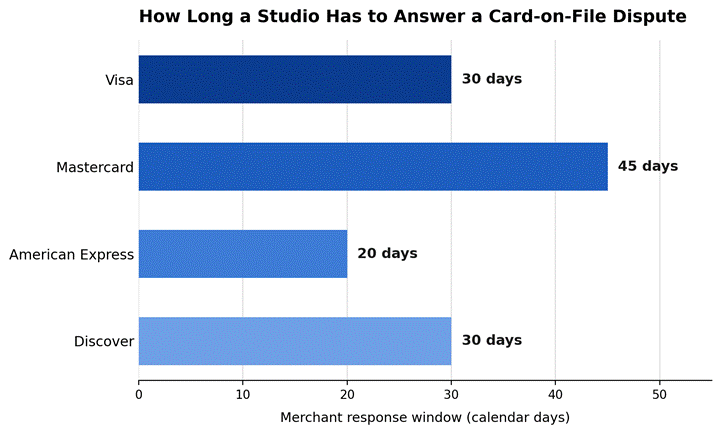
Figure 1. Card network response windows for card-on-file complaints, by network. Sources: card network dispute rules. Compiled by chargebackgurus.com and chargeflow.io (2026).
Documentation speed and quality determine the outcome of a case. An argument is likely to be more successful if it is submitted by a studio using a complete evidence packet, prepared using an automated evidence-organization tool, rather than a manual document submission.
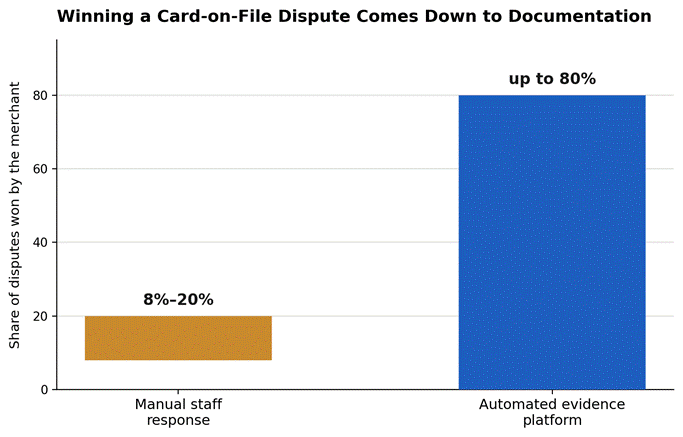
Figure 2. Merchant win rate on card-on-file disputes by response method. Source: chargeflow.io (2026).
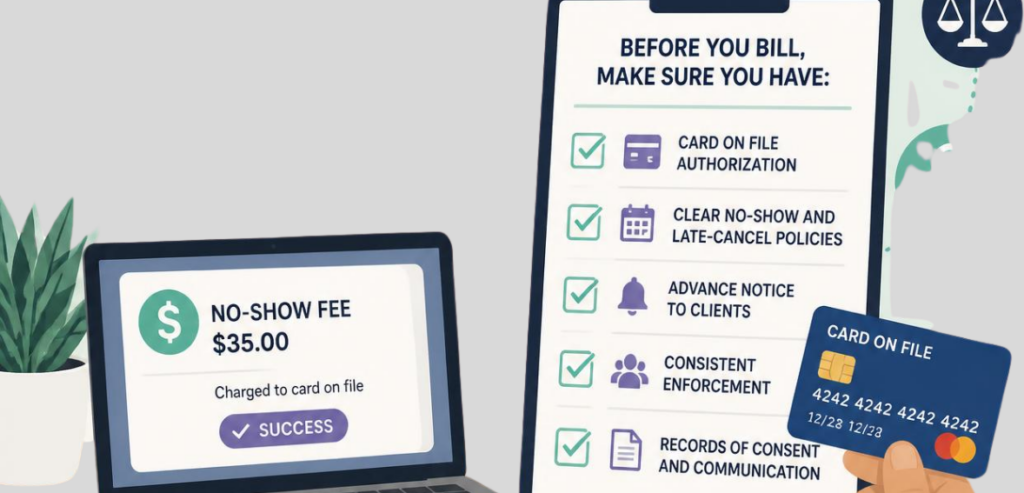
Walk through all the steps a member or a bank would ask about before implementing automatic no-show billing. The following list will not substitute for a payment processor’s compliance review and is not intended to be exhaustive.
| Audit item | Why it matters |
| Standalone consent capture | Required separately from general terms of service, with a timestamp and IP or device record. |
| Policy visibility after sign-up | Members should be able to find the fee policy again, not just see it once at checkout. |
| Fee amount or formula on file | The agreement must state the exact amount or how it will be calculated. |
| Correct COF and MIT flagging | Every follow-up charge must reference the original stored-credential authorization. |
| Attendance and booking retention | Timestamps, cancellation deadlines, and check-in records need to be pulled quickly. |
| Pre- and post-charge notifications | A warning before the window closes and a receipt right after the charge posts. |
| Dispute response workflow | A named owner and a process that can meet a 20-to-45-day response deadline. |
Unlike direct revenue recovery, collections against a card-on-file occur over time, making it more similar to a compliance program. The studios that collect consent and maintain signed records in a place where members can view and/or access them are the studios that earn the fee on a monthly basis. Other studios end up losing the fee as a result of missing steps or biting off more than they can chew.
The studios that lose the fee for the first time do so as a result of a dispute in which they have to learn the exact step they skipped the hard way. By the time a dispute occurs, there is no step they can take to recover the fee.
The studio can charge the attendee for the missed class as long as the attendee has agreed to the card being stored and the studio has the booking information.
Yes, payment card storage requires the member’s consent. Both Visa and Mastercard require a card to be stored for a future transaction with separate and informed consent.
Bring the timestamp of the booking and, if the member cancelled, the time of the cancellation. Also bring, if applicable, studio records of check-in and the waitlist.
Yes, a member is able to request a chargeback for a missed class. Studios usually get between 20 and 45 days to present their evidence to the card issuer.
The policy needs to have a deadline for cancellations, the fee for missed classes and how the card on file will be charged.
Fitness and Gym Payment Resources covers charging no-show and late-cancel fees alongside membership billing, declines and disputes, all in one place.