
Posted: August 12, 2026
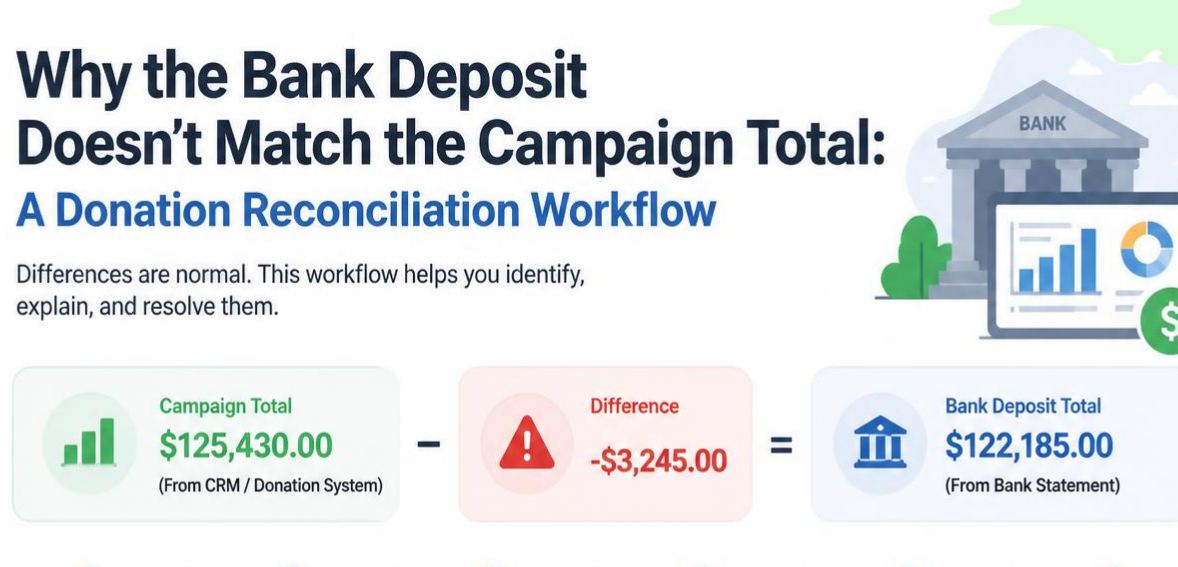
There is a record of $50,000 being raised on your dashboard. Your bank account shows a balance of $47,750. There were no fraudulent transactions that could account for the discrepancy. There were no duplicate transactions. The gap is typical of the donation processing methods that are standard today.
Each nonprofit finance team inevitably experiences this situation. A fundraising campaign closure brings with it a question from a board member for the final amount. The amount logged in the fundraising software is at odds with the amount in the bank. The ability to explain this discrepancy and formulate a standard operating procedure to address it is what differentiates a clean audit from a stressful one.
This guide explains a standard operating procedure (SOP) for donation reconciliation workflow. Included is an explanation of the gap between gross and net amounts, of the multiplication of deposits due to settlement batching, and a workflow that explains campaign dashboard and bank statement discrepancies in a manner that is easy for any auditor to follow.
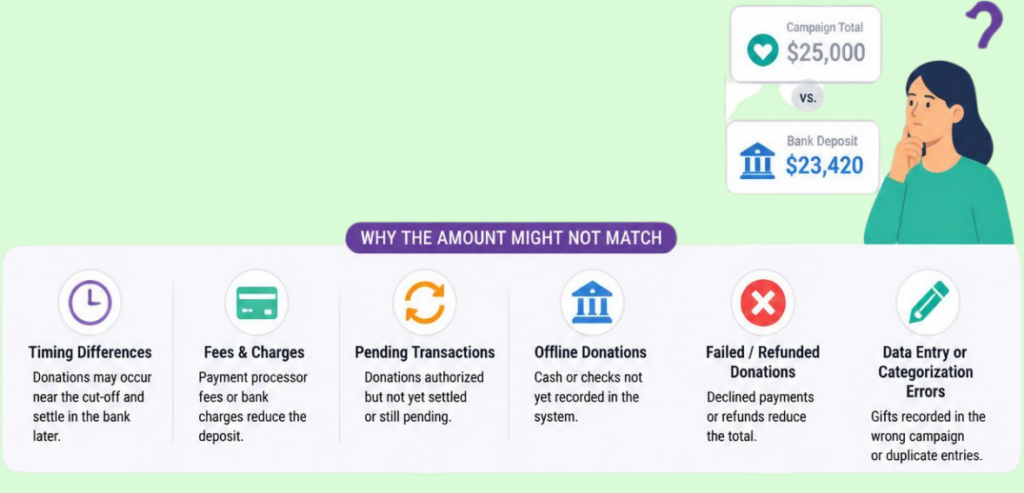
When a donor makes a $100 contribution to a nonprofit, the dashboard records a $100 donation. The only money that the bank records is what is left after the payment processor takes its fee. That is the only reason there is a difference, and it is not a mistake but by design. There are no contradictions in the accounting sense. The contribution revenue is governed by FASB ASC 958-605. For the nonprofit, the contribution processing fee does not reduce the contribution revenue, and the fee is recorded as an expense. In addition, the gross receipts reported on the Form 990 must be reported in their entirety, and a deduction of the fee, cost, or expense is not permitted. The donor in this example receives a tax receipt for $100, and the nonprofit incurred a processing expense.
The campaign dashboard reflects a gross value for each contribution; therefore, it will not match the bank deposit, which shows the net contribution value after the payment processing fees. The two values are not meant to answer the same questions. One value reflects what was contributed, and the other reflects what was received by the organization. A reconciliation process is meant to connect the two values.
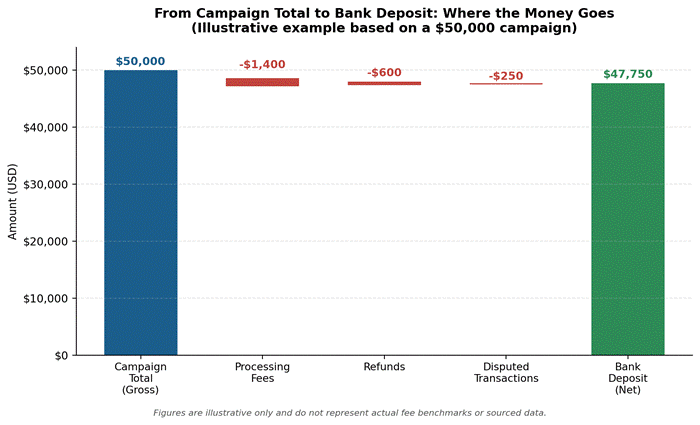
Illustrative example only. Figures are for demonstration and do not represent sourced benchmarks.
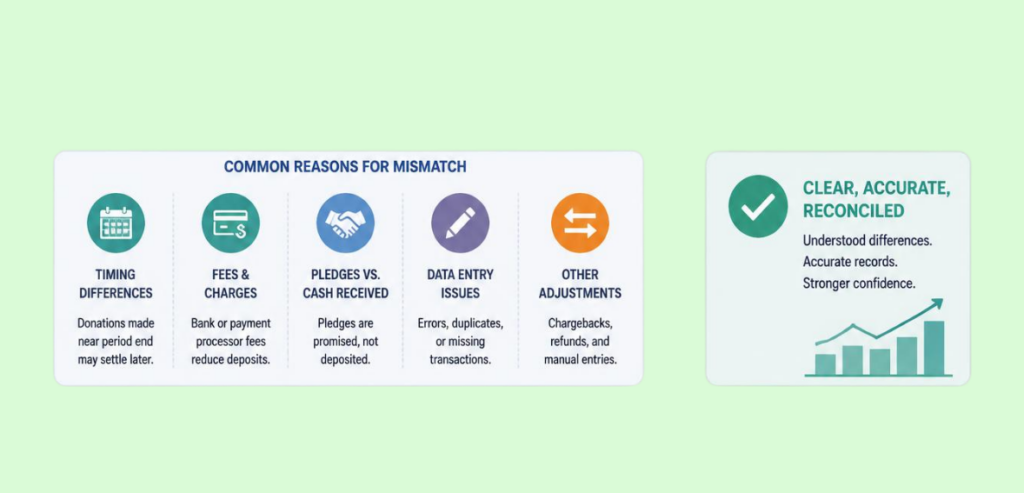
There are four forces that account for the total difference between the campaign total and the deposit total. The majority of the issues pertaining to reconciliation can be attributed to one of the four. Processing fees are the most significant and most certain of these forces. For every card and bank transfer donation, there is a cost that is retained during the processing of the transaction before the funds are transferred to the bank.
The next largest are refunds. If a donor mistakenly donates two times, or asks for their donation back, a refund is accomplished by reducing a subsequent payout instead of reversing the original donation, which results in the refund being recorded in a different reporting period than the original donation. The third is disputes and chargebacks, which can be the most disruptive because they can occur weeks or months after a campaign has been closed and reported to the board. Lastly, timing is the quietest of the four forces. A donation made on the last day of a campaign may not settle into the bank until the next reporting period, so it is possible for a donation to appear in the dashboard and bank statement in different reporting periods.
Published rates from the major processors illustrate how much of a donation goes to fees and how long funds are delayed. A typical card processing fee in the U.S. is 2.9 percent plus 30 cents per transaction. Nonprofits can often apply for discounted nonprofit pricing, usually granted to organizations where at least 80 percent of payment volume is charitable donations. The discount brings the processing fee to about 2.2 percent plus 30 cents per transaction, with American Express fees typically at 3.5 percent. Donation processing fees via bank transfer through ACH (Automated Clearing House) are much lower. This fee is typically around 0.8 percent of the transaction, capped at around 5 dollars, or a flat fee in the range of 0.25 to 1 dollar, depending on the processor. ACH transactions are preferred over card processing transactions, especially for high-value donations such as a 1,000-dollar donation, since the ACH fee is a few dollars at most compared to the card processing fee of 22 dollars to 35 dollars.
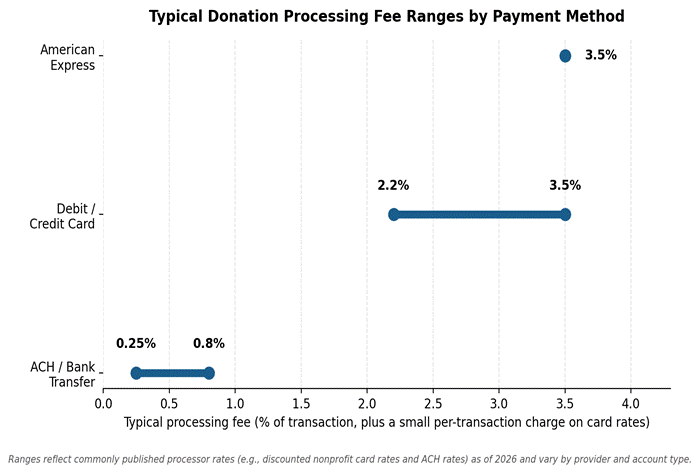
Ranges reflect commonly published processor rates as of 2026 and vary by provider and account type.
Many first-time reconcilers are understandably puzzled by the missing transactions from a fundraising campaign. This is caused by the way payment processors batch and group transactions, leading to a delay in settlement to the bank account. A fundraising campaign that lasts a week can produce several (five or more) separate deposits to the bank account due to bank holidays or weekend closures. A Friday batch can settle to the bank as early as Tuesday or Wednesday of the following week. This can be further complicated by a campaign that has multiple payment methods. Multiple payment methods can include a card processor, a separate ACH rail, and an in-person payment terminal, which can significantly multiply the number of payouts and therefore the number of deposits to account for. All of this is part of the normal payment and settlement process, and the reconciler may expect a single deposit for the campaign total, but will more likely face a many-to-one reconciliation.
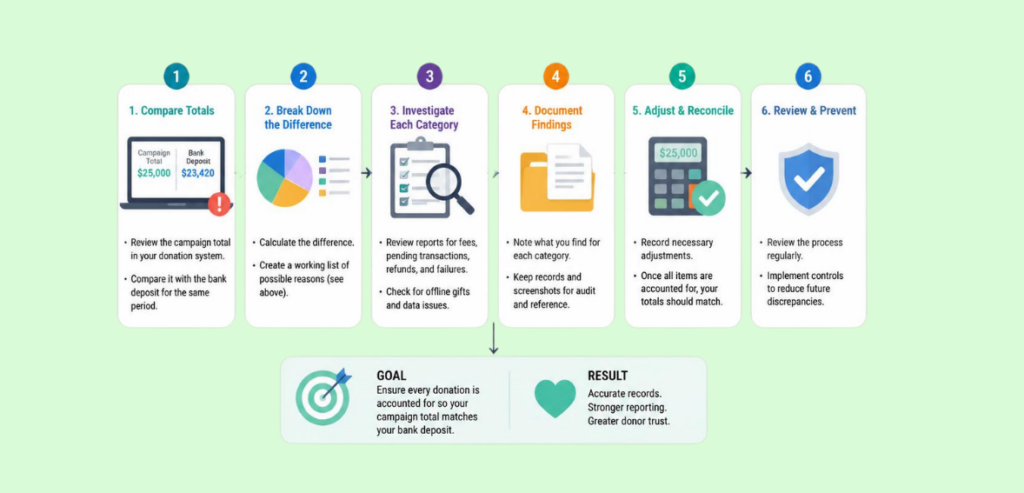
Using a bridge schedule provides a dependable method for closing the gap. Stepwise, it takes you from the total gross amount raised during the campaign to the amount deposited in the bank. The total gross amount raised in the campaign, which is the starting point of the bridge schedule, is obtained from the campaign fundraising platform dashboard. After the gross total, the only source of truth for fees is the processor payout report, since bank statements only reflect the net deposit.
The bridge schedule, starting from the total gross amount, will deduct total processing fees, refunds, voids, returns, and donations that are pending settlement. The bank deposit amount for that time period is the amount that is reached on the bridge. If the amount reached on the bridge schedule is not the bank deposit amount, this is usually due to a timing gap: a donation received near the reporting cut-off is recorded in one period but does not settle until the next.
Just like every other fee, processing fees should have their own line in the chart of accounts, apart from contribution revenue. While the donation is accounted for as full revenue, the processing fee is charged to expense, usually under Bank and Merchant Processing Fees and/or Fundraising Expenses. If the processing fee is netted against revenue, it will understate gross receipts and will misstate the fundraising ratio.
This will create complications for the yearly audit because auditors expect gross revenue and gross expenses. For Form 990 Statement of Functional Expense, the processing fee expense is assigned to the fundraising and/or administration expense category. Because of this, the processing fee expense line has a direct effect on the organization’s fundraising efficiency. A nonprofit that nets processing fees against revenue will grossly underreport the total contributions and total fundraising expense, and this will be evident when comparing the organization’s annual financial statements, even though the organization’s cash position is unchanged.
Of the various reconciliation items, disputes are the most likely to reopen a closed period. This is because the different payment rails have different rules with incredibly long time limits on how long a donor is able to contest a transaction. These time limits often exceed the length of typical fundraising cycles.
When compared to card donations, bank transfer donations have different rules and behaviors. A bank can reverse an unauthorized ACH debit within 60 days of the original settlement. There is no formal procedure or special circumstance that allows a nonprofit to challenge a return. In this case, the money will be deducted from the nonprofit’s future payouts. ACH donations provide a unique challenge because a donor can reverse the donation up to 60 days after settlement. For this reason, the reconciliation of bank transfers should treat ACH donations as not final until the return window has passed. A prior period ACH donation return should be recorded as its own line in the reconciliation.
A card donation takes longer to become final because the donor is given more time to contest the transaction. The major card networks allow contesting transactions for up to 120 days, although the timeframe can be extended for certain fraud issues. Compared to the time allowed to the donor, the processor has a much shorter time to prepare a response to the contest. Visa gives about 30 days, while Mastercard allows about 45 days. In the case a donation is contested, the processor will withdraw the amount and a dispute fee will be charged to the nonprofit. Even though the donation is reversed, the fee and the withdrawn amount have to be entered as negative items in the reconciliation to account for the net deposit.
Implementing a consistent methodology to deal with month-end closings and the subsequent activities resulting from the month-end process helps mitigate the wide variances and large year-end gaps that can create confusion and disputes. This methodology involves obtaining the payout or settlement report from the processor for the period. The report lists various payouts and associated fees, refunds, and disputes. Each payout is matched to the bank statement. This verifies that the payout was the amount deposited to the bank. The posted fee expense and posted contribution revenue should match the processor report, so the total fees for the period are verified against it.
To prevent confusion, donations that have been reported on the dashboard but are not reflected in the bank by the end of the period are flagged. Reports for disputes and returns are analyzed and journal entries are created to the corresponding accounts. Fees and disputes are reconciled, and the bridge schedule, bank statement, and processor reports are filed in the audit file. This routine is done on a monthly basis to keep gaps small and easily explainable instead of doing this at the end of the year.
Ultimately, there are really only two numbers for a campaign, and both need to be reported. For most situations, the number that appears on the fundraising dashboard needs to be communicated. This number needs to be on tax receipts, and it is the number that the public should use to reference the total amount raised. Both the number that reflects the amount raised (the gross number) and the number that reflects the amount available to spend (the net number) should also be communicated to the finance team for use during cash flow and fundraising budget planning.
Both numbers and the bridge should be reported to the board to avoid the situation where board members’ questions cannot be answered, and to eliminate the annoying discrepancy between the amount that was announced and the amount that appears in the bank account. It should also satisfy the auditors, who will expect to see gross revenue, fee expenses, and cash flow reconciled to the gross amount with no blended figure.
Variances between the campaign total and the bank deposit are not inherently problematic. This is merely a consequence of timing differences between settlements, payment processing fees, refunds, and disputes. These things happen at different times and have different rules. A nonprofit won’t be shocked to see a difference between the campaign total and bank deposit when they account for donations at the gross amount, record payment processing fees in a separate account, and perform dashboard reconciliations every month. The difference between the campaign total and bank deposit would be the least concern to an organization that performs regular monthly reconciliations when compared to those organizations that attempt to reconcile several months of bank statements in one accounting period. The greatest benefit of reconciliations would be experienced by an organization that establishes the practice for the long term.
Payment processors take their cut and can deduct more payments for refunds or disputes. What you see in the campaign total is the gross amount of gifts and not what you’ll see in your bank account.
Fees are automatically deducted prior to bank payouts; thus, fees must be recorded as an expense in order to account for the difference between gross revenue and net deposits.
Gross amounts refer to the full contributions made by a donor. Net amounts refer to what remains after processing fees, refunds, and disputes are deducted, which is the amount actually deposited in the bank.
Create a bridge schedule that shows the gross dashboard total for the reporting period as the starting point. Subtract fees, refunds, and disputes as shown on the processor’s payout report. The result should equal the bank deposit amount.
When running a multi-day campaign, it is not uncommon to receive several deposits instead of a single consolidated deposit at the end of the campaign. This is due to the fact that different settlement batches run over the course of several days, and each batch is settled individually.