
Many nonprofits fail to recognize the critical nature of the payment page. However, for the donor, this page represents the ‘moment of truth’. Although the donor may have mentally made the gift, the absence of their donation payment method will cause them to leave the site. Classy experienced this and discovered that 20% of donors will potentially gift if their payment method is present.
Mistakes like this in the opposite direction are equally impactful and costly. With each additional payment option, there is a cost for payment rails, added receipting, added reconciliation, etc. Added payment options are not acts of kindness.
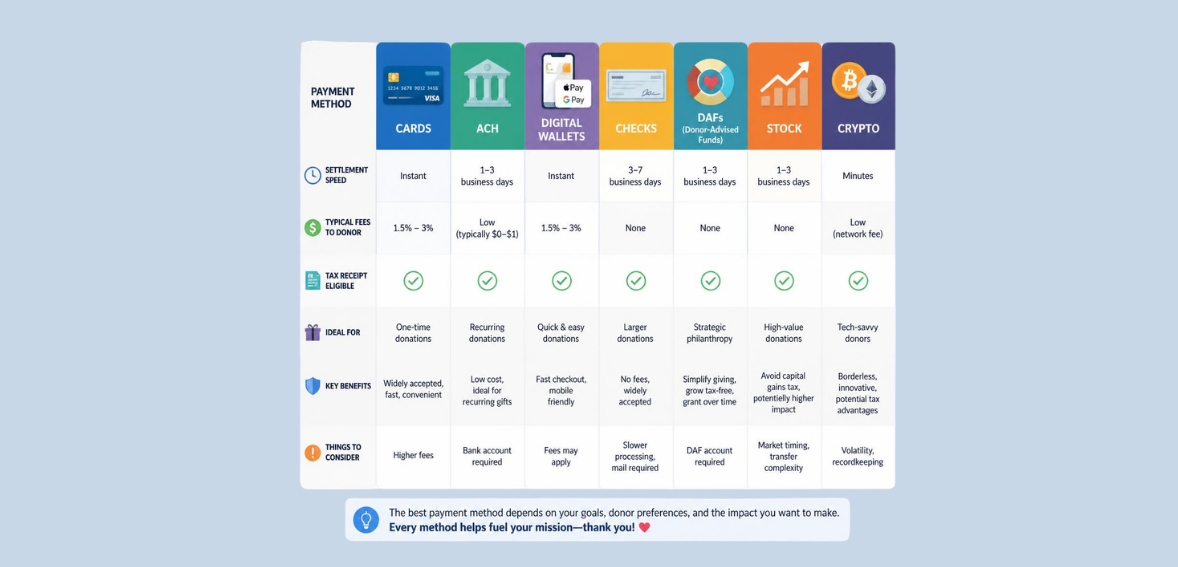
The goal is intentional scarcity. Below is a chart that compares the most important payment methods in 2026.
There is a capital cost for each payment rail. A blockchain wallet that is only checked biannually will still need a valuation policy and a rule for liquidation and disposition. Someone still needs to open the envelopes for a check program and a second processor means a second settlement file.
Adding a payment method is a permanent commitment and is not a simple switch. In fact, it is worse to add a method poorly than to not add one at all. Many donation pages display nine payment method logos and yet still omit ACH, which is the one payment method that would have actually saved them money.
Discipline is clear-cut for methods of payment. Before the activation of a payment method, define the donor segment, the expected income, and the staff member who will undertake the reconciliation. Do not activate a payment method if you are unable to define the donor segment for that method.
Evaluating only the costs of each method is not sufficient for making comparisons. Instead, each method should be considered in relation to the same six criteria.
A method can be a net loser even if it wins on fees. Checks are free to process, but they consume the most employee time per dollar spent.
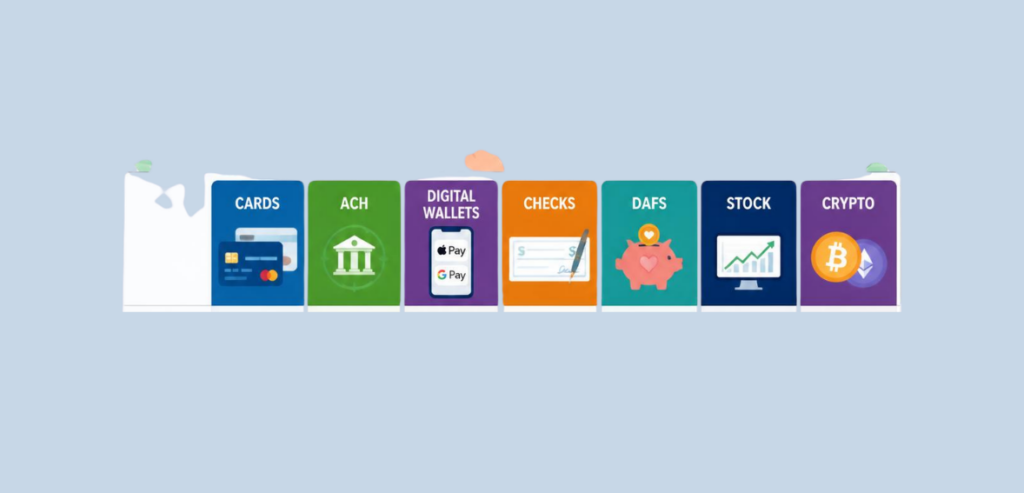
| Method | Typical cost to you | Settlement | Best suited for |
| Credit/debit card | 2.2%–2.9% + $0.30 | 1–3 business days | First-time, impulse and event gifts |
| ACH / bank transfer | $0.25–$1.00 flat, or ~0.8% capped | 2–5 business days | Sustainers and mid-level gifts |
| Digital wallets | Same as the underlying card | 1–3 business days | Mobile and social traffic |
| Check | No processing fee, high handling cost | 5–15 days including mail | Older donors and large one-time gifts |
| Donor-advised fund | Usually no fee to the charity | 1–4 weeks by mail, days if electronic | Loyal mid-level and major donors |
| Stock/securities | Small brokerage sale commission | 2–7 business days | Appreciated-asset major gifts |
| Cryptocurrency | 1%–3% platform fee plus spread | Minutes to hours | Younger, high-net-worth digital donors |
There are good reasons for making cards the default for online donations. Approximately 63% of donors prefer making donations online with credit or debit cards. The process is quick and easy, thus making cards the most effective way for organizations to receive first-time donations, respond to event donations, and conduct emergency campaigns.
The convenience of cards comes at a cost. Organizations should expect to pay between 2.2% and 2.9% of the donation amount plus a $0.30 fee based on the payment processor and the type of cards used for the transaction. American Express cards are even more expensive. Organizations may have to adopt a ‘retail’ payment stance, meaning they pay full price for card transactions, before they realize that they are receiving charitable interchange rates and discounted payment processing fees when their merchant accounts are classified under MCC 8398.
Cards also have the potential for the highest rate of failed transactions. Cards are expensive to replace and have the potential to fail transactions when donors switch banks or when the card is renewed after the card is flagged for fraudulent activity. Each failed transaction makes it seem like the donor no longer supports the organization. Although the potential for a chargeback is low, it becomes an issue when the donor is brought back to the transaction after authorizing it.
The Automated Clearing House (ACH) system withdraws contributions directly from the donor’s bank account. With ACH, the charge is typically a fixed fee rather than a fee charged as a percentage. Most fixed fees fall in the range of $0.25 – $1.00. Some systems charge a hard cap fee of 0.8%. The median cost of ACH services is 26 – 50 cents.
ACH radically changes the cost structure for large donations. A $10,000 donation via credit card would cost $200 to $300. ACH would process that same donation for less than a dollar. For any organization that routinely receives large donations, adding ACH as a donation option is likely to provide the best return.
ACH also has the strongest option for routine donations because bank account numbers rarely change. The drawbacks of ACH are adoption and speed. Donors have to find a routing number which can suppress the motivation to donate on the spot. Settlement occurs in 2 to 5 business days and returns from insufficient funds typically cost $2 to $5.
This isn’t one of those competitions where you crown a single champion. Cards have the edge at the upper end of the funnel due to their role in determining the likelihood of the gift. ACH has the upper hand at the lower end of the funnel where the gift is significant or occurs multiple times.
Therefore, the right approach is to begin with cards and wallets for the pages dedicated to acquisition. Once the relationship is established, then shift sustainers toward ACH. For example, if donors have an option of a bank transfer on the form, and are told that this option would send more of their contribution to the program, this would convert much better than having the option hidden in the dropdown menu.
According to the M+R Benchmarks 2026 report, digital wallets have become an integral part of the donation process for nonprofits. PayPal, Google Pay, Apple Pay, and Venmo, respectively, appear on 79%, 58%, 57%, and 44% of nonprofit donation pages. From 2024 to 2025, mobile revenue increased by 48% while online revenue increased by 15%. The preferred method of payment for mobile donors is digital wallets.
Apple Pay and Google Pay charge the same fees as traditional card payment methods because they also tokenize the payment method. Classy reported an 11% to 14% increase in donation conversion rates after adding digital wallets, while Fundraise Up reported that digital wallets were most important for donations of $80 or less. Mobile payment wallets use biometric authentication, which helps remove the time-consuming process of typing for mobile donors.
Small organizations should be careful. Routing donations through a personal Venmo or PayPal account means there will be no record of the donation for the organization, no compliant receipt, and no record of the donation for the customer relationship management system. While this may appear to save money, it actually costs the organization the relationship with the donor. Digital wallets should be used with a legitimate donation form.
Checks appear free to customers because there’s no processing fee. In fact, they’re some of the more costly gifts a not-for-profit receives. Someone has to open the mail, log the gift, and scan the check to prepare the deposit and enter the record. This labor easily surpasses 2.9% for a small gift.
Checks should still have a place in your system. Older donors are more comfortable with them, many direct-mail appeals rely on gifts by check, and some of the very large gifts are received by mail. Do not remove the mailing address on your appeals.
There are two points of operation to consider. The year-end timing is determined by the postmark and not the date of the deposit; thus, a check that is postmarked December 31 will be counted for the tax year. Be sure to keep the envelope. Also, a bank lockbox will be less expensive than staff labor, once the volume exceeds a few hundred checks per month.
A donor-advised fund (DAF) is a unique charitable giving vehicle. A donor places assets into the fund, takes a charitable tax deduction, and advises the fund to make a grant on their behalf. The assets at the fund are pre-committed to charitable giving, so the donor cannot take their grant advice back.
The scope is daunting. There are over three million DAFs in the U.S. with over $326 billion in assets. The 2026 DAF Fundraising Report found that among 54 nonprofits, median DAF revenue increased 75% from 2021-2025 while revenue outside DAFs increased by less than 12%. DAF donor retention was also 13% higher than the average. For nonprofits with revenue less than $10 million, the DAF’s share of income increased from 13.7% to 24.1%.
From an operational standpoint, the DAF’s gifts are almost ideal. DAF gifts typically also have no processing fee, chargeback risk, or expiration. However, there is a unique problem with the receipting, which would result in a compliance issue. The tax deduction would be for the donor’s contribution to the DAF, and not the grant the nonprofit received, and thus the gift should be acknowledged without mentioning the tax deduction. The primary friction points with DAF gifts are the speed with which a grant arrives, and the anonymity with which a paper grant is issued.
Chariot developed DAFpay, a tool that streamlines the donor-advised fund (DAF) grant process. By integrating the DAFpay tool within your donation form, donors can now process DAF grants without the need to sign into a sponsor portal. DAFpay is currently available to over 70 fundraising platform partners and offers electronic payouts. Digital DAF volume more than doubled from 2024 to 2025 due to the introduction of such tools.
Gifts of appreciated stock tend to be the most hidden potential opportunity for many portfolios. However, they can be the most beneficial. A donor is able to donate appreciated stock to the charity after the one-year period of holding the stock. Then, the donor takes a tax deduction for the value of the stock, and the donor avoids the capital gains tax. If the donor sells the stock and donates the cash, the donor incurs a higher tax bill for a smaller gift.
These gifts are sizeable. The Giving Block identified stock gifts averaging $51,250 in 2025, a 29% increase from the prior year.
You need three things. First, a brokerage account. Second, a policy published and documented that allows DTC transfers. Third, a gift acceptance policy that allows the immediate liquidation of publicly traded stock also removes the market-risk issue from the discussion from the board. The last thing you need is a valuation policy that uses the average of the day’s high and low trades.
The paperwork is the most frequent issue. Stock that is publicly traded will be described in Section A of Form 8283 and will not need a qualified appraisal, regardless of the amount. A receipt will be issued that will document the shares and quantity, but will not state the value.
Cryptocurrency has evolved from the status of an unusual donation method to the establishment of a key donation method, with The Giving Block forecasting more than $100 million in donations and a 66% year-over-year growth through 22,000 donations. Statistics show that the average donation is $11,019, and that 20% of the organizations received more than $100,000. Approximately 50% of the donation volume was made in Bitcoin, while more than $32 million was made in stablecoin.
The donation of appreciated crypto has the same tax ramifications as appreciated stock. Since the IRS also views crypto as property, a donor can deduct the appreciated coin at the fair market value with no capital gains tax. The tax compliance burden is greater with crypto, however, as gifts valued at $5,000 or more are required to receive a qualified appraisal, and the donor must sign, with you, Section B of Form 8283. If you sell the crypto within three years, you must file Form 8282 within 125 days of the sale.
Unless your Board has voted otherwise, we recommend the policy of automatic liquidation. The receiving organization will not bear the risk of valuation; and, in view of the volatility of crypto, will remove the need for an elaborate audit. Donations made in crypto have a pronounced seasonality. Over 30% of donations made in crypto are made in Quarter 4. Therefore, we recommend starting the policy of accepting donations in crypto before Quarter 4.
The Giving Block has processed over $300 million in donations since 2018 and is a leader in the niche market of non-profit crypto, stock, and non-cash donation processing. It provides a single platform for processing crypto and stock donations and Donor-Advised Fund (DAF) grants, and also assists with donation receipts and reporting for IRS Form 8282. The concern with in-house crypto donations is reporting, and The Giving Block handles that.
Fee coverage is the easiest way to capture fees on a donation form. Donors check the box to add the processing fee, allowing the full amount to reach the mission. Donors don’t like the thought of the donation being cut, so fee coverage is usually well adopted. One organization using Bloomerang Payments reported a $6,000 annual savings because of this.
Be sure to include the donation amount, not the percentage, and test the revenue impact of checking the box for fee coverage by default. Pre-checking the box on the donation form improves coverage rates, but can lead to an increase in complaints, so be sure to monitor them both. Adjust the revenue based on the complaints.
Watch out for fee coverage with donations that involve DAF grants, crypto, stock, and checks. There is no fee associated with these donations. There is no recovery used on gift cards. Fee coverage applies only to card, wallet, and ACH donations.
When generating recurring revenue, method selection is especially important. According to M+R Benchmarks 2026, one-time donors have a 12-month retention rate of 24%, whereas monthly sustainers have a 12-month retention rate of 71%. It’s worth the effort to protect those numbers.
In terms of retention rate, the ACH method is the most durable, as bank information rarely changes. Wallets are in second place, as tokenized credentials can survive a card reissue. The card method is the least durable of the three options. Regardless of the method selected, the combination of an account updater service, reasonable retry logic, and a self-service link for the donors to update their credentials is the primary protective measure.
Your blend should be formed first by your donors and your capacity and not by the features of your platform.
Please implement one mobile-first payment form as specified. Allow payment by Cards, Apple Pay, Google Pay, and an option for setting up recurring payments. Use ACH for your preferred platform. Include a mailing address and state that you welcome DAF, grants, and stock gifts. These will need to be handled manually. Do not implement a payment option for Cryptocurrency at this time.
This is the optimum point for investing in ACH promotion and DAF integration. Allow fees for donors to be covered, change sustainers to transfers, add a DAF widget to your main form, and open a brokerage account with transfer instructions.
Designate the entirety of the responsibility to particular teams. The Finance team has full responsibility for the timing of reconciliation and settlement. The major gifts team has responsibility for the constellations of stock, DAFs, and crypto. Someone is responsible for reviewing and “owning” the non-cash acceptance policy. Given your size, you likely have the leverage to negotiate for interchange-plus pricing instead of blended pricing and to eliminate early termination penalties from contracts.
Your donor base is more important than your organization’s size. For a church with older congregants, you will need strong check processing. A flawless mobile wallet will be a must for your youth-based environmental group. A university foundation will require stock and donor-advised fund (DAF) offerings. Rather than copying the stacks of others, utilize your own data first.
Payment methods dictate your donor base, influence the donation amount that actually reaches your cause, and determine how much of finance’s time is available for reporting as opposed to reconciling.
As payment methods become more prevalent, they all follow a similar trend. Cards and wallets are now buying conversion. ACH donations allow your organization to retain more of the donation. Checks are still necessary for your organization’s older donors. Current policies will need to address the largest gifts that are now being offered in the form of DAFs, stock, and crypto.
Implementing payment method policies will be most effective if, to begin with, DAFs are added to the main payment form, or ACH is made a standard option with no fee. With time, the payment methods that apply to your organization will yield far greater results than the payment methods that are rarely utilized.
ACH costs less and performs better for large and recurring gifts, at approximately $0.25 to $1.00 per transaction. Cards are better for first-time and spontaneous gifts. Because of this, most nonprofits require an ACH system and a card processing system.
Yes, please complete the necessary paperwork since the average crypto gift was valued over $11,000 in 2025. If you cannot perform the appraisal countersignature and the Form 8282 report, just leave it out.
This grant has been proposed by a donor-advised fund which has received funding from the donor. Please provide an appropriate acknowledgment for this grant. Please do not reference tax deductions.
Yes, there is an opt-in checkbox on card, wallet, and ACH gifts. The adoption of this feature is generally high. Show the exact dollar amount instead of a percentage.
Using DTC, the donor transfers shares to your brokerage account. Per your gift acceptance policy, you sell the shares without delay. No qualified appraisal is necessary for publicly traded securities.
