Posted: August 07, 2026 | Updated: October 06, 2026 at 6:00 PM
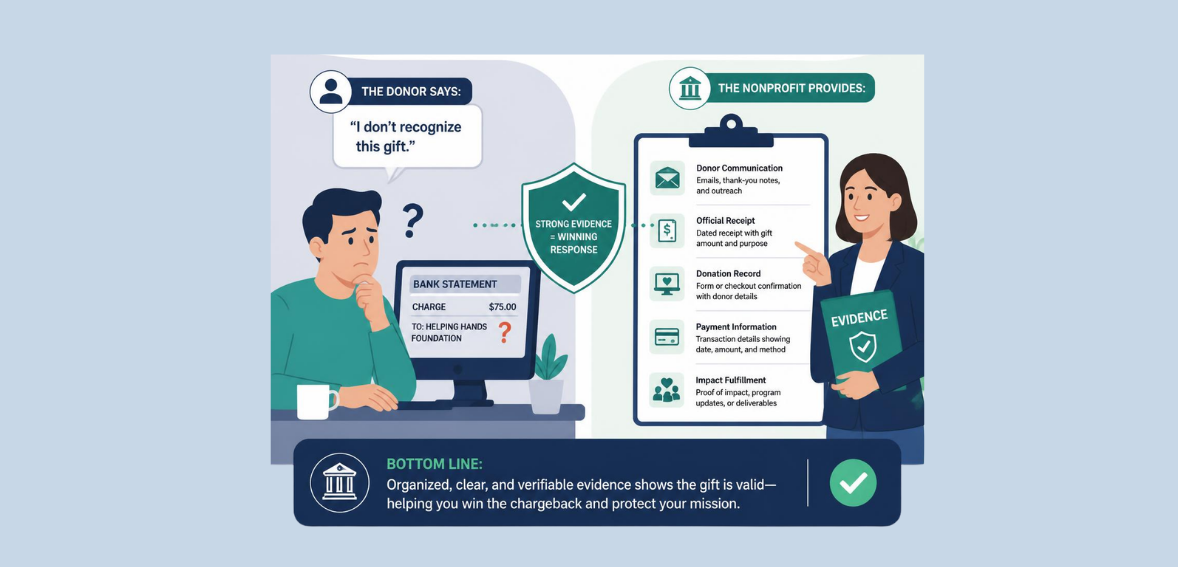
You get an email on a Tuesday. Your processor flags a donor’s $250 gift as disputed. The reason says “cardholder does not recognize transaction.” There was no fraud. There was no complaint. The donor didn’t even know that they made the gift. They opened their bank statement, saw a transaction, and called the bank. Now the gift is frozen. There is a penalty: the gift plus a fee, incurred whether you dispute or not. The timer has started.
This is an example of the kind of dispute that most commonly occurs in a nonprofit environment and is one of the easiest to win. Most disputed gifts are not fraudulent in nature. The donor simply forgot that they made a year-end gift. The mystery charge is a gift made by their spouse. The bank will usually side with the cardholder, and inaction will result in losing the gift.
However, you still have the proof. The contents of this document will show you how to win a donation chargeback, the race against the clock to do this, the one-line text fix that will prevent the majority of these disputes, and the best way to prioritize your time and resources to mount a challenge.
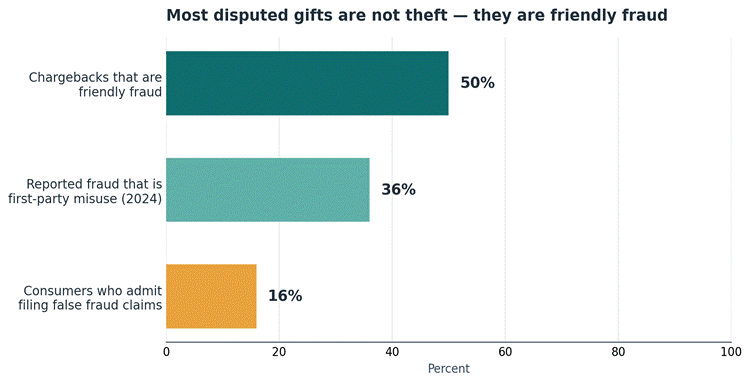
Figure 1. Most disputed donations are not criminal fraud. They are memory gaps, family surprises, and unrecognized statement lines.
Most assume that disputes on gifts equate to stolen cards. This is not the case. It is estimated that nearly half of chargebacks occur because of friendly fraud. This is where the cardholder disputes a transaction that they have authorized. First-party fraud was 36% of the fraud pie in 2024 – a staggering increase from previous years. True fraud made up the rest of the pie.
As for nonprofits, the trend is clearer. Since donors are impulse givers, they often donate in response to an appeal and may even donate late at night. By the time they remember, the donation may show up next to regular purchases like gas and groceries, and they will not associate the charge with the donation, so they dispute the charge, leaving the nonprofit with the loss. It is estimated that almost 1 in 6 people will dispute a transaction that they are satisfied with.
These situations are easy to resolve. A donor may forget that they have set up a recurring donation. Or a donor may donate on a shared credit card without notice. Most statement lines may read out of context and may confuse a donor. In all of these cases, the donation was made, and the donor has not experienced a loss.
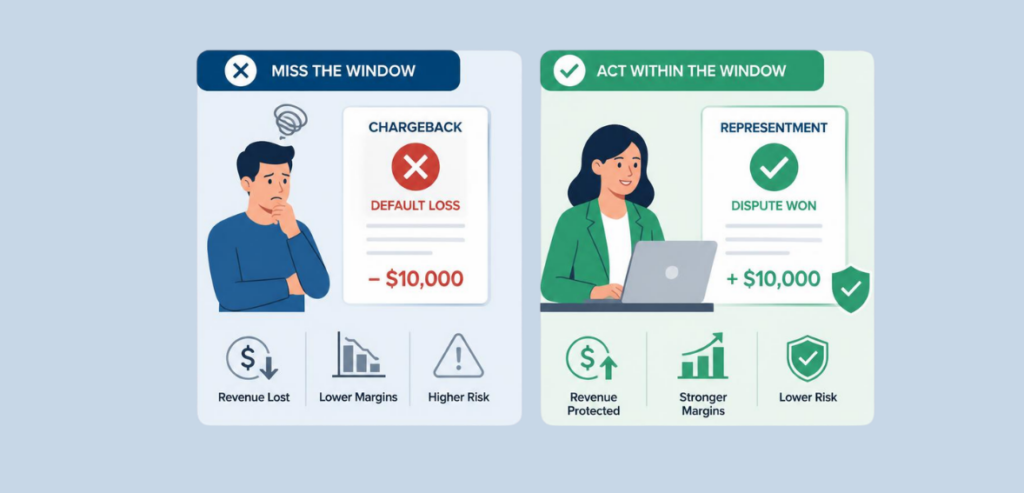
The term for contesting a chargeback is representment. This means submitting the transaction to the bank again with proof that the charge was indeed valid. Unfortunately, representment is a race against time. When a dispute gets filed, a timer starts, and if you miss a certain time frame, the case is lost; no proof will change that.
You might assume that the time limits are more flexible than they actually are. Banks will usually advertise longer time limits, but in reality your bank will set its own time limits. It will take your bank time to gather your documents, yet in many cases merchants have around five to ten business days to respond. Treat the time frame with urgency from the very moment you are notified, and do not treat it as a normal time limit.
Merchants are given a response time of about 20 days for each phase of the dispute by Visa. Visa used to be more flexible about the time allowed to respond to a dispute. However, Visa has automated and optimized their dispute processes, which means there is reduced flexibility and a greater need for a rapid internal response. If your gift records are more of a disorganized mess, your response time will elapse long before you have the opportunity to put together a case.
Mastercard provides 45 days in a single phase. Although the additional time is helpful, it is still a limit. The cutoff time set by your acquirer still applies, and whichever time frame is shorter is the one that you need to work with. When designing your process, assume the worst time frame as opposed to the best time frame, based on a network rulebook.
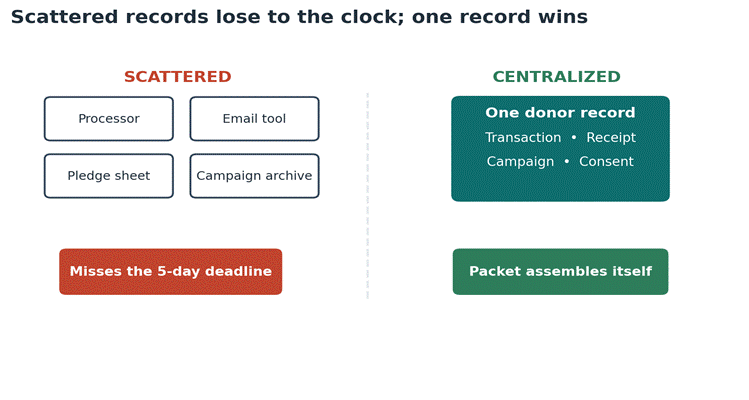
Figure 2. Network windows look generous, but your acquirer’s internal cutoff is the deadline that actually governs.
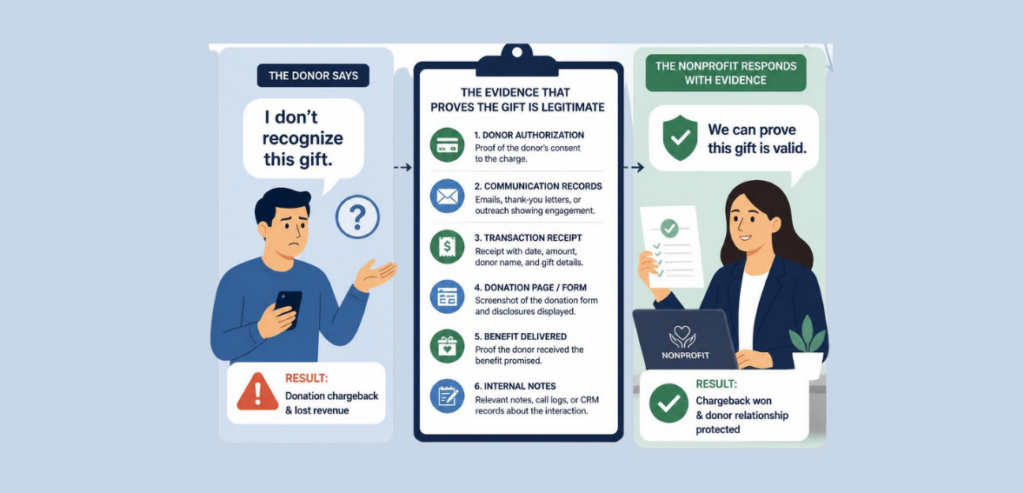
Winning a donation chargeback depends entirely on one noticeable fact. This fact must show that a certain person intentionally donated a specific amount for a specific cause. Four pieces of evidence help validate this fact to show a reviewer easy-to-follow documentation for a donation chargeback in less than a minute.
The first piece of evidence is the gift transaction record. These records show transactional data such as date, amount, IP address, and Card Verification Match results. These records are an electronic way of showing that a person was present at a donation charge. The second piece of evidence is a receipt or confirmation email showing that a person received an acknowledgment message regarding a specific charge.
The appeal or campaign showcased in the evidence is what the donation was responding to. This is a donation that is tied to a specific ask via a response that is documented. The fourth piece of evidence is a record showing that a person’s subsequent donations result from their consent to that schedule. Submitted together, these four records will show a bank reviewer a documented gift rather than vague evidence of a gift.
Why should people fix their billing descriptor after they read this document? Because it is the first line people read when a charge appears on their bank statement. There are no other lines. A billing descriptor is a chief reason transaction disputes are initiated. A billing descriptor is extremely important and is neglected by most nonprofit organizations. There is an unfortunate tradeoff between naming a nonprofit organization and describing the transaction on a bank statement.
The descriptor will say the name of the nonprofit organization. Transaction details will say nothing.
What is the cost of fixing this? The answer is absolutely nothing. Ask your payment processor. Billing descriptors are approximately 22 characters long. So be brief. The phone number and a descriptor that is a clear identifier will prevent most of the transaction disputes. A donor who sees ” Redcreek Foodbank ” and a phone number will contact the nonprofit directly before disputing.
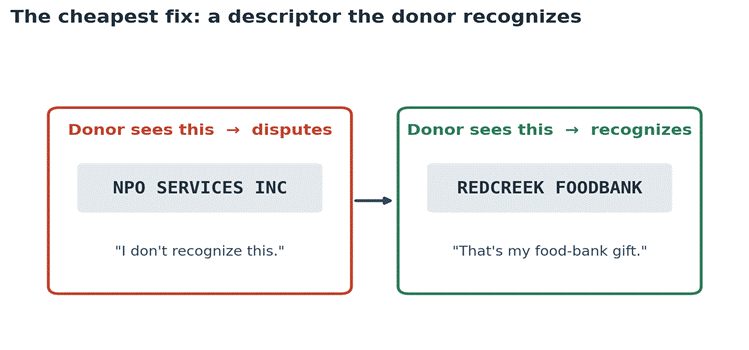
Figure 3. A recognizable descriptor turns a mystery charge into an obvious gift, stopping disputes before they start.

A bank reviewer doesn’t have the luxury of time to investigate a case like a detective. The aim here is to make the connection to the disputed charge in a bank review and your records obvious and instant. The best packs have the gift amount as recorded in the bank statement and in the receipt submitted. They all have to be the same.
Match the numbers and win the case. There is a disputed charge, which has a date and an amount. Your response to the disputed charge should have the same date and amount in the donor’s confirmation and an engagement record in reference to the same campaign. If the reviewer sees “$250 on March 3 in the spring shelter appeal” on the statement, your record, and the donor’s receipt, then the dispute is in order.
If records are not aligned, then even the most certain of victories is at risk. If your gift amount is in one record system, your gift confirmation is stored in a different record system, and your engagement records are nowhere to be found, then there is little hope that the gift amount and confirmation will be aligned in time. The evidence is there but scattered. Winning organizations understand the importance of time in assembling evidence as opposed to the number of proofs.
Communication history strengthens a case, but only the right kind. Reviewers reward relevance and punish clutter. The objective is a concise collection where every piece of evidence demonstrates that the donor was aware of, and desired, the gift, and where nothing detracts from that evidence.
Relevant evidence shows intent by the donor. For example, a received donor thank-you with a reply confirming the gift, a donation to the event with a gift, and a message creating a recurring gift all exemplify a purpose of engaging. Also, these examples attest to intent, and the older the time stamps are in relation to the gift, the stronger the example.
Less is more. Donor relation internal notes, your mission, and long unrelated threads all serve to bury important case facts. Reviewers may not see the one email that proves the case among your excessively long collection of case evidence. The collection of evidence must be concise, unambiguous, and ordered, with evidence of donor intent placed at the top. A succinct evidence collection will always be better than an exhaustive and overly verbose collection.
Not all chargebacks are worth the effort. Disputing chargebacks costs time and resources and might incur fees regardless of the outcome. Efficient teams prioritize the situations with stronger supporting evidence and a higher potential payoff and allow the unwinnable cases to go unchallenged.
More often than not, the numbers show that the chargeback dispute should be fought. The average rate of winning a dispute is around 41 percent, with winnable disputes being for transactions under $30. The average gift for a nonprofit is usually under $30, so the data support disputing chargebacks more often. Strong evidence for a chargeback dispute is a signed consent form for a recurring donation, and failing to dispute a chargeback is essentially donating money to the card issuer.
The cases that absolutely should not be disputed are when the donor did not intend to donate, the card was stolen, or there is an accidental double charge. These should be promptly refunded and accepted. Win rates on true fraud disputes are under 9 percent, and the time spent pursuing such a low probability of winning chargeback dispute is not worth it. Additionally, a high number of disputes harms your business: a chargeback ratio above around 0.9 percent can result in account termination, monitoring programs, and higher fees. Disputing chargebacks should be done with care to protect your time and your business.
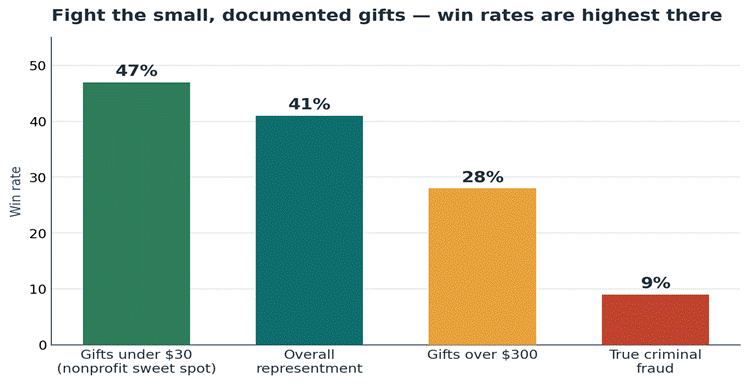
Figure 4. Win rates are highest on the small, well-documented gifts nonprofits see most, and lowest on true fraud.
Everything leads to one primary reason behind lost disputes. The evidence is genuine, yet it is fragmented. In the limited time available, evidence that is scattered cannot be pieced together. The history of gifts needs to be consolidated, because this is what turns evidence into the legal disputes that you win.
Imagine the two workflows. The fragmented one. An alert for a dispute causes the staff to pull records from the payment processor, the email system, a spreadsheet of pledges, and an archive of past campaigns in order to reconstruct a single gift that is time-limited to five days.
The centralized version has one consolidated record for the donor that includes the transaction, the receipt, the campaign, and the consent statement, and it links everything with time stamps. The packet assembles itself. One version of the workflow loses because of the missed deadlines. The other wins because of the time it was allowed to prepare.
Figure 5. Scattered records lose winnable gifts to the clock. A single donor record assembles the evidence packet on demand.
The compounding benefit is strengthening your defense. A central system that provides clear receipts, issues reminders to recurring donors before credit card charges are processed, and features a clear descriptor helps limit constituent disputes. Fewer disputes will lower a chargeback ratio and keep your merchant account healthy and processing fees low. The win rate increases not because of better arguments, but because the evidence was prepared before the argument was presented.
Disputing an “I don’t recognize this” charge is typically not due to a crime. It’s an unfortunate memory lapse, a surprise gift from a relative, or an unexpected charge on a bank statement. Most of the time it is easily resolvable. The charge was a gift, and there is proof. The result will be decided by your ability to get that proof to the bank before the time runs out.
Those actions support each other, so when making these disputes, consider that this is a friendly fraud, not a crime. Because of this, when making the dispute, you should consider the outcome to be positive. Each gift dispute must be submitted within the time frame; otherwise, the dispute will be lost. When filing a gift dispute, gather the gift documentation, gift receipt, dispute request, and consent form, and ensure all amounts match so the reviewer can easily recognize the charge as a gift.
To avoid disputes, fix the billing description first. Only include communication that supports the donor’s intent. Everything else should be omitted. Focus your efforts on the well-documented gift disputes and let the unwinnable ones go. The most important thing of all is to organize the gift documentation so that the documented gift history will support your evidence and easily bring back the disputed gift.
Usually they forgot the gift or did not recognize your name on their statement. A spouse giving on a shared card is another common, honest cause.
Four things: the transaction record, the receipt you sent, the appeal or campaign the gift answered, and proof of consent for recurring gifts. The amounts must match across all of them.
It is the roughly 22-character name that shows on a donor’s statement. When it does not match your charity’s known name, donors assume fraud and dispute the charge.
Networks allow weeks, but your acquiring bank’s cutoff is often just five to ten days. Treat the alert as urgent the day it arrives.
Yes. Use a recognizable billing descriptor, send instant clear receipts, and remind recurring donors before each charge. Most unrecognized-charge disputes disappear.
Nonprofit Payment Resources covers donation chargebacks alongside receipts, recurring giving and processing fees, all in one place.