Posted: October 06, 2026 | Updated: October 08, 2026 at 3:18 PM
Cash and checks still account for a considerable share of U.S. retail. The Federal Reserve’s 2026 Diary of Consumer Payment Choice, published in May 2026, reported that the average consumer made 47 payments in 2025. The report said six of those payments, about 13 percent, were made with cash. Each cash sale prompts a cashier to count out change.
At the time of sale, 1-cent coins were in short supply. The Philadelphia facility of the U.S. Mint struck the last general circulation pennies on Nov. 12, 2025. Merchants addressed the shortfall with store-specific policies, and those policies varied from store to store. Prior to the passage of H.R. 10167, there was no federal law that specifically outlined how a cash sale could be settled without a penny.
On Sept. 28, 2026, the U.S. Senate passed H.R. 10167 without a dissent, and the bill now awaits the President’s signature. Payments Dive and Constantine LLP (constantinellp.com/antitrust-group/payments-news-update-october-2-2026) reported the passage of the bill.
This article reviews the Common Cents Act, H.R. 10167, step by step, outlines the process to round cash sales to the next lower dollar, and gives the status of the bill.
On August 27, 2026, Representative Lisa McClain of Michigan introduced H.R. 10167 in the House. Representative Robert Garcia of California ranked this as his first co-sponsorship. According to Payments Dive, the companion bill in the Senate was introduced by Wyoming’s Cynthia Lummis and New York’s Kirsten Gillibrand.
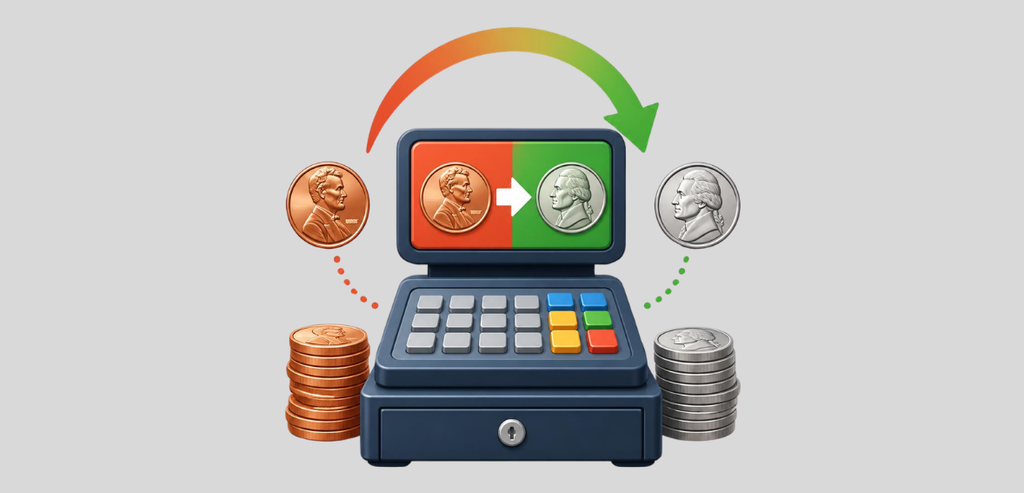
Section 2 of H.R. 1967 modifies the Coinage Act of 1965 to forbid the Secretary of the Treasury from producing circulating pennies. The Mint is still authorized to sell penny blanks to collectors. Pennies will continue to be treated as currency and will not lose their face value.
Section 3 states that cash sales may be rounded to the nearest five cents. For cash sales, the seller can charge the buyer the amount that is nearest to the five-dollar increment. If the sales price is less than five dollars, the seller can charge the buyer five dollars.
Section 4 deals with liability. A seller that utilizes the procedures in Section 3 is treated as being in compliance with federal law and with state, tribal, and municipal law, regarding this point. Wage and hour obligations are outside of this protection. Minimum pay, overtime, and paid leave obligations are in effect, just as they were previously.
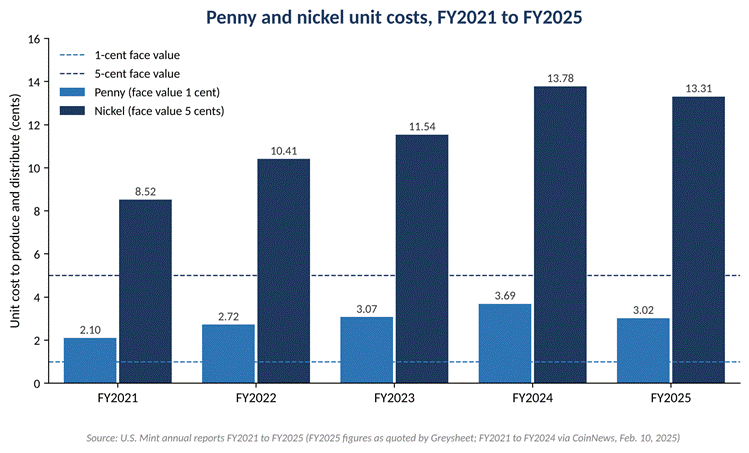
Section 2 also allows for a cheaper 5-cent piece. The coin could be made with a zinc core, with a nickel outer layer. The Treasury can utilize a new metal alloy only after testing has established that two outcomes are achieved: the cost per coin is lower, and the smallest impact on vending machines, and other equipment that take coins. For fiscal 2025, the Mint’s annual report indicated that the cost to produce and distribute each nickel was 13.31 cents.
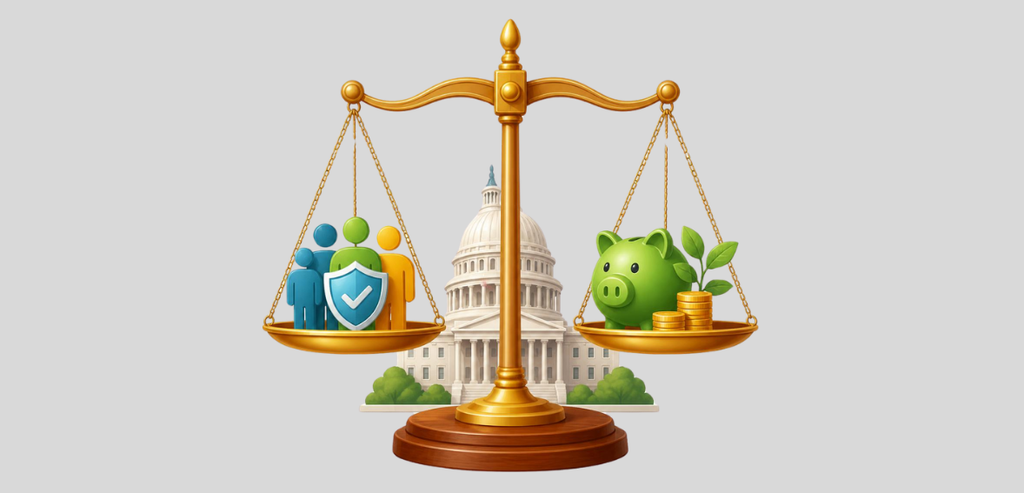
Two related studies are included. After it becomes law, the Board of Governors of the Federal Reserve has 90 days to develop a procedure for how commercial coin terminals will accept and dispense pennies. The Department of the Treasury has to study how scarce pennies and rounding impact low-income households and older unbanked people. Section 6 originated with Sen. Elizabeth Warren. It requires Treasury to provide 60 days’ notice to Congress before they wind down the production of any circulating coin.
Four votes on the House floor were needed to send the Warren Amendment to the President’s desk. The Senate cleared its bill, S. 1525, containing the Warren Amendment, on August 7, 2026. With the two chambers having different language, the House drafted its own bill. The House on September 14, 2026 passed H.R. 10167, containing the Warren Amendment, as on 09/14/2026, without a recorded vote. Vending MarketWatch reported the Senate agreed to the same language on 9/28/2026.
The bill remained unsigned on October 8, 2026, and Fox News said the same on October 7. NACS, which represents convenience retailers, told members on September 29, 2026 that they expected a signature in the coming weeks. Payments Dive reported that the National Retail Federation’s Dylan Jeon said on September 29 that the bill was a practical solution for stores.
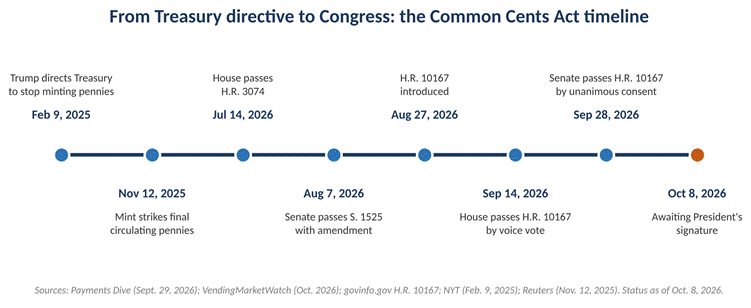
No portion of the House-passed text moves the rounding rules implementation to a later date. Be aware of the signing date when it happens.
Rounding only applies to cash. According to section 3(d), rounding is disabled for payment methods such as cards, checks, money orders, electronic fund transfers (including EFTs), gift cards and similar methods. Payments Dive summarized this in one sentence on September 29: for electronic payments, rounding does not apply.
For a merchant, the effect is a clean split. Payment methods such as cards, NFC, taps, and bank-to-bank payments all settle for the exact amount. Checks also settle for the exact amount, though they are paper. Rounding only happens with cash withdrawals.
One case deserves its own rule: the customer that pays with a combination of cash and card. Rounding applies to the cash payment only.
Penny rounding according to H.R. 10167 means that you consider only the cents column. Find the amount due. For a 1/ 2, round down to 0. For a 6/7, round down to 5. For a 3 or 4, round up to 5. For an 8/ 9, round up to 0. For a 0/ 5, stay the same. For downward moves, consult Section 3(a)(1), and for upward moves, consult Section 3(a)(2).
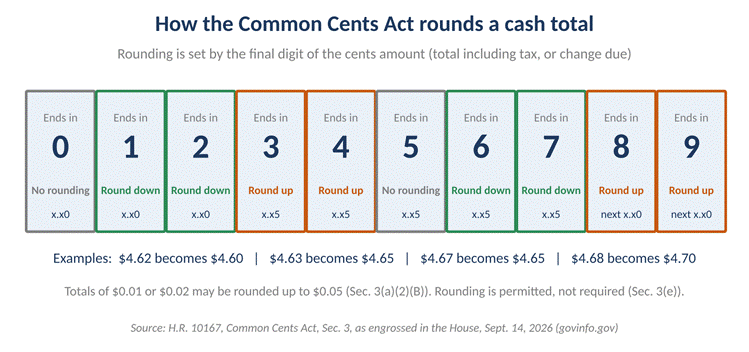
According to the statute, the term “covered amount” refers to the figure that is rounded. For a sale, the final figure would be the total of the sales bill plus any sales tax. Since tax is computed first, rounding is done last. A sales bill totaling $3.21 would be settled at $3.20. A sales bill totaling $3.23 would be settled at $3.25.
| Cash total (incl. tax) | Final digit | Rounded cash total | Difference |
| $3.21 | 1 | $3.20 | -$0.01 |
| $3.23 | 3 | $3.25 | +$0.02 |
| $3.25 | 5 | $3.25 | $0.00 |
| $3.27 | 7 | $3.25 | -$0.02 |
| $3.29 | 9 | $3.30 | +$0.01 |
| $0.02 | 2 (small sale) | $0.05 | +$0.03 |
Very small purchases (less than a nickel) must have a separate line. Section 3(a)(2)(B) states that a one-cent or two-cent bill may be collected as a five-cent bill.
Change Rounding
Instead of covering the bill, the amount rounded can be the change. So, if the customer gave more cash than the bill, the digit test can be performed on the change owed. Change of 38 cents can be rounded out as 40 cents. Change of 36 cents can be rounded out as 35 cents.
Rounding in the Customer’s Favor
Section 3(b) gives a one-way alternative to the seller. Every adjustment can be in the customer’s favor. Cash flowing out to the customer gets moved up. Cash flowing in from the customer gets moved down. There is no part of the bill that allows a seller to move all cash sales upward.
Cash Wages
Section 3(c) is about cash wages paid to employees. In this case, the employer gets to make the choice, and the amount can only be rounded up to the next five-cent mark. The employer can always pay the exact amount.
This was a cost-saving measure. President Trump directed the Treasury Department to discontinue making the coin in February 2025. The cost to manufacture each coin was reported to be 3.69 cents in the Mint’s Fiscal 2024 report. The Treasury Department projected a savings of $56 million a year from not manufacturing the coin, according to Payments Dive. The 2025 report said the face value of the penny and the nickel were less than the costs to produce them for the past 20 consecutive fiscal years, according to Greysheet.
Shortly after this change, cash register shortages became commonplace. On September 15, 2026, NACS notified its members that, because of the absence of a federal law authorizing rounding, cash register retailers who round transactions could be subject to class action lawsuits. Some retailers reported giving up odd cents on every cash transaction to avoid possible litigation.
Furthermore, competing laws in the same jurisdiction made it difficult for sellers to use the rounding method of payment. For example, a seller who rounds transactions in Connecticut, which also protects against conflicting state and local laws, is protected from conflicting state and local laws once the law is effective.
Rounding at the time of sale can lead to drawers being off. Two major U.S. POS vendors have shipped rounding controls and documented it.
Square
Square released cash rounding to U.S. sellers in an open beta. For the feature to work, their POS devices need to be running Square’s app at version 6.84 or higher. The control is on the Early feature access page of the Square Dashboard. Rounding at Square means that $1.01 and $1.02 settle at $1.00, and $1.03 and $1.04 settle at $1.05. That’s the same pattern as in section three.
In the Square setting, cash tenders are rounded, while card and wallet tenders are left at the exact amount. A receipt shows the bill before rounding, plus or minus adjustments and cash collected. A sales summary report shows the total adjustments, and the sales tax is calculated on the unrounded bill, and Square says sellers should adjust their tax reporting if needed.
Tender order can affect the rounding. Square’s example shows a $10.36 bill, which is evenly split between cash and card. If the cash tender is collected first, the card is charged $5.18 and the total is $10.36. If the card tender is collected first, the total comes to $10.38.
Toast
Toast has rolled out cash rounding to select U.S. restaurants. It is located in the finance settings of the Toast Web app. Operators can choose from three modes. One mode lowers every cash check. One mode raises every cash check. The last mode changes every cash check to the five cent mark. This last mode is based on the Section 3 digit test.
Toast books the adjustment after discounts and taxes, as a cash drawer entry with no taxes. It rounds cash only if the customer does not pay exactly the amount due. Toast’s Sales Summary report shows a running total of cash that has been rounded.
The selection of the mode has legal weight. According to Section 3, a seller can only move a cash bill up if the last cent digit of the cash is a five or a zero, or if the whole cash bill is one or two cents. An up-only mode also lifts bills if the last cent digit of the cash is a five or a zero. That falls outside the Section 3 method, and protection of Section 4 relies on following the Section 3 method.
Run four tests before you go live on any system. Pay with a card and check if there was any adjustment. Ring a taxable item and check if rounding happened after tax. Close a drawer and check if the adjustments reconcile on their own line. Split a payment and check if only the cash payment moved. As per Toast’s documentation, compliance and customer communication are both placed on the merchant.
H.R. 10167 contains no mandatory disclosure requirements.
According to Square’s help center, some states may expect sellers to inform buyers about five-cent rounding, and have directed sellers to state and local guidance.
Toast provides a notice to customers stating that cash totals may be adjusted. Customer-facing displays and receipts printed before payment state that cash totals may be changed, and the reason for the adjustment is noted on the receipt printed after payment.
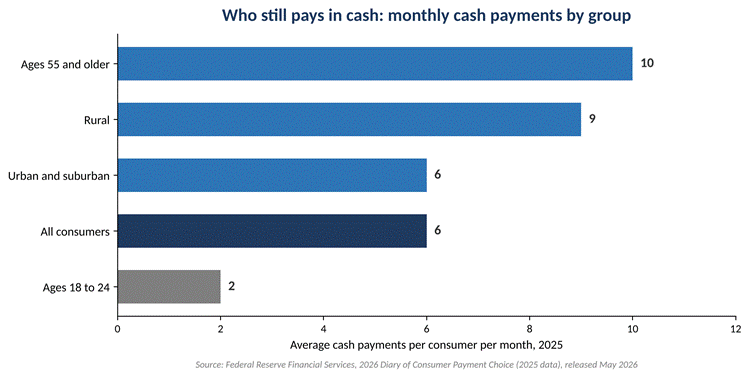
Customers most likely to see an adjustment skew older and rural. The Fed’s 2026 Diary documented 10 monthly cash payments for consumers 55 and older in 2025, compared to two for consumers 18 to 24. Rural residents averaged nine cash payments, while city and suburban residents averaged six. Digital Transactions reported on May 12, 2026, that the same research showed 75% of consumers kept cash on hand. Cash was the payment method of choice for 16% of all in-person payments in 2025, down from 27% in 2016. A cashier can easily explain the whole policy using plain language: cash is adjusted only for odd cents, with cents below the midpoint rounded down and cents above the midpoint rounded up.
H.R. 10167 gives cash-handling businesses a national uniform option, as opposed to a patchwork. The bill deals only with cash. It says the last cent digit of the taxed total or change. It grants a seller an option, not a requirement. So a seller who uses this method is protected from conflicting local laws.
The Senate’s Sept. 28, 2026 vote sent this bill to the President, and it was unsigned on Oct. 8, 2026. Rounding controls provided by Square and Toast have already been implemented by many U.S. merchants. Of the three modes provided by Toast, the closest rounding mode and the down mode most closely resemble the requirements of this bill.
No. Card sales are excluded in 3(d).
Yes. Final digits of 1 or 2, and 6 or 7, round down. Final digits of 3 or 4, and 8 or 9, round up. It is also permitted to round down only.
No. Section 3(e) states that the bill does not require anyone to round to the nearest cent. It gives a seller the right to round if they do not have the exact change.