Posted: August 21, 2026 | Updated: September 22, 2026 at 3:53 PM
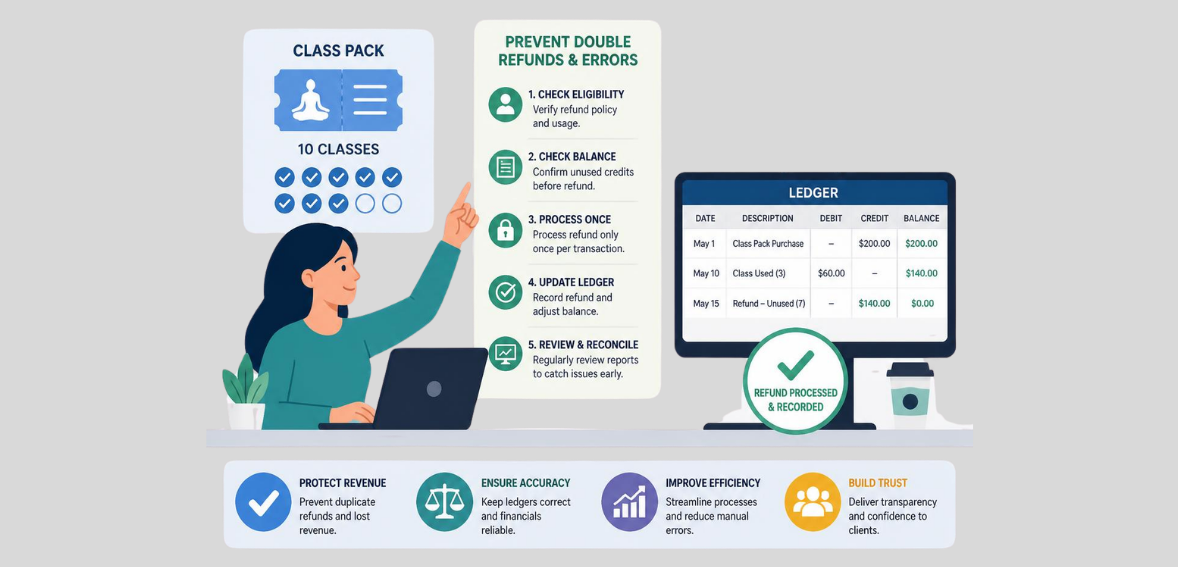
A client cancels her 10-class pack after only 3 classes. The front desk issues a refund for the unused classes on a Tuesday. About two weeks later, a different staff member notes this request in an email and credits her client account with a full 10-class pack since the system does not show the first refund was processed. As a result, the studio will have to pay for the cancellation of the class pack twice, and they will discover their error only after an anomaly in their monthly report.
This is a problem that almost every fitness and wellness business faces. Although a membership is either active or inactive, a class pack is usually partially used. The pack is sold, but part of its dollar value has not yet been earned. The studio is in big trouble if they do the math incorrectly, or skip a lot of essential paperwork, and two staff members interact with the same request. This guide will outline how to prorate class pack refunds to ensure class packs are never refunded twice, when account credit should be used instead of a refund, and who should be authorized to refund class packs.
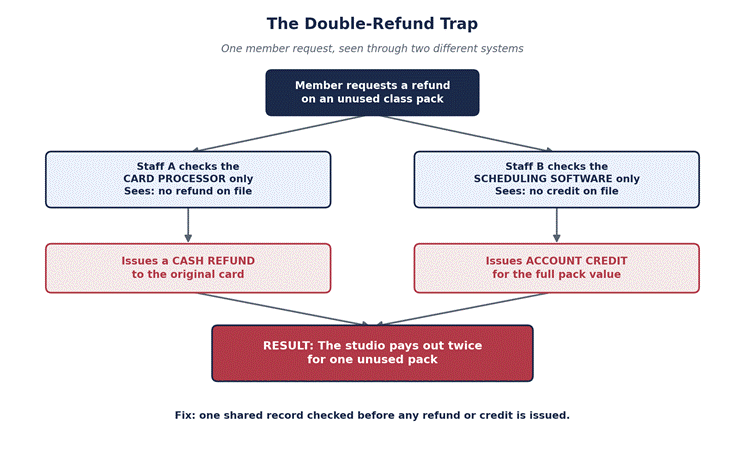
Figure 1. How the same refund request gets paid twice when there’s no single source of truth.
An anomaly is what you might call a double refund. More often than not, a double refund occurs when business systems are disconnected. A client calls the front desk, emails the owner, and messages the owner on Instagram about an unused pack. Three staff members view requests and can have absolutely no way of seeing the requests of the other staff members. Each staff member, to help the client, issues a refund.
Other systems used by the studio to transact and the side effects which are inherent to them also create a gap. The studio uses a card processor which deals with refunds. This processor is not integrated with the scheduling software. There is no reconciliation between the scheduling system and the business bank account. From any one of the three systems, a staff member will see a member who appears not to have been refunded, because from that seat, no refund is visible.
The first step to solving this is to view refund requests as look-up requests prior to treating them as payment requests. Without checking the requester’s account and class pack log, no staff member should process a refund request. If the studio cannot ascertain within a minute whether a refund has already been issued, a double refund will eventually happen.
Most small studios have the most problems with this case in particular, as generally there are only a few staff. This means that the same person does sales, memberships, and resolves disputes (with no overlapping shifts to consult with). One very simple habit that the staff member executes to fill in part of the gaps proves to be of great help and efficient in resolving this problem.
That employee records refunds centrally, and everyone else checks there first.

The starting point in processing refunds for class pack customers is the member’s total owed. Class packs sell for a certain price for a predetermined number of classes. Member payments are calculated as the total cost of the class pack divided by the total number of classes. For a class pack sold for $250 for 10 classes, the cost per class is $25. A member who has taken 3 classes has received a value of $75 from the studio, and the studio therefore has a refund obligation of $175, not a refund obligation of a percentage of the purchase price.
Packs sold at a promotion or bundled with a free class or gift significantly complicate this calculation. When a refund is required, the class pack should be refunded at the promotional class pack price. When a member has an add-on gift or a free class that is part of the class pack, the free class should be ignored when the promotional per-class price is determined.
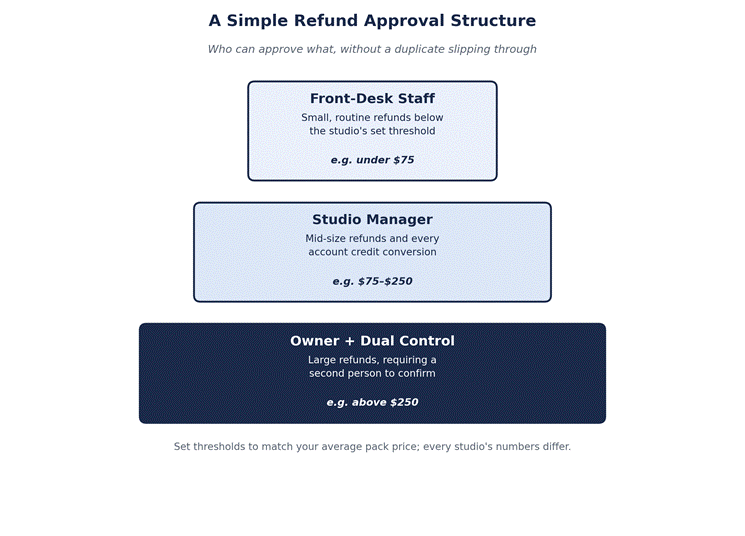
Figure 2. The prorated refund on unused classes comes from the per-class rate, which is the class pack price divided by the number of classes.
Rounding can be important. A rounding policy can be that each client is refunded one or two cents more than the exact figure. Without this type of rounding policy, two staff members would be having disputes regarding how to calculate refund amounts. Being generous is not the same as being organized.

Not all unused credits need to be refunded to the bank account. Refunds come into play when the studio was at fault. For example, closing a class, changes to schedules, or cancellations within policy. In these instances, a refund is appropriate. However, when the studio is simply showing goodwill on a member-initiated request, an account credit is used.
Account credit retains the member of the business, whereas a refund sends the money and the relationship with it out the door and beyond.
The point is not the studio’s goodwill. It’s the reason the member is asking for a refund. A cash refund in exchange for a credit card payment is a bad result of poor thinking that may very well backfire.
When members request a refund, card network guidelines state that refunds should be processed back to the original payment method. If a member is switched to account credit without the client’s permission, that member can dispute the charge with the bank. A chargeback is more expensive to the studio than a refund would be, and it also creates a poor relationship with the processor. Never provide account credit as a substitute for a refund.
Just because a pack is unused doesn’t mean it deserves a refund. As a way to protect the value of the studio and maintain client engagement, members can transfer unused packs to family or friends. Similarly, when members take a temporary break from the studio, classes can be gifted to friends and family. When that happens, money stays in the studio because classes don’t have to be refunded. This should be documented the same way as a refund.
In a different case, when a member asks for a refund because a pack is about to expire, the member’s pack should be extended instead. Usually, members request refunds because they are unable to use the classes in a pack before expiration. Most studios do not give refunds. However, extending packs before they expire solves the issue that leads to requests for refunds. A short grace period before packs expire should be offered to fading members to reduce requests for refunds.
Every refund requires an owner. This owner cannot be the person who happens to work the front desk that day. Setting a threshold of a certain dollar amount would complete the policies needed. Anything under the threshold is able to be processed by a front desk employee. A manager should be needed for any refund over this predetermined dollar amount. This policy should sufficiently prevent duplicating refunds. The common failure case is an employee processing the refund without approval and, without review, a colleague also processing the same refund.
For larger dollar amounts, it is more important to have the principle of dual control. This control is achieved with a policy in which two individuals are needed to confirm a refund of a specific high dollar amount. The first person processes the refund while the other approves the refund. This control is not necessarily distrust of employees. This is to prevent the same employee from both processing and approving a refund.
Most studio management systems include vendor-wide permission features to set up login credentials that allow users to issue refunds or account credits. Set these permissions up early and review the logs periodically; this closes the doors left open by former employee accounts or shared passwords.
Figure 3. A straightforward approach to approving refunds: who can execute that refund without a manager’s approval.
There’s a refund without a paper trail, and then there’s a refund waiting to happen twice. Every refund should record a reason, the number of classes used, the approval, and the date. All of these things should be logged to the member’s account before the refund is processed.
The next staff member who opens the account sees that note before they can process another refund.
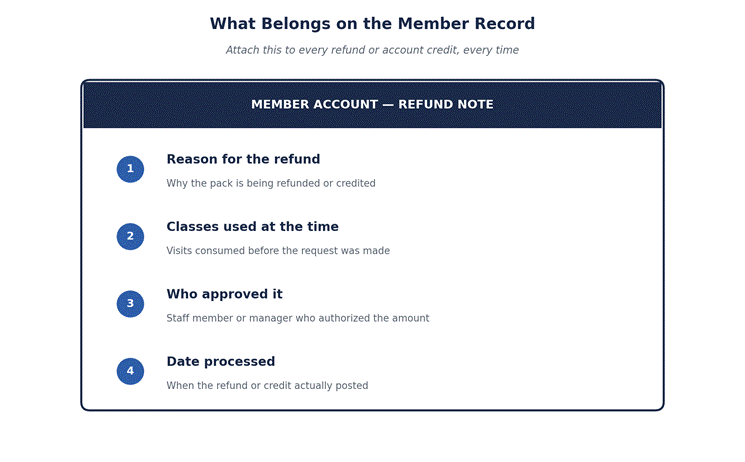
Figure 4. What we should enter on member records for refunds or credits.
This feature has the additional benefit of protecting the studio from a member filing a dispute stating that they were overcharged unjustly. Owners can analyze various trends, for example, patterns of specific staff members issuing refunds well beyond what would be expected of them, compared to the rest of the staff. A studio that reviews its refund logs on a monthly basis is able to nip problems in the bud before they become a pattern of chargebacks or excessive refunds.

Members tend to agree with what they can see. Showing the math, the classes used, the per-class rate, and the total refunded helps convince the member the refund is correct. It will also help eliminate the need for conversations. This also helps build trust for the next pack a member buys, as the member gets to see the studio handle the last pack they bought.
Transparency with how the math is set up builds trust. If the studio shows the calculation with the refund, members can verify the refund themselves. One of the easiest ways to build distrust is a refund that appears only as a silent, unexplained line on the member’s bank statement a couple of weeks after the member requested it. An email with the calculation, the receipt, and the refund shows the member everything, and should be sent on the day the request was made.
No policy means no consistency. This impacts the first employee and the 500th equally. A policy should detail the proration formula, the credit-cash refund line, the approval thresholds, and the location of the documentation. This should be simple enough that a new employee understands the process and doesn’t have to continuously go to their manager for each example.
A policy loses its value without supporting software. If a policy states that a specific dollar value refund requires manager approval, but the scheduling/payment system makes requesting approval an undue burden on staff, this defeats the policy. The best way to prevent a double refund, an incorrect credit, or an entry error in the ledger that takes hours to resolve is consistency in the written policy and the supporting software. Both should be reviewed together at least once a year as changes in pack prices and staff turnover will occur.
No one enjoys dealing with class pack refunds, but they happen for the most boring reason. When a refund is requested, there shouldn’t be any surprises. The refund for an unutilized class pack should be the unused classes times the cost per class. Class pack refunds should be cash refunds. Card network rules govern whether the money goes back to the original payment method or can sit as account credit. Requests for refunds typically can be done without any cash leaving the studio, as long as the requests are for transfers, gifting of classes, or extending the validity of the unused classes.
The system is mostly based on documentation and permissions. There is a cut-off point at which personnel can approve refund requests. All documentation should be on file along with the transaction and a record of each dollar the member spent. Finally, a concise policy should be created so every staff employee knows the policy and can follow it. It is not a complicated process; it just has to be done every time for the next staff employee to understand every prior action that was taken on that account.
To know how much a partial class pack refund should be, you should know how much each class costs. The price of the class pack is always lower than the combined prices of individual classes. To calculate how much each class should cost, divide the total price of the class pack by the number of classes. Multiply this price by the number of unused classes to get how much should be refunded.
If it is a studio-initiated cancellation or the member has asked for cash back, cash back should be used. In situations that are initiated by the member or offered at the studio’s discretion, credit should be used.
If the expiration terms were disclosed at the time of sale, packs can expire. Many studios offer a short extension or extend the pack before it expires.
Each refund should be reviewed individually. Impose a dollar limit above which refunds must be reviewed and approved by a manager.
Yes, many studios offer this type of service. Record the number of classes used and transfer the remaining classes with the pack’s history intact.