Posted: August 10, 2026
The tap of a screen is worth more today than it was yesterday, and for some it is about to get much better. Because of a partnership between Apple and American Express, cardholders can now use some of their Membership Rewards points to partially pay for purchases completed using Apple Pay. While there are plenty of articles and commentary about the Amex-Apple partnership, the real impact of this integration is something different, and it matters most for merchants. It is a reminder that customers expect mobile wallets for a growing percentage of transactions, with or without rewards. Merchants who consider the acceptance of mobile wallets the end of their payment integration are losing significant sales.
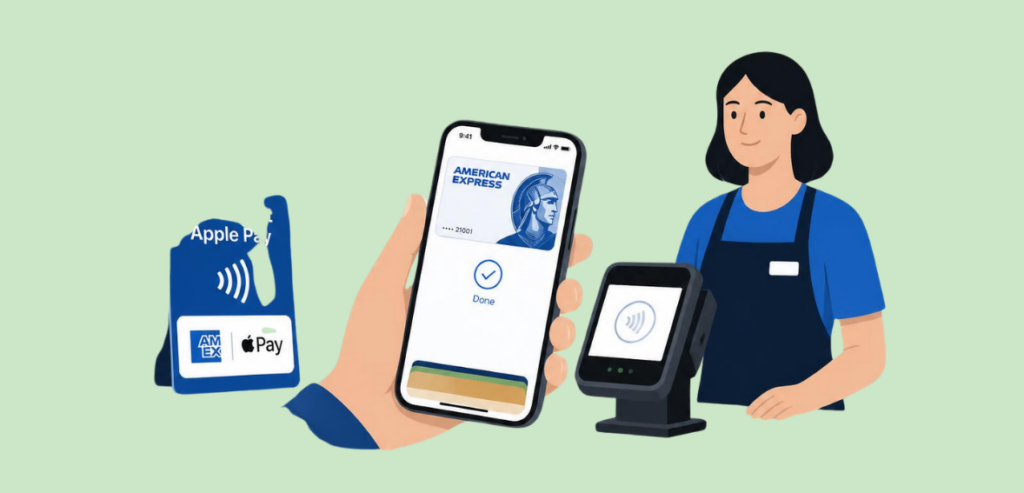
American Express and Apple introduced “Pay with Points with Apple Pay” for American Express cardholders in the United States with Membership Rewards. To use this feature, users select an eligible Amex card in Apple Pay, and a “Use Rewards” button appears. Using the button, users select the number of points to use to pay for a portion or the total value of the purchase.
This feature is available on the iPhone and iPad and can be used entirely within Apple Pay; no other applications need to be used to redeem points. Currently, this feature is limited to online and in-app purchases. As of the initial announcement, American Express has not extended the feature to Apple Pay transactions in physical stores, which is probably the most relevant detail for merchants reading the announcement.
Redemption rates provide additional context. American Express estimates that the value of points redeemed through Apple Pay is approximately $0.007/point, meaning that 10,000 points equals $70. This is significantly less than the value of points transferred to airline or hotel partners, which generally provide a value of $0.02/point.
This feature is primarily focused on user convenience. For merchants, the value and convenience differences of redemption are overshadowed by the largest implications of this collaboration: two of the largest consumer payment partners are demonstrating a commitment to creating a mobile payments ecosystem.
American Express became an Apple Pay partner at the service’s 2014 U.S. launch and has led the campaign to provide consumers with enhanced transactional convenience using their credit cards. Lisa Kalhans, the Executive VP for Amex’s U.S. Consumer Cards, believes that integrating point redemption systems into daily transactional activities provides consumers with an incentive to use their cards.
Customers have a convenient way to redeem their rewards, and Amex customers reportedly maintain a high transactional volume. Therefore, integrating the Amex system into Apple Pay provides Amex customers a convenience that many rewards point systems fail to offer. Amex reportedly gained a significant increase in customers in the target market of Gen Z and Millennial customers. Gen Z and Millennial customers are reportedly the most active users of mobile wallet payments.
Jennifer Bailey, Apple’s VP of Apple Pay, commented on Amex’s innovative integration and the flexibility that it provides to consumers. The point redemption system allows consumers to make purchases using Amex rewards points. Before Amex, Apple Pay’s rewards redemption capability had only been adopted by Discover in the U.S. and Zilch in the U.K. Amex is by far the largest card issuer to integrate point redemption into Apple Pay.
While the Amex-Apple feature is currently applicable to online and in-app purchases only, there is minimal impact on a physical store location. However, there is a more pertinent and persistent question for any merchant: beyond one issuer’s promotion, do customers expect to walk in and pay by tapping a phone or a watch, and is your store’s payment terminal ready for that? The answer is increasingly yes.
Over 65% of face-to-face card transactions in the United States are made using contactless technology (card, phone, or wearable) as of now. The number of proximity mobile payment users in the United States crossed 111.8 million in 2024 (44.9% of the total smartphone population), and that number is expected to grow to 132.6 million (50.2% of the total smartphone population) by 2028.
The digital wallet payment technology is growing at an unprecedented pace and is expected to grow to be valued at $145.35 billion by 2030 from $56.77 billion in 2025. The growth of this technology and the resulting shift in how people will pay will not be affected by any single bank’s rewards program, including Membership Rewards.
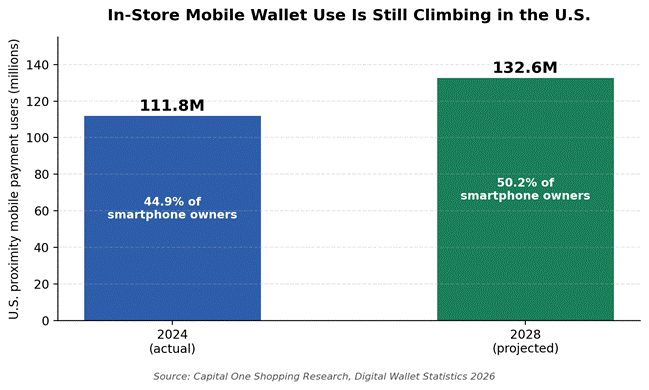
US proximity mobile payment users, 2024 actual vs. 2028 projected. Source: Capital One Shopping Research, Digital Wallet Statistics 2026.
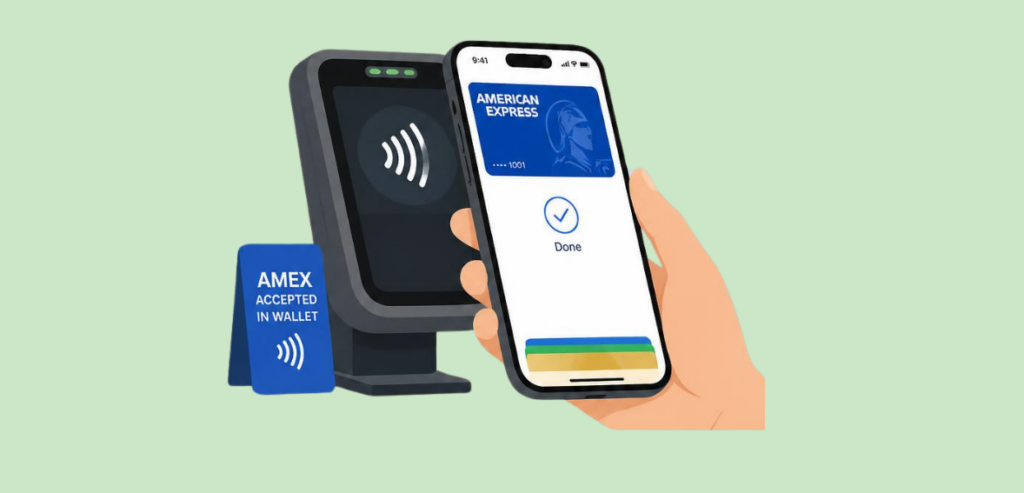
Most point-of-sale systems manufactured in the past few years include NFC antennas. These antennas enable them to interact with systems that support tapping a card, or in many cases, a smartphone. If contactless payment is not available, the issue typically lies with the terminal not being certified for contactless payments, or more frequently, the issue lies in the processor account not supporting contactless payments at the transaction gateway level.
It is easiest to find out if contactless payments are supported simply by calling up your payment processor or terminal provider to see if switching contactless payments on for your account is an option. If it is, they can usually enable it quickly.
Merchants tend to conflate two questions. Can the terminal read a tap (which most devices built in the past few years can do)? And, does the merchant account and processing agreement allow for contactless payments to be enabled in the routing of transactions? The second question is back-office related and not hardware related. Often, the necessary equipment to support contactless payments is sitting idle because no one pushed the processor to enable it.
Apple is also helping small shopkeepers accept payments without requiring them to buy hardware. Tap to Pay on iPhone turns certain iPhones into payment terminals, allowing shopkeepers to accept payments from a contactless card, Apple Pay, or any other contactless digital wallet, right on the same device they already have with them. On the hardware cost front, this eliminates the cost argument for a market stall, solo service provider, or a pop-up shop, since the payment acceptance tool is the shopkeeper’s phone already in their pocket.
A customer that pulls out their phone at checkout already knows how they want to pay. If a reader fails to respond quickly to payment, that choice can collapse into a card swipe. Some customers fumble to take out a physical card, some take their time, and some walk away at the sight of a stalled terminal. There is a well-known industry gap between people eager to use their phone as a payment method and the financial transactions that are actually completed.
Although about 85% of U.S. retailers accept Apple Pay, it only comprises 10.2% of all eligible, potential in-store transactions. It is by far the largest gap of accept versus use in consumer payments, and the terminal friction is a large reason behind it. Providing payment acceptance and the ability to tap are as different as day and night, and only one protects the sale.
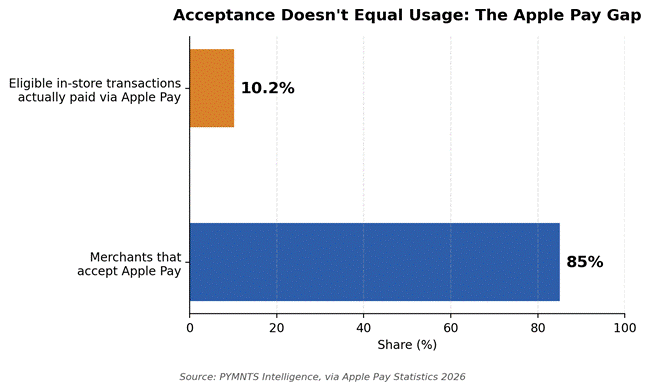
Apple Pay U.S. merchant acceptance vs. share of eligible in-store transactions actually completed via Apple Pay. Source: PYMNTS Intelligence.
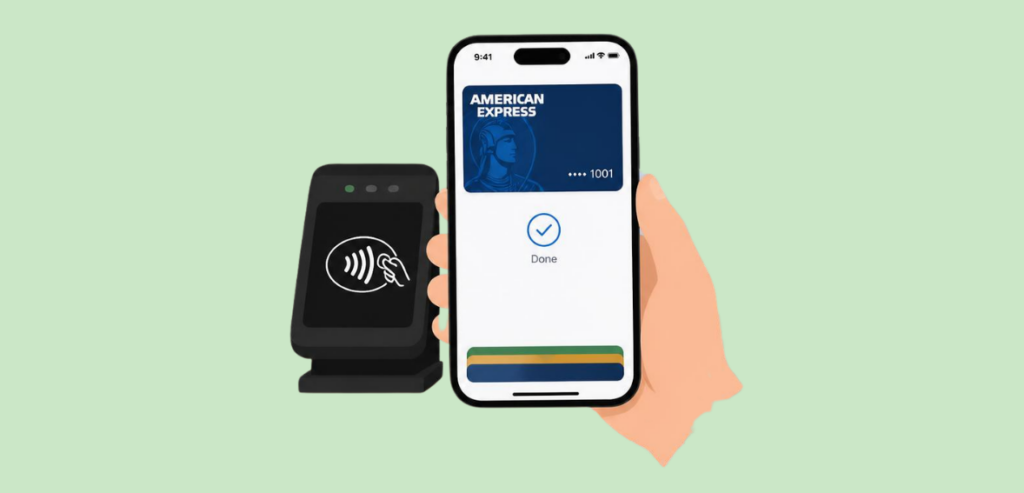
Wallet-first customers want essentially the same experience regardless of the bank or phone they use: a quick tap and instant confirmation with no need to enter a PIN for small purchases. They also prefer security features that reside in their wallets, like tokenization (the replacement of a card number with a code that will only be used once), and Face ID or Touch ID as a replacement for signature.
Younger customers, with Gen Z and millennials as prime examples, are already responsible for higher levels of spending and are now among the main customers of companies like American Express. For these customers, smooth and seamless checkouts are simply the baseline (and no longer a bonus). If a checkout cannot provide this, it will be seen as an old and outdated checkout system.
There are some unvoiced assumptions customers make about contactless checkouts. If a contactless checkout is set up properly, it should work without a hiccup. If a checkout requires a customer to use a physical card rather than a contactless checkout, this suggests the contactless checkout is either faulty or set up incorrectly. If a checkout requires a customer to use a physical card, it will leave a lasting impression, while a checkout that taps cleanly is one customers will continue to use without consciously thinking about it.
Small business owners often think tap-to-pay systems might charge them more per transaction than traditional swipe or insert systems. That thought is misguided in light of card networks’ rules. Like chip insert transactions, contactless transactions are also card-present transactions, and therefore, are likely to be assessed the same interchange rate as chip transactions. The relevant rate difference is between card-present transactions, whether tapped or dipped, and card-not-present transactions, such as telephone orders or payments that have to be keyed in, which are subject to much higher interchange, due to the greater likelihood of fraud.
The cost to merchants generally increases because of the mix of card types used by customers, since, whether insert, swipe, or contactless, payment with premium reward cards means higher interchange costs. It is incorrect to think that the cost to the merchant is due to a surcharge on tap systems.
Upgrading contactless payment acceptance typically requires no new hardware. For a terminal already on your counter, your processor can push a firmware update to enable NFC. For merchants that don’t even have a dedicated terminal, a software-based POS (point of sale) system that can turn your smartphone or tablet into a payment reader is becoming an accepted industry norm.
By 2027, reports indicate that this software-based POS will be deployed globally to over 34.5 million merchants. This trend will continue to expand the payment acceptance options of small to mid-sized businesses (SMBs) at an affordable price. Before purchasing new hardware, be sure to ask your processor whether the capabilities can be enabled for the payment reader you already have.
Everything important can be verified in a short 5-minute internal check before a busy weekend. First, confirm that the terminal is not just present, but that the NFC reader is on. Then check that the terminal is updated. Outdated firmware can lead to failed contactless transactions.
Make sure your staff is familiar with what a successful tap looks and sounds like, since a slow read could be mistaken for a declined card. Tap-to-pay signage by the register will ease customer concerns about using contactless payment. Lastly, do not forget to do a tap transaction every so often to confirm the system is still working, rather than assuming it has been working for the last few months.
The Amex-Apple rewards feature benefits those who make purchases through Apple Pay. While Apple and American Express are partnered and Apple Pay users are their target customers, physical store merchants are left out. The rewards feature is a good example of how Apple and American Express are continuing their investment in the Apple Pay ecosystem. The rewards feature is good for online and in-app purchases and for American Express’s customers; however, the rewards feature is of no use for the majority of physical store merchants.
The takeaway more valuable than one issuer’s promotion is that contactless payment is no longer a preference for customers, but a requirement. Contactless readiness is less about any single promotion and more about the store’s staff and payment systems. Ensuring that contactless payment systems work means a customer is never the first to discover that they do not.
You lose potential sales if you don’t accept them. In the U.S., over 65% of face-to-face credit card transactions are contactless. The majority of new terminals come with support for contactless transactions at no added cost.
No. Under standard network rules, contactless transactions are treated the same as chip transactions, and therefore, qualify for the same card-present interchange rate.
The causes are usually a disabled contactless setting on the customer’s card, outdated firmware, or a card spending limit; the hardware itself is usually fine.
Yes. Wallets reduce fraud and disputes through the use of tokenization and biometric authentication. In this technology, card numbers are replaced with a code that can be used only one time.
Confirm with your payment processor that NFC is on and the firmware is up to date. Most terminals just need an update to the settings and won’t need new hardware.