Posted: July 20, 2026
Imagine this: It’s the second week of December, orders are coming in, and your team is working overtime. You expect the numbers to show your best quarter of the year. But your bank account says otherwise. Payroll is due this Friday. Your largest customer has an unpaid invoice that is now over 45 days old. Your suppliers want deposits for the holiday inventory. Do you relate to this? You are not alone.
The holiday season is the period when small businesses experience the highest income and lowest liquidity. The great news is that this holiday cash flow squeeze is not inevitable. This guide is going to show you practical techniques that are going to help improve cash flow for your business before the peak holiday season, helping you to start the new year with money in the bank and not a pile of IOUs.
When the holiday season is approaching, a small business can improve cash flow by implementing these techniques: weekly cash flow forecasting, immediate invoicing, reduced standard payment terms, invoicing via text message with a payment link, early payment discounts, requiring deposits on large orders, collecting through instant payment channels, postponing non-essential purchases, a pre-approved line of credit, and more.
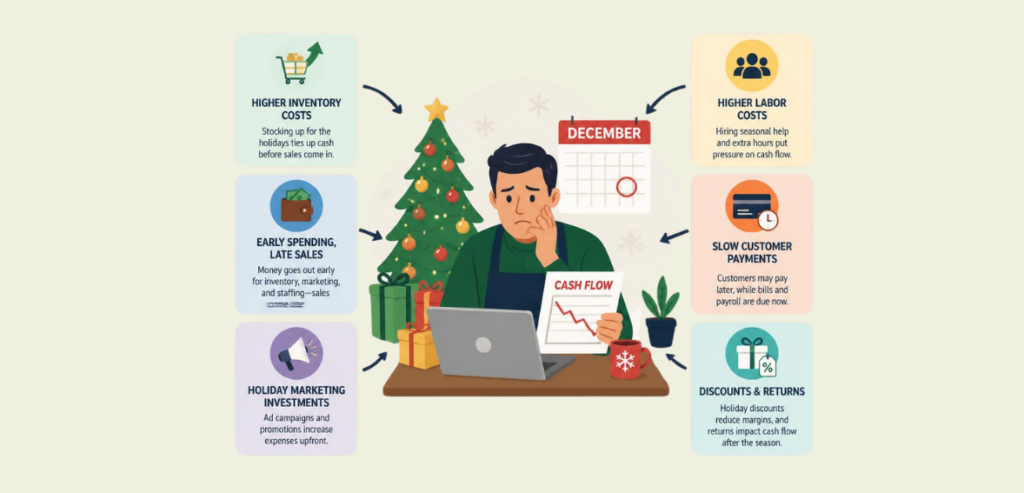
Profit and cash flow are two completely different ideas. Profit, at the end of the day, is what is recorded. Cash flow is all about the timing of events. The timing of cash flow, during the holidays, is unfortunately quite bad. The expenses come before the revenue. Inventory is purchased in September and October. Seasonal employees are hired in November. The extra expenses caused by shipping, packaging, and marketing are all sent before the holiday sales come in. Even purchases that are made at retail locations have immediate payment, but business-to-business payment is not as timely. Many corporate clients will hold the payments for 30, 45, or 60 days, and many accounts payable departments will come to a virtual standstill by the end of the year, due to employees out on holiday. The cash flow then turns from a steady stream into a flood going out and a trickle coming in. This holiday cash flow crunch is difficult to deal with, and the intention of the following strategies is to alleviate this problem.
The holiday season cash flow crunch can be most painful because the month of January is typically a slow month in most industries. If you run the cash flow down in December, you are then left starting the new year with cash flow and sales that are both low. The goal of tightening the cash flow is to protect the first quarter of the new year.
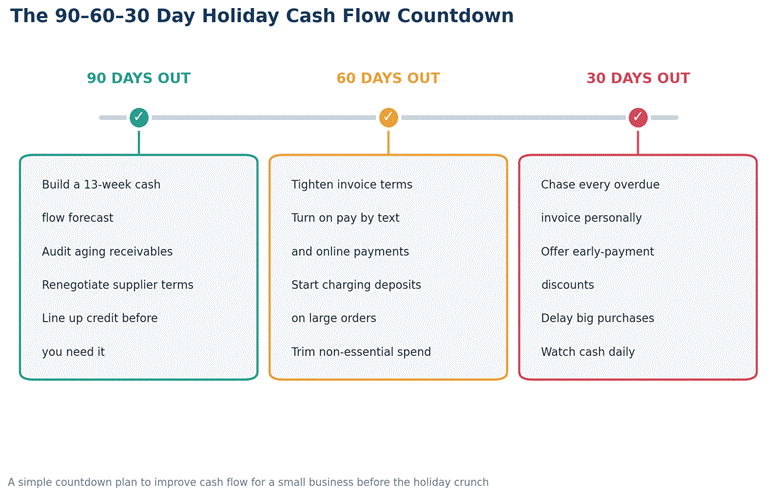
Infographic 1: The 90–60–30-day holiday cash flow countdown for small businesses.
You can’t solve an issue you can’t identify. The most effective aid for holiday planning is a 13-week cash flow forecast. This planning tool consists of a few simple components. Each week represents a column, and each cash item makes up a row. Some of the cash items include customer payments, payroll, rent, inventory, loans, taxes, and owner draws. The projection will produce your expected account balance for the end of each week over the next 13 weeks.
Why is this tool useful weekly as opposed to monthly? Businesses actually run out of cash at the end of a week, not at the end of a month. This tool will help you visualize the week when your balance is critically low and help you strategize before it. Since you are able to see the forecast weeks or even months in advance, you are now able to move the week when your balance is low by reaching out to customers for an earlier payment, postponing a purchase, or organizing a loan; you are now able to plan. For best results, complete the forecast every Monday morning, as it will only take you a few minutes.
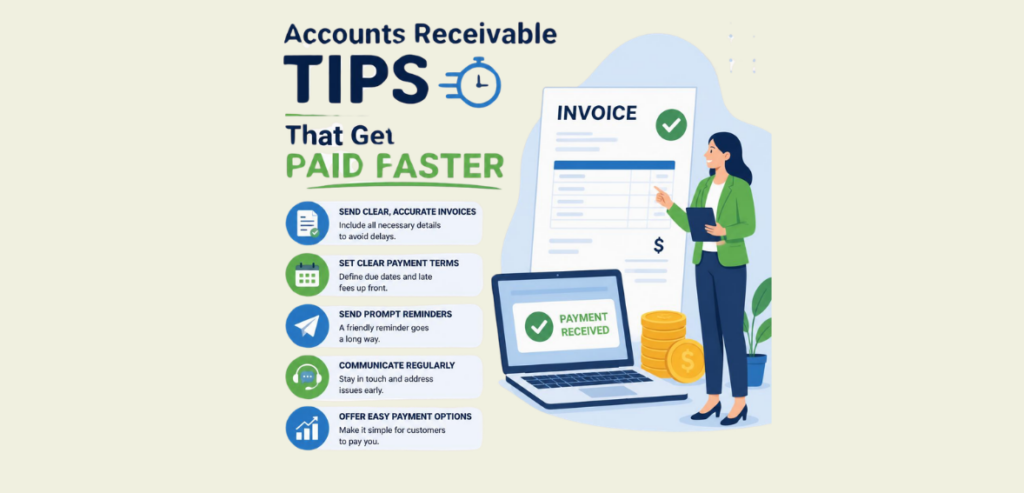
For many wholesalers, contractors, and other service businesses, the largest amount of trapped cash is in accounts receivable. This is the cash you’ve earned and is waiting to be collected. The quickest way to improve cash flow is to reduce your days sales outstanding or DSO, with accounts receivable. These tips are simple, but the compound effect will be significant.
A lot of small businesses send out invoices all at once at the end of the month. This practice makes payment wait at least an additional 30 days. To prevent this from happening, send an invoice as soon as the work is completed or the product is shipped. For example, if a job is completed on the 3rd and an invoice is sent on the 30th, then the customer had a loan for 4 weeks with the business earning no interest. To save on average collection time, consider the practice of invoicing the same day work is completed. No additional tools or expenses are required.
Net 30 is just standard practice. You should review your business terms before every holiday and adjust the payment terms for new clients to Net 15 or Due on Receipt. Make it a practice to state an actual date. You will find that “December 5, 2026” gets paid faster than “30 Days Net from Invoice Date.” In the event your client fails to pay you on time, state a reasonable late fee clearly on your invoice. You may never actually charge the fee, but it will encourage your client to pay sooner.
The majority of late payments happen because of oversight. Invoicing software can help to automate reminders by sending a notification before the payment due date and on the due date. Notifications can also be sent for overdue payments at specified time intervals. The awkwardness and variability of messaging to request payments are eliminated by automated reminders. It is also advised to change your communication method from email to phone for invoices that are 15 days past due. One two-minute phone call is more effective for collecting overdue payments than 10 emails.
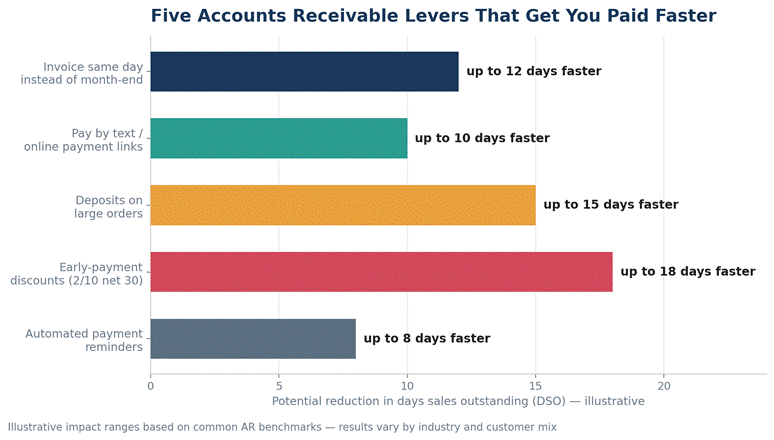
Infographic 2: Accounts receivable levers that help small businesses get paid faster (illustrative impact).
Pay by text invoicing can have the largest impact on your business during the holidays. In place of an emailed PDF invoice, an SMS message with a payment link is sent to the customer. It takes about a minute for the customer to view the invoice and pay via a stored payment method. Behavioral psychology, along with technology, is a game changer. Text message open rates exceed ninety percent, and messages are typically read within a few minutes. In contrast, PDF invoices are ignored, forwarded, then printed, or sent directly to the trash folder. A text message is delivered to a customer most conveniently.
Pay by text is perfect for any business that completes a job in the field and needs to collect payment, like home services, automotive, medical and dental services, as well as salons and landscaping. Payment is collected before the technician leaves the job. Text to pay is a perfect end-of-the-year cash flow solution. The holiday rush is the most profitable time for your business to implement text to pay.
An early payment discount reduces margin but improves cash flow. The standard construction of this discount is “2/10, net 30.” The first part means that if the customer pays within 10 days, they get a 2% discount. If they miss the 10 day window, then the full amount is due within 30 days. Taking this construction on its face, for a $10,000 invoice, the customer would save $200, and the seller would receive $200 less in exchange for having the cash in hand up to 20 days sooner.
Is the trade worth it? You will have to do the math for yourself. Although 2% sounds small, if the early payment discount is treated as a financing charge, the discount is worth 36%/year, assuming the customer takes the discount on every invoice. Treat early payment discounts as a scalpel, not a hammer. These discounts are worth using on your largest invoices, your slowest, but consistent, customers, and your broader customer base in the weeks before the holiday season. When cash is tight, certainty has real value, and a $9,800 invoice (after the discount) in hand is worth more than $10,000 arriving in 6 weeks (if the discount is not taken).
If your business needs custom orders, handles big projects, or has bookings for the holidays, deposits can be very helpful for you. Requiring 25%-50% deposits has three main benefits. First, it means you won’t have to finance the materials or labor needed to fulfill the order yourself because the deposit pays for it. Second, it helps weed out the customers who aren’t really interested. You won’t lose out on capacity during your busy season. Third, it helps minimize your loss for the orders that get canceled or for the customers that disappear.
Many owners also avoid asking for deposits because they are afraid of losing the sale. In reality, deposits are pretty much an industry standard for construction, catering, custom manufacturing, event services, and wholesale. Serious customers expect to pay a deposit. Make deposits part of your quoting policy by requiring the deposit at quote signing, clearly stating the remaining balance and milestones, and allowing deposits to be paid with a link provided via text or email. For large holiday orders, consider progress billing where a deposit is required to sign the order, a payment is due halfway through the order, and the balance is payable at the time of delivery.
This way, your expected cash flows are aligned with your actual cash flows because of the deposits.
In the US, instant payments for businesses went from being a convenient option to an essential feature for operating a business. Unlike ACH transfers and checks that take anywhere from 1 to 3 business days to a week and beyond to clear, instant payment networks move money between bank accounts instantly and are available 24/7, 365 days a year. Funds settle with finality, meaning there are no waiting periods and business owners do not have to worry that the payment will bounce after the business has already shipped the goods. For small businesses during the holiday season, receiving payments over the weekend that are available to spend on business operations is a real competitive advantage.
The Federal Reserve launched its instant payment service called FedNow in July 2023. As of now, banks and credit unions on the FedNow system can send and receive payments in seconds, any time of day, any day of the year. Adoption of the system is rapidly spreading, with thousands of financial institutions on the system. Small businesses can directly benefit from instant payment access when funds arrive, control over when payments are sent out, and a significantly lower risk of an overdraft stemming from payment delay due to system settlement.
Since 2017, The Clearing House’s RTP network has served as one of the other major real-time payment systems in the U.S. RTP also provides real-time payment access to a large number of U.S. demand deposit accounts through its participating banks. Payments made through RTP, like FedNow, are settled instantly, available 24/7, and finalized in an irrevocable manner. Many invoicing and accounting systems now route payments via RTP or FedNow. If your invoicing system has the ability to provide instant bank payments, enable that feature. It is one of the least costly ways to speed up the collection of payments before the upcoming holidays.
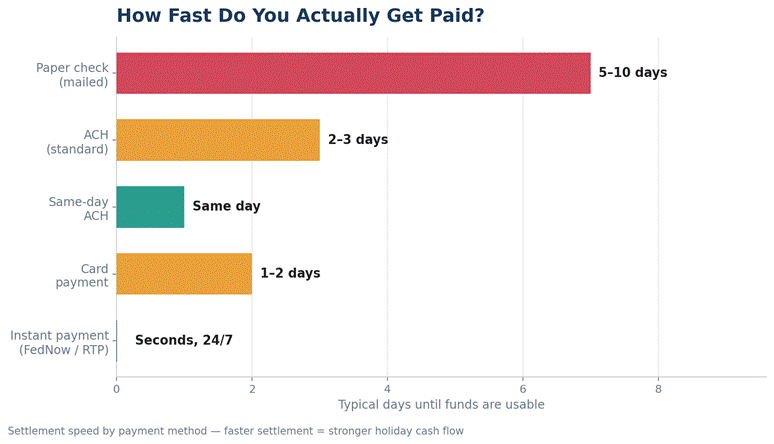
Infographic 3: Payment settlement speed compared — instant payments like FedNow and RTP settle in seconds.
Tightening cash flow works on both sides of the coin. So far, the focus has been on bringing money in faster. The other side is slowing down the money going out of your business. Start with your suppliers. If you’re on good terms with your suppliers, consider negotiating payment terms, such as moving to a 45-day instead of a 30-day payment term. Suppliers would prefer to accommodate your request rather than lose a customer, and the worst answer you can get is no. Pay your bills on the due date rather than early. Being the early payer of bills makes one feel responsible; however, doing so gives away your liquidity to someone else’s balance sheet at the exact moment you need it most. Where suppliers offer their own early-payment discounts, take them only when the math beats your cost of capital.
Next, take a good look at expenses that happen on a routine basis. Over the course of a business’s operation, it is common for a business to acquire services in the form of software subscriptions or memberships that eventually lose utility. Look at what you can minimize for the quarter. Delay purchases and upgrades of equipment that are not time-sensitive until January. Suppliers are usually more eager to make a sale during this time of the year and will often be more flexible in pricing. Lastly, place a temporary approval threshold on discretionary spending. Any expense above $500 will require owner approval.
Inventory is cash in disguise. Stock that isn’t selling will never be paying wages. Don’t place orders without reviewing last year’s sales and analyzing at the individual item level. Know your actual best sellers and order accordingly. Be heartless with your slow movers. You should almost always prefer to sell out of a slow-moving product, or else it will be on your shelves in February and be sold at a clearance sale.
If your suppliers allow, consider placing smaller and more frequent orders, even if the unit cost is higher. The volume discount is unlikely to be more valuable than the flexibility. Also, now is the time to put inventory on clearance that has not been selling for a long time. Early October is the best time to sell inventory in order to make cash so that you are able to place orders for the inventory you will actually need in November.
You can’t plan for everything. One of your customers might decide to delay payment. A shipping quote might come back double. You can only build your safety net ahead of time, as a calm-looking business is more likely to receive lender approval. A business line of credit is a go-to solution. You draw funds and pay interest; leave it unused, and it costs you nothing. Apply in the early months of Q4, as lenders want to see trailing revenue in your financials. Consider business credit cards with zero percent introductory offers, invoice financing, and merchant cash advances, which all come with their own costs, but should be considered if other options are exhausted. Regardless of your choice, consider the funds borrowed to fill cash flow gaps in your 13-week forecast. Do not consider it a long-term solution to a collections problem.
Peak season is an intense time for any business, but with these steps broken down into a 90-day calendar, dealing with cash flow becomes a breeze. Ninety days before peak season, you forecast your cash flow based on work in progress and customer orders, analyze your aging receivables metric, renegotiate your supplier payment terms, and submit a request for a revolving credit line. Next comes the 60-day mark. You make sure each invoice gets paid on time, push text-to-pay and instant payment links, begin taking deposits on large sales orders, and trim your spending on subscriptions and contracts that cost you monthly.
At the 30-day mark, as the peak season gets closer, you begin to call the overdue accounts for payment, offer discounts for early payment on large invoices, suspend any further purchasing, and start monitoring your cash flow on a daily basis. When combined, all of these steps will unlock months of cash flow for you to focus on the important work.
The holiday crunch is more about timing than revenue. Money leaves too early and returns too late, with a wide gap in between. This is where even healthy businesses feel the cash flow pain. Don’t wait for a miracle. Forecast your cash flow weekly, and you will notice trends that help you avoid cash flow issues in the future. Send invoices and make it as easy as possible for your clients to pay with just a text. Offering an early payment discount also helps. Protect your large projects by requiring a deposit. Control your spending and use a line of credit for the time being. Start the plan 90 days in advance to anticipate your cash needs. With a successful holiday season behind you, January can be an excellent month instead of a painful one.
Begin with a 13-week cash flow projection to identify shortfalls in advance. Speed up cash inflows and slow down cash outflows. Create a culture of same-day invoice collection and payment. Shorten the payment term. Use text message payments. Offer discounts for early payment. Request payment on large orders in the form of a deposit. Control payment outflows by negotiating for longer payment terms with suppliers, stopping non-essential payment subscriptions, and postponing major outflows until January. Establish a business LOC in the early fall to prevent shortfalls from turning into a cash flow emergency.
Combine three tactics. First, invoice immediately after completing your work. Second, send an invoice via text with a one-tap link to pay. Third, use FedNow or the RTP network for instant bank payments so the payment completes in seconds. Businesses that use same-day invoicing with text-to-pay often collect payment within hours of completing the work.
Yes. FedNow and RTP settle in seconds, any time, day or night, and on any day of the year, even holidays. You can also make instant payments. This shortens your cash conversion cycle, reduces the risk of overdraft due to a delay in payment settlement, and eliminates anxiety related to bounced checks. Instant payments for business are particularly useful during the holiday season because of the long payment time gaps. This allows you to receive revenue on a Friday night and spend it on Saturday. Be sure to ask your bank if your account can receive instant payments.
Usually, yes. An upfront deposit of 25 to 50 percent covers your direct costs and protects your business from non-serious customers and cancellations. Most businesses in construction, catering, events, and custom manufacturing and wholesale have deposits. Serious customers expect them. Ensure your quote clearly states the deposit requirement. Make it easy to pay with a text or email link. For very large projects, consider milestone billing to align your cash inflows and outflows.
An early payment discount is a small incentive for early payment. One of the most common examples is the “2/10 net 30” discount. Buyers can take a 2 percent discount if payment is made within 10 days. If the payment is made after ten days but within 30 days, the seller collects the full invoice amount. Using the example of a $10,000 invoice, the buyer is able to save $200, and the seller receives $9,800 about 3 weeks early. Consider the high cost of capital and use discounts selectively on large invoices during the holiday crunch, and compare the cost of the discount against the cost of drawing on your credit line before offering discounts widely.