
Posted: July 22, 2026
You received a silent dismissal from a good customer. They got a better deal elsewhere. The revenue went away like a slow-moving leak. In a price-sensitive market, it is worse than ever before.
79% of customers trade down. Over half say they look for discounted prices for every purchase they make. While many business owners have good reason to be afraid of this, a price-sensitive customer is not a disloyal customer. They are asking for your proof of value. Businesses that answer this question are the most successful. Those that ignore it are the ones losing customers.
This guide contains a better way. It has time-tested techniques for customer retention that you can implement with little-to-no budget. You will see the true value of a customer. There is a walkable path to loyalty programs that cost you and your customers next to nothing and deliver real value to them. You will be able to start this and other retention best practices in the coming 60 days.
Caution influences how people shop. As money feels tight, shopping habits slow. In fact, many shoppers report putting off purchases over the next three months. Shopping occurs more intentionally, with increased price and brand comparison. This means shoppers have higher skepticism of brands.
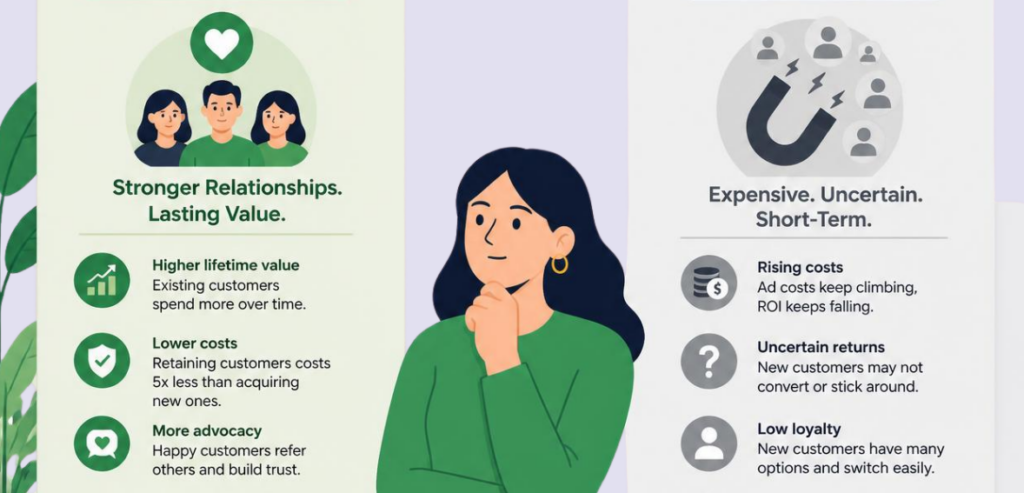
This is the most challenging phase of customer acquisition. The newly skeptical customer has no reason to trust you and is likely comparing competing offers, which means you spend more to acquire them, with little or no return.
While your new customers have no experience with your company, your existing customers are more likely to trust you with their money again. Most owners do not view this trust as an asset. The statistics of selling to an existing customer versus a new customer are in the owner’s favor. The chances of selling to an existing customer are between 60% and 70%, while the chances of selling to a new customer are between 5% and 20%.
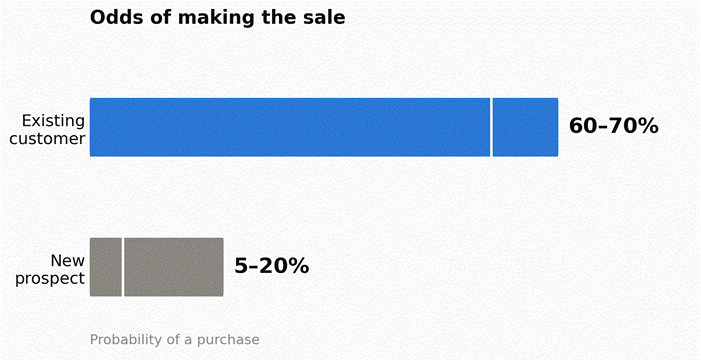
Figure 1: You are far more likely to sell to an existing customer than a new prospect.
This flips a few logical assumptions of marketing in a more cautious market. The more expensive game is the acquisition of customers. Taking the time to build stronger relationships with existing customers is the more cost-effective option. Customer retention is not a defensive marketing move; it is the most cost-effective marketing strategy.
There is a loyalty angle with the marketing psychology of value-seeking. Brands that build trust and reward their customers don’t see a large turnover in their customer base. Almost 79% of Millennials are brand loyal when a brand has a strong loyalty program. The distinction between a deal-seeker and a loyal customer is thin, and it can be the same person. The organization just has to provide an incentive for both.
Retention numbers seem too good to be true on the surface. Let’s go through the numbers step by step.
Generally, you can expect to pay five times as much to acquire a new customer compared to the cost of retention. This should be a good enough reason to shift how you allocate budget. Very few budgets reflect this as they continue to prioritize the top of the funnel to the detriment of the bottom.
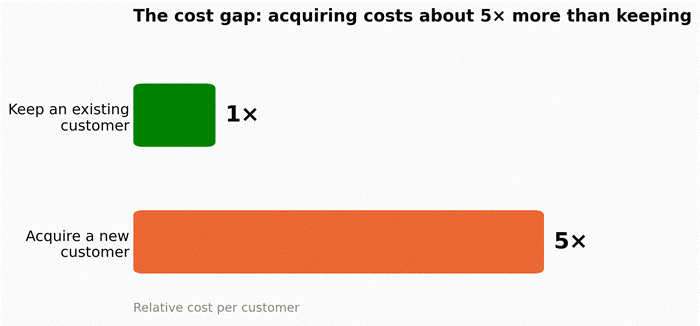
Figure 2: The cost of acquiring a new customer versus keeping one you already have.
Now consider profit because this is what is most important. Increasing customer retention by 5% improves profits by 25% to 95%. No, that is not a mistake. A slight increase in retention has an incredible benefit to profitability. Compounding is the reason for this. A customer that has been retained will purchase again, spend more, and will be less expensive to sell to again.
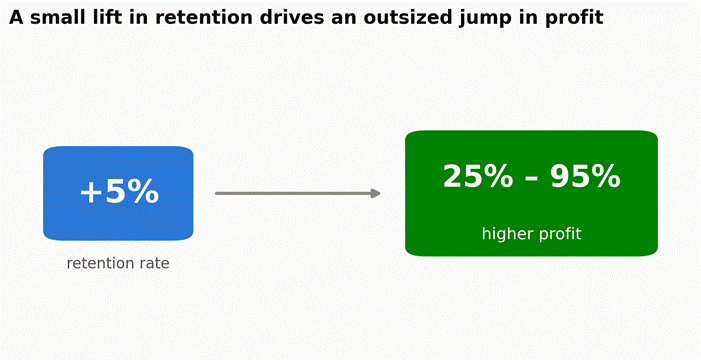
Figure 3: A 5% lift in retention can raise profits by 25% to 95%.
The spending gap is a phenomenon where current customers spend around 67% more than new customers. Simply put, loyalty builds deeper relationships and an even deeper wallet. About 65% of a company’s revenue comes from previous customers. Most owners evaluating retention programs focus on the cost and look away from the value.
Repeat customer marketing is where you see the potential of this value. Repeat customers need no advertising to get them to buy again. You are just reminding a friend that you are still there, which makes retention revenue the most cost-effective revenue there is.
Here’s how small businesses tend to fail. They create a loyalty program within a separate app. Customers must go through the hassle of downloading the app, creating an account, and remembering to use it. Spoiler alert: they don’t. The friction of having a separate app kills the program before it has the chance to start.
The solution is easy. Manage your loyalty program through the point-of-sale system you use every day. Your point-of-sale system recognizes who purchased what and when. Associate their rewards to a phone number or email. Done. No separate app. No friction. The customer just has to say their number and poof! Rewards.
This is even more important to a value-seeking shopper. The top reason people join a loyalty program is for a discount. In fact, 58% of loyalty program members said they join to receive program-specific savings. A point-of-sale-driven loyalty program gives savings to the customer at the moment of interest, which is when they are checking out.
The results speak for themselves. Loyalty programs, when executed correctly, tend to generate an increase in gross sales by 12% to 18% for the business. And, loyalty programs are welcomed by shoppers. 57% of shoppers tend to spend more money with a business they feel loyal to. It is potentially the best investment a business could make.
Square Loyalty exemplifies a POS-first system. It integrates directly into Square POS, which is utilized by numerous cafés, salons, and retailers. Square Loyalty allows customers to enroll at checkout using their phone number, so there’s no need for a separate app. Customers earn loyalty points automatically at every visit, and rewards are applied at checkout. This effectively eliminates the two biggest barriers to loyalty programs, cost and complexity, for small businesses. The data Square Loyalty captures integrates directly into the customer records, which sets up everything for the next section.
Once your POS system records the data associated with your customers’ purchases, you know the details of every customer purchase. You know the frequency of their visits. You know how much they spend. This data is highly valuable to any company. This is how your company markets itself at the lowest possible cost.
An offer is cheap and effective when it is highly relevant. A 20% coupon shared with the masses is expensive. Sending a small, carefully crafted offer to a customer is a much better investment. One example is the customer who buys coffee every Tuesday. Offering a free pastry on a slow Thursday will result in an additional purchase, at a cost of a single pastry to your company.
You are not expected to provide the lowest-priced goods. You are achieving the extraordinary by selling the perfect item for a customer, at the perfect time. This creates loyal customers. Poorly executed personalization will drive your customers away. About 39% of customers will stop buying your goods after a poorly executed offer.
The best part is that you will be marketing your products at a very low price. Entering a customer’s data and contact information is the bulk of the work. A carefully crafted email or text to your customer is your lowest-priced ad to date. This is highly valuable compared to the hundreds you lose on ads targeted to cold customers, who have never heard of you.
Some customers will inevitably leave, and that’s to be expected. The real error, however, is not attempting to keep them. Before they’ve really left, that’s your opportunity to launch a win-back campaign.
Begin by defining ‘quiet’ for your business. Most commonly, customers who have not purchased anything within the last 3-6 months have become dormant. This should be your cue to take action, and looking at your point-of-sale data will help you identify them with ease. As soon as that purchase gap occurs, that’s your cue to begin reaching out.
When crafting your outreach, warm is the tone to take, while desperate is not the tone to take. Lightly acknowledge the absence, and then remind the customer why they liked you in the first place. As for your pool of lapsed customers (also called dormant customers), typically this group is about 3-5 times larger than your active customers, so you can expect that even the smallest incentives will yield a substantial impact.
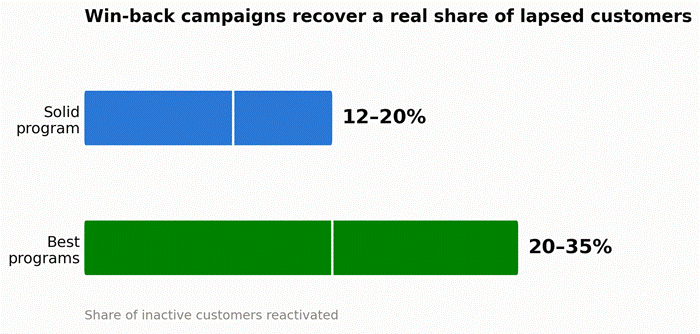
Figure 4: A well-run win-back program recovers a meaningful share of inactive customers.
The expense is worth it. Well-designed reactivation efforts return 12 – 20% of old customers. Top-tier reactivation efforts return 20 – 35%. The tight-budget-friendly part is that lapsed customers are five to ten times cheaper to win back than new customers are to acquire. The trust that had to be earned for each new customer has already been built.
The exact timing of the attempt to win back the clientele also matters. Attempts at re-establishing communication or a relationship that are too late will result in a permanently cold relationship. The ideal time for reaching out is approximately 120 to 180 days of silence. After that, most people will have no interest in your attempts to reach out. Build the plan, set the trigger, and allow it to operate in the background.
Discounts aren’t everything. The tactics in this section are largely free. One of these tactics involves exceeding expectations. This tactic is called ‘surprise and delight’.
Think about the last business that surprised you with an act of kindness. Did a barista remember your name? Did a shop give you a free sample? That small act means a lot. It creates a relationship, and relationships are what bring loyal customers.
This tactic is quite inexpensive. Two minutes and a stamp for a note. Free for a text. Remembering a regular’s order costs attention. To the business, these gestures are nothing. To the customer, it’s incredible.
This tactic works for emotional reasons over logical ones. People easily forget prices. People more easily remember good acts. One of these good acts will help someone forget about a higher price. In a market where 33% of customers will leave after one poor experience, the opposite also holds: one good act can keep a customer for years.
You can’t evaluate the success of something you can’t quantify. Retention has three key metrics. Each one describes a different dimension of the story. Collectively, they reveal the success of your loyalty strategies.
The repeat purchase rate refers to the percentage of your customers who make a repeat purchase. It’s your simplest form of a health check. A growing repeat purchase rate signifies that your work on customer retention is effective. On the other hand, a low, flat rate of repeat purchases indicates that customers have sampled your offerings and have not returned. Track this rate on a monthly basis and observe the trend rather than the value.
Frequency is defined by how often a customer purchases a particular time interval. Loyalty is stronger when it not only brings a customer back but brings them back more frequently. If your frequency is on the rise, this means you are successfully sending reminders and rewards to your customers. A coffee shop that successfully converts a customer from making a weekly visit to a daily one has been able to multiply the value of that customer without incurring any expense on advertisements.
Customer Lifetime Value (CLV) is an important measure of the profit attributed to the entire future relationship with a customer. It provides a clear justification for the value of customer retention. As your repeat purchase rate and purchase frequency increase, so will the customer lifetime value. A higher customer lifetime value justifies the money spent on customer loyalty programs. It communicates the maximum investment a company can spend to satisfy and retain an individual customer. An increasing customer lifetime value indicates that the customer retention and loyalty strategies are successful.
Action is the true measure of any strategy. This plan outlines a procedure over the next two months to enable the execution of that strategy via sequential steps of setup, outreach, and measurement.
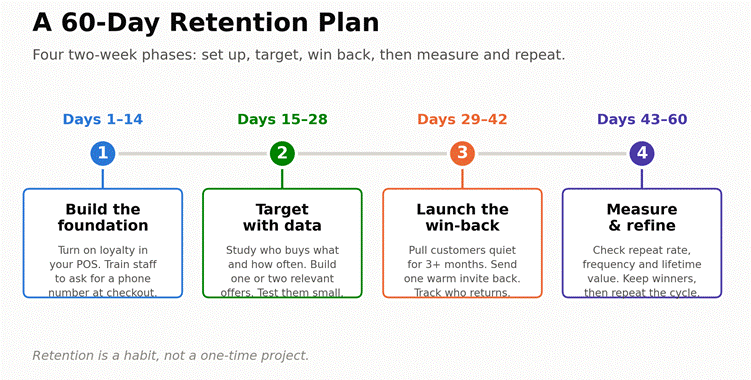
Figure 5: A simple 60-day path from setup to win-back to measurement.
The first two weeks are for groundwork. Enable loyalty options in your POS system. Educate your staff on how to request phone numbers for each transaction. Begin documentation of contact info for customers who consent. Groundwork like this should never be expedited as it lays the foundation for everything that follows.
Weeks three and four are for the application of groundwork. Analyze purchase patterns and frequency of purchases. Create a couple of basic offers that align with those patterns. Start small and offer to this customer segment through email and SMS. Wait for feedback and adjust based on what you learn.
Weeks five and six are for the implementation of the customer re-engagement process. Identify customers who haven’t purchased in the last three months. Develop an offer with a friendly tone. Email and SMS this offer. Measure the return rate. The re-engagement process often pays for itself with the first few redemptions.
The last two weeks are for learning. Measure the repeat purchase rate and the early customer lifetime value. Measure the success of offers. Eliminate offers with dismal response rates. Retention should be measured frequently as an ongoing process.
Your customers looking for the best deals are not your enemies. They show you how much value you are providing. Advertise to them through costly ads and meaningless discounts, and you will come up short. Provide what they need, when they want it, with genuine value, and they will be your customers for many years.
The math has been simple for a while, and you have probably heard this expression. It costs more to find a new customer than it does to keep an existing one. A slight increase in customer retention will lead to a much larger increase in profit. Your clients have already made a purchase, trust you, and you possess data about them. There is no need to search for a client in the cold market. The client is right in front of you when you make a sale.
Most of these ideas are inexpensive. They just need a little more thought. A loyalty program on your POS with a couple of good offers, a short note to win back, and a small act of goodwill will surpass most acquisition campaigns. Try the 60-day plan first. Keep an eye on your numbers, and you will see your quietest customers start to spread the word. Retention is not risky. It is the best strategy in today’s market.
It’s cheaper to keep a customer than to get a new one. It costs five times more to get a customer than to keep one. That five times more cost is due to trust. When a customer has no trust in you, you have to spend on marketing, offers, and time. With an existing customer, you don’t have to spend on trust, and existing customers have been shown to spend over 67% more than a new customer, so the retention efforts you have with your existing customer bring more value than the efforts you spend on gaining a new customer.
The easiest loyalty program runs on the same point-of-sale system you already have. There is no app to download. Customers enroll by providing their phone number during checkout. Customer loyalty points are created automatically on each visit. Customer loyalty rewards are redeemed at the register. This removes barriers that compromise most loyalty programs. It is inexpensive to operate and collects valuable purchase data at the same time. It is almost always the best option to use a POS-based program for a small business.
Start by identifying them. If a customer has become quiet and hasn’t bought anything in the last three to six months, reach out to them with an honest, warm message before it’s too late, in the next 120 to 180 days. If you take too long to send a recovery message, it will become increasingly difficult to win the customer back. When reaching out to them, be sure to remind them why they liked your business and provide them with a small, enticing offer to encourage them to return. A successful recovery campaign will get back 12 to 20% of the customers, and top-tier campaigns get back 20 to 35%. Additionally, a recovery win-back campaign will cost less than 20% of the total expected cost of acquiring a new customer.
While tracking metrics, you’ll want to focus on three numbers. The first is the repeat purchase rate. This metric is the share of customers who make repeat purchases. The next is purchase frequency. This metric considers the time interval in which customers make repeat purchases. The last is customer lifetime value. This metric considers the potential total profit that can be gained from a customer over the entire business-customer relationship. You should track these metrics on a monthly basis. The trends are what matter. An increase in the repeat purchase rate and the purchase frequency will cause an increase in the customer lifetime value. This value increase suggests that the business’s customer retention strategy is successfully gaining repeat customers and is a strategy worth keeping.
They could be even more important than ever. Value-seeking is not disloyalty. Actually, 58% of shoppers engage in loyalty programs to get discounts, and 57% of shoppers spend more money with the brands they are loyal to. When money is tight, loyalty programs that deliver value give shoppers reason to pick your brand over cheaper competitors. The most important element of a loyalty program is relevance. When rewards are relevant to customer habits, the price-sensitive customer will have a higher likelihood of shopping with your brand repeatedly.