

A full mat at the belt testing session is evidence that a system is functioning with feedback. An accumulation of declined credit cards and late payments the following day proves otherwise. Each month, martial arts school owners contend with real losses from unpaid belt-testing fees and incorrectly billed family accounts. Usually, students do not intend to skip payments. Rather, the billing system is the main hurdle. Martial arts school billing software addresses that gap.
It manages automated billing and belt testing fees as a separate line item, applies family discounts, and maintains your financial records in a ready-to-audit state with zero extra work on your part. This article describes the time-saving billing and payment tricks of the trade used by successful dojos, academies, and studios to maintain a healthy cash flow while maximizing student retention.
Parents view a martial arts studio the same way they view any subscription service. When they receive a faulty invoice, or their child is double-charged for a belt test, or the sibling discount disappears for just one month, they’re going to notice. Although the billing errors may create a bad impression, they aren’t likely to be intentional. When billing is a manual process, errors are inevitable when information is captured through paper logs, manual billing, and enrollment systems that are completely disconnected.
Billing that is systematic and consistent is more likely to build trust. Trust means families are more likely to stay, and a martial arts school will see more revenue from family retention rather than new student enrollment. Keeping satisfaction with families is equal to successful operations in a martial arts school.

Martial arts school billing software should go beyond simply processing credit cards. It should enable family-account billing at the household level, differentiate between recurring tuition and one-time belt-testing fees, and automatically apply family discounts. It should also automate renewal and failed-payment reminders and assist in generating reports for tax and revenue forecasts. Schools that have to combine all these functions with a generic payment app, spreadsheets, and sign-in sheets end up duplicating the work: once at the front desk and again during bank statement reconciliation.
Front desk personnel need a system that works at the front desk, not just one that runs from a back-end office. A modern point of sale (POS) system that integrates the sale of tuition, retail sale items such as sparring gear, and fees for school-sponsored events and workshops, and that processes all of these sales in one transaction, saves staff time during the front desk system’s busiest time of day: the time that students are arriving at the school to attend class.
The same front-desk pressure shows up across class-based fitness businesses, and the processing economics underneath it — interchange-plus versus flat-rate pricing, dunning sequences, integration versus bolt-on POS — are covered in our fitness and gym payment resources hub.

If schools want to compare subscription-based billing platforms, they should definitely consider Cloud Studio Manager. Their system provides a free point-of-sale solution tailored to businesses like Martial Arts Schools. With this system, business owners can charge tuition, make retail sales, and charge event fees, and do all of this from one screen. The owner does all of this with no additional cost for a different POS license. For a smaller school, or one just getting away from billing customers on paper, Cloud Studio Manager is a great way to modernize your billing into a fully online system. It is completely free for every school — there is no limited tier and nothing to upgrade to later.
Like a bank, martial arts schools must treat recurring payment systems with the utmost care. Clear payment authorizations must be signed by all students/guardians before any payment is taken, and they must include the designated amount, payment interval, and date, as well as the cancellation terms. This protects the school from chargebacks and the family from unexpected payment requests.
The US Chamber of Commerce outlines a system in which the payment plan is stated in simple terms and the plan, along with payment terms, is made apparent prior to checkout, with a description of the renewal and payment failure policies. Schools that incorporate this system into their payment structure will find that disputes and difficult payment-related conversations at the front desk are greatly reduced.
Recurring card-on-file payments must also include a system to handle payment failures. Cards that have expired or have been reissued account for the majority of failed payments, and the best way to ensure payment is taken is to have a system that automatically updates card details before each payment interval. This will keep a school’s funds secure without staff needing to interact with families about payment issues.

Of all possible billing methods, disputing belt testing fees is the most common among our clients. Because testing fees do not follow a regular schedule, families are more likely to be caught off guard by them than by tuition bills. A simple solution is to create a distinct line item for testing fees separate from tuition. The full fee schedule should be provided to families when they enroll.
One to two weeks prior to a testing cycle, sending an automated reminder with the testing fees and testing date helps eliminate confusion. Schools that incorporate testing fees into an increased monthly tuition bill are likely to receive more disputes compared to those that have a fee breakdown that lists the exam, new belt, and certificate.
Family discounts help martial arts schools retain entire households, rather than allowing them to drop to one weekly class. This model usually covers full tuition for the first family member, with each additional family member paying a reduced rate. The discount generally increases at subsequent tiers. This model has found that households with multiple students are a target demographic, while helping martial arts schools retain their finances.
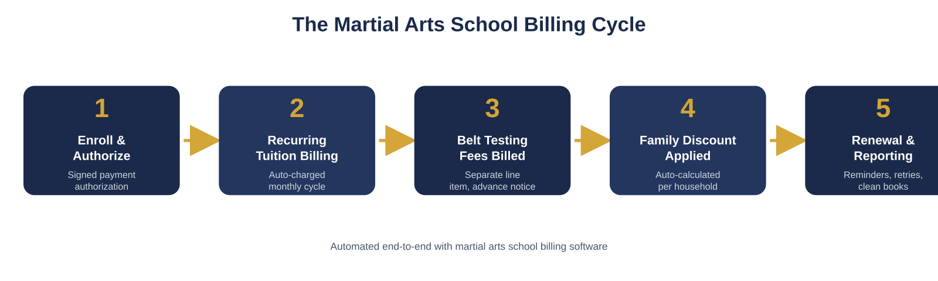
The end-to-end billing cycle, from enrollment authorization through renewal.
The discount only applies when it is automatically applied every month. Manually applying discounts to invoices for families causes billing problems, especially for schools that manage multiple students from the same family. Martial arts school billing software that recognizes linked families and applies the family discount tier without staff intervention eliminates the problem.

A sample family discount structure. Belt testing fees are typically billed outside this discount.
Not having family discount structures buried in contracts and keeping them visible to parents is worth noting. Family discount structures on enrollment pages, welcome packets, and application materials with noted savings at each discount tier provide families with reasons to enroll additional children at the school.
Declined tuition is typically caused by an expired card, technical issues, or insufficient funds, rather than any family’s refusal to pay tuition. When schools impose immediate late fees due to automatic billing failures, they ultimately damage their relationships with families much faster than they protect their revenue.
Best practices suggest adding automated card retries and establishing clear communication about billing declines as the two most effective ways to optimize your billing while retaining your customers. For a martial arts school, this means automatically retrying a card that was declined for payment, informing the family of the declined charge, providing an easy way to update card information via text or email, and reserving the late fee for families who have not updated their card information past the late fee grace period.
This method retains enrollment. Families who have a card mix-up and feel they were billed fairly are much more likely to retain their membership, whereas families who have an automated late fee due to a bank error typically end up shopping for a new school.

Because martial arts schools often serve minors, they have a greater responsibility to protect consumer data that is even more sensitive than the data handled by retail businesses. For example, storing customer payment information in a spreadsheet, notebook, or unsecured customer relationship management software is insecure and would violate consumer data protection laws.
As stated in the PCI compliance guide by the US Chamber of Commerce, businesses must assess what payment information they collect, identify any risks in the way that information is stored or transmitted, and do everything possible to avoid storing payment information. Sensitive payment information should only be stored in a secure, tokenized payment processing system.
Using martial arts school billing software with built-in PCI-compliant payment processing elevates the school’s responsibility for data security. The billing software provider tokenizes payment data so that the school’s computers do not have to store sensitive information.
This is even more of a trust issue for the parents. Knowing that a school does not store card numbers and instead uses a secure, tokenized payment system gives families more confidence to sign their child up for classes.
Lack of visibility on certain policies is the cause of most invoicing complaints. Plain language cancellation policies, testing fees, discount structures, and auto-renewal dates must be communicated prior to the first payment. These should not be hidden in long contracts that are never reread.
Simple, plain-language policies at signup, covering the timing of invoicing, the purpose of testing fees, the structure of discounts, and the cancellation policy, will eliminate the most common complaints to the front desk. Schools that do this well tend to explain invoices to parents and students far less often and have far more time to teach.
Manual renewal processes have two major issues. First, students who needed to renew are missed. Second, students who intended to cancel are still being charged. Both scenarios cost time and effort and result in a loss of trust. Predictability and ease in the billing and renewal process can be achieved by setting billing and renewal dates, providing a notice to renew a few days in advance, and implementing a simple mechanism for a family to request cancellation.
Refunds should follow the same logic. Documents that define a refund policy and ensure it is consistently applied through a billing system, rather than negotiated exceptions at the front desk, provide clean bookkeeping for tax time and defend against the perception of favoritism.
The table below summarizes the most common charges at a martial arts school, with and without a family discount application.
| Fee Type | Billing Frequency | Typical Range | Discount Eligible? |
| Monthly tuition | Recurring (monthly) | $100 – $200 | Yes – family discounts apply |
| Belt testing fees | Per test cycle | $30 – $75 | Usually no |
| Uniform/gear | One-time | $40 – $120 | No |
| Tournament entry | As scheduled | $25 – $60 | No |
| Annual registration | Yearly | $25 – $50 | Varies by school |
Typical fee structure for a US martial arts school. Ranges vary by region and program.
Billing is probably the most tedious aspect of running a martial arts school. However, billing systems interact with each family every month. Getting billing correct with automated, recurring tuition, clear belt testing fees, set family discounts, PCI-secure processing, and straightforward tuition policies protects a school’s revenue and leads to longer student retention. The right billing software solves day-to-day billing issues and allows staff to focus on the primary driver of growth for a school: a great class. A great way to modernize your billing and move away from paper at no cost is to use a free platform like Cloud Studio Manager’s POS — it is free for every school, not a limited tier.
The best billing software for martial arts schools varies by school, depending on its size and budget. However, the best options include some of the same features. Automatic, recurring tuition billing, family account grouping for family discounts, separate handling of belt testing fees, PCI compliance for payment processing, and membership business-tailored reporting are all examples. Cloud Studio Manager is a completely free option that lets schools handle tuition and retail sales at the point of sale.
Communicate testing dates and associated fees to parents in advance, and bill testing fees as a separate line item from monthly tuition. This avoids conflict by not rolling testing fees into an increased tuition or charging testing fees without alerting parents.
Most martial arts organizations request full payment for the initial family member’s tuition. Discounts of 10-20% would be applied to subsequent family members. The discounts would be tiered by the order of family members. The specific discount percentages will be determined by the local market, but the discount structures should be simple for parents to understand and consistent, so that no manual calculation is required for staff.
Yes. Because they offer a point-of-sale service at no cost, smaller martial arts schools can process payments for tuition and sales of items and services without incurring the cost of a dedicated POS license. And because it is free for everyone, it can serve as a permanent solution rather than a stopgap.
