Posted: October 09, 2026
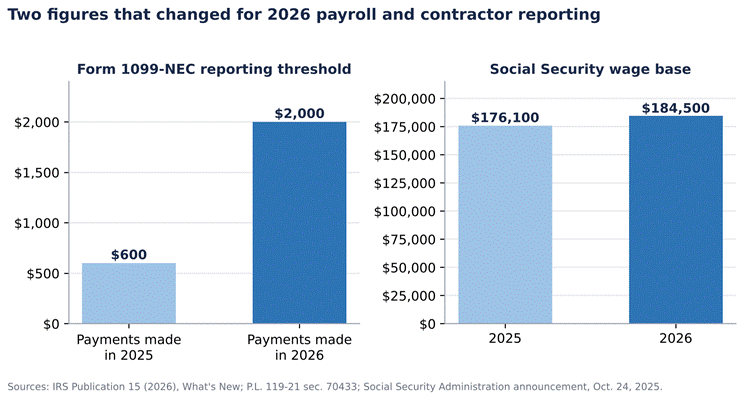
Rules governing payroll processing for 2026 are different from any previous years. One Big Beautiful Bill Act, signed on July 4, 2025, increased the threshold for 1099-NEC from $600 to $2,000. Three new box 12 codes were added to the 2026 W-2. The Social Security Administration also increased the taxable wage base to $184,500.
The due dates set by the IRS moved the deadline for filing 2026 W-2s to employees and to the SSA to February 1, 2027. As January 31, 2027, is a Sunday, the regular due date for small businesses to give employees their W-2s is moved to February 2, 2027. Employees have a set time to prepare payroll records, update employee records, verify employee time records, and close the payroll for the year.
This year-end payroll and timesheet checklist is based on the order the processes occur for end-of-the-year payroll. Starting with the time cards, this payroll checklist ends with the 2027 payroll calendar. Wherever possible, the federal legislation that supports each step of this payroll process is cited. Because laws vary from state to state, you may want to check with your state’s agency for payroll laws, and/or consult a payroll professional.
Three federal changes will affect year-end closes for 2026. The first is the contractor threshold. IRS Publication 15 (2026) states that starting for payments made after 2025, the reporting threshold for 1099s is $2,000. The same $2,000 threshold will apply for Form W-2 when no Federal income, Social Security or Medicare tax was withheld. The threshold is indexed for inflation.
The second is the wage base. On October 24, 2025, the SSA announced the wage base for 2026 will be increased to $184,500, on which the Social Security tax is computed at 6.2%. The 2025 wage base was $176,100. The 2026 total Social Security tax will be $11,439, of which the employee and the employer will each be responsible for paying $5,714.50.
The last change is the form itself. The 2026 Form W-2 has new codes for qualified overtime and Trump account contributions, as well as tips. Those codes are determined by pay and time off, which is why the 2026 Form W-2 has a new checklist starting with Timesheets.
Timesheets are the foundation of all year-end forms. Hours worked posted to a timesheet ultimately impact the employee’s W-2.
According to the Department of Labor’s Fact Sheet 21, the records employers must maintain for each non-exempt employee include: hours worked each day; total hours worked each week; regular hourly rate; total overtime pay for the week; and total wages for the pay period. A format for record keeping is not specified by the FLSA. The act mandates the records be accurate.
Fact Sheet 21 also establishes the retention periods for the payroll records. The payroll records, time cards, wage rate tables, and work schedules must be maintained for at least two and three years, respectively.
Starting in 2026, qualified overtime compensation will be added as a new box TT to Form W-2 to reflect the amount of qualified overtime compensation. The IRS defines this compensation as any compensation paid in excess of the employee’s regular rate as required under section 7 of the FLSA. To be clear, this is time and a half. Under P.L. 119-21, employees can claim up to $12,500, or $25,000 if married filing jointly.
The number in box TT is taken from overtime hours that are reported on timesheets, and may help explain issues regarding overtime pay. For example, weeks that span across two pay periods may cause overtime to be reported in the incorrect week. You should always check weeks that span across a pay period when closing your year.
Establish a cutoff date for the last 2026 timesheet submissions. Send all managers a report showing all timesheet entries that have not been approved. Approve, correct, or reject each of these entries. Adjust the final payroll of the year to lock the periods in the timekeeping system, so that timesheet changes cannot be made to affect 2026 total compensatory time.
Federal laws leave very little to work with to disregard them. In 29 CFR 785.11, work not requested but suffered or permitted is work time. If the employer knows or has reason to believe the employee is working, the time counts.
Treat an unapproved entry as a question, not a deletion. Ask the manager to confirm whether the work occurred. If the work occurred and was recorded as time worked, approve payment for it. If the entry was an error, correct the entry with a notation explaining the error and retain the time card to reflect the true time worked for the pay period. Compensatory time recorded after the final 2026 payroll should be recorded on the 2027 W-2, as it is payment for services rendered in 2027.

A misnamed SSN on a Form W-2 may result in rejection by the SSA. Forms 1099 with erroneous Taxpayer Identification Numbers can lead to penalties.
According to IRS Publication 15, the name and SSN of each employee must be copied from the Social Security card. The SSA, through its Business Services Online, offers the Social Security Number Verification Service (SSNVS). This service verifies if a name is associated with a particular SSN.
The 2026 W-2 instructions state that employers cannot accept an individual taxpayer identification number (ITIN) in place of an SSN, and must truncate an SSN on employee copies of the Form W-2. A copy of Form W-2 must never be filed with the SSA with an ITIN in place of an SSN. Confirm the mailing address of an employee as well. A timely mailed, addressed copy of Form W-2 is deemed to have been furnished.
According to Publication 15, each year employers must ask employees who have claimed exemption from federal withholding to provide a new Form W-4. As a reminder, Publication 15 states employees should provide Form W-4 if they need to change their withholding allowances. Employees who anticipate receiving new tip or overtime income can use a new W-4 to adjust their withholding.
Starting in 2026, a 1099-NEC will be required if the total payments to a payee in the year reach $2,000. In 2025, that limit was $600. Payments made to each vendor in the calendar year should be generated. Identify each payee who was paid $2,000 or more. Confirm those vendors have a Form W-9 on file.
According to Publication 15, payees who have not provided a correct TIN are subject to backup withholding at a rate of 24%. The 2026 Limitation on Federal Taxation Act (PL 119-21) increased the backup withholding threshold to $2,000 as well.
Also during the close, identify who is being paid as a contractor. Publication 15 states that a worker is an employee when the business has the right to control what will be done and how it will be done. Employers who have treated nonemployees as employees may be responsible for paying Social Security or the Medicare taxes as well as withholding income tax. The IRS has Form SS-8 to assist in worker classification.
The final payroll of the year sets the totals that all of the year-end forms report. With payroll, it’s the pay date that matters the most, not the pay period.
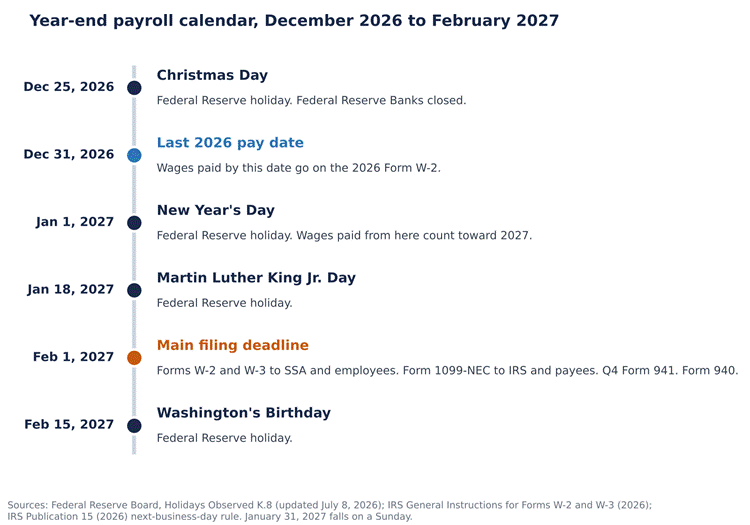
According to the IRS General Instructions for Forms W-2 and W-3, Form W-2 reflects the wages paid during a calendar year. If wages are earned in late December and paid in January, they are reported on the next year’s W-2. Therefore, wages paid on December 31, 2026, would be reflected on the 2026 W-2. Wages paid on January 1, 2027, or later, would be reported on the 2027 W-2.
Finally, many businesses pay year-end bonuses in their last payroll run. According to Publication 15 (2026), the withholding rate for supplemental wages is 22%. The withholding rate for supplemental wages in excess of $1 million paid to a single employee is 37% (entire year). This withholding rate also has been made permanent by P.L. 119-21, which continued the individual tax rates for 2017.
The Federal Reserve Board of Governors has declared both December 25, 2026, and January 1, 2027, as holidays. As such, both of those Fridays would be bank holidays. If a business has a Friday payroll deadline during either of those weeks, the submission would have to be moved up. Additionally, check with your payroll company to see what their cut off would be for either of those weeks.
First, confirm that withholding of Social Security taxes stopped at the $184,500 wage base for 2021 for high earners. According to Publication 15, for calendar year 2021, 0.9% Additional Medicare Tax must be withheld from wages paid in excess of $200,000 to any employee in the year. There is no employer share of this tax.
Next, review taxable fringe benefits. The value of the personal use of a company vehicle, including the commuting expenses of an employee, must be reported in 1, 3, and 5 boxes of the W-2. The cost of group-term life insurance in excess of $50,000 of coverage is reported in boxes 1, 3 and 5 and in box with code C (box 12).
Total amounts reported on Form W-3 are compared by the IRS against the four quarterly Forms 941 for the year. Run a year-to-date payroll register and compare the total wages, Social Security wages, Medicare wages, and withholding against the amounts reported on the quarterly forms. Resolve any discrepancies before filing.
Meets Deadlines: Most forms use the same date.
The 2026 instructions for Forms W-2 and W-3 state that Copies B, C, and 2 are due to employees on February 1, 2027. The same date applies to the filing of Copy A of Forms W-2 and W-3 and Forms W-3 with the SSA(Social Security Administration ). The due date for Form 1099-NEC is January 31 for both the IRS and the recipient. Publication 15 states that, if the due date for a tax return, payment, or other report falls on a Saturday, Sunday or legal holiday, the taxpayer has until the next business day to file it. Thus, the due dates for the 2027 forms will be February 1. The same rule applies to the fourth-quarter Form 941 and the annual Form 940.
Extensions are limited. An extension for filing Form W-2 with the SSA is not automatic. The Internal Revenue Service (IRS) allows a 30-day extension for filing Form W-2 with the IRS only for extraordinary situations or a declared disaster. A request on Form 15397 may provide an extension for the due date for employees to receive the forms. The instructions for the request state that an approval for 15 days or less is generally granted.
The Internal Revenue Service (IRS) finalized four changes to the 2026 Form W-2 for employees.
Box 14b is used when cash tips are reported in Box 12, Code TP. An employee can have up to two codes when tips are reported from more than one occupation.
The W-2 instructions mandate e-filing if at least 10 information returns are filed in a calendar year. The W-2 and the 1099 series forms are combined for this total. The business with six employees and four contractors is required to e-file because it is required to file at least 10 W-2 and 1099-NEC forms. The SSA’s Business Services Online site can generate up to 50 W-2 forms online. The IRS IRIS website provides free filing of 1099 forms.
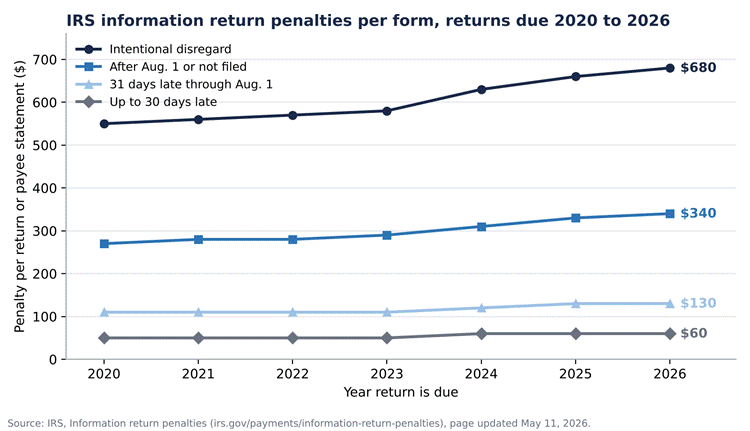
The IRS assesses a separate penalty for each incorrect or late information return and payee statement. In 2026, the IRS will assess $60 per form for forms filed 30 or fewer days late. The penalty rises to $130 for forms filed between August 1 and December 31 and increases to $340 for forms filed after January 1. Penalties for deliberate disregard are $680 per form and are unlimited. The instructions for the 2026 W-2 state that higher, inflation-adjusted amounts will apply to returns required to be filed after December 31, 2026.
Make any corrections to a Form W-2 on Form W-2c. Generally, send the corrected form to employees if the original form went to employees. If the original W-2 was electronically filed, the correction is also made electronically. Copies of the Forms W-2 and W-3 must be maintained for at least four years.
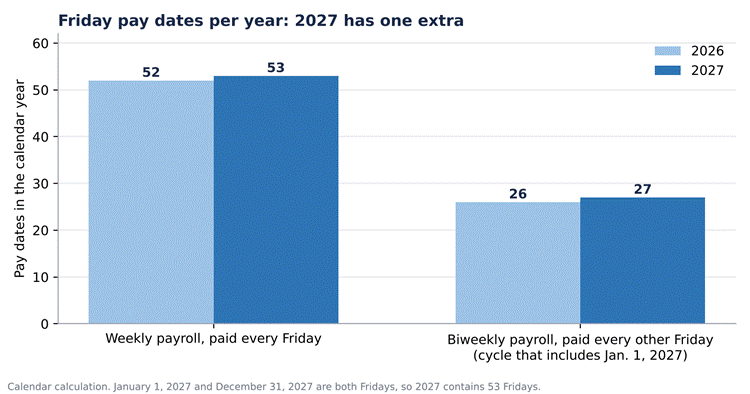
The calendar for 2027 has a strange occurrence relating to payroll. January 1st and December 31st of that year land both on a Friday. Thus, 2027 has 53 Fridays.
A payroll done weekly results in 53 pay periods in 2027 versus 52 in 2026. A biweekly payroll, with the exception of January 1, 2027, results in 27 pay periods in 2027 and 26 in 2026. Employees on an annual salary need a decision before January. To cover the entire cost, you can either divide the salary by 53 or 27 or keep the current amount and increase the budget.
The Federal Reserve has announced 11 holidays for the year 2027. A few of the holidays fall on a Monday, such as Martin Luther King, Jr. Day on January 18, Washington’s Birthday on February 15, and Labor Day on September 6. June 19th (Juneteenth) falls on a Saturday, and Independence Day (July 4th) falls on a Sunday. Federal Reserve offices will be closed on the Monday (July 5th) following Independence Day. Christmas (December 25th) also falls on a Saturday. Make a note of the location of these holidays in conjunction with your pay and tax deposit dates.
Publication 15 states that a statewide legal holiday does not delay the due date of federal tax deposits. For federal filing and deposit purposes, a legal holiday refers to a legal holiday in the District of Columbia. Tax deposits can be made using electronic funds transfer through EFTPS, IRS Direct Pay, or an IRS business tax account.
Update the 2027 Social Security wage base as it is released by the SSA. Update the 2027 Form 1099 threshold, which is indexed for inflation by P.L. 119-21, after 2026. Review the state unemployment rates as the state notices are received. Then set your records retention schedule.
| Record | Minimum retention | Source |
| Payroll records, including hours and wages paid | 3 years | DOL Fact Sheet 21 (FLSA) |
| Time cards, wage rate tables and work schedules | 2 years | DOL Fact Sheet 21 (FLSA) |
| All employment tax records, including Forms W-4 | 4 years | IRS Publication 15 (2026) |
| Copies of Forms W-2 and W-3 | 4 years | IRS Topic 752; W-2 instructions |
A year-end payroll checklist for 2026 is based on four federal facts. Hours worked are wages under 29 CFR 785.11 regardless if a manager approved them. Wages are attributed to the year they are paid, per the IRS calendar year rule. Contractor reporting begins at $2,000 for payments made in 2026. Forms W-2 and 1099-NEC for 2026 are due on February 1, 2027.
If a business closes timesheets in November, verifies names and TINs in December, and reconciles Forms 941 before January, they have the full month of January to file. The 2027 calendar opens with 53 Fridays, including the first one on January 1.
There is no federal rule that defines a due date for final payroll of the year. Wages paid on or before December 31, 2026 are allowed to be included in the 2026 W-2. Christmas Day and New Year’s Day are Federal Reserve Holidays, so payrolls due in those weeks should be submitted early.
SSNVS (Social Security Administration’s [SSA] online service) can be used to confirm SSN and name match. SSA’s address can be confirmed using SSNVS. Ensure that the totals of W-2s match the totals of the 4 Forms 941, and confirm the new codes TT, TP, and TA.
Check with the manager to confirm if work was done. Known work should be paid, per 29 CFR 785.11. A note should be added to explain the adjustment.