
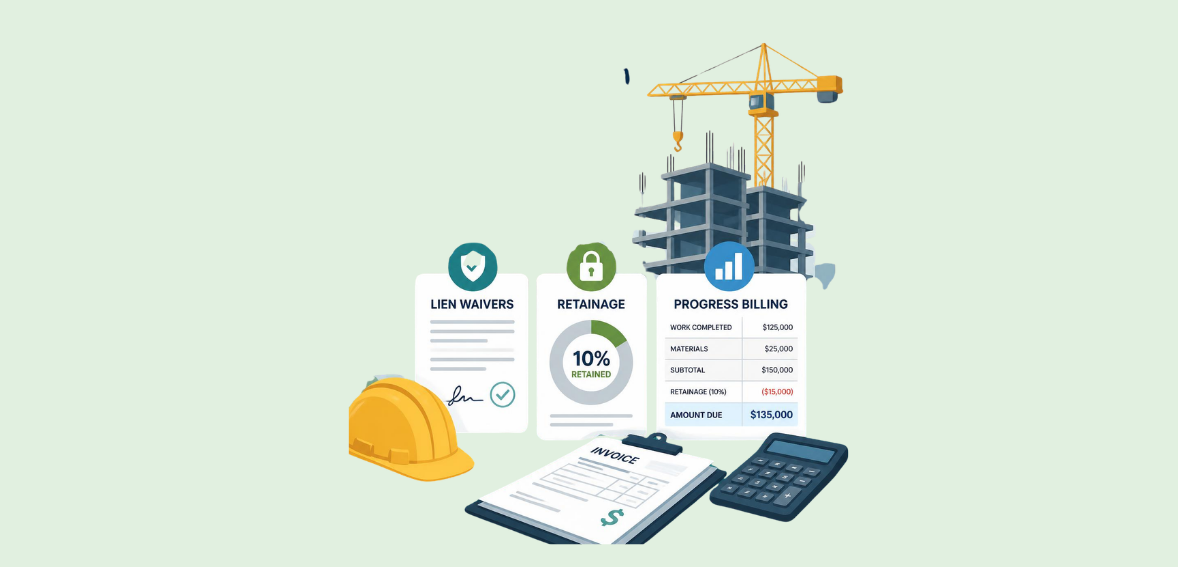
With small repairs, getting paid is easy. You complete the work, send the invoice, and wait for the check to arrive. However, large construction jobs do not operate in this manner. Once a job begins, the money leaves your hands and goes to layers upon layers of owners, subcontractors, and suppliers, only to return to you many months later.
To help manage this money-moving risk, the construction industry created a vocabulary with the terms lien waivers, retainage, progress billing, the schedule of values, and mechanics lien. These construction payment terms can be summarized by saying the construction industry has developed clever language to explain who gets paid, how, when, and for what amount.
The construction money cycle is intricate, and if you are unable to keep up with its structure, you will see the consequences. Many times, subcontractors will sign away their lien rights without realizing it, retainage will be held for years, and suppliers will lose their mechanics lien protection. This guide explains each term and shows how the documents fit together across one construction money cycle.
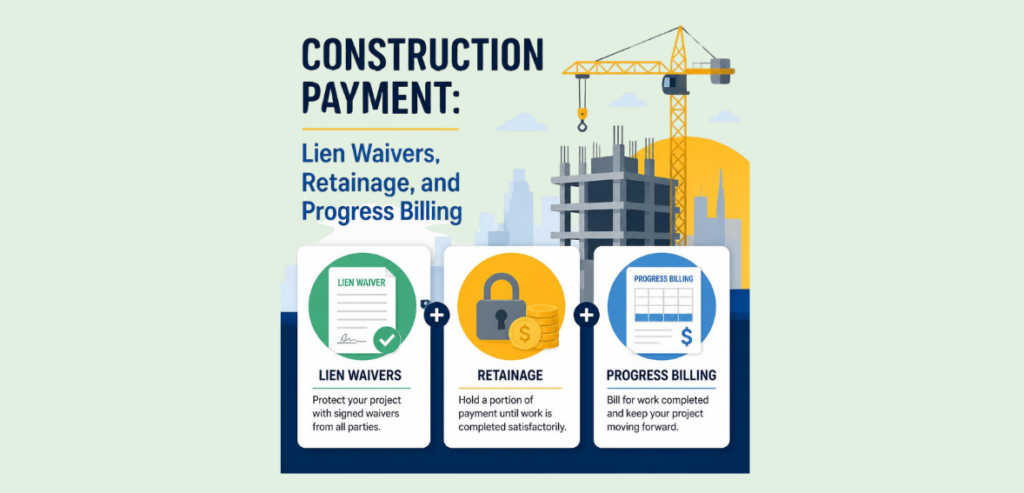
Imagine money as a stream running downhill. The property builder/owner sits at the summit and finances the project, usually with a construction loan. The builder/owner pays the general contractor (GC). The GC pays the sub-contractors. The sub-contractors pay their own sub-subcontractors and suppliers. Each dollar reaching the bottom of the chain flows through those above it on the chain.
This is where the flow of money meets resistance. The property owner wants evidence that everyone below the general contractor has been paid before they release money to the general contractor. The subcontractor wants the money before they sign anything. Each party wants to avoid the situation of having to pay twice for the work.
The remedy behind this standoff is the mechanics lien. When anyone who has provided labor or materials to a project is unpaid, they can lien the property. Mechanics liens will disrupt the selling of the property, upset a lender, and halt a construction project. To minimize the consequences of a mechanics lien, the contractor pays the subcontractor, and in return, the subcontractor waives the mechanics lien.
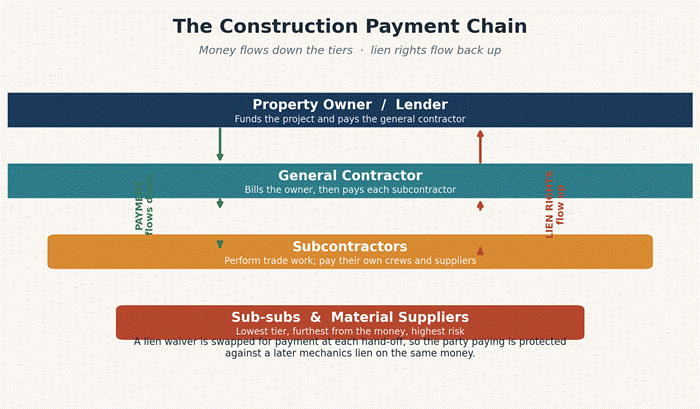
Figure 1 — Payment flows down the tiers while lien rights flow back up.
A lien waiver is a document that is signed to finalize a payment. The paying party demands a waiver as a condition of making the payment. The party being paid signs it to forfeit the right to file a mechanics lien for the payment made. It is similar to a receipt that states, “I will not lien this job for this payment.” The term lien release is used in some states; however, those may have different meanings, so be cautious.
Across the U.S., there are four types of waivers. They can be separated by asking two questions. First, has the payment cleared, or is it still pending? Answering this makes the waiver conditional or unconditional. Second, is this payment the last in the series or one in the series? This makes a waiver a progress or final waiver. These questions can be combined to identify the four standard forms.
A conditional progress waiver covers a single interim payment and takes effect once that payment clears. A conditional final waiver does the same for the last payment on the project. An unconditional progress waiver covers one payment period the instant it is signed. An unconditional final waiver covers the entire project the instant it is signed. Using the incorrect waiver for your situation is one of the most costly errors in construction finance.
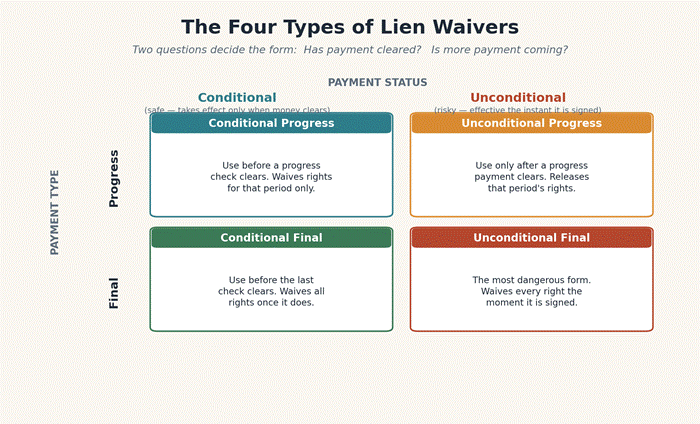
Figure 2 — The four waiver types, sorted by payment status and payment stage.
Levelset publishes some of the most-used public guidance on this topic and provides free waiver forms and automation tools. Their resources state waivers are exchanged millions of times per year, usually signed and passed on with little or no thought. That is exactly when problems can occur. Review Levelset’s material at levelset.com; their lien waiver hub goes in depth on all four waiver types.
This distinction deserves its own section due to the unique nature of disappearing money. A conditional lien waiver is only effective upon the receipt of payment. If the check bounces or does not arrive, your lien rights remain. This is the safest option and the one intended to break the deadlock between payment and signing.
The reverse is true for an unconditional lien waiver. This becomes effective the moment you sign it, regardless of whether or not you have received payment. Sign one, and you have forfeited your leverage for nothing. With this, the payment has failed, and it is more difficult to recover.
The rule of thumb is pretty simple. Use conditional lien waivers until the payment has cleared your account. Then, you sign the unconditional waivers. The trap is exactly in the reversal.
It is not a matter of theory. A prominent Texas case involving the large contractor Zachry Construction turned on release language in routine payment paperwork. The owner argued the language waived rights unrelated to the payments, and it took the contractor years of litigation, all the way to the Texas Supreme Court, to fight that reading. The blunt lesson here is to read every line before signing. Do not assume that the waiver is only related to the payment you are receiving.

Retention occurs when the owner or general contractor withholds a percentage of payment until the completion of the contract. A percentage of each progress payment, typically between 5% and 10%, is held back as leverage to incentivize proper completion of the contracted work and the resolution of any punch list items.
For a 10% retention on a $100,000 contract, $10,000 will eventually be retained. However, that $10,000 will be withheld as a progress payment by progress payment until contract completion. For each payment, the contractor will receive the payment that is earned, except for retention.
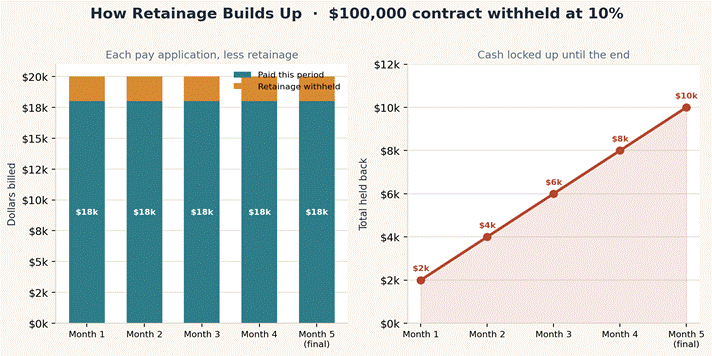
Figure 3 — Retainage skims a slice off every pay application and pools until the end.
The main issue is with the timing of the release. Typically, retainage is released at the end of an entire construction project, as opposed to the end of your specific work. A subcontractor, for example, who has an early trade, may wait for months or even years to receive their retainage. This holds subcontractors’ capital and is a cash flow burden, especially for smaller firms.
There is also a “strict deadline” dilemma. The time to file a mechanics lien can elapse before the end of the construction project and before the retainage is due. If you wait too long to file a lien, you could lose the lien right to the money. Most contractors negotiate for a release of retainage as soon as the work is completed, and retention bonds are used in place of retainage at times.
A word of caution for this entire guide: mechanics lien and retainage laws are usually specific to each state and in some cases, specific to a project type. For instance, private construction jobs in Texas will usually have a ten percent retainage; however, in New Mexico, retainage is prohibited. Always check the state laws before proceeding with your work. This article has no legal standing.
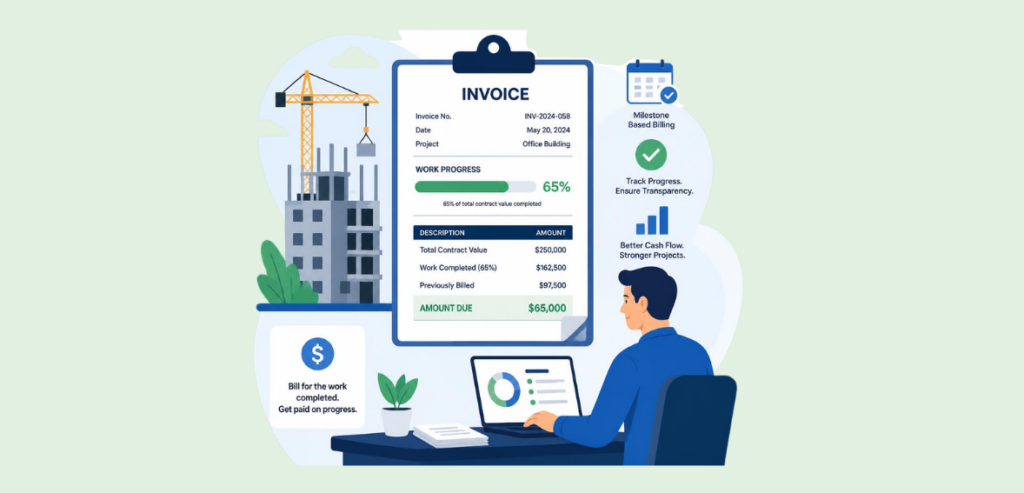
Contractors can’t afford to wait months to get paid after finishing the work. So big jobs get paid in chunks as the work progresses. This is known as progress billing. Invoicing after each work chunk is done helps sustain cash flow up and down the work chain.
Progress billing is made possible by a schedule of values (SOV). The SOV is a breakdown of the work needed to complete the contract and its cost. Once the dollar value is given to each completion task, the sum will be the total contract value. Before work starts, the general contractor drafts the SOV and gets the owner’s approval.
The SOV is updated after each progress billing cycle to reflect the dollar value of the work completed. The newly completed work essentially determines the value of the payment requested. Owners use the SOV to confirm the fairness of the amount requested.
The schedule of values is a billing tool as well as a progress tracking tool. The improper practice of “front-loading” a schedule may appear to help early cash flow, but it actually creates more cash flow risk later. This is because the early billings outrun the early work, leaving the late-stage work underfunded. Owners and lenders are aware of this practice, and an unbalanced schedule raises red flags.
The pay application, or pay app for short, is the document on which a progress bill is carried on. In most commercial jobs, it follows a two-part format based on the AIA G702 and G703 forms.
The first form, G702, is a summary cover sheet and is titled Application and Certificate for Payment. This form shows the total Contract Amount, Total Completed to Date, Total Withheld, Total Previously Paid, and the Total Due. There is a signature block for the general contractor to apply for the payment and for the architect to certify that the work has been completed.
The second form, G703, is the continuation sheet and works as a schedule of values. This form breaks the contract into a list of items and, for each item, shows the scheduled value, work completed in previous periods, work completed in the current period, any stored material, % of completion, the balance remaining, and retainage. In short, the G702 form shows you the total amount, and the G703 form shows you the detailed work.
Typically, a lien waiver is submitted with the pay app. The party making the payment requires a signed waiver to be submitted with the payment. This is why each of the topics of retainage, progress billing, and waiver is not a separate topic, as each is part of the same monthly cycle.
A mechanics lien is the critical backbone of the system. This lien provides the right to an individual or entity that has not been paid for the provision of labor or material to record the lien on the subject property. Because a lien clouds the title, it serves its purpose well to compel payment. The existence of lien waivers is more for the management of risk than for the mechanics lien to be filed.
In most states, a preliminary notice is required to preserve lien rights. This notice is sent to the owner, lender, or general contractor to notify them of the intent to work on the project. It serves to preserve the right to lien if payment is not made. It does not constitute a lien and is not meant to serve as a threat. However, in some states, not sending a preliminary notice will result in the forfeiture of the right to lien.
After a preliminary notice has been sent, the process is governed by very strict time constraints. These time limits vary considerably from state to state for each of the subsequent steps. A claim can very easily be rendered invalid as a result of a single oversight in a single state. For these reasons, tracking lien requirements is a critical administrative task for many firms.
This is the way things fit together in one month. After completing the phase, a subcontractor completes a pay application with the schedule of values using the G702 and G703. The general contractor and/or architect reviews the claimed percentages and certifies the amount that is truly complete.
The payment is still in process, so the subcontractor signs a conditional progress waiver to allow the general contractor to release the payment. The general contractor makes the payment, keeping retainage. The subcontractor then signs the unconditional progress waiver after the payment clears, confirming the payment for that period has been completed.
This process is repeated for every billing cycle. The retainage taken for each payment is accumulated and is paid out at the end of the project, after substantial completion, and is usually paid after the conditional final waiver and, once payment clears, the unconditional final waiver is signed. If the order of the waivers is incorrect, you risk waiving rights to money you have not actually received.
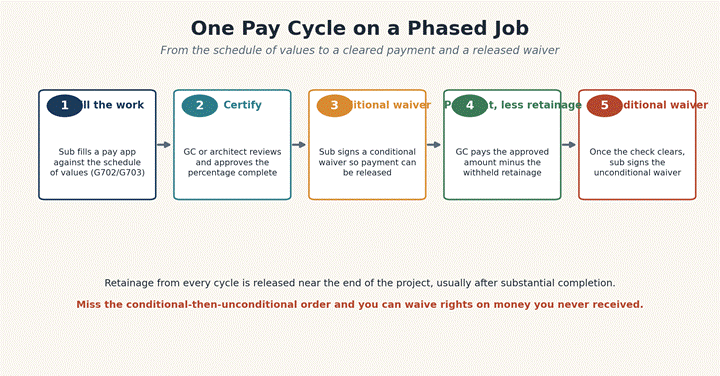
Figure 4 — One billing cycle, start to finish, on a phased project.
The above paperwork is where you lose jobs. There is a hefty administrative burden associated with tracking who owes what waiver, which notices have been sent, and when retainage is due. There are a couple of resources that help to lighten the burden.
Levelset is all about construction payment. Levelset automates the waiver exchange process and offers free waiver and notice forms, waiver and notice deadline calculators, and lien and retainage guides for all fifty states. For a company that is inundated with waiver requests, automating the exchange process is a big deal.
HMS Contractor and Field-Service Processing
Contractors and field-service operators who need a single workflow for billing and job data can use Cloud Job Manager, the free field-service platform backed by Host Merchant Services. It pairs your billing data with your waiver process, and combined with disciplined job costing, it allows you to trace each pay application to the true cost of the work. As a result, retainage and progress billing will not mask a diminishing margin.
The SBA is the federal agency dedicated to small businesses, and it provides one of the best introductory cash-flow management guides out there. Owners who want to create a better financial structure for their business will appreciate this resource. Go to the SBA.gov business guide.
One might think that lien waivers, retainage, and progress billing are three separate issues, but in reality, they are three components of a single system used to ensure that appropriate payment is disbursed to the appropriate parties at the appropriate time on large-scale projects that cannot be settled with a single payment. The combination of progress billing and the schedule of values outlines the limit of what can be billed. The retainage is an amount temporarily withheld to ensure that the work is completed and satisfies the requirements. To complete the cycle, lien waivers are signed, and the mechanics lien rights are reserved in the case of ultimate failure.
Getting the rhythm down and sticking to the process works, and it turns the system to your advantage. Sign conditional waivers until payment clears, track the retainage you are owed, maintain an honest schedule of values, and never miss a notice or lien deadline. Since the laws vary for each state, use the information provided here as a basis to find the current laws for your project location. The contractors who learn this language become reliable and predictable in receiving payment.
A construction lien waiver is a document exchanged when a payment is made in accordance with a contract. The party receiving payment signs the waiver and relinquishes its right to file a mechanics lien for the payment. It provides the paying party security against future claims for the same payment, acting as both a receipt for the payment and a release of lien rights.
A conditional waiver releases lien rights only after payment is received and cleared; an unconditional waiver releases them the moment you sign, cleared or not.
Retainage means retention. This refers to the percentages of a progress payment amount the owner/general contractor withholds until project completion (usually 5% – 10%). The withheld amounts are meant to ensure the contractor finishes the work and are usually released at the project’s end.
With progress billing, a contractor can send out multiple invoices during the course of the project, as opposed to sending a single invoice upon project completion. After each billing period, the contractor makes updates to the work’s schedule of values to reflect the completed portion of the work. The contractor then submits a pay application for the completed work, less the retainage. The owner compares the request to the schedule and makes the payment for the certified work.
Yes. 12 states have specific statutory waiver forms. Other states do allow some discretion to the parties for the language. Only a few states require notarization. Retainage limits, notice periods, and time limits for filing a lien, if applicable, all vary state by state and sometimes by the type of construction project. Always check the rules for the particular state where your construction projects are located before relying on any general rules.