
Posted: September 04, 2026 | Updated: September 22, 2026 at 3:53 PM
When one of the apps most widely used by small business owners was in the news this past summer, it was as part of a $45 million settlement. The app, Cash App, is owned by Block, Inc. Cash App settled with 46 states after regulators claimed Cash App misled consumers about fraud protection and failed to protect activities that consumers believed were covered. The underlying issue is that Cash App built tools and technologies that are meant for person-to-person payments and should never be used for business-to-customer payments as those tools are designed for low volumes and do not provide adequate protection from liability.
Hundreds of thousands of transactions happen through Cash App and other payment apps as consumers pay small businesses every day. Cash App makes it very easy to use, so business owners often set it up and never think about doing something better. Business owners who collect their revenue through a P2P app do themselves a disservice by not using a real piece of business software to manage their finances. Using a payment app means you have no recourse if something goes wrong. With the Cash App settlement, it is clear that there is a huge difference between ease of use and reliability.
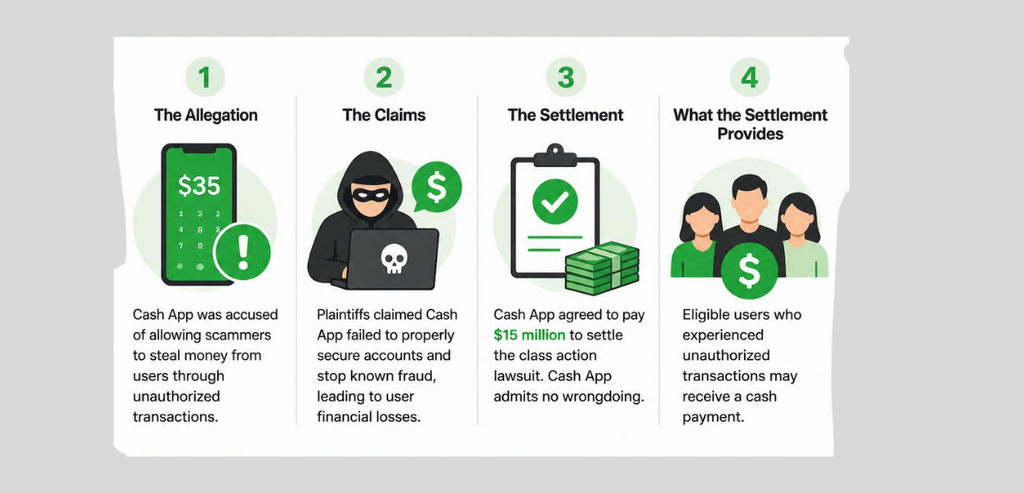
On July 8, 2026, Block agreed to pay $45 million to settle a multistate probe into Cash App. Oregon and Texas led the investigation, and the 46 participating states filed the settlement in their respective state courts. Regulators said Block misled customers about Cash App’s safety measures and failed to provide fraud protection.
Block will create customer support systems for fraud complaints and account lockouts. Block has agreed to have a phone support line active for at least 13.5 hours a day and a chat support system for at least 18 hours a day. States are also reviewing Cash App’s “Cash App Fridays” promotion that rewarded payment posts with a prize and exposed users to scamming.
This is not Block’s first scrape with regulators. In January 2025, Block agreed to pay $255 million to 48 states and the Consumer Financial Protection Bureau over failures to comply with fraud protection and consumer protection laws, with a promise to provide at least $75 million in reimbursement to consumers. Additionally, Cash App was ordered to pay Washington state $20 million for funneling fraudulent unemployment benefits in the wake of the pandemic. Block argues this settlement resolves a legacy Cash App case and says its current practices have improved protection for consumers.
The three actions combined span approximately eighteen months and over $300 million in total penalties and redress. No single amount is the most important here. Length and timing matter. Regulators only return to the same entity within a year or two when there is a persistent pattern of related complaints. To a business owner judging whether it is worth using a given platform for revenue, the clear enforcement pattern is many times more persuasive than any individual media article.
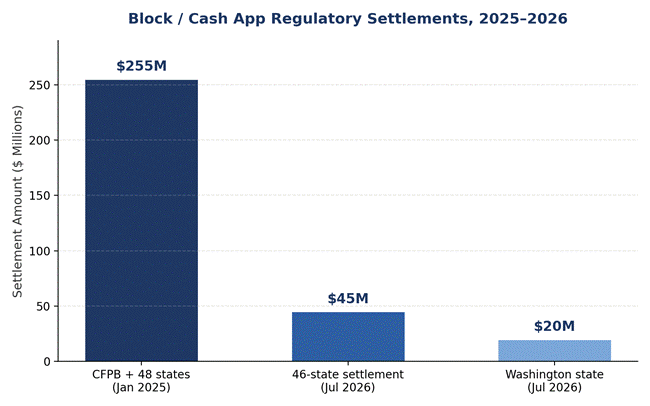
Sourced: Payments Dive coverage of the $45M Cash App settlement, July 2026.
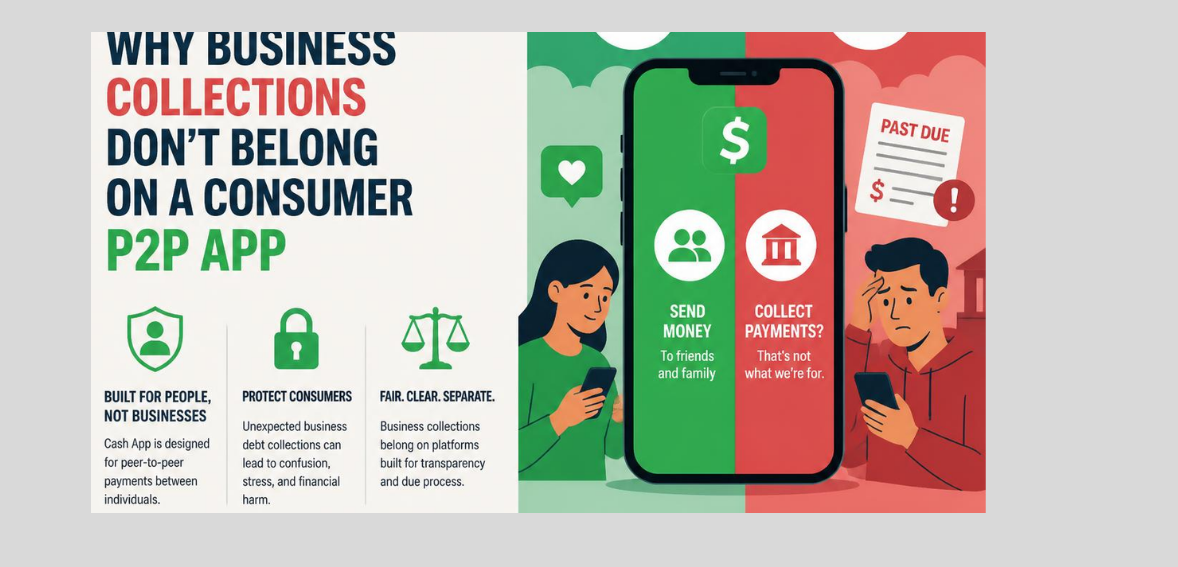
Peer-to-peer money transfer apps are intended for situations where people transfer funds between one another. Examples include splitting a bill, sending a gift, or repaying a small personal debt. In these situations, the risk is very low. Business collections are very different in that one party purchases goods from the other party and funds the transaction. There are risks for both sides of the transaction, and it’s possible that funds will not be received. The transfer of funds must be verified and provide a means for recourse in case there is a dispute.
The payment industry was built to address problems associated with the collection of funds. This involves the underwriting of a merchant, determination of merchant identity, and the signing of an agreement to resolve disputes. P2P consumer apps avoid most of these issues because they were not intended to manage a commercial relationship. When a business owner transfers funds from a customer to a personal P2P money transfer app, the app processes that transaction as a P2P transfer even though the relationship is commercial.
The Cash App settlement emphasizes this conflict. Regulators found that consumers didn’t receive protections that they believed they had. Higher volume, more frequent transactions, and larger dollar amounts increase the risks for a business owner collecting customer payments through consumer payment rails.
Along with everything else, there is also a volume issue. A personal user might make a couple of P2P transfers each month. A business that collects customer payments could be processing dozens or hundreds of transactions through that account per week. Consumer apps were never load tested from the risk and support perspective to handle that sort of commercial volume. An account that used to be OK with casual transfers can start triggering reviews and get flagged for holds or even freezes, all because it is starting to behave like a business, which is the exact behavior the app was never designed to support.
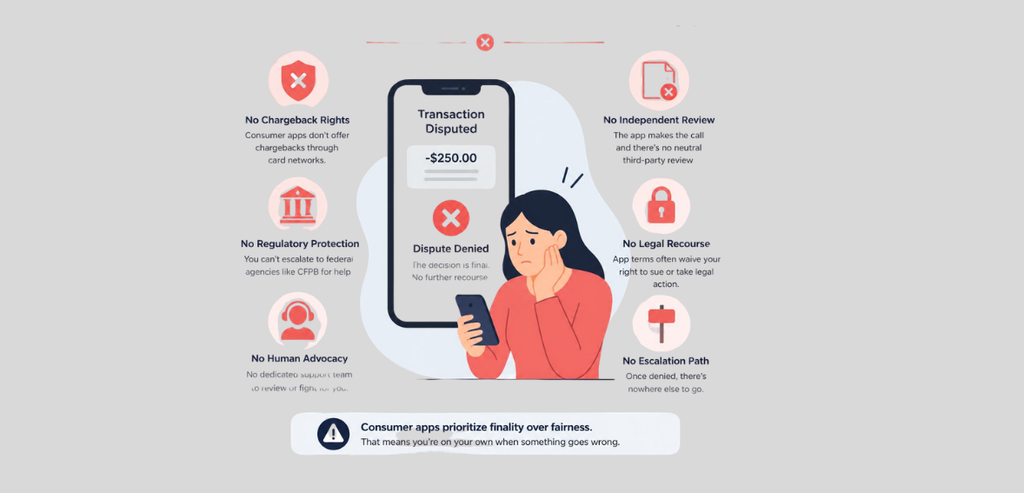
The Federal Trade Commission has said that compared to credit card transactions, P2P payment schemes provide significantly less protection to consumers. In fact, P2P payment schemes mimic cash transactions. Consumers have little right to recourse; once sent, the money is effectively gone unless the payee chooses to return it. There is no contractual dispute process.
For a business receiving payments, the effects are the same, but in the opposite direction. There is no standard process for the business to demonstrate the service was rendered, no documentation trail for commercial disputes, and no agreed-upon approach for resolving a dispute at a given network. If the customer claims they never received the service, or reverses the payment after the fact, the business has little more than a chat log available. In comparison, a merchant account provides a network-based dispute resolution for both parties.
This asymmetry isn’t good for anyone. Let’s say a customer gets scammed on a P2P app. In that case, there’s (currently) little chance for that customer to recover their losses. This is the same instance that the regulators pointed to in their case to justify the settlement. An honest business owner is in the same spot. There’s no formal representation process, so that business owner is also at the mercy of the system with no appeal process like the one card network rules provide.
Fraud handling was a primary concern in the states’ Cash App investigation. As the investigation detailed, Cash App understood that P2P services were target-rich environments for scammers. Despite that, Cash App continued to promote a service that revealed usernames to scammers and did not provide assistance to users whose accounts were compromised. Under the new settlement, Block will be obligated to establish a minimum threshold for support hours, something regulators clearly believed was lacking earlier.
In the case of a business, that particular support deficiency matters even more than it does for an individual user. One personal account fraud incident is painful. For a business, if the primary collection tool has a pattern of fraud incidents, cash flow can be totally restricted, especially if the tool locks the account during its investigation. Consumer apps lack the support and structure to address the business-level fraud that has the potential to lock accounts and stop business.
The Federal Trade Commission explains how P2P scams usually work. Scammers pose as a bank or business, or impersonate one of the victim’s contacts, and convince victims to send them money. A business account is a very attractive target for the same scheme because there is a much greater motivation to scam an account with a lot of activity compared to one used personally for a few transfers. Business owners have a greater fraud risk exposure, with no added protection.
Using a personal payment app to run a business leaves a significant paperwork problem. Peer-to-peer (P2P) accounts do not differentiate between personal and business transactions, which requires additional labor and increases the risk of underreporting revenue. Payment volume greater than what is expected can push the account past reporting thresholds and complicate tax filings, since personal and business activity are mixed in one account.
The uncertainty surrounding the use of personal payment accounts is resolved from the outset with a merchant account. Each transaction is logged to a business account and is presented to the business as a net sales report. The reports give an accountant a clean view of the records and are ideal for an audit or a loan application, as revenue is clearly documented for each transaction.
HMS Pay targets the void left by consumer P2P apps. Having a merchant account gives a business its own identity in the card networks, which gives each business the ability to process transactions with the appropriate merchant category code, and gives businesses the right to dispute transactions as well as the ability to view the data as soon as a sale happens. Instead of sharing a support chat with millions of casual P2P users, a merchant account provides risk surveillance and chargeback tools.
The nature of the problem really shows itself when something goes wrong. A merchant account transaction processor would be able to analyze the flow of transactions and stop what could become a fraudulent event before it is too late. Unlike a consumer application, a merchant account processor is also able to guide the business through the formal disputing process and provide the requested documentation for filing taxes.
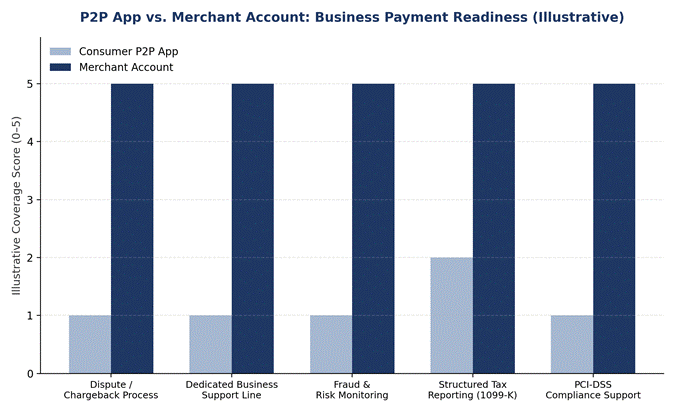
Illustrative: Relative feature coverage varies by provider and account type. The numbers presented do not represent a specific vendor’s scoring.
P2P apps are useful for quickly and easily sending money to people you trust, and the use case for that will almost certainly remain. Someone asking a friend to reimburse them, a roommate paying their half of the electric bill, or a parent sending their child an allowance are all transactions that P2P apps can be used for, and there is virtually no risk to the transactions.
Things get problematic when money begins to move to or from people who are not known, or when the transactions are really business transactions. Recurring customer transactions, services for which an invoice has been sent, sales via an e-commerce platform, and transactions for which the buyer may claim that what they received was not right are all transfers that should be done on the payment rails designed for commerce.
The Cash App settlement is a good example to show that even for the app’s typical consumer, the app’s services were lacking what the regulatory agencies required. It is a considerable risk for a business owner to use the app’s payment rails when the app was not designed for payments in commercial contexts.
Moving off a personal payment app should not disrupt a business’s cash flow. The process typically begins by opening a proper merchant account and undergoing some basic underwriting. After underwriting is complete and the business is established, a payment link, invoicing tool, or card reader can be used in place of informal collection methods, usually within days rather than weeks.
The people side of the change usually takes longer. Customers need to be directed to the new payment method, and the business must no longer use the P2P app as a backup. Using both at the same time creates the same issues this article addressed with respect to reconciliation and fraud exposure. A clean cutoff, followed by business communication to customers, is the only way to address the problem the settlement exposed.
The Cash App Settlement is a consumer protection action on the state level. It is not, on its face, about business payments. However, it shows exactly why consumer P2P apps and business collections should not overlap. The consumer P2P apps suffer from weak dispute resolution, thin fraud support, and poor recordkeeping. Those may be slight annoyances when it is a consumer transfer.
A merchant account is designed to fill those gaps and offers underwriting, dispute rights, and reporting, among other things. Merchants that collect payment through consumer-focused apps take on little to no risk when they move to a dedicated merchant account. The settlement does a good job of focusing their attention on moving collections away from consumer-focused apps.
Commercial transactions should make P2P app users pause. Most P2P apps are put together to facilitate consumer transactions and as such, do not have the necessary built-in tools, automation, systems, and reporting for dispute resolution or management to address the needs of a growing business.
In its settlement, Block agreed to pay $45 million to 46 states to resolve claims of misrepresenting its fraud protections and support.
A merchant account is designed as a business account with dispute and reporting rights. A P2P account is a personal account for peer-to-peer transactions.
Usually not. Rights and recourse rest in the discretion of the payment app.
Yes, especially if you accept customer payments on a regular basis. A merchant account aids in the protection of your revenue and clean reporting for taxes.