
Posted: August 13, 2026
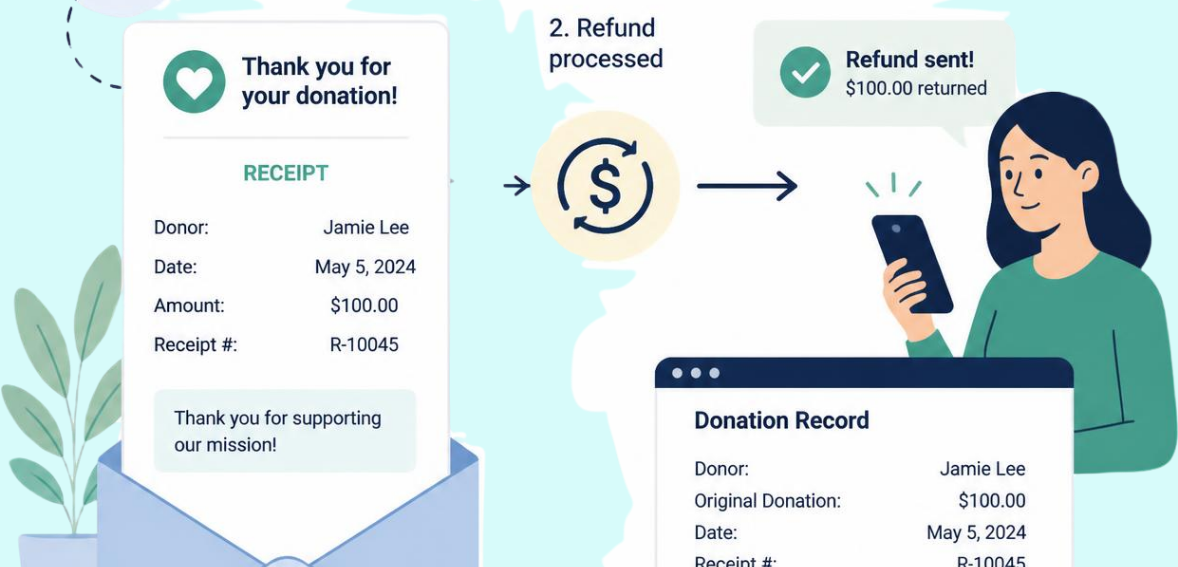
A donor calls three weeks after giving. Her tax receipt has just landed in her inbox. She is now requesting a refund. Could she have intended a different (or no) donation? Was the donation meant to fund something else that has now been canceled? Could she have meant to write $500 instead of $5,000? Whatever the reasoning, the donation is no longer the warm and fuzzy gift to help people that it once was. It is now a recorded transaction.
The several wrong ways to reverse it will all create a discrepancy between your ledger and reality. This is exactly the kind of discrepancy an auditor is trained to find and mark with a red pen. This guide shows you the correct method for refunding a donation, fixing the documentation, and preserving a permanent trail for the transaction.
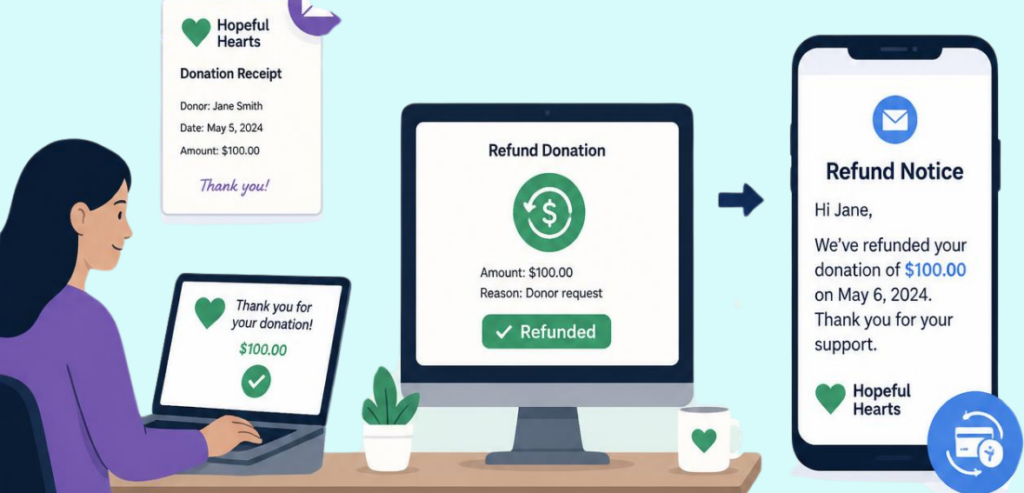
Refund requests are not usually unexpected. Nonprofit accountants see the same repeat problems, and knowing these helps everyone to better understand how to manage the refund request. The most common reason for refunds involves mistakes made by the donor. Donor errors come in many different forms. An example would be a donor submitting a payment multiple times because of a bug in their browser, or a payment could be submitted with a misplaced decimal.
The second most common reason for a refund request is the donor’s dissatisfaction with the way the funds are being utilized. Many donors are displeased when the money is used in a way that does not match the mission that the donors intended to support.
The third reason is an organizational conflict: the donor gave for a stated purpose, and the organization cannot fulfill that purpose. Lastly, a donor may simply change their mind. Most organizations clearly address the second, third, and fourth reasons in a written refund policy. The funds are most frequently returned in the first and third cases.
“Void” and “refund” mean the same thing to most donors, but payment processors, and consequently accounting systems, treat them very differently. A “void” cancels a card transaction that hasn’t been processed yet. Since the transaction hasn’t left the donor’s bank, and the organization hasn’t yet received the funds, a void erases the transaction for the organization. Since no funds were moved, there is no accounting entry for a refund, and in many instances, the pending charge simply drops off the donor’s bank statement. A refund is required for cleared transactions.
Since the funds have been received by the organization, a refund means the organization must complete a separate transaction to send the funds, and this appears as a separate line on the donor’s bank statement.
Typically for most card processors, the effective cutoff for a void is at the end of the business day that the transaction has been processed. If a charge is voided on the same day that the charge is processed, there is no cost to the organization. If a charge is not voided on the same day, the only option is to refund the charge, which is a lengthier process for the donor, and in most cases, the original processing fee is not returned.
Most card processors define authorization and capture in the same way. Once a charge runs, it is authorized. By the end of the day, the charge is swept into a batch to be settled. The charge can be voided to prevent batch inclusion. Once settled, the charge is final and the processor requires a refund transaction.
ACH gifts run on a different schedule. According to Nacha’s rules, an organization has five banking days from the settlement date of an ACH transaction to reverse the transaction. Once the window has closed, a refund transaction must be done or the organization must negotiate with the donor’s bank. Regulation E gives consumer protection to a donor who can dispute an ACH transaction with their bank for an unauthorized transaction within 60 days of the transaction posting to the bank statement.
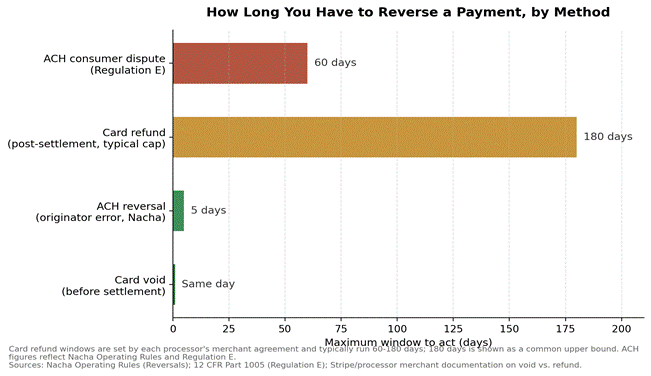
Figure 1: Refund windows for each payment method are represented here. Generally, the windows for card refunds are 60-180 days and are dependent on the merchant agreement for each processor.
Check the exact cutoffs in your merchant agreements with your payment processors. Don’t rely on the figure above for live cases, since cutoff windows can vary based on the provider and card network.
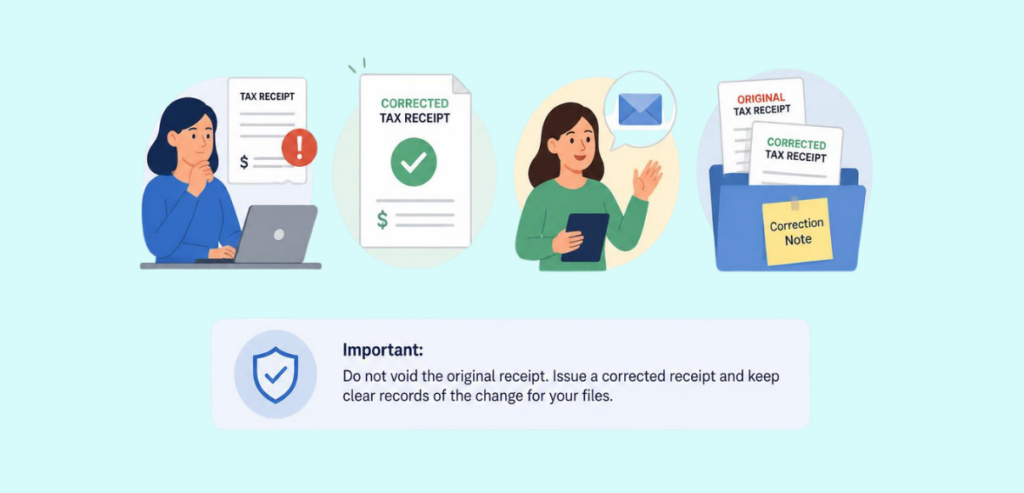
A written acknowledgment sent to the donor does not, by itself, make the gift final in the eyes of the IRS. The IRS considers substantiation of the gift to be critical. As per IRS Publication 1771, a donor who claimed $250 deduction or more must have a written acknowledgment stating the name of the organization, the date, and the amount. The refund of the gift, in full or in part, would make the letter no longer valid for the donor, and should not be relied on for a deduction.
The simplest solution is the rewritten acknowledgment letter, not the removal of the letter. The prior acknowledgment should be stated to be null and void. If the refund was partial, then the new amount should be stated. Both the old and the new acknowledgment should be kept on record. If the refund of the gift was complete, then it should be stated as such in the letter, so the donor has proof that a tax deduction should not be taken.
Whether the donation refund should be reported on Form 1099 is an issue that the organization should route to their accountant for resolution, as it would require facts that the organization would not have, such as if the donor, in fact, received the deduction.
A silent overstatement occurs when a refund processed at the payment processor is still counted on the campaign dashboard. The total remains on the dashboard, but the organization can no longer count it as cash. The reversal should be recorded as its own transaction type in the development database while maintaining the connection to the gift record. Deleting a record removes the gift from the campaign, and subsequently, the auditor will not be able to verify the gift. The record can be modified to preserve the gift and the correction along with the linked reversal transaction.
The same logic applies to restricted funds and the totals of related events. The same is true for gifts that have satisfied the requirement of a matching gift challenge; these gifts will still need corrections beyond the main ledger. This method of reconciliation proves to be useful when the campaign management system reports are compared against the payment processor settlement reports. In the course of this comparison, any refund that is not accounted for will be easily found before the year-end reports are prepared.
Every reversal must include a concise and objective description in the donor record and on the transaction itself. The note must also include the rationale for the reversal, the approver, the approval date, and the final disposition of the receipt after the reversal. The note itself is the defense. The note communicates the information and the reason for the reversal to the auditors and eliminates the need to contact staff.
Revenue auditors sample contributions and contribution reversals. A refund transaction that does not have a note, even if justified, is a control deficiency. A note must be signed and dated and must also include approval of the refund and a corrected receipt. It must also provide the explanation and justification for the reversal.

The external message to donors is as important as the internal processing. It should identify the amount to be refunded, the method of payment used, and the anticipated date by which the donor will receive the refund. Refunds are processed to the original payment method to satisfy card network rules and to avoid creating an unverified payment relationship with the donor.
The message should indicate whether a corrected tax receipt is included with the refund or will be sent separately. Providing this information will assist the donor in the completion of his or her tax filing. The refund gives the last opportunity to the nonprofit to express appreciation to the donor and to provide the reason for the refund in a non-transactional message. Most refunds are the last interaction the donor will have with the nonprofit and the message will shape the donor’s decision about future donations.
Two categories require more attention because applying the standard refund path is not as clear. The first category is restricted donations that organizations are unable to utilize as intended. An example is a donation to a restricted fund that is set for a program that is yet to be created. Nonprofit advisory accounting groups suggest that this causes a legal issue.
If the organization cannot substantially fulfill the terms of the donation, the organization is obligated to return the donation, redirect it with the donor’s permission, or petition to release or modify the restrictions of the donation with the attorney general’s consent per the state’s adaptation of the Uniform Prudent Management of Institutional Funds Act. This act pertains to the situation where the funds’ restrictions cannot be fulfilled, and the organization cannot remove the restrictions without notifying the state’s attorney general.
The second category is donations given in error. This is most often a gift that is a repeated donation or a donation from a donor who intended to gift to another organization. This category raises fewer ethical questions, as the gift stems from a procedural error rather than any dispute over the gift’s intended use or mission. Similar to the other categories, a corrective action must be documented, including a note that describes the error, a replacement receipt, and a ledger entry that indicates a correction rather than a deletion of the ledger entry.
Any refund process that’s dependent on a single employee will come to a halt whenever that employee is absent. To address that issue, establish a process that ensures consistency and reduces reliance on any single employee. Each request is logged by the organization, including the request date, request reason, and details of the employee and donor related to the request. Staff review the original transaction and the receipt.
They also check if the gift was restricted or if it was earmarked for a particular campaign. This will also influence the approval process. They also confirm if the charge is settled, as this will determine if the charge is to be refunded or is to be voided. Once the payment transaction is completed, the donor receives the revised gift acknowledgment, the campaign ledger and donor record are updated and a note is added to the record to complete the process.
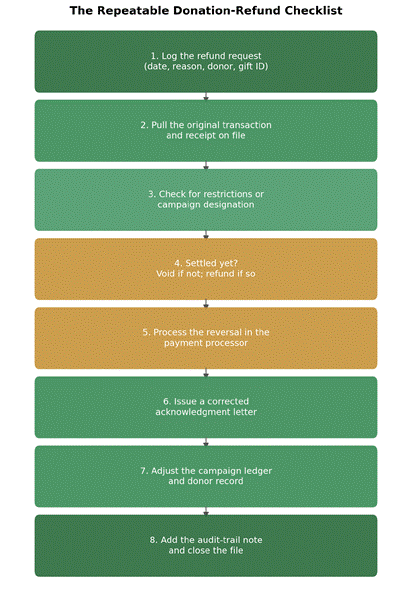
Figure 2: This refund process has steps that are documented the same way on all refund cases, no matter who processes that case.
Thinking of a donation refund as a small accounting issue is a mistake. There are many effects that a donation refund can have including tax substantiation, campaign finance, donor trust, and audit documentation. The mechanics demand precision. Ideally, a donation should be voided before it has been settled. In the absence of this possibility, the donation should be correctly refunded, the receipt corrected, and a clear notation left. Most organizations spend too much time explaining donation refunds, whether the question comes from a donor, a board member, or an auditor.
A standard checklist for donation refund requests changes that. With one, the organization handles refunds efficiently and consistently. Without one, the money still gets refunded, but the organization spends far too much time explaining the refund to the board or to an auditor.
Yes. Though there is no federal law preventing it, gifts are normally thought to be irrevocable after the donee has accepted the gift. Hence, most organizations handle refunds through a written policy rather than as a donor’s right.
A void occurs when a transaction is canceled before it settles, so you don’t lose any money. A refund is requested to reverse a charge that has already settled, and this returns the funds in a separate transaction.
Yes. Please send a revised acknowledgment letter correcting the original receipt as void or adjusted, so the donor is not relying on incorrect documentation at the time of filing taxes.
You have to return the funds, get the donor’s written approval to redirect the funds, or for larger endowed funds, you need to follow the procedure in your state’s UPMIFA to get a formal release.
Do not delete it. Link the reversal to the original gift record and add a note explaining the reason along with the details of the approval (name and date). State in the note the method used to correct the receipt.