Posted: August 11, 2026
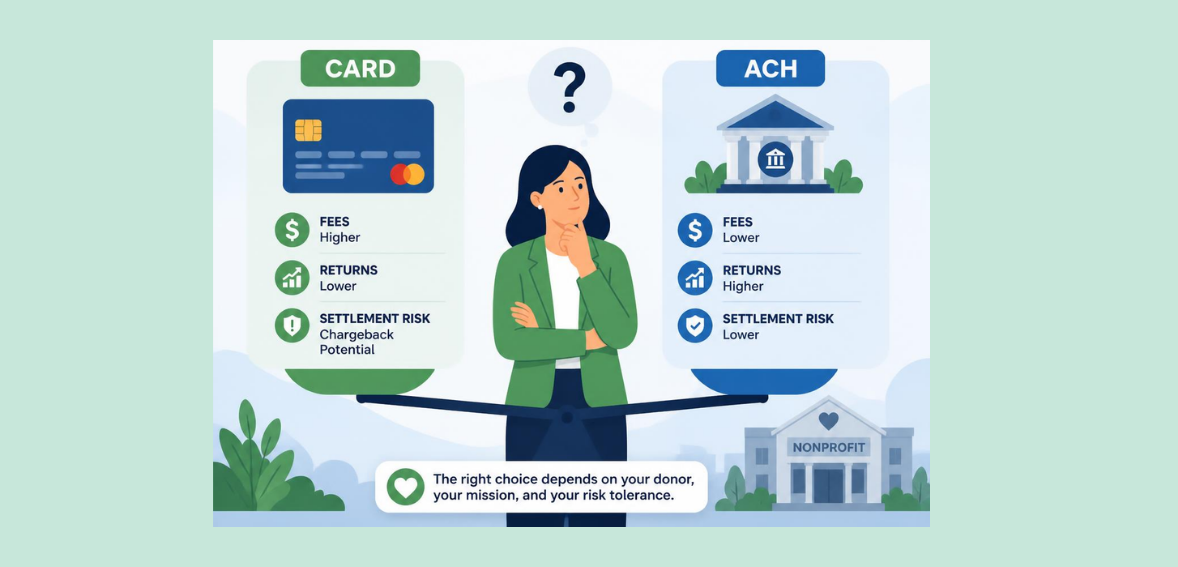
A $50 donation vs. a $50,000 donation should never require the same level of consideration. But most nonprofits do just that, simply processing donations based on the buttons clicked. While this method may be efficient (and harmless) when it comes to small donations, larger donations can mean thousands of lost dollars for an organization, as a payment rail chosen by a donor can leave a significant pledge in a state of limbo for a long duration, even after a thank-you letter has been sent.
The card or ACH payment options do not serve the same purpose when a significant donation has been made. Each has a different cost, a different settlement duration, and a different risk of a donation being revoked. A development team needs to understand this before a significant donation has been made.
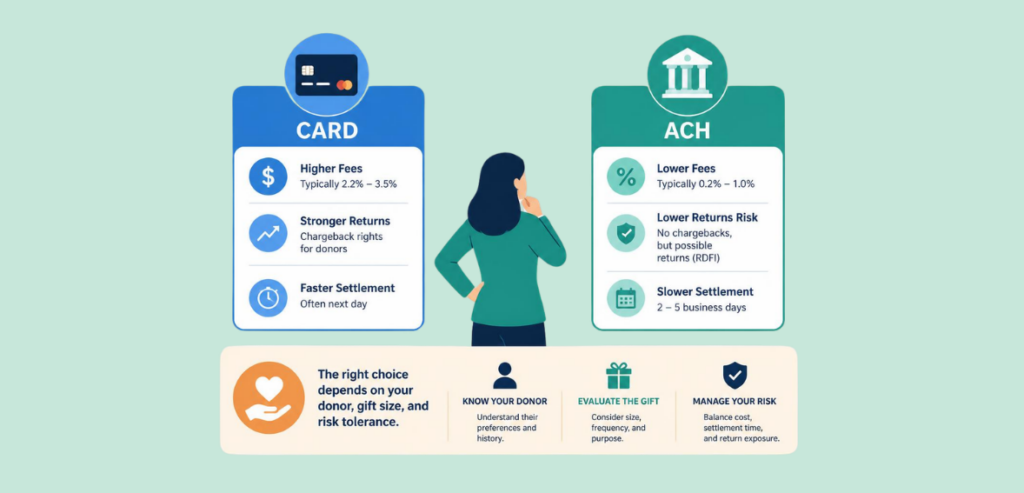
For payments under $25 for a digital gift, there is not much of a debate. Fees incurred using cards or ACH payments are negligible. For small amounts, the donor experience is the priority over processing cost. Things are different for larger amounts. ACH payment fees are fixed. For card payments, fees are charged as a percentage of the transaction. Processing fees are basically negligible for small amounts. For large amounts, the fee will be larger. This is the essence of the challenge.
There is not a set dollar amount for ‘major gifts.’ For a small nonprofit, a gift may be considered ‘major’ at $1,000 or more, whereas gifts of $25,000, $50,000, or more may be considered ‘major’ at a large hospital or university. Based on a major gift program study for the U.S. and Canada, gifts are considered ‘major’ in the $5,000 to $9,999 range.
However, gifts of this level are considered ‘major’ by the organization depending on their donor pool and budget. Gifts of this level, however, are vastly more expensive to process if made by card as opposed to ACH gifts. The costs are nearly the same between card and ACH for small gifts, but they are vastly different for large ones.
Most of a nonprofit’s gift revenue comes from a small number of large gifts, which makes this even more challenging.
Most nonprofits follow the 80-20 rule with their individual donors. In this rule, 80% of the individual donor revenue comes from 20% of the individual donors. In a given fundraising year, a few large gifts are needed to make the fundraising successful. The processing cost on a small individual gift is a small difference, but for the few large gifts that make up the annual funding, the difference is huge. A finance director of a nonprofit will likely have to deal with the large difference. Because of this, when talking about the larger gifts, the issue of payment-rail strategy will most likely come up, even though it doesn’t normally come up in the discussion on the annual fund.
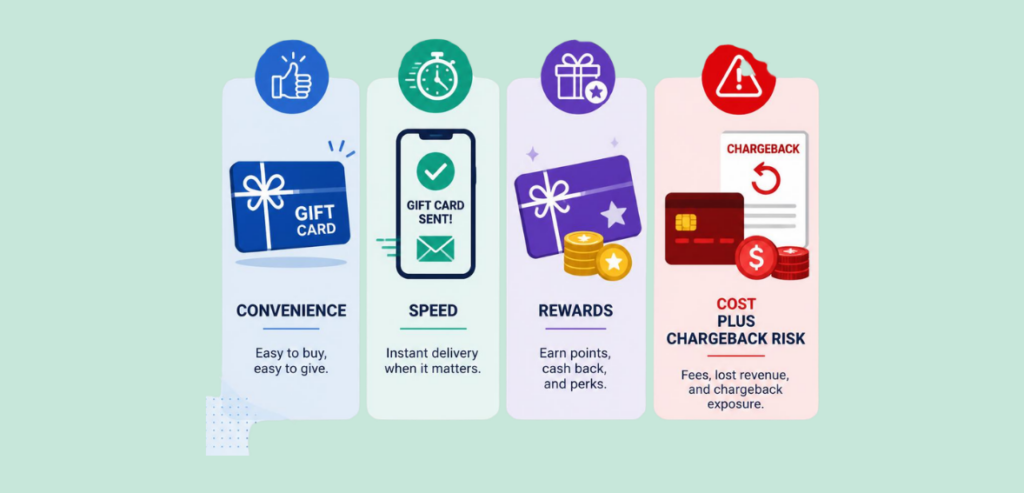
Donors like the ease of giving with the swipe of a card, especially when charitable giving means cash back or rewards. There is less of a personal out-of-pocket cost to a donor, but nonprofits experience the cost of processing. Credit card charges for nonprofits average approximately 2.2% + $0.30 to 3.5% + $0.30 for each swipe, depending on the processor, card network, and if the organization is receiving a nonprofit discount. Therefore, the fees for processing a $5,000 gift could be $110 to $175. For a $50,000 gift, the fees would be $1,100 to $1,750, and those fees are money that the nonprofit mission does not receive.
Beyond setting these costs, Visa and Mastercard also establish the rules for charge dispute timeframes. In general, all four networks— Visa, Mastercard, American Express, and Discover—allow chargebacks to be filed within 120 days. Some chargeback reason codes that are related to fraud even allow for extensions beyond 120 days.
Timeframes for a nonprofit to respond to disputes are significantly shorter and allow merchants a time period of anywhere from 20 to 45 days to respond. This means that the acceptance of a major gift by credit card isn’t completely final for around 120 days. During this period, the card charging the major gift can be reversed. This can be done for several reasons, such as the card number having been stolen and used fraudulently.
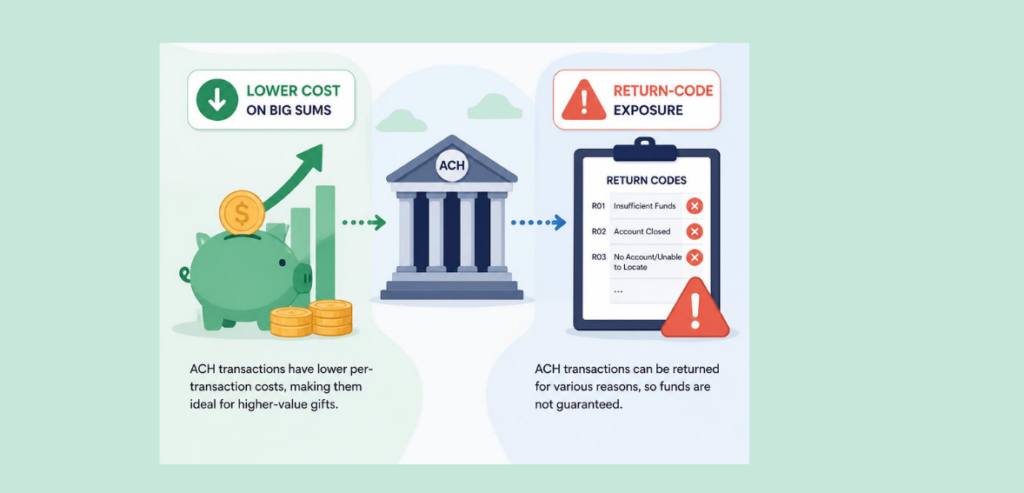
Payments sent using ACH move directly between the sending and receiving bank systems. As a result, the pricing structure reflects that ACH payments do not involve a fee relative to the payment; rather, a flat fee of $0.25 to $0.75 is charged for payment processing, regardless of the payment amount. For this reason, ACH payments become a highly cost-effective payment solution for large donations.
A processed ACH gift of $50,000 would cost significantly less than a processed gift of the same amount via credit card, which would exceed $1,000. This advantage of the cost of ACH payments over credit card payments holds for each payment that is made to fulfill the pledge of a multi-year commitment that is paid in installments.
NACHA established the return timeframes on bank transfers that can still be reversed after clearing. Typically, a return from a business or corporate account (i.e., the type typically used by a donor-advised fund or family foundation) must be initiated within two business days of the transfer date. A return from an individual account works differently. If the donor’s bank determines the transfer was unauthorized, the donor’s bank can return the transfer within 60 calendar days.
A return from an individual account provides a much longer exposure time compared to the two days for a return from a corporate account. Therefore, an ACH transfer from a personal account is not fully final, and the transfer remains reversible for 60 days, even though the transfer appears to be completed on the payment beneficiary’s account.
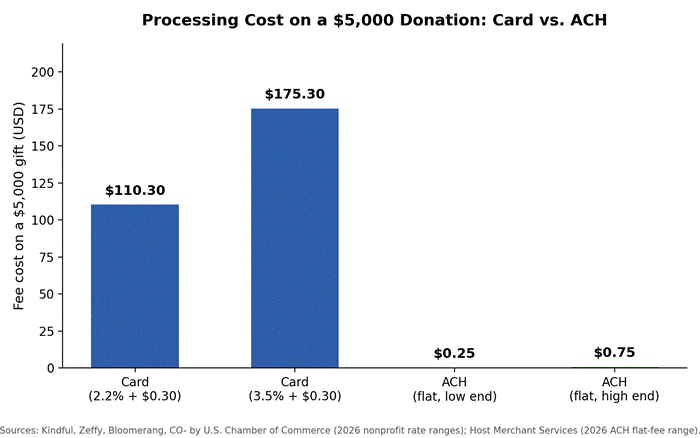
Figure 1. Processing cost on a $5,000 gift, card vs. ACH, using published 2026 nonprofit rate ranges.
“Available” funds from card or ACH gifts generally means you’ll have access to those funds within 1-3 business days. Occasionally, gift processors may provide the availability option for the same day or within a few hours for an added cost. Though funds may be “available,” there is no finality to the gift. This is where many nonprofits run into problems when planning or budgeting for a pledge.
A card gift can be reversed up to 120 days after the transaction. Consumer ACH gifts can also be reversed within 60 days. However, ACH gifts made by businesses are generally considered final within 2 banking days since the return window for business accounts is also 2 days. Therefore, the most secure and time-efficient way to receive a major gift is an ACH transfer from a foundation, donor-advised fund, or business corporate giving fund. Development and finance team members who report pledge revenue as “received” when funds are available run the risk of overstating the value of a large gift in the weeks following the transaction, as the gift may still be reversed.
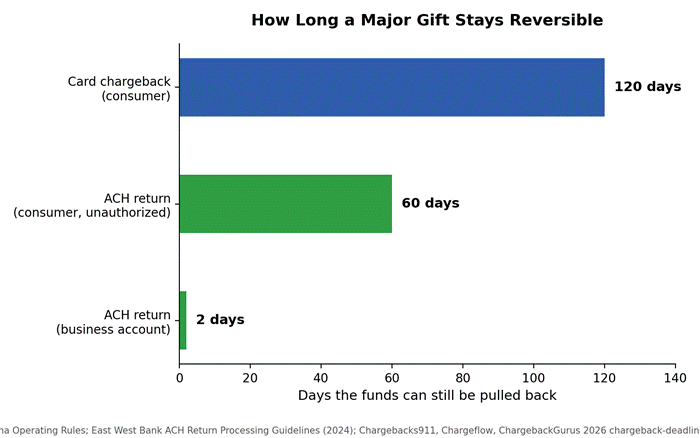
Figure 2. How many days a settled gift can still be pulled back, by payment rail and account type.

Donor payment preferences are more dictated by what donors feel comfortable with and what they are accustomed to, rather than payment processing fees. This is because most donors do not consider how much payment processing costs nonprofits for the donors’ level of contribution. It is common for high-level, high-capacity donors to use credit cards to make large donations. This is because high-value donations are processed quickly and may even result in a reward for the donor. High-capacity donors may not even consider the consequences of charging a high-value donation.
Conversely, a large portion of donors, particularly those making donations through a trust, foundation, or donor-advised fund, have payments made through institutional practice, which typically leaves little flexibility in payment methods. A small number of donors actually prefer ACH payments once they understand the difference, for the reason that the majority of the contribution will go directly to the cause rather than to payment processing. This group tends to respond well when the question is framed as “which payment method allows the most of your contribution to reach its intended destination?” as opposed to a more technical explanation regarding interchange fees and rates.
Recurring donations represent a special case. For example, a donor who agrees to a $10,000 pledge paid monthly for 12 months will result in the charity paying the processing fee each month. From a processing perspective, paying via credit card means that the charity is paying a percentage-based cost for each monthly donation. Conversely, if the payment is made via ACH, there is only a small flat fee for each installment.
The fee gap grows the most with multi-year pledges, and a short discussion when the pledge is made can save the organization money for the entire pledge duration.
For most nonprofits, running both card and ACH rails simultaneously is the right move. However, it adds a significant bookkeeping burden. Regardless of which rail handled the transaction, a donor’s complete giving history needs to exist in a single CRM record, requiring finance and gift staff to have the matching transaction identifiers to connect a bank deposit batch to a pledge.
The challenges such a system creates often become apparent when a donor changes channels in the middle of a pledge (for example, switching from a recurring pledge via Card to ACH) or when a processor’s settlement batch combines several donations into one deposit, which the finance staff has to split. The majority of nonprofits consider card and ACH systems as separate systems, with reconciliations done at the end of the month, thereby only discovering a discrepancy when a major donor inquires about their total. The matching logic should be included in the gift-entry process to avoid such surprises.
A helpful guideline directly connects an appropriate payment method to gift size, weighing both cost and risk. The table below presents an initial framework most gift officers can adjust to fit their organization’s thresholds.
| Gift Size | Most Cost-Efficient Rail | Why |
| Under $1,000 | Card | Fee difference is a few dollars; donor convenience wins. |
| $1,000 – $10,000 | Either, ask the donor | Fee gap becomes noticeable but not decisive on its own. |
| $10,000 – $50,000 | ACH preferred | Percentage card fees now run into hundreds or low thousands. |
| Above $50,000 | ACH or wire from an institutional account | Flat fee stays negligible; corporate ACH also becomes final fastest. |
To navigate the payment method question with a principal donor, it’s best to focus on the relationship versus the fee. One approach might be to tell the donor, “we’d love to talk through the best way to structure this.” That opens the donor to various other questions, including the timing of the gift, the donor’s level of comfort, and tax considerations, while leaving the payment method as just one of many questions to consider.
Starting with a fee lecture just underscores to a generous donor that their preferred method of giving is being put into question and is sure to make them feel uncomfortable. Most donors, when thinking about the payment method options that way, prefer to give by ACH rather than by credit card, as the former causes the donor to feel that more of the gift is going to the program that the donor is concerned about, and that less of the gift is going to the credit card processing fees. Those donors are the ones most likely, on a larger gift, to choose ACH, and to continue to choose it on future gifts.
There is no one “right” answer to be found when it comes to methods to accept major gifts: neither card nor ACH wins outright. When comparing the two options, card is the most donor-friendly option for ease; however, the cost for major gifts increases, and lengthy windows for chargebacks are a consideration. ACH, at scale, is the less expensive option, and, relatively speaking, the exposure window is shorter if the payment is coming from an institution.
ACH carries the 60-day exposure when coming from a personal account. Nonprofits that accept major gifts successfully are those that don’t consider the payment method for major gifts an afterthought, and have a habit of clean reconciliation for both methods. These nonprofits are also the most transparent with donors about payment method choice rather than silently absorbing the payment method cost. This approach protects the monetary and relational value of the gift.
Since ACH charges a flat fee between $0.25 and $0.75, it is the most cost-effective option for large gifts. Card fees on the other hand, add a percentage-based fee in addition to a $0.30 fee. These fees can be between 2.2% and 3.5% and will increase with the size of the gift.
Yes. A consumer bank account can return an unauthorized ACH debit up to sixty (60) calendar days after settlement. Business accounts can only return unauthorized ACH debit requests within two (2) banking days.
Both ACH and card gift transactions usually clear within one to three business days. However, “available” doesn’t mean the transaction can no longer be reversed.
Nonprofits should be able to offer and explain ACH for larger or recurring donations. Donors should not feel pressured to use the service to make donations. It should instead be made clear to donors that this option is available.
It varies by donor. For many, donations via card are the most convenient and commonly used method. Some donors use a card to donate to take advantage of rewards. Donations made through foundations or donor-advised funds are typically already set up for ACH or wire transfers and therefore use those methods.