
For those who have encountered the message “successful liability shift for enrolled card is required” during online checkout attempts or while adding a payment method to a subscription service, know that you are not the only one. This message combines rules of card networks, fraud prevention, and general issues that come with card payment checkouts. Due to the complexity of the logic, most users and merchants get stuck without adequate explanations.
At its core, the phrase describes a shift in who is financially responsible when a transaction proves fraudulent. Historically, the risk of fraud was borne by the merchant. In the last twenty years, card networks have developed technology — EMV chip validation and 3D Secure — to shift that risk to card issuers or to the payment network. However, this is only the case when certain technological conditions are met. In the absence of these conditions, the system displays the error message rather than accepting a transaction that, for all parties, is undesirable.
This guide will explain the reasons for this error message, why it is most often seen with gift card purchases and payments to subscription services such as OnlyFans, how 3D Secure is related, and how to resolve it, regardless of whether you are the one paying or the one being paid.

Derived from the payment system, this message appears as a rejection notice rather than a standard decline and typically occurs during online checkouts or at point-of-sale terminals. This message indicates that the system’s fraud detection mechanism was triggered and that the fraud liability shift conditions were not met for this transaction.
Liability shift refers to an emerging industry, meaning that someone has to take the financial hit when a charge is deemed to be fraudulent. Historically, this has almost always been the merchant of record. With the introduction of rules by card networks such as Visa, Mastercard, American Express, and Discover, the financial hit is reassigned to the card issuer or the payment network at large. This financial hit is reassigned under specific and verifiable conditions.
The successful liability shift will occur only if the card used in the transaction is enrolled in a specific program, such as EMV chip technology (in-person transactions) or 3D Secure (online transactions). If the card is not enrolled or the transaction path does not trigger the enrollment check, this message is the result.
The practical implication is that the transaction will either be declined or require additional verification. The underlying issue will be resolved if the proper security protocol for the transaction is enforced and the card supports it.
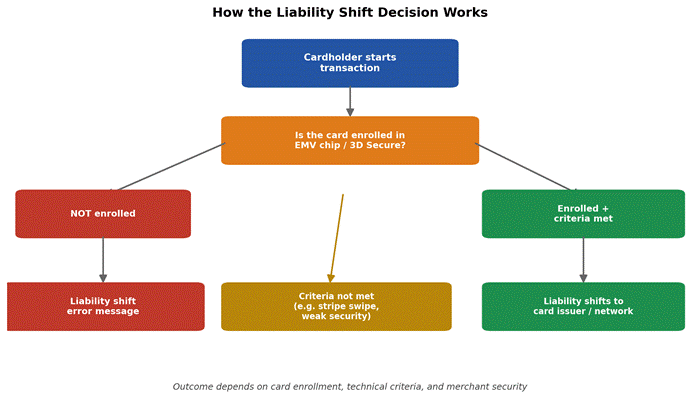
Figure 1. The decision path that determines whether a transaction qualifies for a successful liability shift.

This message can appear in both online and offline sales systems. The causes can be grouped into four categories. Knowing which category your case belongs to will help you resolve the issue most quickly.
One trigger is easy to identify. The card in use is not registered with a system that supports a liability shift for enrolled cards (such as EMV chip technology or 3D Secure), which would otherwise leave the merchant exposed to financial liability. Typically, prepaid cards, lower-end debit cards, and certain gift cards are not registered with these systems. Because of this, no configuration on the merchant’s part will make the transaction successful. If the card was not designed to be part of a liability shift system, it will be flagged.
Every part of the transaction must be compliant, even when the card is enrolled. For an EMV chip transaction, both the card and the terminal need to be chip-enabled. If the cashier swipes the magnetic stripe instead of inserting or tapping the card, the chip card does not provide the successful liability shift. The same applies to online transactions. If the merchant’s checkout process does not include the 3D Secure step, the card will not be able to provide a liability shift, even if it is eligible.
The loss of a liability shift is meant to encourage better security by a merchant. Liability shifts when a merchant’s security is weak. Merchants are expected to use up-to-date encryption, tokenization, and authentication. A merchant’s checkout software that is obsolete, does not meet PCI DSS, or does not perform the necessary authentication will put the merchant in a position where they will be denied the liability shift, even when the customer’s card is capable.
Processors connect merchants with card issuers. Various processors have different technological needs that help shift the liability. For example, one processor may require a specific software version to shift liability, while another may require different API integration. Some processors may require different gateway settings. If the merchant is unable to fulfill these requests, the processor will not be able to certify the transaction, and the annoying error message will still occur regardless of what the cardholder does.
These four reasons combined help us understand why the error message manifests in so many different situations. It could be an unenrolled card, a skipped authentication step, inadequate merchant security, or limitations imposed by the processor. No matter the situation, the fix is essentially the same: meet the full technical requirements for a successful liability shift across the enrolled card, the terminal or checkout, and the processor.
Many people getting this error are trying to make purchases where gift cards aren’t accepted. Many error results include the phrase “OnlyFans successful liability shift for enrolled card” since OnlyFans is one of the primary platforms where people encounter this issue.
OnlyFans exclusively accepts payments processed through credit and debit cards. Store-branded or general-purpose gift cards are undoubtedly not accepted. When a user attempts to tip a creator or make a purchase with a gift card, OnlyFans’ payment gateway is unable to complete the required authentication to shift liability. This is primarily because most gift cards are not enrolled in either EMV or 3D Secure. Even if they were enrolled, the OnlyFans payment gateway cannot process a gift card transaction.
This is the reasoning behind the numerous queries related to “OnlyFans successful liability shift.” In simple terms, the payment method and the platform are incompatible, and the rejection is due to the liability-shift language that the system is programmed to convey.
There is more to learn here beyond OnlyFans. Every company lists the payment methods it actually accepts in its terms of use or payment policy. Gift cards offer convenience, but they are not accepted everywhere, and their eligibility for liability-shift programs varies by issuer. Before using a gift card to pay for a subscription or service on any content platform, it is a good idea to check that company’s payment methods page. If a gift card is declined, the simplest solution is to use a regular credit or debit card enrolled in the merchant’s supported programs.
Fraudulent online transactions that do not require card presence posed a long-standing challenge for payment card networks. 3D Secure was created to tackle this problem. Visa and Mastercard have the most widely adopted versions in this area. 3D Secure enables merchants to achieve a successful liability shift for online card purchases.
3D Secure 2.0 (or 3DS2) is the latest generation of card payment security technology. 3DS2 was created to address challenges and shortcomings of the friction-filled card security technology of the past. With 3DS2, card-issuing banks evaluate risk signals (e.g., device data, transaction history, location) and may require cardholders to complete additional verification only if the risk score (e.g., risk assessment) warrants it. 3DS2 also drives the technology of Strong Customer Authentication (SCA) requirements under the European PSD2 regulation. In the U.S., however, the use of SCA requirements is mostly optional and is determined by the card-issuing bank.
Fraud risk is higher for card-not-present transactions than for face-to-face transactions, due to the lack of a physical card and PIN. In these cases, an additional step is added that only a legitimate cardholder can complete. This added verification ties the authorization to the legitimate cardholder and, therefore, card networks have agreed to offer a reward to merchants who implement it correctly, thereby removing fraud liability from their books. This is exactly what is meant by the successful liability shift language.
Figure 2. Fraud liability generally follows the strength of the authentication method used at checkout.
3D Secure is not implemented by every merchant, and not every transaction initiates 3D Secure. 3D Secure adoption depends on the card issuer, payment processor, transaction value, risk scoring, and other factors. This is partly why the same card can be used successfully to complete purchases on some websites and then encounter a liability-shift error on others.
It’s helpful to think of this requirement as a favor. Fraud loss is moved away from the merchant. However, the card networks will only agree to this if they are provided with clear evidence of true security engagement during the transaction. Evidence is provided by the implementation of 3D Secure, which addresses a few specific points.
3D Secure works by sending the cardholder a one-time passcode or requiring a biometric check. Since fraudsters typically can’t respond to these verifications, 3D Secure can confirm that the person entering the card information is the cardholder.
The anonymity that card-not-present fraud enjoys is a built-in advantage. 3D Secure makes fraud much more expensive and difficult to perpetrate, which is the goal of card networks, by introducing a real-time authentication step on the cardholder’s device and/or banking app.
Upon successful completion of 3D Secure authentication, an authentication value is created. This value can be submitted by the merchant’s acquirer if the transaction is later disputed. This value signifies that a liability shift for transactions involving enrolled cards has occurred. In this case, the cost of the fraudulent transaction is incurred by the issuer, and not the merchant.
Across most payment networks and processors, 3D Secure is now required for all higher-risk merchant categories. Its adoption means that the merchant has dedicated resources to protecting cardholder data. For this reason, many processors offer their most competitive pricing and lowest chargeback rates to merchants that regularly implement the protocol.
| Authentication Method | Where It Applies | Typical Liability Outcome |
| EMV chip (insert/tap) | In-person point-of-sale terminals | Shift is possible if both the card and the terminal support the chip |
| Magnetic stripe swipe | Older or fallback terminals | No shift — merchant retains liability |
| 3D Secure (online) | E-commerce checkouts | Shift possible once authentication completes |
| No authentication (card-not-present) | Basic online checkouts | No shift — merchant retains liability |
The idea evolved over several years, with the implementation of the EMV liability shift. Card networks set the October 2015 deadline for the U.S. after chip cards became the standard in other countries. Prior to the deadline, the merchant absorbed the cost of any fraudulent transaction involving a counterfeit card. After the deadline, networks changed the rules. If a chip card was available and a transaction was processed by swipe due to the merchant’s failure to upgrade the terminal or a chip reader malfunction, then liability for the fraud generally fell to the party using the lesser technology — in this case, the merchant.
To an extent, the same concept was applied to the online realm with the introduction of 3D Secure. Originally, 3D Secure required cardholders to agree to and input a password for each transaction. This required extra effort from customers and caused a high number of transaction abandonments. To alleviate this, 3D Secure 2.0 was introduced in the late 2010s, enabling issuers to remove the password requirement for low-risk transactions. The liability shift associated with this protocol change balanced the risk of fraudulent transactions and improved the user experience.
This explains some of the frustration toward the errors in the system.
Two years ago, a card or checkout that did not generate an error may now trigger one due to changes in network rules, the issuer’s risk model, or the particular processor’s supported protocol version.
Merchants have more control over this error than most cardholders are aware. Below is a checklist covering business-side failure areas of a liability shift.
While there is no way to eliminate the risk of fraud altogether, each of the steps provided helps prevent an enrolled card transaction from turning what should be an easy, successful liability shift into a frustrating, time-consuming process for a customer who is trying to complete a purchase.
If you’re the cardholder and having trouble completing a purchase or the merchant and having trouble with a checkout, the fixes detailed below address the most common reasons for a block.
Determine if the card supports EMV chip technology, 3D Secure, or both. If it doesn’t, as is the case with some prepaid and gift cards, contact the card issuer to ask about enrollment, or use a different card that is known to offer these programs.
Ensure merchant payment systems support the required protocol. If 3D Secure is never invoked, there is no value in card enrollment. The merchant must resolve the payment gateway configuration issue.
Some merchants may limit the types of cards and networks they accept for liability-shift-eligible transactions. Please consult the merchant’s payments policy or contact the merchant’s customer support for card type acceptance.
If your card is supposed to be enrolled and the error still occurs, the card issuer’s customer service representatives can check and enroll the card for you on the call in most cases.
If the error is more permanent and cannot be resolved, the next best option is to use an alternative credit card, debit card, or an accepted digital wallet.
If nothing else works, contacting the merchant’s support desk can provide insight into the payment and authentication methods they support, as well as any internal issues related to your account.
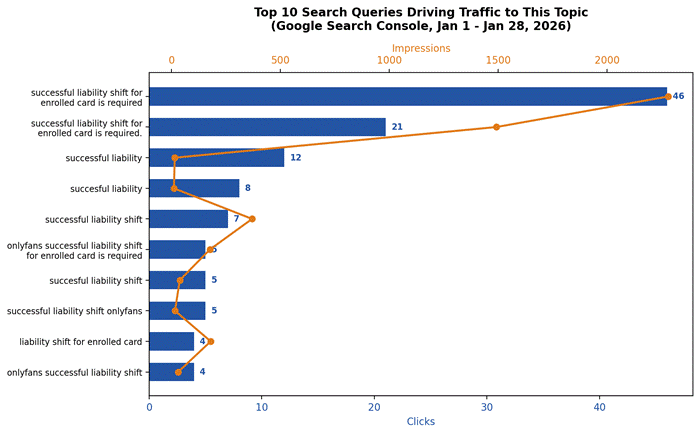
Figure 3. Real search demand around this exact error message — note how much of it involves misspellings (“succesful”) and OnlyFans-specific phrasing, both addressed above.
The successful liability shift for enrolled cards is a required message that serves as a security measure, preventing a transaction from being completed until the issuer or the network is verified to accept liability for the fraud. This message most commonly appears with unsupported payment methods, such as gift cards on services like OnlyFans, and during online checkout when 3D Secure is not implemented.
The four primary reasons why a liability shift message appears are now clear. The card is not enrolled, the transaction does not qualify (such as a swipe instead of a chip, or a skipped 3D Secure step), the merchant has not met the required security standards, or there are limitations on the payment processor side. In almost all cases, the solution would require coupling an enrolled and capable card with a merchant’s checkout that performs the required authentication.
For the cardholder, this means using a standard credit or debit card instead of a gift card. For the merchant, this means ensuring that the required settings for 3D Secure and EMV are implemented on all of the checkout pathways, as the absence of even one of the settings would result in fraud liability remaining with the merchant for those transactions.
This message typically appears when one of the merchant’s payment processing systems cannot complete the authentication step required to process the payment. This usually occurs when the payment method is an unsupported gift card.
It depends on the enrollment program. For example, enrollment for EMV chip cards is done by the issuer when the card is issued. On the other hand, enrollment for 3D Secure is done automatically for cards that support it. Check with your card issuer for confirmation or further information.
Yes – “successful liability” and “successful liability shift” are simply variants of the same error message and refer to the same issue that is described in this guide.
This is an authentication method that addresses online payment fraud and verifies a cardholder’s identity at the point of transaction. For this purpose, similar to a one-time password, it employs an authentication challenge/response.
No. Support differs by merchant, payment processor, and even transaction value. Because of this, the same card could trigger 3D Secure on one website and not on another.
Consider using an alternative credit or debit card, a digital wallet, or other payment methods the merchant accepts. You can also request your card issuer to upgrade to a card with EMV or 3D Secure, if applicable.
You can find phone, email, or live chat information for payment-related issues under a “Contact Us” or “Support” option on most merchants’ websites or apps.
