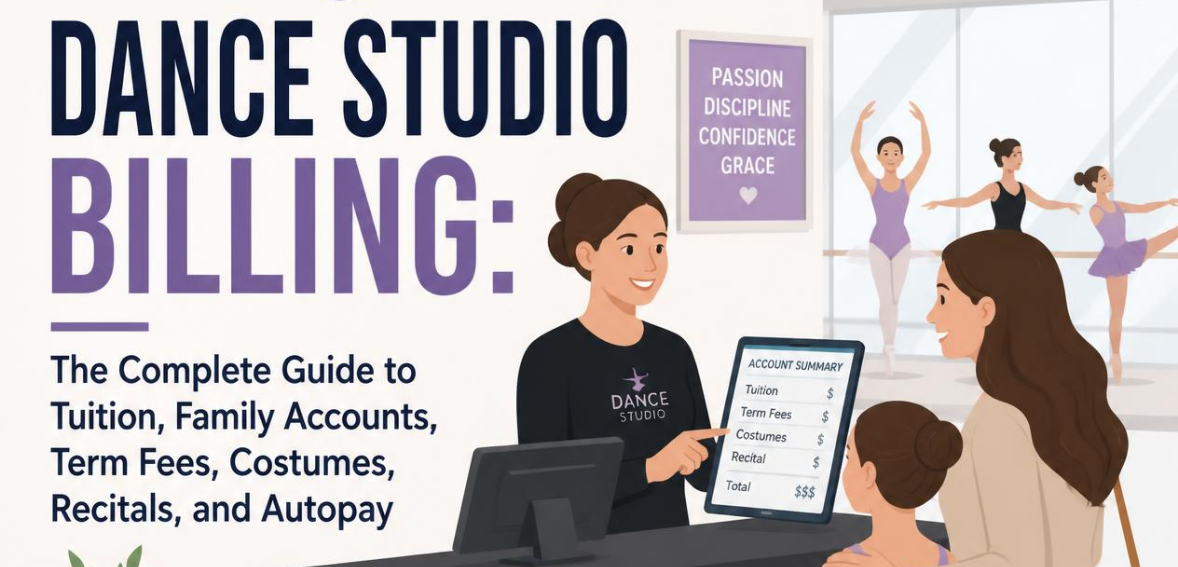
A dance studio sells more than just classes. Students pay weekly tuition, costume, recital, and competition fees. Each of these transactions is likely billed to the same family but on five different schedules. Three dancers can mean three different classes, three different transactions and three different online accounts. Get these systems wrong, and enrollment suffers because parents abandon their kids’ dance classes. Get it right, and the money comes in on time, families have faith in the system, and the owners can spend their time choreographing rather than chasing unpaid balances.
This guide explains how dance studio billing systems operate, including monthly vs term billing, family accounts including multiple dancers and caregivers, proration, competition and costume fees, recital ticketing, sibling discounts, refund policy and consolidated ledgers.

Typically, a gym charges each member a flat monthly fee. This model doesn’t work for dance billing. A single family can easily enroll multiple dancers across different classes and programs resulting in multiple weekly fees, costume cycles, and recital fees. Studios need to create a family account to manage the balance instead of billing each child’s fees separately. In addition to the weekly fees, dance studios have additional seasonal fees, which gyms don’t have. These include costume deposits in the fall, competition fees in the winter, and recital tickets in the spring. A system designed for single-member subscriptions fails when the single unit of billing shifts from an individual to a family. This design distinction is the most important aspect for studio owners when they decide to select a payment model or a software solution.
Studios typically utilize one of two tuition structures. With term billing, families pay a larger, lump sum charge at the start of each term. In this case, a studio collects revenue in three or four large installments during the year. With the monthly autopay, the studio collects the same amount, but the charge is made every month, on a date set by the studio, usually the first, for a year’s duration. Term billing provides a studio with a large cash inflow at the beginning of each term, which is helpful when securing the funds needed for costumes and staffing, and can be a large single cash outflow burden on a family’s budget. Monthly autopay eliminates that burden and provides predictable revenue on a month-to-month basis for the studio, thus decreasing the likelihood of missed payments. Because of that burden, many studios prefer to set new families to monthly autopay after the first term billing once trust and a card-on-file agreement are established, but will still offer term billing as an option for families.
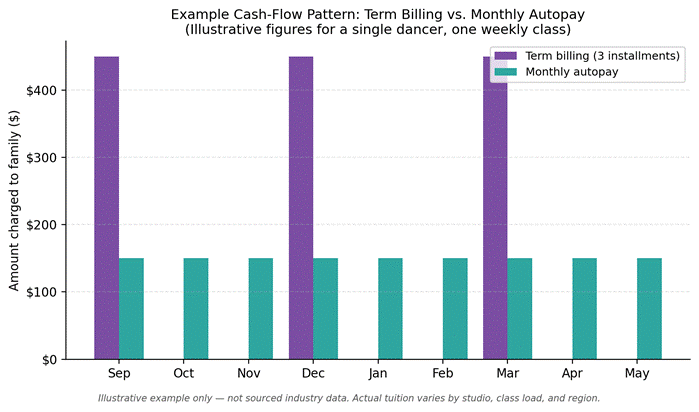
Figure 1: Illustrative comparison of term billing versus monthly autopay cash flow for a single dancer in one weekly class. Figures are for illustration only and do not represent real studio pricing.
Through a family account, every dancer in a household is consolidated under a single account and a single balance rather than requiring a parent to manage separate accounts for each of their children. This hinges on the fact that the majority of questions that a front desk staff member addresses regarding billing concerns are truly family-level concerns. These include the classic “what do we owe across all three kids?” question. A family account that is well thought out and constructed should address these questions without staff needing to answer the phone.
A family account should also address the issue of billing concerns for split households. Many dancers today have 2 guardians, both of whom want access to the account, and many families also split billing responsibilities, meaning that one guardian covers certain aspects of a dancer’s account while the other covers different aspects. The studio’s billing system should be able to assign one guardian the responsibility of certain account functions. Additionally, the system should enable both guardians to have access to the account and the account’s history.

It is uncommon for all dancers to commence at the same time. Dancers who start mid-cycle should not pay for classes they did not attend, and studios cannot subsidize this cost. Proration addresses this issue by charging for the portion of the cycle the dancer actually attended, with the full amount billed from the following cycle. The first month is typically prorated by the studio on a daily basis. After the first month, all families are then synced to the same billing cycle date for the rest of the time that they are continuing classes. This is typically the first of the month. A common billing date eliminates the need for the studio to keep track of many different billing cycles. Proration is especially important for the studio in the first few weeks to help build the family’s trust and retain the family.
Costumes are one of the most challenging elements of billing for dance studios. This is because a studio must pay the costume vendor long before a family pays the studio. For this reason, most studios charge a costume deposit the day of sizing, which may be months prior to the actual shipment of the costume, with the balance due closer to the recital. Size exchanges after the order often carry an additional charge, creating another billing event. Competitive teams charge entry fees for each competition, as well as travel costs and coaching fees, which are all separate from the payment of class tuition. Due to the large, vendor-based nature of costume and competition charges, they are billed as single charges for events, as opposed to being incorporated in the recurring autopay, to facilitate transparency to families.
Recital season temporarily turns a dance studio into a pop-up shop. Tickets are required to watch the shows and, to reduce the need for a dedicated ticketing system, studios are now offering tickets for sale through the same billing system as tuition. This feature allows studios to sell tickets and keep all charges in a single location while limiting ticket sales to the capacity of the venue. Merchandise is also sold in relation to the recital, including recital t-shirts, buttons and other items. Various forms of media packages that improve the experience by providing keepsakes are also offered and can be purchased via the same system that is used for tickets. Because the need for a second login is eliminated, families are likely to purchase more through this system. The most critical feature during the high-demand recital week is keeping the charges for tickets and merchandise clearly itemized apart from tuition, as muddled charges will typically offend families and cause them concern during the week when they are most emotionally invested.
Sibling discounts, as their name implies, reward families with multiple children enrolled at a studio and are usually applied as a percentage off the second child’s tuition (though the discount is never applied to the first). Similar to the structure of sibling discounts, multi-class discounts reward a dancer for taking a larger number of classes through a week. Both discounts, while sounding straightforward, create headaches for a studio when they must be calculated by hand for several classes, several times a month, for several families.
For this reason, most studios now use billing software that automatically calculates sibling and multi-class discounts based on the number of classes and members of the household, thus freeing employees from manual re-billing for each family. Some studios reward the loyalty of families taking larger numbers of classes by capping the family’s tuition, with the cumulative effect of this discount being that a large family is less likely to look for a different studio for their children.
The intersection of billing and customer service is evident with a studio’s withdrawal policy. Generally, the family must give written notice (usually a thirty-day notice) to avoid another month’s tuition being billed. The studio will typically refuse a refund for the recital and costume fees, since the studio has paid the vendor. Fees for classes paid for but not attended will generally be refunded (prorated based on the withdrawal date). Maintaining a policy and clearly notifying families at the time of enrollment is important for a studio. The withdrawal policy is one of the primary areas where families notice inconsistent policy application, and the lack of a policy will greatly erode a studio’s enrollment.
All the charges described so far, including tuition, sibling discounts, costume fees, and recital tickets, should land in one place: a consolidated family ledger. This shows what is owed, paid, and what is next to be charged for the family. Without this, a family looks at a bank statement with five separate charges and a studio owner spends hours reconciling who actually paid what. A consolidated ledger provides a running balance for each family and is updated automatically for each charge and payment. This also provides the studio owner a real-time answer to the most important question before recital season: how much revenue is still owed and what are the different types of charges?
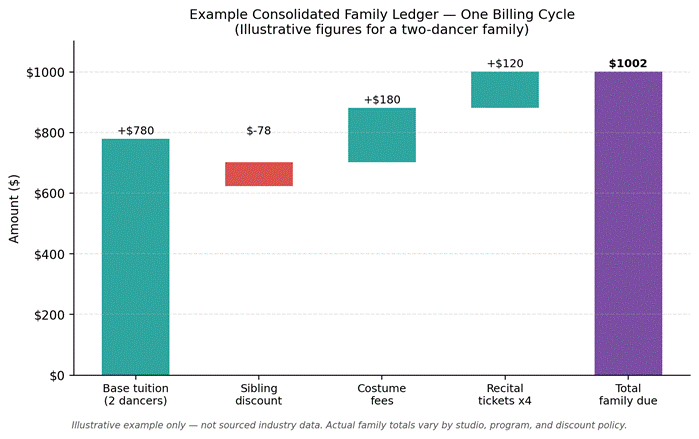
Figure 2: Illustrative consolidated family ledger for one billing cycle, showing how tuition, a sibling discount, costume fees, and recital tickets roll up into a single family total. Figures are for illustration only and do not represent real studio pricing.

Payment tools that are made for general e-commerce or gym applications tend to treat recurring charges as distinct subscriptions. As a result, family-level discounts and consolidated balances are problematic to implement and maintain. Dance studio platforms solve this problem by integrating billing to the family level as opposed to the individual dancer level. The categories below highlight the options studio owners have today.
Dedicated dance studio management platforms have led this space for several years. Offering customizable solutions for dance studios, such as tuition management, class scheduling, and family communications, as well as dedicated costume and competition team management, these platforms reduce the need for tedious spreadsheets during recital season.
Dance-specific billing tools work in concert with the unique aspects of dance studios. Built to accommodate monthly tuition cycles, seasonal enrollments, and accounts with multiple enrolled children, many even offer automatic retries for declined cards. Studio owners will appreciate a single dashboard to track all studio families’ pending, paid, and outstanding balances.
An integrated studio billing system is the most appropriate substitute for the spreadsheet and generic processor setups that many smaller studios start with. These systems automate the tuition run on the requested date and calculate sibling discounts. They also allow studios to charge costume, competition, and recital fees to an individual dancer or to an entire class at once.
Regardless of the software solution a dance studio chooses, the evaluation criteria are the same. Does the solution focus on families (rather than individuals) and not lose the family context with discounts? Does the solution automate the processing of discounts? Does the solution handle the proration of mid-season enrollments? Does the solution reconcile and push clean data to the dance studio’s accounting software? Additionally, it is crucial for dance studios to check the platform’s PCI-DSS compliance and secure card data storage due to the nature of dance studios handling recurring payments from hundreds of families for an entire school year.
Dance studio billing is as complex as the dance families that use it. Each family consists of multiple dancers, multiple caregivers, and multiple charge types. In addition, the family calendar goes from routine month-to-month autopay to a busy costume, competition, and recital schedule in the spring. The studios that handle this well bill the family as one unit rather than as isolated dancers.
Studios should also implement clear billing systems to communicate the purpose of each charge. In addition, sibling discounts should also be automated. One of the other main billing systems that studios should implement is a consolidated ledger. All charges should be visible to the dance family and the studio front desk. Implementing these systems preserves the trust that is most easily lost during the busy recital season, and streamlined billing processes build that trust over time.
Most studios employ one of three methods for client billing. The first, term billing, charges clients according to a term set by the studio. Second, session billing charges clients based on attendance to studio sessions. Finally, monthly billing charges clients at a predetermined date for the month.
With a family account, all enrolled dancers are consolidated under one login and one balance. This means parents view a single consolidated total bill rather than several separate bills.
Typically, costumes are charged as a deposit at the time of sizing with the balance due before shipment. Recital tickets and merchandise are sold as one-time event charges.
Yes, various modern systems enable one guardian to take on the role of the primary autopay account holder, while allowing a second guardian to have read access to that account.
Fees paid for classes from which a student withdraws will generally be refunded on a prorated basis; however, costume and recital fees become non-refundable after the costume order is placed and/or tickets are purchased for the recital.
With dance studio billing on your list, the fitness and gym resources hub has the related guides.