Block

Block’s Lending Hits $200B Fintech Fills Small Business and BNPL Credit Gaps

The availability of credit has been changing over the years. Where traditional lenders often moved slowly and relied heavily on legacy credit models, fintech companies like Block built faster, more consumer-friendly credit products for consumers and small businesses. With this, the old banking models with rigid credit scores and approval systems that took a long time are no longer effective.

However, with the emergence of fintech, this shift has begun to accelerate significantly. This is where Block, Inc. said on January 20, 2026, that it had provided access to more than $200 billion in credit across Cash App Borrow, Afterpay, and Square Loans.

This is not merely a milestone of scale, but it also indicates a larger change in the pattern of credit provision. The development in fintech is replacing the traditional institutions that have failed to deliver. Along with this, credit has been made quicker, more inclusive, and more flexible to the realities of the world through products such as small-business financing and Buy Now, Pay Later (BNPL) services.

Key Takeaways

  • Block says customers have financed more than $200 billion across its lending products.
  • Block serves consumers through Cash App Borrow and Afterpay, and small businesses through Square Loans.
  • Block uses near-real-time behavioral data to make lending decisions.
  • Consumer purchase and cash flow management in the market are evolving as Afterpay BNPL grows.
  • Faster, better solutions for debt financing are available to small businesses through Block’s $200B lending program.
  • Fintech will evolve to a full-fledged financial ecosystem rather than a single service.

Understanding the Credit Gap Issue

Credit Gap

The traditional financial system is concerned with stability and the cost of accessibility in most instances. Banks usually make their decisions based on credit scores, financial background, and collateral. These measures reduce risk. However, they close the door to a good number of borrowers who do not fit the type.

This brings a credit gap, especially in the following cases:

  • Fintech small business loans for those with unstable financial incomes.
  • First-time borrowers with no security to take loans.
  • Customers who need immediate money.

It has therefore led to a limitation of opportunities and to the adoption of other, more expensive, money-lending and alternative lending options.

Block Inc New Lending Model

New Lending Model

Block belongs to the group of fintech companies that address problems by changing how lending decisions are made. They do not rely on fixed credit scores but on real-time information and behavior insights of the borrower.

These insights usually include:

  • customer payment Transaction history.
  • Customer Spending Patterns.
  • Small-business sales performance.
  • Cash flow trends in the market.

Lending decisions made by fintech providers are more informed when real money users’ earnings and spending are analyzed. This will lead to increased loan approvals, but it will also introduce equal value for people judged by current payment patterns rather than past ones.

This has made loans quicker compared to those that would have taken weeks to be approved, and credit has become significantly cheaper in this case.

Learning the Lending Ecosystem

Block’s connected ecosystem of credit products has helped it surpass $200 billion in credit provided to customers. All the products target a credit market gap.

Block’s lending success is attributed to its connected ecosystem, which meets a range of financial needs. It does not sell general solutions but rather more specific ones for consumers and businesses.

Making Consumer Credit Easier

Consumer Credit

For consumers, Block’s ecosystem includes Cash App Borrow for short-term loans and Afterpay for installment-based purchases. These loans are helpful whether you need quick cash.

In this case, a significant number of users of such services would not come under the already established systems. However, their repayment behavior is usually predictable, suggesting that responsible credit access can expand with the assistance of higher-quality data intelligence.​

BNPL: Refining the Everyday Spending

Buy Now, Pay Later (BNPL) has rapidly become a popular payment option among most consumers. Afterpay’s classic BNPL model is often marketed around simple installment payments, but Block’s newer pay-over-time products can also include a clear finance fee depending on the structure.

This model is effective because it aligns with the customer’s contemporary financial behaviour. Individuals are increasingly seeking flexibility and avoiding debt and high interest rates.

However, Afterpay BNPL growth does not go without challenges. The ease of accessing installment payments can lead to overspending, particularly when users are careless. This is why responsible usage and awareness are necessary when using this model.

Increasing Small Business Power

Small businesses face the most difficult financing hurdle. For sellers, Square Loans is the business-lending product highlighted in Block’s $200 billion milestone announcement. Conventional loans may involve lengthy approval processes that don’t allow business owners to respond to opportunities as quickly as they’d like.

This is transformed by Fintech, which provides funds that are Faster to access, Easier to qualify for, and more flexible in repayment terms.

In most instances, repayments are pegged to the business’s performance, thus alleviating strain during low seasons. Such support enables entrepreneurs to grow without worrying about strict financial commitments.

Embedded Finance Options

Embedded finance is one of the most significant changes in the modern world’s financial sphere. This idea is based on embedding the financial services into platforms that individuals already utilize.

Users can now access multiple systems in a single go, rather than using a separate system. Take out fintech small-business loans and other loans in an app they already trust. Select an installment at checkout. Also track real-time activity-based access funding.

This is a smooth experience that eliminates friction and simplifies financial tools. It also promotes greater adoption, as users need not go through complicated procedures to access basic financial services.

Can This System of Payments Work?

As fintech continues to grow, sustainability issues arise. Is lending on such a large scale sustainable?

The solution seems to be encouraging. The information from websites such as Block suggests that high repayment rates and manageable risk may go hand in hand with high growth rates. This challenges the conventional view that increased access to credit will inevitably raise financial risk.

That said, sustainability is a matter of balance. The companies are obliged to keep their models honed, and users must be responsible when borrowing money. All these factors, combined, define the long-term success of fintech and alternative lending.

About Block Company Profile

Block, Inc. is a financial technology firm that was launched in 2009 with a vision to make access to and expansion of financial services simple and accessible. What was initially a system to offer payments to small businesses has become an entire ecosystem serving individuals and companies.

In the current day, Block provides a variety of services such as:

  • Payment processing tools
  • Financial applications by consumers.
  • Buy Now, Pay Later solutions.
  • Business financing options

Accessibility has always been the concern of the company. Through technology and data, it will develop a financial system that benefits more individuals, not only those who meet the conventional requirements.

The industry’s evolution is reflected in the fact that it started as a traditional payments platform but has now transformed into a multi-dimensional fintech ecosystem.

Conclusion

The fact that Block $200B lending is a milestone, not just for Block but for the entire fintech industry. It emphasizes the extent to which digital finance has gone to address inefficiencies in legacy systems.

Fintech is expanding opportunities that were not open to many individuals and businesses by increasing the speed, flexibility, and accessibility of credit. Small businesses can expand without unnecessary delays, and consumers are better able to control their finances.

Nevertheless, with this development comes responsibility. This will be sustainable development reflected through transparency, responsible borrowing, and further innovativeness.

Finally, the actual outcome of fintech is not the amount of credit provided, but the quality of that credit’s ability to empower people to progress.

FAQs

  1. What does it mean by Block reaching the $200 billion lending milestone?

    It means Block says customers have financed more than $200 billion across Cash App Borrow, Afterpay, and Square Loans.​

  2. What is the main difference between fintech lending and traditional lending?

    Fintech focuses on real-time data and online operations, enabling faster approvals and greater accessibility than the traditional system, which relies heavily on credit history.

  3. Why is BNPL so popular among consumers?

    BNPL offers flexibility, allowing users to divide payments into low installments that, in most cases, do not attract interest, making purchases easier.

  4. What does fintech do for small businesses?

    It offers faster access to capital, simplified application procedures, and flexible repayment options for small businesses.

  5. Is there any risk associated with fintech lending?

    Yes, there are risks, as with any form of borrowing. Repayment problems may result from misuse or inadequate budgeting, and it is advisable to use them wisely.

  6. What is embedded finance?

    Embedded finance puts financial services on the same platform as their users, enabling them to use features such as loaning or payments without leaving the application they are in.

Membership Growth Strategies

How to Grow Memberships and Streamline Operations of Your Fitness Studio

The boutique fitness space is seeing increasing competition every day. Every fitness business wants to grow its gym memberships. There are plenty of studio management tips available online, but not all of them yield results. Some of them are just noise that only increases the hassle for the business owners without providing actual growth.

Scaling a fitness boutique business is not about running more Facebook ads. It requires a dual approach: aggressively capturing local demand while effectively plugging operational leaks. Fitness boutique businesses are like buckets, but most of them are ‘leaky buckets’ with a hole in the bottom. Business owners devote themselves completely to filling up the bucket with aggressive marketing and capturing local customers. But somehow operational leakage always drains the bucket, and growth cannot be sustained.

To achieve stable growth, you need to plug the holes in your fitness boutique business and prevent your efforts from going to waste. This blog will provide you with data-backed membership growth strategies and streamline operations for your fitness boutique, thus helping you increase revenue and save time.

The Foundation: Automate Studio Operations

Automate Studio Operations

You go out and market your boutique with targeted ads to acquire new customers, but it is all in vain if you do not have the capacity to handle them beforehand. Before trying to acquire 100 new members, the studio must be able to handle them without breaking down. This brings us to the foundation of scaling any business: automate studio operations.

Fitness professionals save an average of 28 hours a month just by automating booking, waitlists, and payments. It is interesting to note that a mere 5-minute delay in response to a new lead drastically drops the chances of conversion. Automation also helps reduce the risk of losing potential customers.

There are many benefits associated with automating studio operations, such as:

  • Maximizing lead conversions: By using automated message sequences, you can instantly respond to your customers at any given time. This allows leads to book trials 24/7 without human intervention.
  • Capturing revenue with automated waitlists: If a spot opens up due to a late cancellation, the system can automatically text the next person on the waitlist, fill the spot, and bill the client. This helps you effectively capture lost revenue through automated waitlists.
  • Eliminate manual friction: Automating operations prevents your staff from wasting hours chasing late credit card payments or answering repetitive texts. Reducing this manual administrative friction frees up your staff to focus entirely on the in-person member experience, thus increasing customer satisfaction and retention rates.

Proven Membership Growth Strategies

The fitness industry standard for new customer acquisition is between 0.5% and 2% of your total audience per month. This is quite low, and it is difficult to acquire new customers solely relying on random outreach. But there is another very interesting statistic. It states that 87% of consumers consider recommendations from friends and family highly credible, and member referrals convert into paying clients at a rate 30% higher than traditional promo leads. This suggests a very strong growth strategy: referrals.

Just offering a discount to referred customers or giving referral bonuses would not cut it in this competitive era. You need something new and refreshing. Here are some of the most effective growth strategies:

Launch a Tiered, Gamified Referral Program

Referral Program

You should not just go around asking your customers for favours. Instead, focus on offering two-way tangible rewards. For example, the referrer gets a free month, and the new customer who came through the referral gets 50% off their first month. This makes it more lucrative for both the referrer and the referred customer, as they see their own personal benefit. It also helps your business grow faster by acquiring newer customers and having existing ones act as sales agents.

Capitalize on the “First 100 Days” with Starter Packs

The first 100 days with a customer are crucial for building trust and loyalty. You can offer a specialized introductory pack that requires completing a 3-month commitment at a slightly discounted rate. In the short term, this increases the average order value. And getting a member past the 3-month mark significantly increases their lifetime value.

Dominate Local Search Engine Optimization (SEO)

Dominate Local Search Engine Optimization

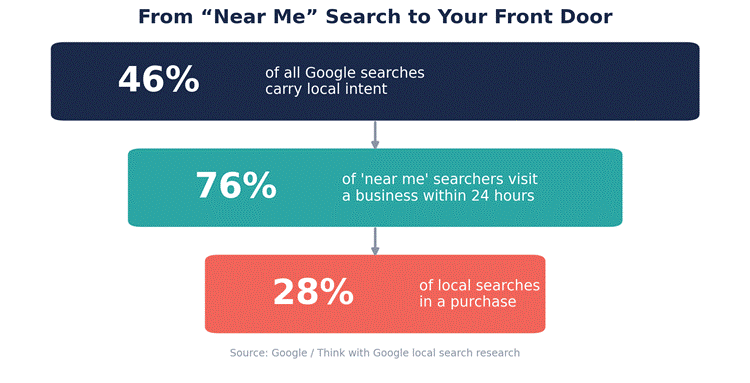
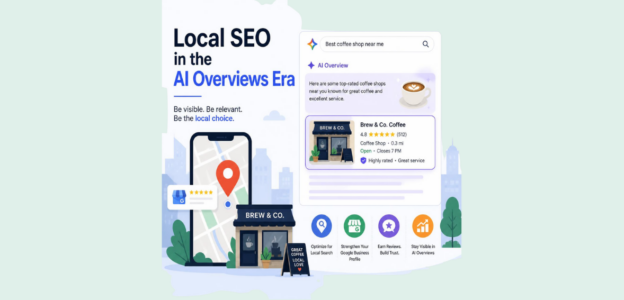
Local leads are more likely to convert than those who discover your business through promos, thanks to their higher intent. You should optimize your Google Business Profile (GBP) to capture the high-intent “near me” searches. These have the highest conversion rates for physical brick-and-mortar studio businesses.
Maximizing Fitness Studio Retention

This is all about the economics of churn. A rule of thumb is that retention of existing customers is better than finding new ones. The harsh reality of most fitness studios is that 50% of new gym members quit within their first six months. In contrast, 87% of members who undergo a structured onboarding process remain active after 6 months.

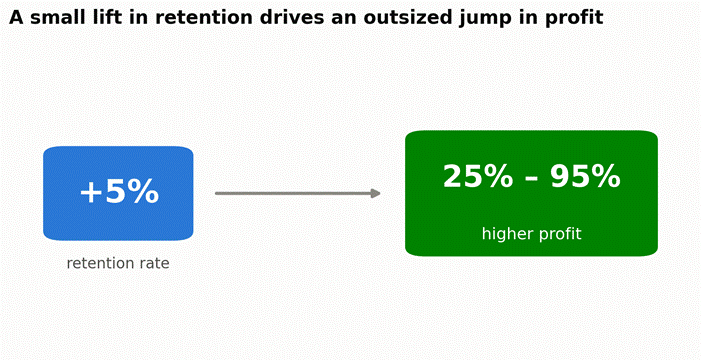
Losing a customer is not just about lost revenue; it is about starting the cycle over with a new customer, which can drain resources and cause burnout for the business. A key metric suggests that replacing a lost member costs up to 9 times as much in sales and marketing as retaining an existing one. This is important because a mere 5% increase in retention rates is proven to boost profits by 25% to 95%.

There are many strategies you can implement to boost customer retention. Given below are some of the specific actions you can take in your fitness business to maximize customer retention rates.

Implement 30-Day Phased Onboarding Process

You need to move past the “single gym tour”. Instead, focus on mapping out weekly touchpoints such as

  • A welcome text on Day 1.
  • Check-ins on their first class within the first week.
  • A goal-setting email on Day 14.
  • Milestone celebration on key milestones such as a month, two months, and so on.

Building Community

Building Community

Members who participate in group classes or small-group training 3-4 times per month are 20% more likely to remain loyal customers than solo gym-goers. You should focus on building a community through group dynamics, so customers have goals to look forward to, can track progress with peers, and are encouraged to participate more.

Tracking and Addressing the “Missed Week”

Missed weeks often mean that either the customer is losing interest or motivation, or is planning to change studios. You should have a robust and automated system in place to address these instances. You can start by setting up system alerts for when a highly active member misses 7-10 days consecutively. Reaching out with personalized and non-salesy texts, such as “We miss you”, can pull them back before the habit breaks entirely and you lose a customer.

Studio Management Tips to Improve Financial Health

So far, we have discussed the administrative and operational aspects of the fitness boutique business, and some strategies to optimize them.

Now it is time to discuss another important aspect, the financial and managerial health of your fitness business. A healthy fitness boutique studio aims for a utilization rate of 70% or higher (meaning 70% or more of available spots are filled) and strives to keep monthly client churn at 5% or less.

There are three key performance indicators (KPIs) every fitness business owner must track to ensure their business’s health.

Average Monthly Recurring Revenue (AMRR) per member

AMRR is calculated by dividing the total subscription revenue by the total number of active clients. This is an accurate indicator of your true pricing power and reveals if members are buying high-margin upsells such as retail or personal training.

Optimize Utilization Rate

You should also focus on maximizing your class utilization rate. Class utilization is calculated by dividing the Total Booked Hours by the Total Available Hours.

Class Utilization Rate = Total Booked Hours / Total Available Hours.

If a specific class time consistently underperforms, say hitting below 40%, it is a financial drain and needs to be moved, merged, or cut to save on payroll.

Labor Cost Management

The labor cost percentage is a measure of your business’s staffing efficiency. You can calculate it by dividing the total monthly instructor wages by the total monthly revenue. You should always aim to keep this between 20% to 25% to maintain healthy profit margins for your business.

Labor Cost Percentage = Total Instructor Wages per month / Total Monthly Revenue

Empower Your Staff to Drive Retention and Growth

A study of gym-goers found that, for up to 40% of boutique fitness members, the primary reason for renewing their membership is a specific instructor. And, another study concluded that replacing an excellent staff member can cost up to 33% of their annual salary in recruiting time, training, and lost revenue.

Having good staff and then retaining them is crucial to any customer-facing business. You should provide effective training for your staff and appropriate rewards to acknowledge excellent work. Some specific methods that you can use to empower your staff are:

Standardize “Front Desk Greeting”

You should never leave your first impressions to chance. A detailed greeting protocol that makes the customer feel welcome and valued is important for them to keep coming back. If you can make your lead feel like an important person, you are more likely to convert.

Link Instructor Compensation to Class Utilization

Instead of relying on a flat hourly rate, you must implement a base-plus-bonus model of paying your instructors. For example, if instructors earn a bonus for class utilization above 85%, they will become highly motivated internal marketers, as their growth now directly depends on your business’s growth.

Streamlining Payroll and Availability

You should prioritize integrating staff schedules into your primary studio management software. This will help prevent double-bookings, eliminate manual timesheet errors, and keep the staff morale high by ensuring they are paid on time.

Conclusion

Sustainable studio growth is never an accident. It is a result of strategic resource management and maintaining perfect equilibrium. You must aggressively bring more customers through the doors of your business, while also maintaining a frictionless automated operational system so they don’t walk back out.

Your passion for fitness must be matched by a passion for business metrics. The most important thing is to plug your “leaky bucket” so that your efforts are not in vain.

Frequently Asked Questions

What is a good retention rate for a fitness studio?

The annual average for the fitness industry is a 71% retention rate. If your studio maintains an annual rate of 80% or more, then you are operating in the top tier of the boutique fitness space.

How much should a fitness studio spend on marketing?

A standard benchmark for studios is to spend around 7% to 10% of their gross revenue in marketing. However, during aggressive market-share capture, you can spend up to 15% of your gross revenue on marketing.

Why do most new members quit?

The leading factors in gym membership cancellations are cost, changing personal circumstances, and a lack of guidance. You should go head-on to tackle the lack of guidance.

How often should I track my KPIs?

Ideally, you should track operational metrics such as class utilization rates and lead conversion rates weekly.

From where should I start automating my business?

You can start by automating client-facing bottlenecks first. Automated class bookings, waitlist management, and missed-payment follow-ups are a good start; you can then move on to other operations.

Instant Fund Transfer

FedNow’s Rapid Growth Signals Instant Payment Rise

In the last decade, the way people send and receive money, how businesses conduct financial transactions, and the global flow of cash have undergone massive shifts. Driven by factors such as speed, convenience, and clarity, new-age financial services have taken on a new shape, paving the way for instant fund transfer networks to gain momentum across all sectors worldwide. Having said this, the fast expansion of the FedNow system in a very short span of time is one of the most vital developments of the time. The platform is dedicated to accelerating participation from multifaceted financial institutions. This increase in participation clearly points to the growing popularity of the instant payment infrastructure.

The flow of money across financial sectors is heavily influenced by the growth in FedNow adoption. A decade ago, when instant payment options were considered and used as experiments, real-time transfers were now a crucial part of almost every sector of financial transactions. Countless businesses have come forward to join this rapidly growing network of instant payment, making it an invincible element of new-age banking service.

This massive growth in FedNow’s instant payment infrastructure mirrors the pace at which real-time and faster payments have taken over the financial sector and serves as the pivot around which the entire digital economy is revolving today.

Real-Time Payment: A Brief History of Emergence

Real-Time Payment

The traditional method of transferring cash and enabling money flow has served us for an infinite number of years. It is needless to say that this traditional cash infrastructure is reliable and consistent, making it a robust way to transact in cash. However, these traditional methods take a long time to process payments, especially for bank transfers, making the entire process tedious.

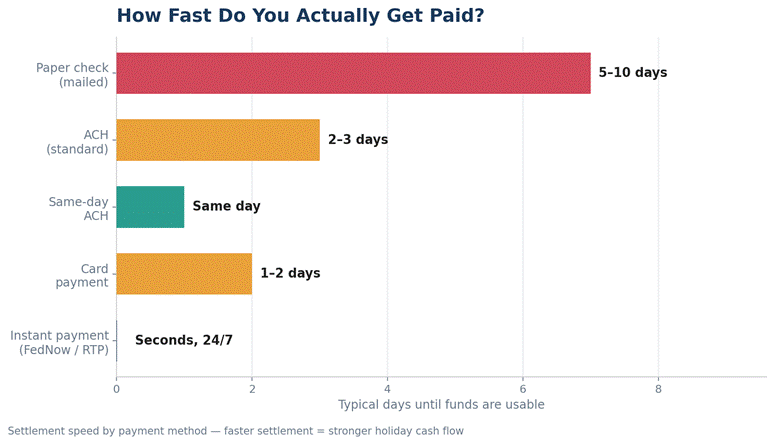
Real-time payment networks were created to address recurring payment delays for consumers. These networks operate nonstop: 24 hours a day, 7 days a week, 365 days a year. Unlike traditional methods, real-time infrastructure enables seamless, immediate transactions by processing payments instantly.

FedNow is one such platform that allows real-time payments. Instant transfer of funds between all the registered financial organizations to ensure that all the payment requests get processed and completed from anywhere and anytime. With increased participation, FedNow is rapidly expanding its branches.

FedNow Real-time Payments: Rising and Expanding Network

In recent months, many financial institutions have joined FedNow’s network. FedNow now has over 1,500 banks participating or in the process of doing so. Banks are often considered a yardstick to measure the growth of the FedNow real-time payment network in recent years.

The number suggests a significant increase in participation in the real-time fund transfer system. For any payment network to attain popularity and momentum, it is important that more banks, credit unions, and financial service providers join their system. FedNow has achieved these milestones and is expected to gain attention in the years to come.

The massive reach and development of FedNow also indicate that businesses are benefiting from these fast-payment methods. Be it small- or large-scale businesses with significant cash transactions, instant fund transfers have proven beneficial for business growth by ensuring a constant, uninterrupted flow of cash.

The FedNow adoption growth rate also suggests that the framework for instant fund transfers is not limited to a select group but is becoming increasingly accessible to the masses over time. More customers are opting for instant fund transfer, escalating the shift from traditional to modern payment methods.

Instant Payment: A Leap in the Transaction Activity

Instant Payment

With the increase in FedNow’s popularity, a surge in transaction volume worldwide is also seen. With the adoption of the FedNow instant fund transfer model among institutions, instant payment volume has also risen rapidly yet steadily in 2025. Consumers and business owners are swiftly shifting their interest from traditional processes to modern methods of fund transfer for daily transactions as well.

These increases in daily transaction volume indicate that the instant fund transfer model is gaining people’s trust. With the increase in reliability and familiarity, modern methods of instant fund transfers are slowly and eventually replacing the traditional method in many ways, including but not limited to the following:

•              Transfer of funds among individuals

•              Instant bill payments

•              Payments for auto-pay or recurring subscriptions

•              Instant transfer of funds for medical or any emergency purpose

•              Payments for events and gigs

•              Payments for recharge

Previously, to carry out all these transactions, there was a long wait period, but with the introduction of instant fund transfer, millions of consumers can now complete these transactions in one click. Instant payment FedNow stats, too, reflect this need for speed along with credibility in financial transactions.

Instant Fund Transfer Method: The Growing Competitive Scenario

Like all other services in the modern world, instant fund transfer is not restricted to a single network. There are numerous platforms that allow consumers to make hassle-free instant payments, and as demand for this infrastructure grows, more financial institutions are providing this service to the masses.

In a fast-evolving, competitive environment, financial institutions that adapt to the real-time network model at an intermediate level should remain competitive in today’s instant-fund-transfer marketplace. The surge in real-time payments and FedNow transactions shows that the FedNow service is adapting quickly to consumer demand.

Real-Time Payment and Consumer Benefit

Real-Time Payment and Consumer Benefit

Regardless of which platform a transactor chooses, real-time payments benefit consumers significantly. Instant access to transferred funds, greater transparency, and lesser uncertainty are the most important benefits that people gain from the real-time payment method.

People don’t have to worry about the funds they’ll receive. Real-time payment provides instant confirmation once a payment is completed. The receiver can see the funds reflected in their account instantly. These reduce uncertainty and dilemma for both the sender and the receiver.

This is particularly effective when an emergency fund transfer is needed. Last-minute payments, too, become easier with this fund transfer system. This not only reduces confusion but also saves people from paying late fees and high transfer charges.

Real-Time Payment and Uninterrupted Cash Flow

One of the greatest beneficiaries of this real-time payment system is businesses that require a constant flow of funds. Traditional methods of settling dues and addressing payment delays delay cash flow, forcing business owners to face a cash crisis as wait times are long. This results in an abrupt cut in the flow of business transactions and operations.

Instant payments accelerate efficient cash flow and foster business growth by reducing the need for temporary credit. In 2025, instant payment volumes increased significantly, suggesting that more businesses are opting for this modern method over traditional payment methods. It can be assumed that, in the coming years, real-time payments will likely be the ideal system for continuous, sustained cash transactions.

Real-time Payment Adoption Surge and the Role of Technology

Technological infrastructure plays a huge role in the adoption of real-time payments. To implement continuous cash transactions via a real-time payment method, institutions must ensure that they have upgraded technology. Failing to keep pace with technological advances will result in a low adoption rate of real-time payments.

There are many tools available, including cloud-based platforms and other digital banking tools, that make it easier for financial institutions to accelerate real-time payment adoption. Faster payment adoption, along with improved technological infrastructure, also demands a high level of security.

Apart from meeting high security standards, it is also important to have technologies installed that enable fraud detection and support seamless, secure cash transactions. Adhering to the technological needs of the real-time payment setup, FedNow adoption growth can expand significantly in the days to come.

Conclusion

Imagine the days when you had to travel to the bank to carry out a transaction: standing in a queue, filling out lengthy forms, and waiting for days to get it transferred. But with the advancement of technology and the discovery of modern-age methods, payments, too, are made simple and just one click away. The current growth in FedNow adoption demonstrates the rapid pace at which financial institutions and consumers are integrating this shift in how they conduct financial transactions.

With the increase in daily transactions, it is expected that the modern method of real-time or instant payment will gradually gain a trustworthy place in the global financial system. The day is not far when instant payment will become the norm rather than the exception.

The engagement of FedNow 1500 banks and a sustained rise in instant payment volume in 2025 are driving real-time payments forward worldwide. The instant payments FedNow stats indicate that, in this fast-paced world, where everything is just a tap away, People expect money to move as quickly as a wink.

On-the-Go Shoppers

Proven Ways to Connect with On-the-Go Shoppers This Year

In today’s time, consumers don’t just browse on their phones. They practically live in it. Consumer behavior is constantly evolving, with people spending more time on their screens. To survive the current retail landscape, mastering mobile commerce and prioritizing mobile shopping optimization is no longer optional. These are the new baselines to stay in business.

A recent study showed that mobile non-gaming app purchases have crossed $85 billion, officially surpassing mobile gaming revenue. With users spending more time and money on non-gaming apps, it becomes essential to understand consumer behavior and connect with them to boost your business.

Connecting with your customers online and capturing the attention of on-the-go shoppers requires many steps, from optimizing site speed to removing friction at every step of the buying process.

This article will provide proven strategies to increase your online relevance and connect with potential customers, helping you grow your business in 2026.

Reality of On-the-Go Shoppers

Reality of On-the-Go Shoppers

The e-commerce landscape has changed significantly in the past few years. Earlier, online commerce was simply about creating a site, listing products, and waiting for customers to come, but that is no longer the case.

Global mobile e-commerce sales have reached an astonishing $4 trillion, accounting for 59% of all online retail worldwide. With the increase in market cap, competition has become more fierce, and with so many options to choose from, consumers often pick the option that feels easiest. In such heavy competition, it’s important to understand the shopper mentality.

First, we need to know who these on-the-go shoppers are. These people are not intently searching for something online; they are multitasking, such as commuting, waiting in lines, or price-checking at a physical store. The one thing they hate the most is friction.

This will become clearer with an example. Suppose you are at a coffee shop waiting in line for your order to arrive, but you suddenly remember that you forgot to buy a gift for the small get-together you are headed to. You open your phone, and among all the options, you naturally choose the one that has the least friction. You simply do not have the time to create accounts, reset forgotten passwords, or fish your credit card out of your wallet to enter the data and complete the purchase manually. You need a quick tap solution before your coffee arrives.

So, on-the-go shoppers have zero tolerance for friction. But one must wonder as to why they should even cater to on-the-go shoppers.

Actually, there are many benefits of catering to on-the-go shoppers:

  • Capturing high-intent impulse buys.
  • A dramatic increase in repeat customers, because you trust the app that you’ve used already when you are in a hurry.
  • Insulating your brand against competitors who still rely on desktop-first architecture.

There is one important point to understand before diving deep into mobile shopping optimization. There is a “conversion gap” between desktop and mobile traffic. Desktop conversion rates are higher, despite the majority of traffic being on mobile. This can be explained by the fact that visitors to a desktop site are high-intent leads, whereas mobile traffic has lower intent. If we can bridge this “conversion gap” somehow, the sales and repeat customers are bound to increase.
On-the-Go Shoppers: 4 Proven Ways To Connect in 2026

Building a Lightning Fast Mobile-Friendly Website

Fast Mobile-Friendly Website

According to data, 63% of users immediately leave a mobile page if it takes more than 4 seconds to load. And if you think this is shocking, there’s another study that shows a mere 1-second delay in mobile load time can tank conversion rates by up to 20%. The lesson: “Speed is non-negotiable.”

A truly mobile-friendly website is built on speed first, and aesthetics second. Having a lightning-fast mobile website is one of the most important things that any online business must do.

There are a few tips and tricks you can use to increase the speed of your mobile website:

  • Compress all images like crazy. Large media files are the silent killers of performance.
  • Implement lazy loading on your website. You don’t need to load everything at once; load the products only when the user scrolls to them.
  • Upgrade your hosting services. It might be expensive at first, but in the long run, it is thousands of dollars saved by preventing lost sales.

Building a mobile-friendly website has many benefits. The first thing it does is remove friction from mobile checkout. There are many advantages of a frictionless mobile checkout:

  • It instantly lowers your bounce rate, i.e., the number of people leaving your website without making a purchase.
  • Your website ranks higher in Google’s mobile-first index.
  • This one is interesting. Users subconsciously associate speed with security. A slow or laggy website raises doubts in users, while a speedy website makes users feel at ease. Thus, a fast website builds subconscious trust in buyers’ minds.

Streamlining Mobile Checkout Experience

An astounding statistic reveals that mobile cart abandonment is 85.65%, compared to 69.32% on desktop. And, 47% of these abandonments are caused by surprise costs, such as shipping or taxes, at the very end.

Understanding the above data is important. It is an important insight into how users interpret costs during online checkout. People are annoyed by hidden charges applied at checkout. One reason shoppers abandon a website is friction during mobile checkout.

Fixing your mobile checkout process is the highest ROI you can do for your business this year. Here are a few actionable steps that you can take:

  • First, mandate guest checkout. If you force a user to create an account before he explores your website, you’ve already nearly lost them. This is a real conversion killer, so have guest checkout be the first thing you implement.
  • The second thing you can do is use a visual progress bar to give the user an idea of how long the entire process will take. You don’t want to keep them guessing how many steps remain; a visual progress bar increases retention and reduces anxiety friction.
  • Finally, the auto-fill feature must be enabled on your website. You should implement auto-filling addresses using location data or Google autofill.

There are so many benefits associated with reducing friction during checkout:

  • It helps you recover about 20% of revenue that is otherwise lost.
  • Reduces the cognitive load on the buyer, making the process more enjoyable.
  • Eliminates the frustration that otherwise would have caused the user to jump to your competitor’s website.

Contactless Payments and Digital Wallets

Contactless Payments

The days of expecting a customer to enter a 16-digit card number, then its validity, and finally the CVV on a tiny mobile screen are long gone. We are witnessing a massive, permanent shift in how consumers choose to spend their money online.

The numbers speak for themselves. A study indicates that contactless payments and digital wallets account for over $10 trillion in global transaction value, representing 42% of all card payments worldwide.

Integrating contactless payments and digital wallets reduces the payment step to a single tap.

This is driven entirely by user convenience. It is worth noting that over 80% of surveyed consumers now use smartphones for contactless payments. Whether they are grabbing a quick coffee, riding the subway, or taking a walk down the street, their device is their wallet. The fundamental baseline requirement for capturing sales from such shoppers has shifted to adopting a true one-click checkout ecosystem, which was once a premium feature but is now the norm.

There are numerous advantages of adopting digital wallets and contactless payments:

  • Eliminating the friction of manual data entry.
  • Leveraging biometric verification, such as FaceID or fingerprints, of the user device itself to prevent fraud.
  • An interesting figure is that 95% of Gen Z shoppers strictly prefer digital payments over physical cards. If you can evolve your store to accommodate them, you have already tapped into a huge market.

Leveraging Push Notifications

Push Notifications

Once you have successfully captured an initial sale, your overall strategy must shift from merely acquiring customers to one that revolves entirely around keeping them engaged. This is where dedicated mobile apps hold an advantage over websites. Apps have direct screen access and can send push notifications. Instead of hoping the customer returns, you have a permanent presence on their home screen.

The data strongly support this fact. Push notification opt-in rates for retail apps are aound 75% on iOS. You can also notice it in your everyday shopping habits. Often, we buy things because we’re notified of their arrival or a sale via push notifications. Sending out weekly push notifications can multiply 90-day user retention by 2 to 5 times.

Although you must be careful, because there is a thin line between notifying your customers and annoying them, you should never spam the user with daily, irrelevant broadcasts, or they will revoke permissions. Notifications must be personalised user-to-user, and general notifications must include one of three reasons: back-in-stock alert, flash sale, or abandoned cart reminder.

Push notifications are an important tool to hook your customers:

  • Bringing in high-intent shoppers directly to the abandoned cart without ad spend.
  • Create a sense of VIP emergency for new product drops.
  • Significantly increasing customer lifetime value (LTV).

Conclusion

The modern on-the-go shopper does not owe you any loyalty, but you must earn it within milliseconds. The new digital landscape is incredibly competitive, and the brands that actually thrive will be the ones that respect their customers’ time and minimize the effort required to buy something.

It all comes down to mastering three core pillars: prioritizing lightning-fast loading speeds, ensuring a highly streamlined and frictionless checkout, and implementing seamless one-tap payments. Fail to deliver on any one of these fronts, and you just lost a customer to your competitor. If you truly want to stop losing 85% of your customers at the finish line, you must audit mobile speed today, streamline checkout to milliseconds, and let your customers complete purchases with a single tap.

Frequently Asked Questions

  1. What is the biggest reason for cart abandonment?

    The biggest reason for abandoned carts is unexpected costs, such as shipping or taxes, popping up suddenly during checkout. Another reason is a complex and tedious checkout process or forced account creation.

  2. How fast should my mobile website load?

    Ideally, any mobile website must load within 3 seconds. In the first second, you lose about 63% of customers who leave without even seeing your website.

  3. Are digital wallets important?

    Yes, they are very important. They eliminate manual data entry and are very user-friendly. A buyer walking down the street cannot pull out a physical credit card to manually enter details; they’ll simply choose another store that offers contactless payments.

Cash Flow

Cash Flow Planning: Forecasting, Invoicing, and Smart Payment Terms

A business can be highly profitable on paper and still go bankrupt in just a matter of time due to poor liquidity. Business owners often overlook the importance of effective cash flow management. A U.S. Bank study found that 82% of companies fail due to poor cash flow management. This occurs due to factors such as lingering high operational costs.

In the modern scenario, if you are trying to manage your cash flow forecast using simple spreadsheets, then you are up for a failure. In this blog, we will teach you everything you need to learn regarding effective cash flow management. We’ll cover topics like building a forecast, accelerating invoice collection, and negotiating payment terms.

Profit Does Not Equal Cash Flow

Profit Does Not Equal Cash Flow

The first fundamental in cash flow management is understanding the difference between profit and cash flow. The biggest myth to bust here is that profit does not equal cash flow. They are different, despite how similar they feel.

Profit does not always equal available cash. It is just a number on your income statement that indicates whether you made money or not. But it does not guarantee that you actually have the money to operate the business in real time.

Cash flow is the actual metric. It tells you how much money you actually have sitting in your bank account to pay next week’s payroll.

Now that you are no longer under the illusion that profit equals cash flow, let us use an example to help you better understand.

Suppose a B2B service agency secures a $100,000 contract. They record the revenue, and the profit is at an all-time high. Everything looks great on paper, huge profits and all. But there is a catch: the client has 90-day payment terms, and the agency needs to pay the contractors today. The end result is a crushing cash crunch. This is why cash flow forecasting is important, and why profits do not equal cash flow.

Building a Predictive Cash Flow Forecast

Cash Flow Forecast

Before we begin, you do not need to worry about the cash flow forecast. It is just a spreadsheet that tracks money going in and out of your bank account.

This section will provide you with step-by-step instructions on how you can build a predictive cash flow forecast for your business. This will help you follow through with the steps to build an effective cash flow management system to better track your cash flow.

Step 1: 13-Week Rolling Forecasting Model

First of all, a question might arise: why take 13 weeks specifically? This is because of three reasons:

  • It represents one fiscal quarter.
  • It is short enough to make accurate predictions.
  • And it is long enough to foresee potential disasters.

Before we dive into creating a cash flow forecast, we need to know what “rolling” means in the rolling forecast model. It basically means we are building a dynamic or alive spreadsheet. In simple terms, we delete the oldest one each week. For example, when week 1 ends, you add a new week 14 and delete the previous one. This ensures we are always looking at exactly 13 weeks into the future.

The golden rule of cash flow: The amount is entered into the spreadsheet only when the money hits the bank, not when a sale is made.

How to build a rolling cash flow forecast?

To make a cash flow forecast, first, open up a spreadsheet and make three simple rows:

  • Beginning Cash: The exact dollar amount in your bank account every Monday morning.
  • Cash In: The exact date you realistically expect the check from the client or Stripe payments to clear the bank.
  • Cash Out: In this row, enter the exact dates your auto-pay triggers (payroll, rent, software subscriptions, loans, etc.)

If you maintain this sheet for 13 weeks, you will be able to see exactly which week your bank account dips below zero, giving you time to make the necessary adjustments.

Step 2: Tools and Scenario Planning

In 2026, relying solely on last month’s bank statements is dangerous. A common mistake many business owners make is staying overly optimistic and expecting all the pieces to fit in perfectly. But, in the real world, things don’t work perfectly; there are unforeseen delays, losses, and inflation.

You need to stress-test your forecast by deliberately entering bad numbers into the spreadsheet, so you know what it looks like in worst-case scenarios. Some examples of worst scenarios can be:

  • Your biggest and most reliable client is delaying payment by 30 days.
  • Suppose a critical piece of equipment breaks and costs $ 5,000 to fix.
  • The supplier raises costs by 15%

There can be so many scenarios and variables. The key point is that if your forecast is missing payroll due to any of these scenarios, your business is at risk. You need to make a cash buffer to deal with it.

Invoicing Tips to Accelerate Your Accounts Receivable

Accelerate Your Accounts Receivable

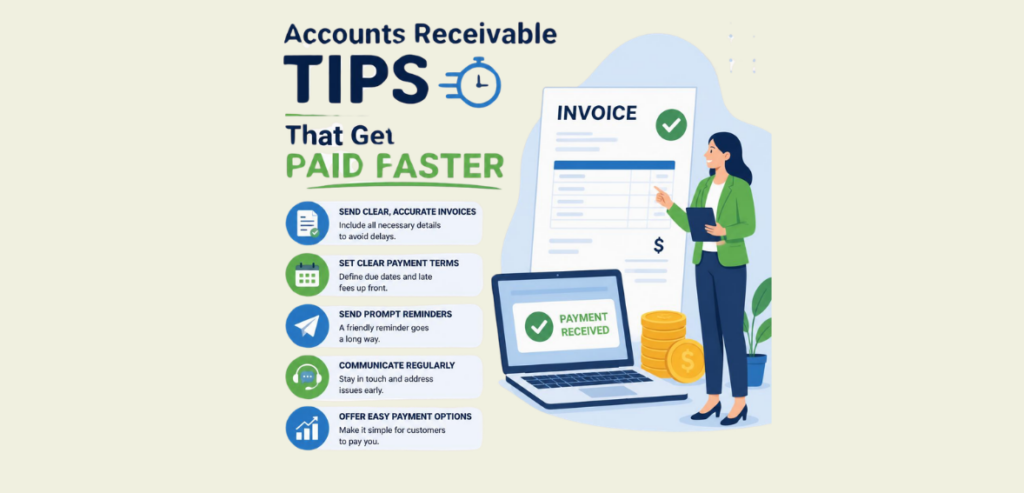
Accounts Receivable (A/R) is a fancy term for “money people owe you”. If you have sent an invoice but haven’t been paid yet, then that money sits in Accounts Receivable.

Another important term here is A/R Aging Report. This is a list generated by accounting software that groups unpaid invoices by how incredibly late they are. It usually categorizes them as 30 days, 31-60 days, 61-90 days, and so on.

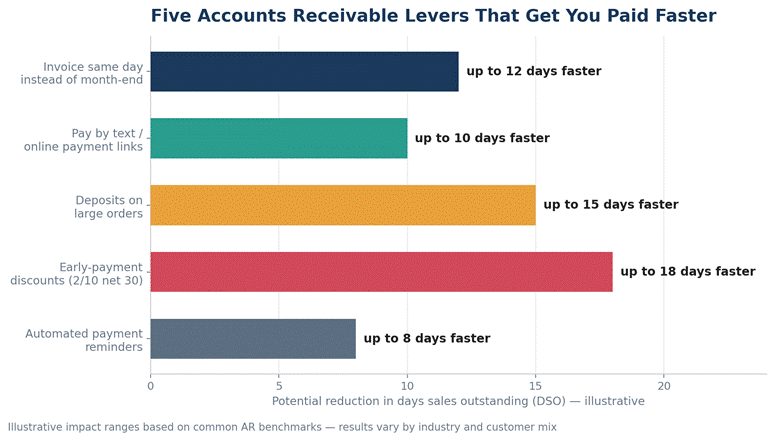
Letting your money sit in A/R is like handing out free 0% interest rate loans to your clients. You should pull Aging reports weekly and actively work to get your invoices paid. Here are some invoice collection tips to better manage your A/R:

Automate the Friction Out of Paying

If your payment process is tedious or takes too long, your payments will inevitably be delayed. Consider the psychology behind payments here. Would you prefer a single-click payment solution or a 5-click process with a manual bank transfer? The answer is obvious: you will delay the payments if there are many steps involved.

To avoid this friction, consider integrating tools such as Stripe, GoCardless, or QuickBooks Payments to enable one-click ACH or credit card payments directly from the invoice. If you optimize this step alone, a large fraction of client payments will become on time.

Bonus :

You should have a clear follow-up sequence for late payers. Having a systematic sequence in place that lays out the exact days overdue and the steps to address them makes it easier for you to manage clients and eliminate confusion.

For example, consider this sample 3-step follow-up sequence for a B2B service agency:

  • Day 1 Overdue: Automated e-mail.
  • Day 7 Overdue: Firm request for a payment date.
  • Overdue by 15+ days: Phone call follow-up and halting all client work.

Rethinking Payment Terms

The default industry standards of payment terms are a great reference point. But blindly following industry standards without considering alternative strategies to maximize your business’s efficiency is not wise.

The most common industry standard for payment terms is Net 30 and Net 60. For small businesses, Net 30 or Net 60 essentially means they are acting as a free 0%-interest bank for their clients. This can be disastrous. The client will pay you for the services you have already rendered after 30 or 60 days, but you need money for the payroll today. Oftentimes, small businesses take out bridge loans to cover this cash-flow gap, but that is a risky move.

Instead, you should move to more strategic plans to address this problem. One rule that you can use is the “2/10 Net 30” rule. It means you send the invoice to the client and tell them they must pay within 30 days of receiving it, or they can pay within the first 10 days and receive a 2% discount. At first glance, this seems like you are compromising your profits. But, in the long term, sacrificing 2% of top-line revenue is often vastly cheaper than taking out short-term bridge loans to cover cash gaps. This is also a great way to boost your accounts receivable

Another thing you can do in parallel is ask your supplier to increase your net quota. For example, if the current arrangement with the supplier is Net 30, then you can renegotiate payment terms to Net 45, so that money stays longer in your bank account.

Hidden Ways to Free Up Working Capital

Free Up Working Capital

Working capital is the “oxygen” for your business.  It is the money a business uses to fund its day-to-day operations. Apart from general tips on cash flow, invoicing, and payment terms, there are also a few smart, practical ways to free up working capital for small businesses.

Inventory Audits:

Dead inventory is cash gathering dust in the basement. This is a waste of crucial resources by just keeping them unused. To address this, you should conduct quarterly audits of your inventory and then sell any dead weight, i.e., unused inventory items.

Subscription Checks:

Review your tech stack. If you are paying for SaaS that is not in use, then you are burning precious money. Eliminate any subscriptions that the business does not need.

Line of Credit:

You should secure a business line of credit when your business is healthy and doesn’t need it. This may sound counterintuitive at first, but you should not wait for your house to go up in flames before digging up a well. Having a business line of credit on good days is better than scrambling when cash is zero.

Conclusion

Cash flow management is the most important thing for a business in 2026. Using the strategies provided in the blog, you can ensure effective cash flow for your business. Combining these strategies with modern automated software is the best defense against economic uncertainty.

You must not wait for the end of the month to start cash flow management; just start now by pulling the current data. Pull out current aging reports and start settling your overdues. In the end, remember that cash flow management is the foundation of any business’s health, and ignoring it can destroy your whole business in the blink of an eye.

Frequently Asked Questions

  1. How do you write a cash flow forecast?

    In any spreadsheet, make three columns: your current cash, expected cash-in date, and expected cash-out dates. We recommend doing it for 13-weeks on a rolling basis to get a good forecast.

  2. What are normal payment terms for a small business?

    Net 30 and Net 60 are the most common payment terms for small businesses. However, the 2/10 rule is more strategically effective for improving cash flow.

  3. How to increase working capital without a loan?

    There are a few simple steps, such as conducting inventory and subscription audits and taking out lines of credit when the business is doing well. It all comes down to liquidating dead assets, managing payment terms with your suppliers, and offering strategic discounts to clients.

AI and Automation

Unlock AI and Automation: Top Ways to Ensure Exponential Growth for Your Small Business

In 2026, if you still think that AI and automation are for big enterprises, then think again, because you might be missing out on the biggest opportunities to achieve exponential growth for your small business. AI is being rapidly adopted by small businesses worldwide to streamline operations, reduce costs, and scale efficiently. Small businesses often struggle with limited resources, tight budgets, and small teams.

But in 2026, with access to a ton of AI and automation tools, you do not need a very big budget or team to scale your business. All that could be done with AI tools in just a fraction of the time and at a fraction of the cost it would have taken earlier. AI for small businesses is a dream come true for business owners looking to scale their operations with AI and automation. Here is why AI for small businesses is the talk of the town:

  • 76% of small businesses are already using or exploring AI tools
  • 91% of SMBs using AI reported a direct positive impact on their revenue growth

This blog is going to tell you how you can use AI and automation to ensure exponential growth for your small businesses.

Why AI and Automation are Transforming Small Businesses

Why AI and Automation are Transforming Small Businesses

Now, what the hype around AI and automation is all about, and whether it can transform your business and take it to the next level. Well, we are not the only ones saying it; the data shows it too:

  • AI can improve employee productivity by up to 40%
  • Businesses successful in implementing AI and automation reportedly cut operational costs by up to 30%

You would wonder how this is even possible. But here’s the thing: AI can drastically reduce operational costs by eliminating manual labour, and intelligent automation systems can improve overall workforce productivity and decision-making. With the wide variety of AI tools now available, data-driven decision-making has become accessible without needing a dedicated in-house data scientist.

Driving Exponential Business Growth using AI

Business Growth using AI

AI and automation can drive exponential growth for your business by automating operations and workflows. A key distinction to explain here is that AI and automation are not about using flashy tools, but about strategic workflows that improve productivity rather than being a burden to your business.

Automating Repetitive Workflows

Let us understand this through an example. As a small business owner, you need to access and store your customers’ data. Human data-entry operators are costly, slow, and prone to mistakes. Now, using automation and AI to connect apps, you can eliminate the need for manual labour, thereby making such operations faster and more efficient.

According to reports on workflow automation, 60% of all occupations have 30% of their activities that can be automated.

For small businesses, automation frees up human capital to focus more on high-level strategy and client relations.

Steps to implement this :

  • Audit daily tasks.
  • Identify the repetitive components.
  • Document and set up automated workflows.

An example of this would be using AI tools like Zapier or Make to automatically sync new leads from Facebook or Google Ads directly into an email marketing list and notify your sales team via Slack.

AI-Powered Customer Support Chatbots

A business achieves stable growth only when its customers feel valued and satisfied with the goods and services it provides. Having customer support that addresses their needs to their satisfaction is very crucial for any business. Having a round-the-clock support team is expensive and difficult to manage, and, more importantly, limited in the number of customers it can address at once.

An AI chatbot using natural language processing (NLP) can handle customer inquiries 24/7 and provide instant responses.  A recent study indicates that chatbots can successfully handle up to 80% of routine customer enquiries.

Steps to implement it are:

  • Compile a robust FAQ of tier-1 customer inquiries.
  • Train an AI bot on your knowledge base.
  • Deploy these chatbots on your websites and social media.

AI tools for small businesses, such as Intercom, Chatbase, and Drift, make it easy to implement AI chatbots. An example of this would be a boutique e-commerce store using an AI chatbot to instantly answer questions about shipping times or return policies at 2 AM.

AI-Driven Marketing and Content Creation

Marketing often requires a large team of creatives across various domains, which is costly and difficult to manage. In 2026, you no longer require big teams to run your marketing campaigns. Using generative AI tools to brainstorm, draft, and optimize marketing materials enables a one-person marketing team to produce multi-channel outputs.

Many tools can help you implement AI marketing automation, such as Jasper, Copy.ai, or Canva AI. Marketers using AI can save an average of 3 hours per piece of content. You can implement AI-driven marketing by following these steps:
  • Define your brand voice.
  • Use prompts to generate desired content.
  • Get the output human-reviewed and schedule for auto-posting.

Predictive Analytics for Smarter Decisions

In small business growth strategies, accurately predicting customer intent is important. Using historical data algorithms to forecast future trends and customer behaviours helps SMBs prevent stockouts, optimize pricing, and identify new market opportunities before competitors do.

Statistics indicate that data-driven businesses are 23 times more likely to acquire new customers and 6 times more likely to retain old ones. Tools such as Google Analytics 4 or Tableau can be used to implement predictive analytics for your business :

  • Centralize business data.
  • Connect an analytics tool.
  • Review forecasted trends periodically.

An example of a small-business implementation would be a local retailer predicting which products will spike in demand in the next season, based on past-season and purchase patterns.

Sales Automation and Lead Nurturing

If you are looking to automate business processes, consider using AI to score leads and automate follow-up conversations based on user behaviour. This is beneficial for small businesses because it ensures no potential customer falls through the cracks and increases conversion rates. Recent studies have shown that implementing sales automation can increase qualified leads by upto 50%.

You can use tools such as HubSpot Sales Hub or Salesforce Einstein to implement sales automation in your business in a few simple steps:

  • First, define lead scoring criteria.
  • Create dynamic email sequences.
  • Set desired triggers (such as on email opens or website visits).

For example, a consulting firm automatically sends a tailored case study to a lead exactly 2 days after the lead downloads a report.

Personalized Customer Experiences Using AI

One of the best ways to win customer trust and loyalty is to make them feel valued. Studies have shown that 71% of consumers expect companies to deliver personalized experiences, and 76% get frustrated when this does not happen.

Customers are more likely to buy when they are delivered tailored product recommendations and dynamic content based on their user profile. This is actually one of the best business automation strategies for increasing average order value (AOD) and building deeper customer loyalty by making users feel understood.

This can be implemented with tools such as Klavio, Dynamic Yield, or Shopify Magic in a few simple steps:

  • Tracking user behaviour on the site.
  • Using an AI recommendation engine.
  • Displaying personalized recommendations.

Examples of these can be seen on e-commerce stores, where returning customers are shown accessories that directly match the main product they bought last time.

AI-Powered Business Insights and Reporting

Another crucial aspect that small businesses should focus more on is the timely and correct reporting of financial, marketing, and operational data into real-time dashboards. Earlier, that required building complex Excel dashboards and then extracting useful insights from the compiled data. In 2026, you do not need any of this manual, daunting work to be done by humans; AI will do it for you.

AI-powered productivity dashboards can track key metrics in real time and provide actionable insights from the data. Tools such as Microsoft Power BI and Looker Studio are the most popular options for building real-time business dashboards and automating small-business tasks in 2026. These can be implemented in a few steps:

  • Define your Key Performance Indicators (KPIs).
  • Connect your data sources to the chosen dashboard tool.
  • Schedule automated periodic summary reports.

An example of such implementation would be a small business owner receiving an automated report summarizing revenue, ad spend, and team utilization in her email every Friday.

Common AI Adoption Mistakes Small Businesses Should Avoid

Common AI Adoption Mistakes
  • Adopting Too Many AI Tools Too Quickly:
    This is the most common mistake small business owners make while adopting AI and automation. Adopting all the AI tools and introducing too many automated workflows all at once could lead to tech-bloat and team-overwhelm, causing more chaos due to failing systems and processes. To prevent this, you should start by automating one process at a time and ensuring there are no loopholes in the implementation before moving on to the next one.
  • Relying Fully on Automation:
    Although AI can do tasks much faster and more efficiently than humans, it still needs a human in the loop to review its output for quality control and tone-checking. You need a human to make sure every piece of content that is pumped out by AI aligns with your brand voice and mission.
  • Lack of Employee Training:
    Buying multiple AI tools solves half the problem; the other half requires training and education of your employees on how to use those tools to maximize productivity. Otherwise, the tools could just be another step in the process and actually reduce productivity. You must provide training for your employees so that they actually incorporate AI into their work and know how to write good prompts.
  • Ignoring Data Privacy Concerns:
    This is actually one of the biggest and most dire mistakes a business can make. You should never input real customer data or sensitive, proprietary company info into public AI models. 

Conclusion

With the increasing accessibility and democratization of AI tools, the technical barrier is coming down, making it easier to use with each passing day. And, since AI is becoming increasingly affordable day by day, it has seen a drastic shift from a “choice” to an absolute necessity for small businesses in a highly competitive market.

AI adoption among small businesses is expected to grow significantly in the coming decade, shifting its status from a competitive advantage to a baseline standard. AI and automation are soon going to be an absolute necessity and the bare minimum for any business to outgrow its competitors in 2026. This article helped you understand the importance of AI and automation to grow your small business exponentially in 2026.

Frequently Asked Questions

  1. How can AI help small businesses grow?

    AI can help cut costs, automate repetitive tasks, and allow smaller teams to produce more output and personalize marketing for their small businesses.

  2. What are the best AI tools for small businesses?

    There are various tools best suited for different tasks, such as Zapier for workflows, Jasper for writing, Canva AI for design, and HubSpot for CRM.

  3. What business processes can be automated?

    Any process that requires repetitive or low-judgment tasks, such as data entry, lead follow-ups, inventory tracking, appointment scheduling, and basic customer support, can be easily automated.

  4. Do I need technical skills to use AI in my small business?

    Most of the modern AI tools are “no-code” and very user-friendly. They have intuitive features and simple drag-and-drop interfaces designed for everyday business users. You can implement almost all the AI tools very easily into everyday business activities.

Small Budget Marketing

Boost Your Business on a Budget: Low-Cost Marketing Strategies for 2026​

Every business needs marketing to succeed, but the biggest challenge for small businesses is the marketing budget. A common myth in modern marketing is that you require a hefty marketing budget to reach consumers. Acquisition costs are rising, and ad platforms such as Google and Facebook are highly competitive. Small businesses, therefore, need better alternatives and small budget marketing strategies. Low-budget marketing, therefore, is no longer a creative feat, but rather a strategic necessity.

This blog will tell you 7 small business marketing strategies that you can use in your business to attract customers on a budget. Low-cost advertising is the best way for any business to gain traction in 2026, and it is also an amazing way for you to reach potential customers on a budget. In other words, you do not require a ‘war chest’ marketing budget in 2026; instead, you require smart and creative low-budget marketing strategies that help your business stand out.​

Why Small Budget Marketing Matters More than Ever

Why Small Budget Marketing Matters

Big businesses and brands have a lot of cash to burn on marketing. Traditional PPC, such as Google and Facebook ads, has become hyper-competitive and requires wads of cash to even make a dent in the market. Another major reason is the growing popularity of organic marketing and the decreasing trust people place in perfectly polished ads. Consumers are most likely to trust human content online rather than polished ads. This makes organic marketing a necessity to survive in today’s market, making it one of the most stable forms of marketing in 2026. More importantly, this low-budget marketing strategy is a less cash-burning and more trusted way to get discovered.

Another reason small-budget marketing is important in 2026 is the AI equalizer. With tasks such as copywriting and design handled by AI agents, the technical barrier has been drastically reduced. Moreover, polished content is often perceived as AI-generated, thereby shifting people’s trust towards more raw, human content. Such content is easy to produce. And, last but not least, low-budget marketing is important because distribution has changed. People are no longer relying on ads or traditional media to be convinced to buy something. Instead, they look for a relatable story a brand tells, and this sense of belonging is what converts viewers into paying customers nowadays.  ​

7 Low-Cost Marketing Strategies

Low-Cost Marketing Strategies

Strategy – 1: The viral loop of short-form content

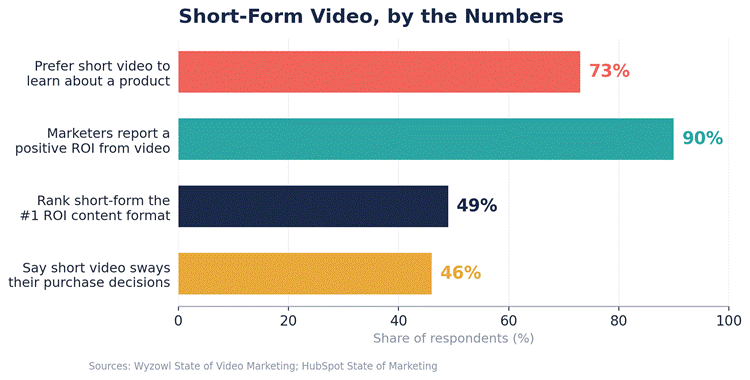
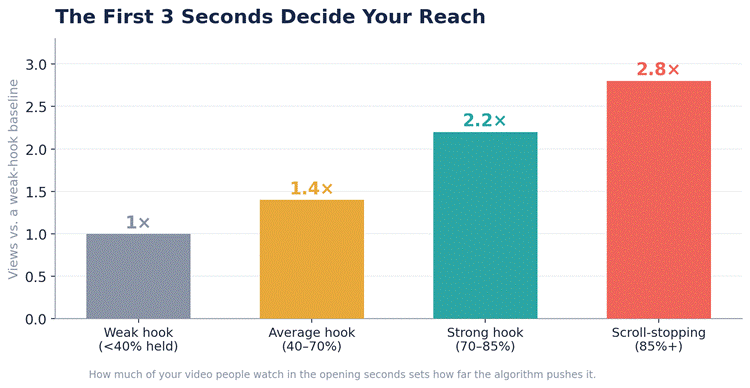
Social media platforms such as Instagram, Facebook, and TikTok are very important tools for reaching your target audience in 2026. Every person these days is on social media, and creating content there is one of the best ways to drive traffic and eyeballs to your business. Creating reels on trending hooks or content that tells your brand story is one of the best and cheapest ways to market your business online.

Some examples of viral short-form content include documenting a journey, a day-in-the-life, or satisfying ASMR content about your products. It’s cheaper, requires less equipment, and builds more trust with viewers.

Strategy – 2: Local SEO and Zero-Click Optimization

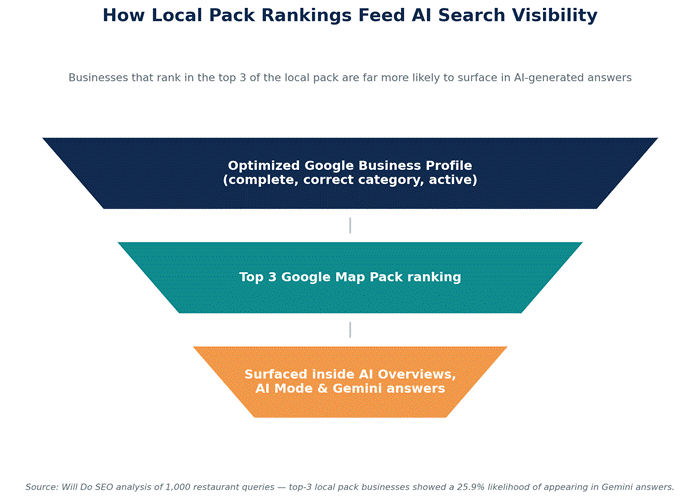
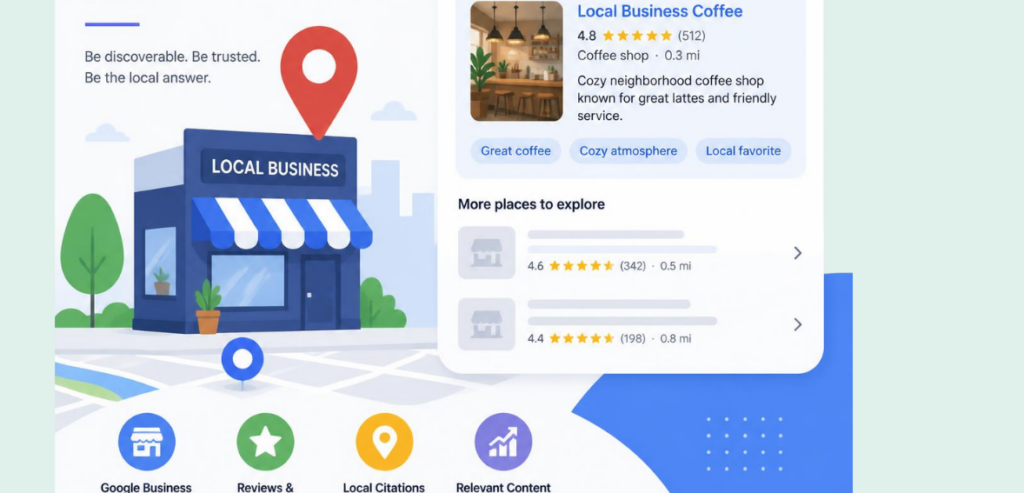
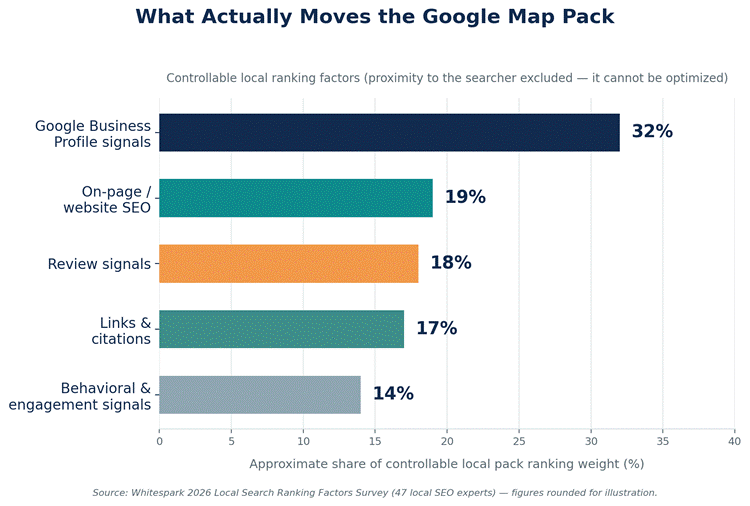
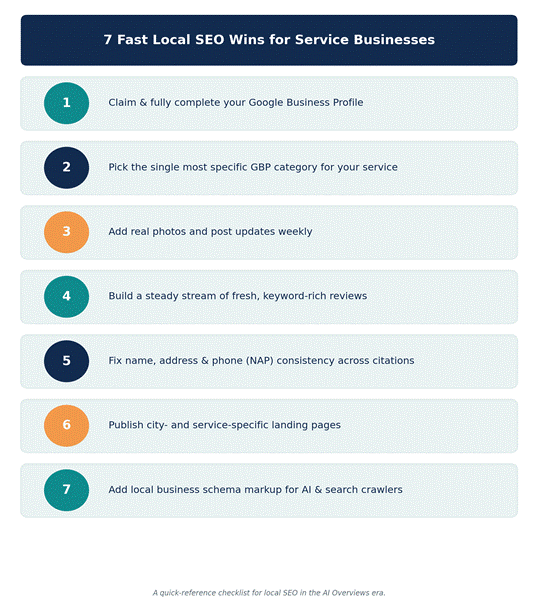
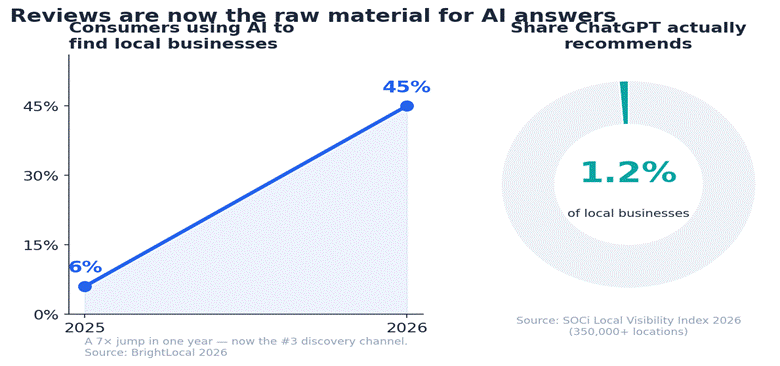
Whenever people look for something in their locality, there are often many choices available. Mastering local SEO and dominating the “Near me” search game on Google or Apple Maps is yet another highly effective yet less-talked-about way to market your business online. Ramping up your SEO game also becomes crucial as people place more trust in AI agents to recommend places or businesses to buy from. Hence, it becomes crucial for you to focus on your business profile, ratings, and reviews to have a good chance of being recommended to the right customer by AI chatbots.

In other words, paying more attention to your Google business profile and its optimization can help you gain customers that you might be losing because of the algorithms, and create more local footfall for your business.

Strategy – 3: AI-Driven Personalized E-mail Marketing

With increasing competition, customers love to shop with businesses that make them feel valued. So, to market your business more effectively, it becomes crucial to improve your customer experience, making them feel valued and cared for rather than just treated as buyers of your product. Make them a part of your story, value their interests, and track their habits. AI-driven e-mail marketing is one of the best ways to convert new customers, and also a low-budget marketing strategy you can implement in your business. Try to make digital products with AI that you can distribute to your customers, and provide them with valuable content through newsletters and e-mail. Make them feel empowered to be a part of your community.

Strategy – 4: Social Media Micro-Content and Niche Groups

As people, we all want to stand out with the choices we make and the products we use. We do not want to be a part of the crowd or just an outcome of the popular narrative. Similarly, whenever customers buy from a brand, they make a subconscious choice to stand with the story it represents.  Another low-budget marketing strategy for your small business is to create communities around it. Go to platforms like Instagram, Reddit, WhatsApp, and more to create close-knit communities. Make the people feel that when they buy from you, they become a part of something exclusive. This way, your word of mouth spreads faster, and you gain more visibility and eventually customers who stand loyal to the story you create for them.

Strategy – 5: Strategic Micro-Influencer Partnerships

In 2026, the creator economy saw an explosive boom with creators gaining local trust and popularity. As a small business, another great small-budget marketing strategy is to collaborate with micro-influencers. These people do not have a very large following and often agree to barter collabs, but since these creators have greater local trust and potential for increased visibility, it ultimately strengthens the trust factor for your brand.

An ideal micro-influencer would be a creator with <10k followers, and a successful collab with such creators could mean very high engagement for your brand at almost negligible cost compared to celebrity influencers.

Strategy – 6: User Generated Content (UGC)

UGC is the goldmine of marketing content for any business out there in 2026. UGC refers to content people create for brands, such as reviews, first-time use, or their experiences with the business. UGC is more trusted by people because it is not created by influencers, so bias is not present. Also, it provides a great way for your business to showcase your real value to people. UGC is an incredible opportunity for you to market your brands and get more customers. Some ideas for UGC are :

  1. Running photo or video contests
  2. Starting online challenges
  3. Creating trending hashtags
  4. Repurposing customer reviews into social media creatives

Strategy – 7: Referral Loops and Community Loyalty

Wouldn’t it be nice if every customer that you sold to became a sales agent for your business? Well, that is not some impossible, imaginative thought; rather, it’s a widely used marketing strategy. The best part about it is that it requires almost no marketing overhead for your business. Yes, you guessed it right, we are talking about referral programs. Offering your customers a share of the profit every time they bring in a new paying customer is almost a perfect, no-risk, low-budget marketing strategy.

Another way to market on a small budget is to build community loyalty, as we discussed earlier. Create a community for your customers, and make them feel part of an exclusive story when they buy from you.

Pro-Tips to Maximize Low-Budget Marketing

Tips to Maximize Low-Budget Marketing

The above strategies will help you market on a low budget, but there are some points you must always keep in mind to make the most of them.

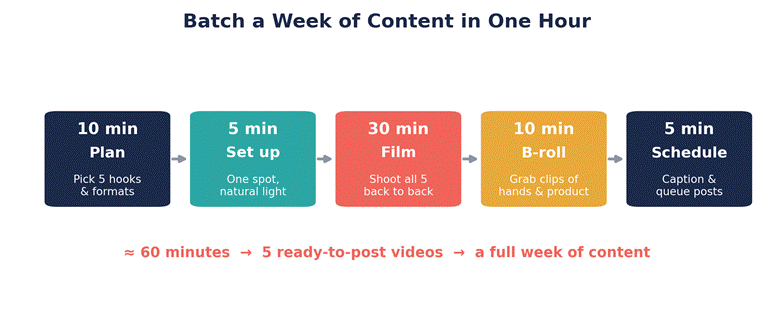
  • Repurposing: A rule to follow for small businesses in the initial days, when you don’t have much data, is to use the 1:5 rule. That is, you repurpose 1 long-form content into 5 short-form content to be used for your brand.
  • The “Free-Value” Hook: To gather more consumer data and build a list of potential customers, offer valuable content in exchange for details, such as contact or survey forms.
  • Data Opposed to Guesswork: Once you have enough data, it is more logical and wise to follow what the data says about your customer habits, rather than aimlessly pushing random content.
  • Consistency is Currency: Staying consistent is one of the most important aspects of low-budget social media marketing. Consistency is what helps you stay relevant, and if it breaks, you risk being lost in the algorithm and having to start over.
Common Low-Budget Marketing Mistakes to Avoid

  • Avoid Overspending on Paid Ads: In 2026, spending on paid ads is equivalent to gambling with your chances of discovery by the right consumer. Instead, focus on creating value-aligned content so your brand reaches its potential customers without getting lost in the noise.
  • Ignoring SEO: SEO is the most important aspect to focus on for any business in 2026. If your SEO is not right, you may end up getting lost in the noise.
  • Lack of Analytics: Not paying attention to your retention, click-through, reach, and engagement rates is a fatal mistake. It could lead to the creation of random, ineffective content, leading to fatigue or “burnout”.

Conclusion

In 2026, marketing is not about hefty ad spends or large campaigns. Low-budget marketing is the new normal for small businesses. Now, it is about being smart and strategic with your content. So, start small, build an audience, and establish trust and authority for your business; eventually, customers will come to you. Small business marketing strategies have never been easier to implement, and we are sure these low-budget marketing strategies will help your business stand out.

“The best time to start was yesterday, the second-best time is today. Wishing you all the best.”

Frequently Asked Questions

  1. Is low-budget marketing really effective in 2026?

    Yes, it is the most popular and trusted form of marketing. Look around you, every brand has a community, a story, and a vision attached to it that customers get into. Low-budget marketing is the most effective in 2026.

  2. How do I start a referral program with $0?

    You should focus on manual outreach and discount codes for anyone who buys through a referral link. This way, your customers can bring in more buyers.

  3. Which digital marketing for online businesses has the highest ROI?

    E-mail marketing and SEO are the best digital marketing channels for achieving the highest ROI for your small business when starting out.

    Checkout with Crypto

    Stripe Plans to Roll Out Cryptocurrency Payment Support

    Stripe recently announced a partnership with Crypto.com, a leading cryptocurrency exchange, to bring checkout with Crypto.com. Crypto.com users can now pay at stores that accept Stripe payments directly from their crypto wallet. Stripe processes the transaction, converts it to the merchant’s preferred local currency, and settles it into the merchant’s account, just like any other payment.

    In parallel, Stripe is also piloting recurring subscription payments in USDC on Base and Polygon. With smart contracts, users can authorize recurring payments without re-signing each month. The transactions are near-instantaneous, with lower operational overhead and, in some cases, half the per-transaction processing cost.

    Key Takeaways
    • At participating Stripe checkouts, Crypto.com Pay will appear to users as the payment method to initiate the payment. Once the payment is settled, merchants receive payments in their preferred local currency.
    • The stablecoin subscription payments use a wallet-authorizing smart contract to process recurring USDC payments, so users don’t have to re-sign each month.
    • Initially, Stipe is specifically targeting stablecoins to cleanly map the pricing, accounting, and regulations surrounding them.

    Stripe Expands Checkout with Crypto.com and Stablecoin Payments

    Stripe Expands Checkout with Crypto

    Stripe’s partnership with Crypto.com, announced in January 2026, is strategically leaning more toward an expanded checkout distribution move than a crypto “pilot.” This partnership benefits both companies in different ways – Crypto.com added a way for its users to pay at online stores and spend on digital assets, while Stripe gained a major crypto wallet network partner to surface payment options across its merchant base.

    Crypto.com also became the first cryptocurrency platform to partner with Stripe for payments directly from customers’ wallet balances. Users can pay directly from their crypto holdings without routing via a separate card or wallet. Stripe, in turn, seamlessly converts and settles payments into the merchant’s account, just like any other payment transaction.

    Stripe is leaning toward keeping the operations as similar to wallet checkouts as possible. Participating merchants who are using Stripe’s Optimized Checkout Suite, Stripe Checkout, and the Payment Element will see Crypto.com as a payment option. After selecting this Crypto.com payment option:

    • User scans a QR code,
    • Validate the transaction in the Crypto.com application,
    • And finally, complete the purchase using their wallet’s crypto balance.

    All crypto proceeds are converted and reconciled by Stripe and deposited into the merchant’s account, along with other card and online payments.

    The highlight of this partnership is that this infrastructure and the framework are designed for merchants’ convenience. Historically, crypto payments for everyday transactions have failed big time because, first, they push merchants to take exchange rate risk, second, they add new and complex operational processes, and third, they leave consumer demand unclear. What this model brings is that merchants don’t need a crypto treasury policy, that’s because merchants get fiat settlement at the end of the day.

    According to some industry experts, this partnership could foreshadow other processors enabling crypto checkout, especially through stablecoins.  However, an important point to note is that how many consumers actually want to pay directly with crypto remains unknown – there’s no substantial, reliable data showing underlying consumer needs.

    checkout

    Stripe isn’t relying on the Crypto.com rail alone. Its other major step is to fix the hardest blockchain-native payment pattern: recurring billing. In October 2025, Stripe began rolling out stablecoin payments for subscriptions in private preview for US businesses, initially supporting USDC on Base and Polygon. Stripe says it built a smart contract that lets customers “save” a wallet as a payment method and authorize recurring charges without re-signing each month, with support across more than 400 wallets. The result is a subscription flow that behaves like cards or ACH from the customer’s perspective, but settles from a crypto wallet.

    Stablecoin acceptance is treated as a first-class payment method on Stripe. Stripe’s documentation shows that businesses can enable a “Crypto” payment method and accept stablecoins through Payment Links, Checkout, Elements, or the Payment Intents API.

    Customers are redirected to crypto.stripe.com to connect their wallet and pay, and the funds settle into the business’s Stripe balance in USD. All refunds are returned as stablecoins to the original wallet. For now, however, only US businesses can accept stablecoin payments, even though customers can pay globally.

    stable coin

    Before enabling, merchants should note the constraints:

    • Stablecoin payments are currently available only to US businesses, and amounts must be USD-denominated
    • Access requires requesting the Crypto payment method in the Dashboard for review.
    • Stripe also documents guardrails such as per-transaction limits and refunds that return stablecoins to the customer’s original wallet.

    Why is this happening now, after Stripe, in a controversial move, dropped Bitcoin support years ago?

    First of all, there has been a shift in the regulations. The newly enacted GENIUS Act created a U.S. framework for payment stablecoins. It reduces legal ambiguity that kept large payment processors cautious. Then there is business economics. Because stablecoins are more like digital cash than speculative assets (like other crypto coins, including meme coins), processors see an opportunity to lower the all-in cost of certain payments, especially cross-border, by steering volume away from interchange-heavy card rails. Merchants and processors can save by bypassing interchange fees when consumers use crypto-funded payments.

    Before the pandemic, Stripe had maintained a stablecoin-first posture. In January 2018, Stripe announced it was winding down Bitcoin support and would stop processing Bitcoin transactions in April 2018, arguing Bitcoin had become more suitable as an asset than a medium of exchange.

    The company’s 2025-2026 crypto moves read like a response to that lesson. Focus on dollar-linked tokens, settle merchants in fiat by default, and build a UX that feels like mainstream payments rather than a blockchain demo.

    Overall, Stripe is building a full crypto-and-stablecoin stack, not a single feature. Stripe completed its acquisition of stablecoin infrastructure platform Bridge in February 2025, then used it to launch Stablecoin Financial Accounts, promising businesses in 101 countries access to dollar-denominated accounts that can move value on stablecoin and traditional rails from the Stripe Dashboard.

    Later in 2025, Stripe announced Open Issuance, a Bridge-powered platform for businesses to launch and manage their own stablecoins, including reserve and liquidity tooling. And in February 2026, there are reports that Bridge received conditional OCC approval to establish a national trust bank, a step toward regulated services like custody and stablecoin issuance/orchestration.

    For merchants, the practical takeaway is to watch three fronts:

    • Geography (Crypto.com checkout starts in the US),
    • Product coverage (one-off purchases now, recurring stablecoin billing emerging),
    • Commercial terms (fees, settlement timing, limits).

    For the payments industry, the implications are greater. If stablecoins keep migrating from trading into real commerce, Stripe is positioning itself as the layer that makes blockchain rails feel as dependable and as boring as cards.

    Conclusion

    Stripe is going all in on “checkout” with crypto implementation. Over the last 6 months or so, Stripe has taken big steps towards crypto adoption and has amplified its integration within its payment ecosystem. The stablecoin subscription product focuses on the plumbing that determines long-term adoption, authorization, recurring pulls, refunds, and reconciliation.

    The question now is whether consumers will change their payment behavior. But merchants don’t need a consumer revolution to benefit; even modest stablecoin volume can matter if it reduces cross-border friction, expands reach to wallet-heavy customers, or lowers acceptance costs. If stablecoin regulation and bank-grade infrastructure continue to mature, Stripe’s approach could make the phrase “crypto payment” fade into the background, replaced by a more important concept, internet-native money that plugs into ordinary commerce.

    Frequently Asked Questions

    1. How does Stripe’s partnership with Crypto.com allow users to pay at online checkouts using their crypto wallet balance?

      Users select Crypto.com Pay at Stripe checkout, scan a QR code, and approve the payment in the Crypto.com app using their crypto wallet balance.

    2. What role does Stripe play in converting crypto payments into the merchant’s local currency?

      Stripe processes the transaction, converts the crypto into the merchant’s preferred fiat currency, and settles the funds into the merchant’s Stripe account.

    3. How do smart contracts enable recurring subscription payments in USDC without requiring users to reauthorize each month?

      A wallet-authorizing smart contract allows users to approve recurring USDC charges once, after which Stripe can automatically process future subscription payments.

    boost Customer Loyalty

    Boost Customer Loyalty: Proven Strategies to Keep Them Coming Back

    Discounts alone have failed to attract customers for a long time. With thousands of brands and millions of websites, customers are picky and seek emotional investment in the brands they choose. With innumerable alternatives, it has become a challenge for all business owners to keep their customers hooked to their brands. Customer loyalty has far transcended into customized personal experience, value, and consistent service.

    The drastic shift in how customers choose brands has made customer retention strategy formulation a necessity across industries. It takes a lot of smart work and a strategic approach to attract new customers. Retention of existing customers also involves time and trust.

    This blog discusses the available methods and strategies to stabilize and boost customer loyalty. No matter what kind or size of business you own, the takeaways of this blog will help you boost customer retention through modern strategies and build a base of loyal customers that keep on choosing your brand over time and years.

    Importance of Customer Loyalty

    Importance of Customer Loyalty

    Customers of this generation demand convenience above all else. With the world operating at an ever-increasing pace, time has become a luxury. Hence, customers demand a personalized experience within a short time frame. Businesses must focus on delivering consistent excellence over episodic offers.

    Gone are the days when customers had only a few options; now there are ample choices. In an environment like this, customer loyalty is crucial to a business’s growth. So, as a business owner, keep in mind that loyal customers are less price-sensitive and often forgive mistakes if they trust the brand. They are often seen to be more accepting of new offers. But if you fail to earn a customer’s loyalty or trust, one bad experience, and the customer is likely to shift brands.

    In addition to these, earning customer loyalty is also important because repeat customers are usually easier to serve. Once the customer starts to understand your products and build trust in your process, they don’t demand much in the way of persuasive strategies, and it becomes easier for a business to allocate its resources to other developments rather than just to customer retention.

    Insight Into Customer Loyalty in the Modern Era

    Insight Into Customer Loyalty

    The loyalty of a modern customer depends on many factors. Unlike customers of the previous era, modern customers’ loyalty is multifaceted. Only repeat purchases don’t mean you have earned your customers’ loyalty. Focusing on emotional connections and engaging personally with your customers is the first step in understanding and earning customers’ trust.

    Below are the prominent features of modern loyalty:

    • Your customers trust the promises made by your brand
    • The customers have faith in the products you manufacture or the service you deliver
    • Your customer gains a positive emotional experience
    • Your brand value caters to the needs of modern customers
    • You provide your customer with a hassle-free transaction experience

    Customer retention strategies in the 21st century address both the rational and emotional needs of customers. You must make your customer feel understood and respected. Curate a heartwarming experience that customers can’t help but choose again and again.

    Boost Customer Loyalty: 5 Proven Strategies

    Proven Strategies

    Strategy 1: Deliver What You Promise

    Loyalty is built exclusively through consistency. Customers should stay with you if you have a track record of delivering on what you promised. That is, be consistent in meeting customer requirements. Be consistent with the quality of the service you deliver or the products that you sell. Be consistent in responding to customer needs by establishing a well-structured, dedicated customer help team.

    Long gone are the days when first impressions make the last impression. An emancipating first impression lasts only briefly if you do not ensure consistency. Customers constantly evaluate the products and services they invest in.

    Strategy 2: Focus on Personalization of Customers’ Experience

    To retain customers, it is extremely important to understand the behaviors of the customers you are dealing with and craft experiences with a personal touch. Make the customer believe that you think about them and you want to invest in fulfilling their customized needs.

    However, there lies a subtle space between being personal and overstepping. Make sure you don’t blur the line in the name of personalization. Listed below are the strategies to curate a personalized experience without being intrusive:

    • Refrain from offering irrelevant recommendations. Instead, offer recommendations that are useful and relevant to customers.
    • Keep track of customers’ preferences.
    • Come up with new, frequent ideas for communication.
    • Appreciate customers through various programs like milestone programs.

    The key to building a strong customer base through a customized experience lies in subtlety. Although customers appreciate brands that value their emotions and offer personal recommendations, they never want to feel invaded. Hence, as a business owner, try to be subtle and precise while curating personalized experiences for customers.

    Strategy 3: Maintain Clarity and Act Transparently

    Customers prefer brands and companies that communicate clearly. Being honest not only helps you attract new customers but also retain the old ones. When a brand states its goals and values honestly, without any hidden agenda, a long-term customer relationship is fostered.

    While it is important to keep a company’s interests in mind to grow and develop in the future, it is also important to build customer trust by acting in accordance with their interests. Your interest should not overpower the customers’ interest. Listed below are a few proven ways to build trust through clarity and transparency:

    • Abstain from hidden charges. Communicate prices transparently.
    • Being loyal and honest while making and explaining policies to customers.
    • It is very likely for businesses to make mistakes. In cases where your business is at fault, don’t try to defend your company. Admit mistakes and work to fix them immediately.
    • Refrain from making promises that sound too good to be true. Customers should have practical, realistic expectations of your company.

    Make honesty and transparency the key elements for earning customers’ trust. As customer trust grows, your business is bound to grow too.

    Strategy 4: Value Customers’ Feedback and Act Upon It

    One of the most effective yet underrated strategies to retain customers is active listening. Customers value a brand that listens to them. But more than that, customers value a brand that takes action on their feedback.

    The most proven strategies to manage feedback are as follows:

    • The process of submitting feedback should be easy and accessible for all customers.
    • Even if you can’t act upon certain feedback, try to acknowledge it.
    • Incorporate improvements based on customers’ feedback as much as possible.
    • Interact with customers with a clear, conscious motive. Let them know the steps you took and the changes your company made in response to their feedback.

    Considering customers’ feedback and making improvements based on it makes a customer feel involved. This fosters a sense of belonging and, in turn, drives long-term customer retention.

    Strategy 5: Identify and Acknowledge Repeat Customers

    The volume of repeat customers is the yardstick against which a company’s growth and loyalty can be measured. Identifying and acknowledging repeat customers motivates them to form a positive, emotional connection with a brand.

    A few simple ways to acknowledge and show gratitude to repeat customers include the following:

    • Provide them with offers and benefits that are exclusive to them.
    • Send personalized messages and emails to express appreciation for their contribution to your brand’s growth.
    • If possible, recognize and appreciate repeat customers on common social media platforms. This enhances your visibility, too.
    • Give fast-track access to newly launched offers to repeat customers.

    Membership appreciation and loyalty acknowledgement help grow brand value and accelerate retention.

    How to Measure and Improve Customer Loyalty and Retention?

    Measure and Improve Customer Loyalty

    To keep your strategies up to date and modern, it is essential to measure customer loyalty and retention. The ways to measure customer loyalty and retention include the following:

    • Keep track of repeat orders
    • Keep a count of the feedback received and the usual trend.
    • Watch out for customer engagement in social media platforms, if applicable.
    • Get an idea of the retention rate in real numbers.

    Keep in mind that focusing solely on data collection is not enough. Although the data provides the actual direction, it is important to interpret it to gain clear insight into customer loyalty and retention. Constant and rigorous interpretation of data is the key to improvement.

    How Will Customer Loyalty Look in the Coming Years?

    Experience, trust, and practical importance are the key drivers of customer loyalty in 2026. It is high time businesses focus on long-term customer relationships and retention rather than just market expansion. Businesses that keep their focus solely on customer onboarding are sure to be left behind in 2026.

    With the increase in choices, customer loyalty serves as an indicator of customers’ choice of a brand over others. The successful implementation of customer strategies is thus essential for customer loyalty in 2026. To continue thriving in this competitive world, brands must invest in their human resources and customers, becoming the face of loyalty and trust that will enhance their growth.

    Conclusion

    To conclude on a note of fidelity, it is needless to say that to manage customers effectively, you must discard all obsolete strategies that yield no real results. Incorporate new, modern strategies that are subtle yet results-driven.

    Invest in understanding your customers thoroughly and build a value system that helps your business stand out from the crowd. Emphasize quality over quantity, and consistency over frequency.

    Adapt strategies that infuse brand values with customer values, and don’t only focus on engaging customers with an agenda. Design ways to engage customers. These could include education programs that add value, or, most effectively, community-based initiatives. Make the customer a part of your extended family. Make them feel heard and valued, and see your business touch high milestones in the years to come.

    Frequently Asked Questions (FAQs)

    1. What is meant by customer loyalty?

      In simple terms, a customer’s repeated choice of the same brand is called customer loyalty.

    2. What is the importance of incorporating customer retention strategies?

      Customer retention strategies help reduce new-customer onboarding costs while ensuring a steady cash flow. These strategies also help build strong brand value, paving the way for growth.

    3. What are the ways to escalate customer retention for small-scale businesses?

      Escalation of customer retention doesn’t always involve substantial investments. There are simple ways for even small-scale businesses to improve customer retention. Two of the most important strategies include consistency and personalized customer experience.

    4. Are loyalty programs worth subscribing to?

      Loyalty programs have become a necessity for all businesses. Instead of focusing on short-term outputs, loyalty programs that prioritize steady, long-term growth are worth subscribing to.

    5. What are the key elements to keep customers hooked to a brand?

      Customers are bound to get hooked to a certain brand if they feel valued, heard, and important. In addition, a personalized experience and consistent product delivery can foster customer retention.

    Subscription Plans

    Maximize Recurring Revenue: Grow Your Subscription and Membership Income

    In a world of business uncertainties, one thing that remains certain and consistent is recurring revenue. Businesses running subscription plans and membership programs have to rely heavily on building strong customer relationships. Trust is the key to growth for any subscription-based business. Although subscription-based businesses often face unpredictability, with the right strategies, this unpredictability can become more predictable, serving as an anchor for the company’s overall growth.

    Subscribers today value experience over anything else. They are thoughtful. They are conscious of the products they invest in. And at the same time, today’s customers tend to act quickly without much ado. Hence, disengagement is a major issue for subscription-based businesses. So, the focus is not only on growing membership but also on finding strategies to keep customers hooked. The secret to this is simple. You have to be honest and transparent without negotiating the value of the product you are delivering.

    The aim of this blog is to provide strategies proven to increase growth and maximize revenue for a subscription-based business. If you are someone running a subscription-based business and want to maximize your revenue and focus on future growth, then this blog is for you.

    Recurring Revenue: Understanding the Core

    Recurring Revenue

    For the growth of a recurring business, it is important that you don’t just focus on increasing the number of subscriptions. Along with chasing one-time transactions, it is crucial to prioritize customer retention. Focusing on customer relationships and long-term trust-building supports continuous improvement.

    If your business’s revenue is predictable and stable, it becomes easier for you to plan and invest in future projects without fear of loss. You can develop products, build a good customer support team, and be innovative without thinking much about risks.

    If we try to understand the mindset of customers opting for subscription-based business, we will see that customers prefer this kind of transaction for the convenience it provides. Today, people are busy. Subscription-based transactions help them avoid making repeated purchase decisions. If a brand can build good trust, customers ought to subscribe and stay. This model benefits both the business provider and the customer. For customers, it provides continuity and convenience, and for business providers, the security of revenue collection.

    Importance of a Strong Value Foundation

    First, define the core value your business delivers. Before considering pricing or marketing, ensure your offering is relevant and appealing enough to attract customers.

    To make it compelling, you must have a concrete reason why a customer will pay for your product month after month or year after year. The reason should be unique and important. Keep in mind that customers prefer progress, clarity, and convenience over anything else. Hence, focus on the facilities and the ease with which your business will provide to customers.

    A value foundation is thus important to help a customer understand why your product is worth investing in. It builds trust and hence accelerates recurring payments. Don’t make your core foundation sound ambiguous. This can lead to misunderstanding, hesitation, and, as a result, less growth. Keep in mind that transparency aids confidence, and confidence improves performance.

    Understand the Needs of the Customers While Designing Subscription Plans

    Needs of the Customers

    While chalking out subscription plans, try to think like a customer. Focus on what they seek from you. Today’s customers want flexible subscriptions. Don’t make your offers overcomplicated. Try to avoid accepting offers that exceed the required amount. Stick to the fundamental offering. This will remove confusion for customers, allowing them to make swift decisions.

    Every subscription you provide should have a clear purpose and goal. Curate your products in a simple, appealing way that caters to customers’ varied needs. Design entry-level plans that build customer trust. Gradually, as you move to higher tiers, purposefully upgrade the plans. The price differences should seem justified rather than abrupt.

    Clarity matters most. Never deceive customers. Avoid hidden fees or sudden price hikes. Offer fair, reasonable prices without sounding manipulative. These strategies help you attract and keep subscribers.

    Retention Vs. Drastic Growth

    One of the most common mistakes subscription-based business owners make is focusing on aggressive growth at the expense of retention. Be slow but steady. It is true that new subscriptions are crucial, but retaining existing subscribers is the most important task. It not only stabilizes your revenue collection but also helps build brand value through trust and long-term customer experiences.

    Focus on retention from the start. Create a hassle-free, welcoming onboarding process. This seamless experience sets the tone for customers and drives early retention.

    Your retention task starts once a customer subscribes. Make sure to have regular conversations. Send customized emails to make them feel valued. Provide customers with thoughtful updates and ensure that a strong support team is always ready to troubleshoot. Customers should feel, from day one, that the choice they made is the absolute right one. Engage with every subscriber and provide them with a purpose significant enough to keep them.

    Value Customer Feedbacks

    Customer Feedbacks

    Customer feedback can be a growth engine for your business when used correctly. It is the customers who can provide you with the most authentic insights essential for designing products and accelerating your growth. Try to understand both the virtues and the vices of the service you offer. Ask them about the area they want upgraded. Asking for customer feedback will not only help you offer better plans but also make customers feel valued and engaged.

    There are multiple ways to collect customer feedback. Make sure the process you choose for collecting feedback is simple and easy. This could include surveys, polls, or direct phone conversations. Keep in mind that the purpose is not just to gather feedback, but to act on it instantly.

    When you make upgrades based on customers’ feedback, a sense of ownership grows among the customers. This caters to a customer’s emotional attachment and increases the likelihood that the customer will stay committed in the long term.

    Curate Personalized Customer Experiences

    Even in a subscription-based business model, customers want a relevant, personalized experience. To begin with, try to have a comprehensive understanding of your customers. Form groups based on customers’ preferences, behavior, and usage patterns. This will help you tailor the subscription experience without much hassle.

    After categorizing customers, send tailored emails and recommendations. Offer subscriptions that match their interests. This way, your service becomes vital to the customer. This approach makes them feel special, not just another person in the crowd.

    Design Easy Billing and Payment Gateways

    Reducing friction in billing and payment works wonders for customer engagement. Effortless, on-the-go payment options ensure on-time payments. Generate clear, quick invoices to maintain customer trust.

    The process of updating payment details should also be smooth. Provide clarity on their billing cycle and communicate renewal plans or available upgrades in a clear, transparent way. This will prevent the customer from becoming frustrated and support the necessary growth of your business.

    Provide Versatile Subscription Options

    It is true that a long-term subscription helps generate stable revenue. But providing adjustable, accommodating, and versatile plans paves the way for engaging customers who are reluctant to commit to a longer period.

    With monthly plans, free trials, or simple deactivation, you let customers test your offerings. These flexibilities encourage voluntary commitments and make choices feel reasonable and valid. Customers can choose freely, without manipulative strategies.

    Focus on Long-Term Outcomes

    Remember that subscriptions are a dynamic, evolving commodity. To help your brand grow and develop, make sure you adapt to customers’ changing needs. Along with focusing on the present needs of the masses, it is also important to have a team dedicated to predicting upcoming market trends in your business sector and the broader subscription market.

    But keeping pace with change doesn’t mean you must introduce abrupt, drastic changes. These may trigger user unrest and make them feel ignored. Instead, incorporate small, meaningful, and adaptable changes that customers can easily handle.

    Grow your business in line with your targeted audience’s evolving needs, in a transparent and thoughtful way. This will not only accelerate your recurring revenue collection but also foster future sustainability.

    Emphasize Credibility and Understanding

    It hardly needs to be said that at the foundation of recurring business lies trust. People decide to connect with you through subscription only when they have faith and trust in your brand. The value a business offers largely contributes to its membership growth.

    An empathetic approach, transparent communication, and mutual trust help a business last longer. Be clear about the cancellation policy and avoid making any irrelevant or misleading commitments. Your goal should be to earn long-term commitment through a natural, ethical approach rather than focusing on short-term commitments driven by dark patterns and manipulative strategies.

    Conclusion

    Revenue in a recurring business setup is not only a transaction but a built-in relationship between the customer and the service provider. Prioritize earning customers’ trust and loyalty through honesty and consistency.

    Don’t make the mistake of sticking to numerical metrics alone. Use strategies to improve customer experience. Appear trustworthy enough to a customer. Make them feel understood and respected. Instead of a forced outcome, the subscription and customer engagement should be automatic.

    Frequently Asked Questions (FAQs)

    1. What is meant by recurring revenue in a subscription plan?

      Stable income earned at regular intervals from subscribers in a subscription-based business is called recurring revenue. The customer has to pay this fee to continue a subscription to a particular product or service.

    2. Is recurring revenue important for steady growth?

      Recurring revenue is important for steady growth because it provides a stable source of revenue, allowing the brand to focus on development and customer retention.

    3. What are the ways to cut down on the deactivation rate?

      To reduce deactivation rates, focus on customer experiences. Design an easy onboarding experience and an easier payment gateway.

    4. What are the characteristics of an ideal pricing model for subscriptions?

      The ideal subscription pricing model is one that caters to consumer needs, is clear, and is hassle-free.

    5. At what frequency should I update subscriber offers?

      When offering updates to customers in a subscription-based business, it is more important to focus on thoughtfulness and the significance of the offer than on frequency.