There has been a lot of talk about cash discount programs and surcharging recently. Though these two payment processing programs have similarities they are not the same. Here is how the two differ.
What are credit card surcharges?
A credit card surcharge is a fee that is assessed at the time a credit card is charged. The small fee is usually added to an existing tax at checkout. This fee is only applied because the transaction was completed with a credit card and is used to pass the cost of the transaction on to the customer. With this program, only credit and transactions see a surcharge and that charge is specifically for processing that card. Problem is with surcharging you are not allowed to apply fees to debit cards and surcharging credit cards is not allowed in all states. Only 40 of our 50 states allow for credit card surcharges.
What are cash discounts?
Cash discount programs apply a “service fee” to all transactions (rather than just credit cards). When a customer pays in cash the fee is discounted. The federal government has ruled that it is illegal to not allow merchants to give a discount for using cash. So in this program, not only is it available in every state, but it is also able to apply the service charge to debit card transactions as well. The fee is usually around 3.5% and covers the cost of the transaction. With cash discount, the merchant receives 100% revenue from their sales. Since the customers pay the cost of their own transactions the merchant pays nothing for transaction costs. The only cost to the merchant using the cash discount program is a small monthly fee for the processing account. The resulting savings for the merchant are considerable.
Conclusion
Both the cash discount program and surcharging result in the customer paying their own credit card transaction fees. Surcharging is not allowed everywhere and only credit cards can be surcharged. The cash discount program is federally recognized and legal everywhere. It also allows the merchant to apply the service fee to debit cards as well as credit cards. Utilizing the cash discount program, merchants can receive up to 100% of their revenue and only pay a small flat fee for the merchant account each month. The cash discount program is by far the least costly merchant account available.
Reduce Your Merchant Services Cost With Cash Discount Program.
Most people are paperless. In fact, many have become so accustomed to paying for goods and services in this manner, it has become a necessity for merchants to have credit card processing solutions. If the merchant wants to do business, he or she must have a merchant solution in place. How do merchants offset the costs associated with card payments? Cash card payments just make sense for most business owners.
Reasons to implement a cash discount program
Cutting costs where it won’t affect the quality of service is good business. If your business has been getting rave reviews and you are pleased with how well you service your clients, then cutting costs there wouldn’t make much sense. Implementing a cash discount program is harmless and won’t affect the quality of the service you provide.
Customers embrace easy ways to save money, and they appreciate you being considerate about their wallet. When you encourage customers to pay in cash, they may be on the fence about doing so. When you tell them you want them to save their hard-earned dollars by switching to cash, it becomes palatable in that this directly benefits them.
Cash discount programs don’t require tracking. Promo codes and loyalty cards all come with added responsibilities. There may be an extra card to punch. If the programs change, the person has to swap out the discount card and push people to download the new app. With a cash discount program, the process is automated by merchant services, and there are no additional maintenance steps required once fully implemented.
Cash discount programs are commonplace, so there is no adjustment to be made. Cash discount programs are commonplace. Most customers who purchase gas have seen these programs in action. There won’t be much resistance or opposition to a system that has become the norm at most convenience stores. Government agencies even have cash discount programs in place.
Collect 100 percent of your revenue with cash discount programs, and avoid jacking up the prices on customers. Getting a merchant service discount program in place will reduce your operating costs, and keep your business competitive among its peers. Implement a discount program today for cash paying customers, and protect your revenue.
Two of the most common payment processing pricing models you will encounter today are flat rate pricing and interchange plus pricing. Here’s how they compare and why interchange plus pricing is the superior choice for most merchants.
Choosing the right credit card processor can be a difficult task when you consider there are several types of pricing models the processor can offer — some more transparent than others. This means looking for the lowest rate is probably not going to come with the lowest cost.
Understanding Interchange Rates
Interchange rates are payment processing fees set by credit card associations like Visa, Mastercard, and Discover. These interchange fees are paid to the bank that issues the credit card. There are hundreds of different interchange fees based on the type of card (such as Gold, Platinum, or rewards), whether the card is present or not present, and more.
Flat Rate Pricing
Many popular processors today advertise great flat rates with no fees or hassles but this comes at a price: the fee is probably much higher than you would pay with a different pricing system.
It’s easy to see the appeal of flat-rate pricing. While many merchant services come with a long list of fees and different rates for different transactions, a flat-rate provider gives you just one rate to worry about. You always know what you’re going to pay for every transaction.
Of course, flat-rate credit card processing companies have to cover the same fees as other processors. This is how they come up with their rates: they’re high enough to include a huge profit margin.
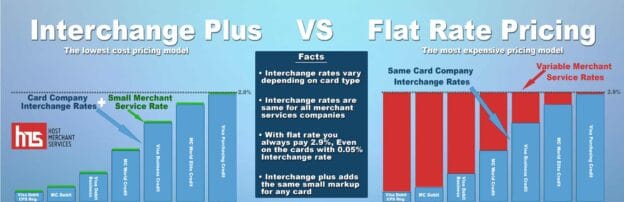
There’s a very good chance that most of the transactions you process would qualify for a much lower rate with a different pricing model. If you are a small- to medium-sized retailer, for example, most of your transactions are probably debit cards swiped at a credit card machine. These transactions have the lowest interchange rates available. With an interchange plus or cost-plus pricing model, you could be paying 0.50% to 1% — far lower than the 2.75% rate advertised with a flat rate model.
Interchange Plus Pricing
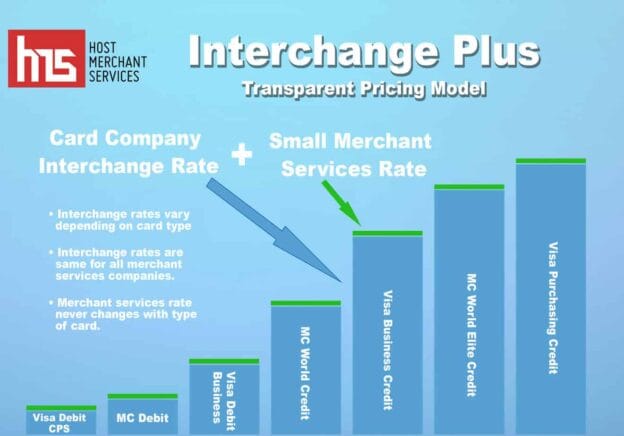
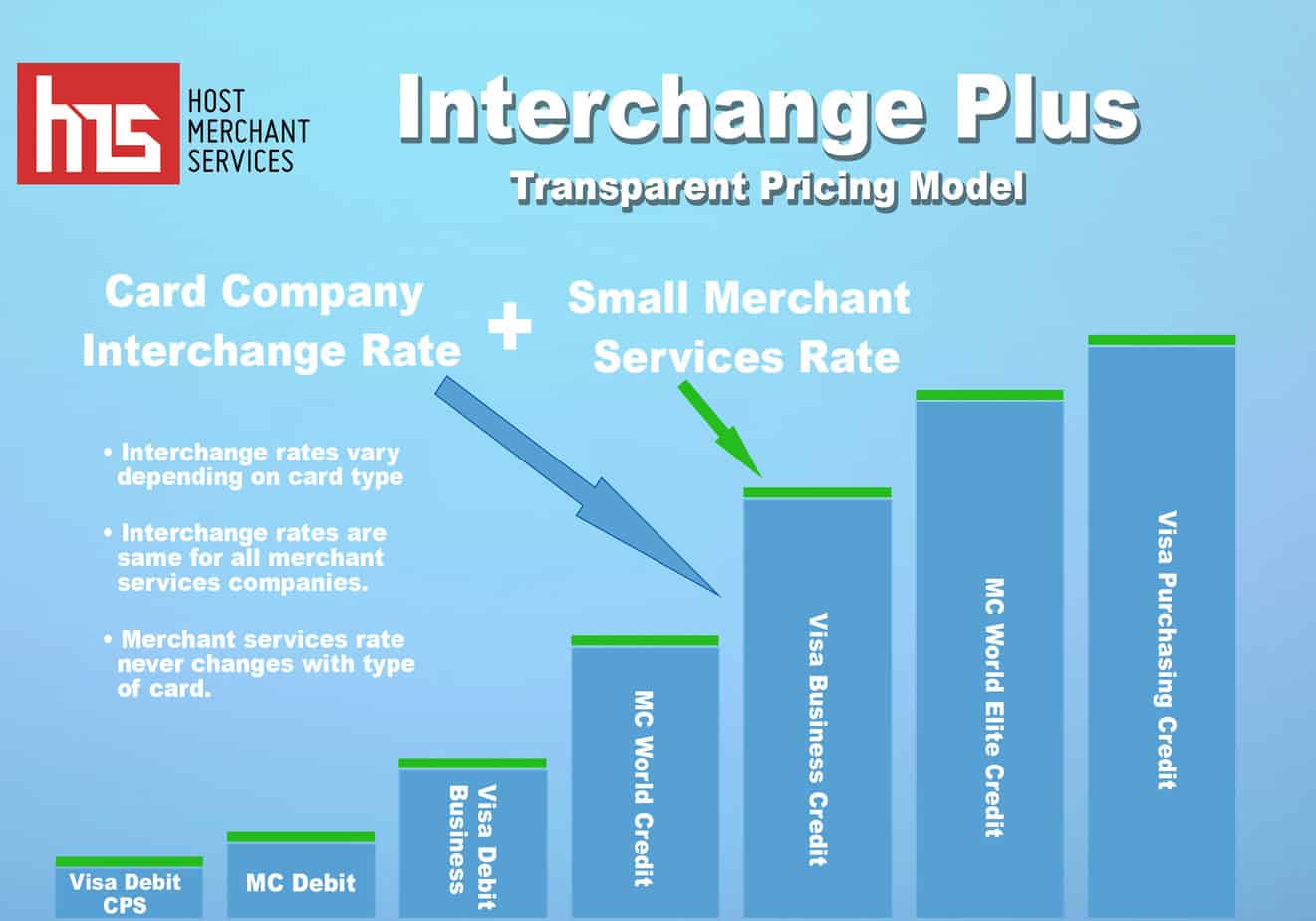
Interchange plus pricing, also known as cost plus, is a transparent pricing model that helps you understand the real cost of credit card processing to get the lowest possible rate. Cost-plus pricing is based on the actual interchange rate “plus” a markup the processor charges. The “plus” component of interchange plus pricing may be a percentage or a flat fee per transaction.
With interchange plus pricing, you can better understand the true cost of merchant services. This pricing method is simple and shows you how much of your processing fee goes toward interchange fees and how much goes to your payment processor. The only drawback to cost-plus pricing is it can make your statements a bit more confusing until you understand the different rates you pay for different transactions.
In the past, cost plus processing was only offered to high-volume merchants but it’s now available to even new and small businesses. With only two rates to consider and transparent pricing, interchange plus is the clear choice for most businesses.
No one wants to pay more than necessary for credit card processing, which can already eat into profits. When comparing merchant services, it’s important to understand how different pricing systems work. Many merchant account providers advertise very low fees as a teaser, even though most transactions do not qualify for these rates.
There are two common pricing models used for payment processing: tiered pricing and interchange plus pricing. Here’s how they compare.
Tiered Pricing
Tiered pricing is probably the most common pricing model for merchant services. While it’s advertised as an easy pricing method that makes statements simpler, the truth is it merely lumps hundreds of interchange rates into just three tiers or buckets. The processor may advertise the rate of the lowest tier, but most transactions will fall into tiers with a much higher rate. A debit card, which usually has the lowest interchange rate, can be billed using the same high rate as a rewards credit card, for example.
There are no set guidelines that determine which cards go in which category which leads to massive overcharging to merchants. Some payment processors have an incentive to downgrade transactions into a lower tier to boost profits. Transactions can be downgraded for any number of reasons, including using terminal software that isn’t updated, tips and tax that aren’t entered separately, or batches that aren’t settled within 48 hours. Not all of these factors are in your control.
As a merchant, you will have no way to predict which rate you will pay for transactions or how much you are being charged above the set interchange rate. You can’t even effectively compare tiered pricing quotes between payment processors because you don’t know what the mid- or non-qualified rates are — just the lowest available rate — and you won’t know the criteria the processor uses to categorize transactions.
Interchange Plus Pricing
Rather than using tiers, the interchange plus pricing model passes the set interchange rates directly to the merchant “plus” a small markup. Because the interchange rates are not changed or lumped into arbitrary categories, you can predict your payment processing costs and know what you are paying above interchange.
The only downside of interchange plus pricing is it does take time to understand the different rates you will pay for different types of transactions and credit cards. Your statements will be longer, but with greater clarity and transparency.
In the not so distant past, interchange plus pricing was only available to merchants with high credit card volume of $25,000 or more. Today, interchange plus credit card processing can be available to small and even new businesses. Interchange plus pricing is a smart choice with only two rates to consider: the transaction fee and the interchange markup fee. This pricing model is the safe and transparent choice with no arbitrary criteria you must meet.
In the healthcare sector, where patient well-being and confidentiality are paramount, the security of financial transactions is critical. This isn’t just about processing payments but it is also about protecting sensitive patient information, from medical histories to financial records, with the highest level of diligence.
The industry is uniquely challenged and tasked with adhering to stringent regulations like the Health Insurance Portability and Accountability Act (HIPAA) while accommodating diverse services and their associated costs. This article aims to unravel the complexities of payment processing for medical practices, emphasizing the importance of selecting services that not only meet compliance standards but also enhance operational efficiency and patient satisfaction. With healthcare providers facing everything from routine preventive care charges to unforeseen emergency fees, the choice of merchant services and payment processing systems is pivotal in streamlining care delivery and ensuring the security and convenience of patient transactions.
Recurring Payments and Payment Plans
Medical care can be expensive. When patients cannot afford to pay their entire bill, they need credit card processing services that support payment plans and recurring payment options. This service allows patients to make payments online or during visits to your medical practice.
Online Bill Pay
If patients are not required to pay their bills when services are rendered, an online bill pay option can make it easier and more convenient for patients to pay. This option can also reduce the need for collections and reminders. If your merchant services include an online payment portal, patients can pay their bill on their terms when they receive it in the mail.
Accept FSA/HSA
Flexible Spending Accounts (FSAs) and Health Savings Accounts (HRAs) give consumers a flexible option to pay for medical expenses with a tax-exempt trust. Today, these accounts come with a debit card that can be used on qualified medical expenses. HRA and FSA use are on the rise and it’s important for your practice to be set up to receive these payments, not just for patient convenience but also to increase collection activity.
A specialized medical merchant account can allow your practice to accept FSA and HRA debit cards by giving your practice a special MCC code that alerts the card issuer that your services or products are related to medical care.
Intuitive Dashboard for Staff
Your staff can benefit from a user-friendly system that shows updated patient balances and streamlines the checkout process. This also improves patient satisfaction and reduces unnecessary wait time. A good system will provide prompts to staff for outstanding patient balances with a real-time POS collection dashboard and other tools to manage billing.
Secure Data Storage
Security is always a big concern with payment processing, but medical offices face unique security concerns and requirements to keep patients’ data safe. Patients should be confident that their payments will be secure and their information will remain private at your practice. Medical merchant services specialize in payment solutions designed for medical providers that are PCI- and HIPAA-compliant.
If your practice is ready to begin accepting credit cards and HRA/FSA cards, or you are unhappy with your current payment processor, it’s time to make a change. Be sure you choose a processor that offers specialized tools to help your medical practice grow. At Host Merchant Services, we offer merchant accounts customized to your practice’s needs without hidden fees or costly term commitments.
Use Of Payment Processing In Medical Practices
Using payment processing for medical practices brings many benefits that extend beyond the mere transaction of funds. These advantages enhance operational efficiency, patient satisfaction, and financial security within the healthcare sector. Here are some key benefits:
Improved Cash Flow Management: Payment processing solutions facilitate faster transaction times, reducing the waiting period for payments to clear. This efficiency in processing payments leads to improved cash flow management, ensuring that medical practices have the necessary funds for daily operations, purchasing supplies, or investing in new technologies.
Enhanced Security: Security is paramount in healthcare, especially when dealing with sensitive patient information, including financial data. Modern payment processing systems have advanced security features like encryption and tokenization, significantly reducing the risk of data breaches and fraud. Compliance with regulations such as HIPAA is also ensured, protecting both the practice and its patients.
Increased Patient Satisfaction: The convenience offered by versatile payment processing options, such as credit/debit cards, online payments, and mobile wallets, meets the expectations of today’s tech-savvy patients. Easy and flexible payment solutions contribute to a better overall patient experience, increasing satisfaction and loyalty.
Streamlined Billing and Accounting Processes: Payment processing systems often come with integrated billing and accounting features that automate many of the tasks associated with financial management. This automation reduces errors, saves time, and allows staff to focus more on patient care than administrative tasks.
Access to Reporting and Analytics: Comprehensive reporting tools provided by payment processing systems offer valuable insights into financial trends, patient payment behaviors, and overall practice performance. These analytics can inform strategic decisions and help practices identify areas for improvement or investment.
Reduced Administrative Burden: Automating the payment process reduces the administrative burden on staff, freeing them from manual entry tasks and minimizing the chances of errors. This efficiency saves time and reduces the costs associated with managing payments, billing, and collections.
Compliance and Risk Management: Payment processors that comply with industry standards and regulations help medical practices manage risk more effectively. By ensuring that payment processing meets legal and regulatory requirements, practices can avoid costly fines and penalties associated with non-compliance.
Tips To Choose the Right Payment Processing Services for Medical Practices?
When selecting payment processing services for medical practices, it’s crucial to choose a system that handles transactions efficiently and meets the healthcare industry’s unique needs. Here are essential features to look for:
Compliance and Security: The service should adhere to industry standards, including the Health Insurance Portability and Accountability Act (HIPAA), to protect sensitive patient information. It should also employ robust security measures, such as encryption, tokenization, and PCI DSS compliance, to safeguard financial data against breaches and fraud.
Integration Capabilities: Look for a payment processor that seamlessly integrates with your existing healthcare management systems, such as electronic health records (EHR), practice management software, and accounting systems. This integration streamlines workflows, reduces manual data entry, and minimizes errors.
Multiple Payment Options: To enhance patient satisfaction and convenience, the service should support a variety of payment methods, including credit and debit cards, online payments, mobile payments, and possibly even payment plans for higher-cost procedures.
Transparent Pricing: Opt for a payment processor with clear, straightforward pricing structures without hidden fees. This transparency helps medical practices manage finances better and avoid unexpected costs.
Recurring Billing and Payment Plans: For practices that offer payment plans or manage recurring payments for ongoing treatments, the payment processor should provide features that automate these processes, including automatic billing and notifications.
Robust Reporting and Analytics: Access to detailed reports and analytics enables practices to track financial performance, patient payment trends, and other vital metrics. This information is crucial for informed decision-making and financial planning.
Customer Support: Reliable, responsive customer support is essential, especially in the healthcare sector, where timely payment processing is crucial. Ensure the service offers comprehensive support through various channels and has a strong reputation for resolving issues promptly.
Ease of Use: The payment processing service should offer a user-friendly interface for staff and patients. Simplifying the payment process can reduce administrative burdens and improve patient experience.
Mobile Payments and Portability: With the increasing use of smartphones and tablets in healthcare settings, the ability to process payments on mobile devices offers flexibility for practitioners and patients. This makes transactions possible anywhere, from bedside to remote consultations.
Security of Patient Data: Beyond financial data, ensure the payment processor can securely handle and store patient health information if it’s involved in the transaction process, maintaining compliance with HIPAA and other relevant privacy laws.
Selecting a payment processing service that encompasses these features can significantly contribute to the efficiency, security, and patient satisfaction of medical practice, ultimately supporting its financial health and compliance with industry regulations.
Conclusion
To sum up, selecting the right payment processing solution is a crucial decision for medical practices, essential for safeguarding patient information, enhancing operational efficiency, and ensuring seamless financial transactions. The perfect blend of compliance, security, convenience, and integration capabilities not only streamlines the payment process but also reinforces patient trust and satisfaction.
As healthcare continues to evolve in its embrace of digital solutions, prioritizing a payment processing system that meets the unique demands of the medical field is indispensable. Ultimately, the right payment processing service empowers medical practices to focus on their primary goal: delivering exemplary patient care underpinned by a robust, secure, and efficient financial infrastructure.
If your business is considered high-risk, it can seem impossible to find a payment processing company that will accept you. The truth is getting merchant services when your business is risky isn’t as difficult as it may seem. The key is taking steps to improve your chances before you apply for a high risk merchant account and working with a company that specializes in potentially risky businesses. The following tips can help you get approved for a merchant account and minimize your costs, whether you accept credit cards online or with a credit card machine.
#1. Be Upfront With the Processor
Don’t make the mistake of trying to lie or misrepresent your business when you apply for merchant services. If you do not fully disclose the services or products you offer, the credit card processing company will find out anyway. Your merchant account will probably be closed without notice and your business will be disrupted. If you are honest and work with a reliable processing company, you can still qualify for merchant account services.
Remember: getting a high-risk merchant account isn’t a bad thing; it just means the payment processor knows the risks associated with your business and is prepared for certain issues like higher-than-average chargebacks.
#2. Provide Previous History
If you have had a merchant account before, provide your previous processing history when you apply for a new merchant account. This will allow the processor to review your history and make an informed decision. Even if you have been denied service or dropped in the past, you can still find a payment processor who will work with you.
#3. Renegotiate Later
If your business is new, you will probably have a more restrictive account with higher terms because you do not have any processing history. You can renegotiate your reserves, rates, and other terms with your processor in a few months once you have sufficient history to review.
#4. Manage Chargebacks
A high chargeback ratio is one of the most common reasons for a high-risk merchant to have their account closed. The good news is there are several steps you can take to prevent chargebacks and address them before they become a problem. You can keep your chargeback ratio low by:
Making your refund policy clear on the receipt. Make sure you direct customers to contact you directly if they are unsatisfied rather than contacting their credit card issuer. A clear refund policy can also help you win invalid disputes.
Look for red flags that indicate fraud. You may require information that a hacker or thief is unlikely to have, such as the card CVV and address verification to make sure the billing address matches the card issuer’s provided contact information.
Use a chargeback alert system to alert you to chargebacks. This will give you 3 days to issue a full refund before the chargeback is initiated.
Send follow-up emails or a confirmation phone call after sales to confirm a customer is happy.
#5. Choose the Right Processor
There are many choices for high-risk merchants today, but they are not equal. Just because your business is considered risky does not mean you can’t qualify for excellent customer service and quality payment processing service. Make sure you choose the right processor by selecting a company that handles PCI compliance without cancellation fees and costly term commitments. A high-quality processor will guarantee to not increase your markup rate later.
At Host Merchant Services, we understand how important card processing is to your business. No matter what type of business you operate, your volume, or your past processing history, we offer top-rated merchant account services to help your business grow.
Accepting credit cards increases customer convenience and helps increase your sales, but the cost of merchant services can be a bit confusing and eat into your profits. You don’t want to pay more than you need to for payment processing, but how do you choose a merchant account provider that charges the best rates? Knowing how much you will pay in advance for credit card processing isn’t easy, especially when the provider uses a complicated pricing system like tiered pricing.
As a merchant, the safest and most upfront pricing model is interchange plus pricing, also known as cost plus pricing. Unlike other pricing models, the interchange plus system breaks down the charges so you can see the markup you are charged to process a transaction. Here’s a look at how interchange plus pricing works and how it protects you from being overcharged.
Understanding Interchange Fees
When a credit card transaction is processed, there are several entities involved. The first is the acquiring bank or merchant services provider. The card issuing bank physically issues the card that the customer is using. The credit card association, which may be Mastercard, Visa, or Discover, is responsible for setting the credit card processing rates for these transactions.
Every debit and credit card has a pre-set interchange rate that the merchant account provider pays to the issuing bank. This is the interchange rate. Debit cards have the lowest interchange rates while high-end rewards cards have the highest rates. Rates can also be lower if the credit card is dipped or swiped on a credit card machine compared to online or keyed sales.
There are hundreds of interchange fees that are comprised of a percentage fee of the volume of the sale and a flat fee per transaction.
How Interchange Plus Pricing Works
Interchange plus pricing is the most beneficial for merchants due to its simplicity and transparency. With this pricing model, merchants pay the actual interchange fee “plus” an additional markup. The “plus” is the amount that exceeds the interchange costs and it covers expenses for the merchant account provider. The markup may be a per-transaction fee or a percentage.
A common alternative to interchange plus pricing is a tiered pricing system, which turns the hundreds of interchange rates into just three tiers: qualified, mid-qualified, and non-qualified. The processor determines which transactions fall into which categories based on criteria like whether a credit card machine is used and whether the transaction was processed same-day.
With tiered pricing, you can never tell which percentage of the processing fee goes tot he credit card association and issuing bank and how much goes to the merchant account provider. This pricing model makes it very easy to hide interchange fees so the processing company can charge a higher markup.
Why Cost Plus Pricing Makes Sense
Tiered and flat-rate pricing models make it easy to overcharge merchants because you never know how much you are paying over interchange. Interchange plus pricing shows you the actual interchange costs for every transaction to see precisely what you are paying over interchange. The cost plus model encourages competition and reasonable markups to save you money on payment processing. While payment processors can still charge whatever they want as a markup, you can easily compare merchant accounts to find the service with the lowest effective rate.
Each year, companies sign on to take advantage of merchant services offered for credit card processing. Skimmers are quickly becoming a threat to unsuspecting customers as companies rely more heavily than ever on point of sale services for their businesses. As a merchant, you want to protect your customer from all potential forms of credit card scams.
Gone are the days where businesses must rely solely on traditional terminal solutions to manage customer payments. Now business has more options than ever to complete customer transactions. Small businesses leverage advancements in payment processing to move about flexibly serving their customers. Credit card processing has changed the way the small business community handles transactions.
These services also cut down on costs in removing the need for paper invoices. Paper invoices cost businesses, contributing to a significant amount of overhead. The paper invoices also add to a company’s carbon footprint. If a paperless invoice is received and subsequently rejected by the recipient, the company adds time to the invoicing process when they issue a correction. Tracking the status of an invoice can be very cumbersome for the typical business, especially when they grow in volume. Conducting payments on site allows the SMB the advantage of eliminating the paper invoice altogether. Companies can go from hundreds of invoices to none.
Mobile Credit Card Processing Effects
Employees are paid more quickly with credit card processing purchases. Shortening the payment cycle is something the SMB community has always been inclined to improve. Having to send an invoice online or offline, and then waiting for the recipient to make the payment within a specified amount of time lengthens the cycle to 20 or more days. Equipped with a mobile swiper, the customer can be invoiced and handle payment right on the spot. This means that employees are paid sooner.
Companies can manage invoices from practically anywhere. This means that the business has the freedom to expand their business to new locations and areas. Companies no longer have to do business exclusively in their immediate areas with flexible credit card processing options. Brick-and-mortar businesses are often required to conduct business in close proximity to their locations.
Greater accuracy is also an advantage in using newer merchant services to include mobile swiper technology. Errors could take months to identify. They can even go undetected if audits aren’t routinely conducted. Fewer people involved in managing the invoicing process reduces the likelihood of clerical errors. When a payment can be handled right then and there on the spot, an error could be addressed simultaneously.
Thanks to the advancement in merchant services, SMB representatives can conduct business anywhere with improved efficiency. Businesses can open and close work orders more easily. They can offer flexible payment options that are more convenient for their customers.
Businesses often face a double-edged sword when accepting credit cards. Credit card processing comes with fees that can eat into your profits, but defraying the cost with a surcharge for shoppers can turn away business. As a business owner, it’s essential to decide which option makes sense for your business, as a growing number of states now allow companies to offer a cash discount or add a credit card fee for electronic payments.
Research suggests that while surcharges can help offset costs, they may impact customer satisfaction in some cases. It seems likely that cash discounts are viewed more positively by consumers. Evidence suggests that careful implementation is crucial to maintain loyalty, especially in competitive markets. Here’s a look at the pros and cons of defraying your costs, when legal.
What Are Credit Card Processing Fees?
Credit card processing fees are charges that merchants pay to accept card payments. These fees fund the ecosystem that involves issuing banks, card networks (such as Visa and Mastercard), and payment processors.
In 2025, average fees range from 1.5% to 3.5% per transaction, depending on factors such as card type (rewards cards incur higher costs), transaction method (in-person vs. online), and business volume. For example, a $100 sale might incur $2.50 in fees.
Components of Fees
When a business accepts card payments, the total cost is made up of several components, each serving a different party in the payment ecosystem. The most significant portion is interchange fees, which go to the card-issuing bank. These typically range from 1.5% to 3% of the transaction amount, plus approximately $0.10 per transaction. Interchange rates vary depending on the type of card used (credit vs. debit, rewards vs. standard) and whether the card was present in the transaction.
Next are assessment fees, which are relatively small but unavoidable charges from the card networks (e.g., Visa, Mastercard). These average around 0.13%–0.15% of the transaction value and are standardized across all processors.
The final layer is the processor markup, which is the charge your payment processor or merchant service provider applies to facilitate the transaction. This markup often runs between 0.2%–0.5% plus $0.10, though it can be negotiable—especially for merchants with significant sales volumes.
High-volume businesses often benefit from interchange-plus pricing, where each component is broken out and open to negotiation. Smaller companies, however, are usually offered flat-rate pricing models, which simplify billing but may ultimately prove more expensive overall. Understanding these fee structures is key to managing payment costs effectively.
Transaction Type
Average Fee Range
In-Person Debit
1.5%-2.0%
In-Person Credit
2.0%-2.9%
Online Credit
2.5%-3.5%
Rewards Card
3.0%-3.5%
Can You Add a Fee for a Card Payment?
Before you even consider adding a fee for shoppers who pay with a credit card, make sure you are allowed to do so. As of 2025, only four jurisdictions forbid surcharges outright: Connecticut, Maine, Massachusetts, and Puerto Rico. This represents a significant shift from 2018, when nine states prohibited them; legal challenges and court rulings have since overturned bans in places like Florida, Kansas, Oklahoma, and Texas. For example, Florida’s ban was deemed unenforceable by federal courts.
Even if your state allows it, you will likely want to be careful of restrictions and regulations. Many states cap surcharges at the merchant’s processing cost or a percentage (e.g., Colorado, 2%; Montana, 3%). Card networks also impose rules: Visa caps transactions at 3%, while Mastercard caps them at 4%. Additionally, surcharges must be disclosed clearly. In general, it’s always advised to place signs warning customers of the charge, especially near your credit card machine. The sign should be legible and clearly display the amount of the charge and the period during which it applies. For online or phone sales, disclose verbally or in text.
Category
States
Key Rules
Prohibited
Connecticut, Maine, Massachusetts, Puerto Rico
No surcharges allowed.
Restricted
Colorado (2% cap), New York (not exceed cost), New Jersey (not exceed cost), Nevada (not exceed cost), South Dakota (up to 4% or cost), Illinois (1% cap), Montana (3% cap), Minnesota (avoidable, changes Jan 2025), California (disclosure-heavy under SB478), Florida (unenforceable ban, follow federal), Oklahoma (unenforceable), Texas (convenience fees ok), etc.
Must disclose; caps apply.
Fully Allowed
Alabama, Alaska, Arizona, Arkansas, Delaware, Hawaii, Idaho, Indiana, Iowa, Kentucky, Louisiana, Maryland, Mississippi, Missouri, Nebraska, New Hampshire, New Mexico, North Carolina, North Dakota, Ohio, Oregon, Pennsylvania, Rhode Island, South Carolina, Tennessee, Utah, Vermont, Virginia, Washington, West Virginia, Wisconsin, Wyoming
Follow card network rules: up to 4%, disclosure required.
Always consult a legal expert or your processor for compliance, as penalties can reach $500-$25,000 per violation.
Understanding Your Options
Options like surcharges, cash discounts, and convenience fees each have nuances. Surcharges pass fees directly, while cash discounts incentivize the use of non-card payments. Consider your industry and customer base before choosing.
Surcharging: Adding a fee directly to card transactions allows you to pass processing costs entirely to customers. While this protects your margins, it may deter some buyers and is subject to regulation in certain regions.
Cash Discount: Offering a lower price for cash or non-card payments encourages customers to avoid card use. This approach is often viewed positively but requires careful pricing adjustments and clear communication.
Pay Fees Yourself: Absorbing the fees as part of your business costs ensures a smooth customer experience and maintains goodwill. However, this reduces your profit margins and can add up quickly for businesses with high volumes or low margins.
Reasons to Avoid Surcharging Customers
The biggest drawback of surcharging is its potential to damage public perception of your business. Many shoppers dislike seeing an extra fee added at checkout, and some may even switch to competitors who don’t surcharge. A survey by creditcards.com showed that most consumers claim they are unwilling to pay a fee to use their credit card, though actual behavior may differ. Some customers may initially resist, but they will later adapt to the surcharge or opt for alternative payment methods. However, data from the 2025 J.D. Power study reinforces this concern: customer satisfaction scores dropped by 39 points when surcharges were applied, and 65% of respondents reported experiencing them.
For businesses with high debit card usage, surcharging is even less effective. Since surcharges apply only to credit cards, the recovered costs cover only a fraction of total transactions, while still risking reputation loss and customer frustration. Department stores and online retailers tend to process a higher volume of credit transactions, making surcharging more relevant. In contrast, gas stations and discount stores typically see higher debit card use, where surcharges offer little benefit.
Common drawbacks include customer loss (71% switch to cash or debit, which can be mitigated by offering alternatives), reputation concerns (87% feel “nickel-and-dimed,” which can be reduced through transparent communication), and accounting complexity (manual tracking is required, but compliant software can help).
What About a Cash Discount?
Another option is to price your merchandise as if shoppers will pay by credit and offer a cash discount. This option can have the same advantages as surcharging without negative opinions. After all, shoppers will be less averse to receiving a discount if they choose to pay cash rather than pay a fee to cover your payment processing costs. In practice, discounts of 3-4% encourage cash use, and they’re legal nationwide, including in states where surcharging is prohibited.
Surcharging vs. Convenience Fees
When evaluating strategies to manage card processing costs, it’s important to distinguish between surcharges and convenience fees, as the rules, applications, and customer impact differ.
Surcharges are fees explicitly added to credit card transactions to offset processing costs. They are capped at 3-4%, depending on card network rules, and are subject to strict regulations in certain states. Surcharges cannot be applied to debit or prepaid cards, and businesses must provide clear disclosures to remain compliant. While surcharging helps recover costs, it risks frustrating customers who feel penalized for using credit.
Convenience fees, on the other hand, apply to any card type or payment method, but only in specific circumstances. They are typically charged when a customer uses a “non-standard” payment channel, such as online, by phone, or through a mobile app, rather than in person. Unlike surcharges, convenience fees often take the form of a flat fee (e.g., $2.50) but may also be percentage-based depending on the provider. States like Texas favor convenience fees over surcharges, making them legally safer in some markets.
Pros include greater flexibility and broader legal acceptance. Cons include the requirement always to offer a fee-free payment alternative to avoid alienating customers.
How to Implement Surcharging Compliantly
Implementing surcharging can help recover credit card processing costs, but it must be handled carefully to avoid fines and damage to reputation. Compliance requires attention to both card network rules and customer transparency. Below are the key steps explained in detail:
Notify Your Processor: Most major card networks (Visa and Mastercard) require you to inform both your acquiring bank and your payment processor at least 30 days before implementing a surcharge. This gives them time to update records and ensure compliance. Discover and American Express do not have this requirement, but confirming with your provider is always best practice.
Disclose Clearly: Transparency is non-negotiable. You must display clear signage at the entrance and point of sale, in at least 32-point font, stating that credit card transactions will include a surcharge. Additionally, every receipt must list the surcharge as a separate line item, so customers understand exactly what they are paying for. Hidden fees can lead to disputes, chargebacks, and fines.
Set Up Technology: Use payment gateways or POS systems that automatically identify the card type. This ensures surcharges are only applied to eligible credit cards and not to debit or prepaid cards, where surcharging is prohibited. Automated systems reduce the risk of human error and help maintain compliance.
Train Your Staff: Employees should be fully briefed on the surcharge policy. This includes knowing how to explain it to customers in a professional and reassuring manner. Training prevents awkward interactions at checkout and ensures customers understand the rationale behind the fee.
Monitor Compliance: Compliance doesn’t end after implementation. Regular audits and updates are essential to stay current with card network changes and evolving state laws. Non-compliance can lead to fines of up to $25,000, as well as potential suspension of processing privileges. Utilizing compliance software and maintaining regular contact with your processor helps minimize these risks.
Industry-Specific Considerations
Payment strategies like surcharging, convenience fees, and cash discounts don’t work the same way across all industries. Customer payment habits, transaction sizes, and competitive pressures shape which approach is most effective.
Understanding these differences helps businesses select a cost-recovery model that minimizes fees without compromising customer trust.
Retail and Online Businesses
In retail and e-commerce, credit card usage tends to dominate over debit, making surcharging a more viable option for recovering processing costs. However, these industries are also highly competitive, where customer experience has a direct impact on sales. Online shoppers in particular are prone to cart abandonment when unexpected fees appear at checkout.
Even small surcharges can trigger adverse reactions, as customers can easily switch to competitors offering “no extra fee” experiences. To minimize the risk, businesses should disclose surcharges early in the purchasing process, provide apparent alternatives such as ACH or PayPal, and consider offering loyalty incentives to offset any negative perceptions.
Gas Stations
Gas stations typically experience higher debit card usage, making surcharging less effective because it can only be applied to credit transactions. For this industry, cash discount programs are usually a better fit. Customers are accustomed to seeing dual pricing—“cash” vs. “credit”—on fuel signage, which makes discounts more acceptable and easier to communicate.
By promoting cash payments, stations can reduce processing costs without alienating their debit-heavy customer base. Since fuel margins are already thin, a well-structured cash discount program can deliver significant savings while maintaining competitive pricing. Compliance with signage requirements remains critical in this model.
Professional Services
Industries such as legal, healthcare, consulting, or education often collect payments via invoices rather than in-person transactions. For these businesses, convenience fees are a more effective tool than surcharges. They allow providers to pass on costs when customers pay online, by phone, or through other non-standard channels, while still offering fee-free alternatives, such as checks or ACH transfers.
Because professional services often deal with larger transaction amounts, even modest fees can recoup significant costs. However, clear communication is essential: positioning the fee as covering the “convenience” of using credit helps reduce resistance and maintains a professional relationship with clients.
Small Businesses
For small businesses, absorbing card processing fees can eat into already thin margins, making surcharging particularly attractive. Studies show that around 33% of small businesses apply surcharges, especially in sectors where competition is less price-sensitive. By passing costs on to customers, small merchants can protect their profitability and reinvest the savings into growth.
However, loyalty risks must be monitored closely—longtime customers may perceive surcharges negatively and seek alternatives. Transparency and customer education are key. Pairing surcharges with loyalty programs, cash discounts, or bundled offers can help mitigate the impact and preserve goodwill while offsetting payment processing expenses.
Tax Implications
Surcharges are generally not considered taxable revenue in the same way as fees or income, but they must still be accounted for separately and with care. While the IRS doesn’t treat surcharges as income for tax purposes, businesses should maintain clear records to differentiate them from sales revenue when filing. However, state-level regulations may differ; several jurisdictions, including Washington and California, require that surcharges be included in the total taxable amount.
Any surcharge added must be included in the “selling price” and is subject to retail sales tax under the same category as the underlying good or service. This means that while surcharges help offset processing costs, they can inadvertently increase your tax liability if not handled properly. Always consult IRS guidance along with your state’s tax regulations, or consider working with a tax professional to ensure accurate and compliant reporting.
Alternatives to Surcharging
While surcharging can help recover card processing costs, it isn’t always the best fit for every business or customer base. Fortunately, as we have discussed before, several alternatives allow merchants to manage expenses while maintaining a positive customer experience.
Negotiate Fees: One of the most effective ways to lower costs is by negotiating directly with your payment processor. Different providers have different markups, and high-volume businesses often have the leverage to secure lower rates. Even small reductions in interchange-plus pricing or processor markups can translate into significant annual savings.
Encourage ACH: Promoting ACH (Automated Clearing House) transfers is another cost-efficient option. These bank-to-bank payments typically carry much lower fees than card transactions. For businesses handling recurring or large payments—such as service providers, landlords, or B2B companies—ACH can significantly reduce processing costs while still offering customers a convenient digital option.
Dual Pricing: Listing both cash and card prices promotes transparency, allowing customers to choose their preferred payment method. This model, commonly used in fuel and convenience retail, encourages cash use without penalizing cardholders directly. It can reduce card usage over time and protect margins while maintaining customer trust.
Absorb Costs: Some businesses choose to simplify the checkout experience by building processing costs into their overall pricing. This approach avoids customer resistance and keeps transactions seamless, especially in competitive markets where hidden fees might drive buyers away. While it reduces margin per transaction, it can strengthen customer loyalty and streamline operations.
Choosing a Merchant Processor
Selecting the right merchant processor is one of the most critical decisions for managing payment costs and compliance. Beyond low rates, businesses should consider transparency, technology, and support for surcharging or alternative pricing models.
Transparent Pricing: Processors should clearly separate interchange fees, assessments, and markups so you know exactly what you’re paying for. Avoid providers that only offer flat rates without transparency, as this often results in higher costs over time.
Compliance Tools: Since surcharging and fee structures are subject to strict network and state rules, choose a processor that provides built-in compliance safeguards—such as automated card detection, receipt formatting, and state-by-state rule guidance.
Surcharge Support: Not all processors allow surcharging, so if this strategy is central to your business, ensure the provider explicitly supports it. Some even specialize in surcharge-friendly solutions.
Top 5 Merchant Processor Picks
1. Stripe
Stripe is highly flexible and developer-friendly, making it a top choice for online and subscription-based businesses. It offers powerful APIs, integrations with e-commerce platforms, and advanced fraud detection tools.
Stripe’s transparent pricing ensures you know exactly what you’re paying, and its ability to scale globally makes it ideal for fast-growing digital-first companies.
2. Square
Square is known for its simplicity and accessibility, making it particularly attractive for small businesses, retail shops, and restaurants.
It provides flat-rate pricing, easy-to-use hardware, and no long-term contracts. Square also bundles inventory management, invoicing, and payroll tools, providing small merchants with an all-in-one solution that eliminates the need for complex setup or negotiation.
3. Stax
Stax focuses on interchange-plus pricing and is one of the few processors that openly supports surcharge programs. This makes it especially appealing to high-volume merchants looking to offset credit card fees without hiding costs.
Stax charges a monthly membership instead of transaction markups, which can deliver substantial savings for businesses processing larger amounts.
4. PayPal
PayPal remains a leader in online and peer-to-peer transactions, offering instant brand recognition and customer trust. It’s powerful for e-commerce, marketplaces, and freelancers who need quick setup and seamless integration with websites or apps.
While fees can be higher than some competitors, PayPal’s global reach and built-in buyer protection are unmatched advantages.
5. Fiserv (Clover)
Fiserv’s Clover platform is a robust option for established retailers and restaurants that need both in-person and online processing. It offers a wide range of POS hardware, inventory systems, and employee management tools.
Clover supports flexible pricing models and surcharge features, making it an ideal solution for businesses that require scalability with enterprise-grade reliability.
Conclusion
Managing credit card processing fees is a balancing act between protecting margins and maintaining customer satisfaction. Surcharging, cash discounts, and convenience fees all have their place, but the right choice depends on your industry, transaction volume, and customer expectations. While surcharges can offset costs, they must be implemented carefully to avoid reputational risks and compliance penalties.
Many businesses find that negotiating better rates, encouraging alternative payment methods, or adopting dual pricing can provide a smoother path to success. Ultimately, success comes from staying transparent, compliant, and customer-focused while choosing the solution that best aligns with long-term growth.
FAQs
Should I surcharge or pay credit card fees myself?
It depends on your business model. Surcharging protects margins but risks customer pushback, while absorbing fees builds goodwill but reduces profit. Many businesses blend strategies with cash discounts or negotiated rates.
Is surcharging legal everywhere?
No. As of 2025, surcharges are prohibited in Connecticut, Maine, Massachusetts, and Puerto Rico, and capped or restricted in several other states. Always check state laws and card network rules before implementing.
Can I surcharge debit card transactions?
No. Card network rules forbid surcharging debit or prepaid cards, even if processed as “credit.” Surcharges apply only to true credit card transactions.
Are surcharges taxable?
At the federal level, surcharges are not considered taxable income but must be reported separately. However, some states, such as California and Washington, require sales tax on the full amount, including the surcharge.
What are alternatives to surcharging?
Alternatives include negotiating lower processor fees, encouraging ACH or bank transfers, using dual pricing (cash vs. card), or absorbing costs by building them into your pricing. These approaches can reduce fees while minimizing customer friction.
Cookie Consent
We use cookies to enhance your browsing experience, analyze site traffic, and support our marketing.You can accept all cookies, reject non-essential ones, or manage your preferences below. Learn more in our Privacy Policy.
Cookie Preferences
Manage your cookie preferences below:
Essential cookies enable basic functions and are necessary for the proper function of the website.
Name
Description
Duration
Cookie Preferences
This cookie is used to store the user's cookie consent preferences.
180 days
These cookies are needed for adding comments on this website.
Name
Description
Duration
comment_author_email
Used to track the user across multiple sessions.
Session
comment_author_url
Used to track the user across multiple sessions.
Session
comment_author
Used to track the user across multiple sessions.
Session
Google Tag Manager simplifies the management of marketing tags on your website without code changes.
Name
Description
Duration
cookiePreferences
Registers cookie preferences of a user
2 years
td
Registers statistical data on users' behaviour on the website. Used for internal analytics by the website operator.
session
These cookies are used for managing login functionality on this website.
Name
Description
Duration
wordpress_logged_in
Used to store logged-in users.
Persistent
wordpress_sec
Used to track the user across multiple sessions.
15 days
wordpress_test_cookie
Used to determine if cookies are enabled.
Session
Statistics cookies collect information anonymously. This information helps us understand how visitors use our website.
Google Analytics is a powerful tool that tracks and analyzes website traffic for informed marketing decisions.
Contains information related to marketing campaigns of the user. These are shared with Google AdWords / Google Ads when the Google Ads and Google Analytics accounts are linked together.
90 days
__utma
ID used to identify users and sessions
2 years after last activity
__utmt
Used to monitor number of Google Analytics server requests
10 minutes
__utmb
Used to distinguish new sessions and visits. This cookie is set when the GA.js javascript library is loaded and there is no existing __utmb cookie. The cookie is updated every time data is sent to the Google Analytics server.
30 minutes after last activity
__utmc
Used only with old Urchin versions of Google Analytics and not with GA.js. Was used to distinguish between new sessions and visits at the end of a session.
End of session (browser)
__utmz
Contains information about the traffic source or campaign that directed user to the website. The cookie is set when the GA.js javascript is loaded and updated when data is sent to the Google Anaytics server
6 months after last activity
__utmv
Contains custom information set by the web developer via the _setCustomVar method in Google Analytics. This cookie is updated every time new data is sent to the Google Analytics server.
2 years after last activity
__utmx
Used to determine whether a user is included in an A / B or Multivariate test.
18 months
_ga
ID used to identify users
2 years
_gali
Used by Google Analytics to determine which links on a page are being clicked
30 seconds
_ga_
ID used to identify users
2 years
_gid
ID used to identify users for 24 hours after last activity
24 hours
_gat
Used to monitor number of Google Analytics server requests when using Google Tag Manager
1 minute
Marketing cookies are used to follow visitors to websites. The intention is to show ads that are relevant and engaging to the individual user.
Facebook Pixel is a web analytics service that tracks and reports website traffic.