
Posted: July 01, 2026 | Updated: October 06, 2026 at 6:00 PM
Now imagine you automatically receive a second check for all your donations, without a new ask or campaign. That is the promise of an employer matching gift program. This is the opportunity that nonprofit teams are overlooking.
The harsh reality is that between $4 and $7 billion in matching gift funds are left unclaimed each year. And those funds are on the company’s books, awaiting distribution to a nonprofit. For most of those funds, the nonprofit does not receive them, and the reason is simple: there is a lack of donor awareness of the program, and the nonprofit does not take the initiative to make the process straightforward.
This guide aims to accomplish that. You will learn about employer matching gift programs, the funds that go to waste, and a clever doubling-the-donation approach that helps you receive two gifts for the price of one. Let’s get started.

Employer matching gift programs represent one model of corporate philanthropy. The program operates on the principle that the company will donate to the same charity as the employee. The employer gives when the employee gives.
The math behind employer matching gift programs is simple. Assume an employee donates $100 to a nonprofit. The employer donates $100. The nonprofit just received a $200 donation, and the employee’s cost of giving is effectively $0. Further, many employers have policies of matching gifts on a dollar-for-dollar basis. Some employers have more generous policies and match gifts at 2:1 or 3:1 ratios.
Employer matching gift programs are not uncommon. Approximately 65% of Fortune 500 companies offer a gift-matching program, and over 26 million people (about the population of Texas) are employed by the companies. For a nonprofit organization, employer-sponsored matching gift programs represent a substantial pool of potential charitable donations from existing nonprofit donors.
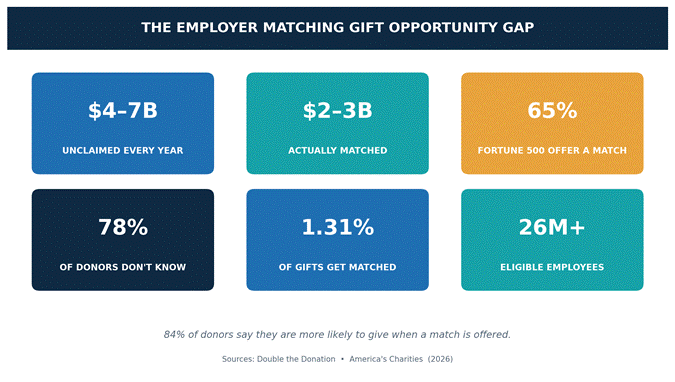
Infographic: The scale of the employer matching gift opportunity and the awareness gap that keeps it unclaimed.

Companies match an estimated $2 to $3 billion in employee donations each year. While that number sounds large, it is small compared to what is left behind. Each year, an estimated additional $4 to $7 billion in matching gift funds go unclaimed.
The primary reason for this is a lack of awareness. Approximately 78% of donors are unaware of whether their company has a matching gift program. After making a donation, the opportunity to participate in a matching gift program is often overlooked.
The statistics do not improve much after that. Only about 1.31% of donations are ever matched. Average employee participation is around 10%. Donors who are aware of matching gift programs are often held back by the burden of completing paperwork, which can lead to confusion and the matching gift expiring.
There is also an awareness gap within the nonprofits themselves. Quite a few development teams lack a structured method for identifying donors eligible for matching gifts or approaching them. The work is perceived as manual and therefore is of low priority. This results in corporate dollars being approved but left unclaimed.
Often, the best fundraising method is matching gifts. With matching gift programs, you’ve already secured the first donation. The second donation comes at the expense of only one fundraising request. With that level of program efficiency, fundraising is a lot easier.
The effectiveness of fundraising campaigns that offer matching gifts is hard to argue against. Mentioning a matching gift offer increases the campaign’s response rate by 71%. Typically, the campaign’s average donation also increases by 51%. Donors are motivated by the offer of a matching gift. Of all donors surveyed, 84% are more inclined to donate to the fundraiser when a matching gift is offered. One-third of the donors surveyed stated they were also more likely to donate a larger amount to the campaign.
Fundraising campaigns that utilize matching gifts can be confident that they have also secured a larger donation. The average donation amount with a matching gift is 1.5 to 2 times that of an unmatched donation. The fundraising gifts secured through a matching gift offer are truly gifts for everyone involved.
| Stakeholder | What They Gain From Matching Gifts |
| Your nonprofit | A second gift at no extra acquisition cost, higher average donations, and stronger donor retention. |
| The donor | Their impact doubles or triples without spending more, making their generosity go further. |
| The employer | Higher employee engagement, a stronger reputation, and tax-advantaged philanthropy. |
This process is straightforward. A donor makes a contribution to your organization. Then, they confirm that their company has a matching gift program and review the guidelines. Each company has different parameters for its program, including matching gift ratio, minimums and maximums, and matching deadlines. The donor then requests a matching gift. Upon approval, the company sends a matching gift contribution to your organization.
This process looks efficient and simple; however, in reality, many potential matching gifts go unclaimed, and each step is a breaking point for most donors. For many, the eligibility check is experienced as a burdensome task. In particular, the matching gift request form duplicates information and the donor’s efforts. This is the point of greatest friction in the process, and where the majority of potential matching gifts remain unclaimed. The map below illustrates the process from the donor’s first gift to the completion of the matching gift contribution.
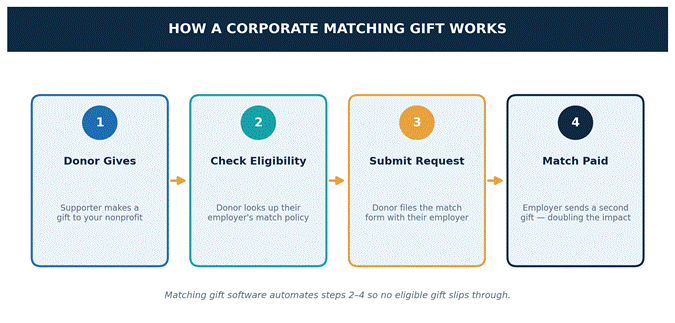
Infographic: The four-step matching gift journey, from the donor’s first gift to the employer’s matched payout.
Some of your donors likely work for the companies listed below. Each company operates a notable program, and the particulars differ in important ways. Below are examples of how a few executives deal with corporate matching gift programs.
Microsoft is lauded as the largest single contributor of matching gift and volunteer grant funds. The tech company matches employee donations dollar-for-dollar, up to $15,000 per employee per year. Both full-time and part-time employees are eligible to request a match. Microsoft matched more than $53 million to nearly 19,000 organizations in a recent year.
The home improvement retailer will match employee donations up to $1,000 per organization and $3,000 per employee annually. This program applies to full-time and part-time employees. To receive the match, requests must be submitted by January 31 of the year following the donation; accordingly, reminders should be provided.
Johnson & Johnson runs one of the most generous programs in corporate America. The company matches current employee donations at a 2:1 ratio, effectively tripling each gift. It also continues to match donations from retirees at a 1:1 ratio, extending the benefit well beyond active staff.
Coca-Cola provides a 2:1 matching gift program. An employee’s $100 gift will result in a $300 donation to the nonprofit. Development teams should recognize that even a small number of Coca-Cola employees among their donors can positively impact fundraising campaign results.
A noteworthy milestone in the story belongs to the GE Foundation. It pioneered the first documented corporate matching gift model in 1954. GE has contributed hundreds of millions of dollars in matching employee donations to 501(c)(3) organizations and associated educational institutions.
The quick-reference table below summarizes how these programs compare.
| Company | Match Ratio | Annual Limit (per employee) |
| Microsoft | 1:1 | Up to $15,000 |
| The Home Depot | 1:1 | Up to $3,000 |
| Johnson & Johnson | 2:1 (1:1 retirees) | Varies by policy |
| The Coca-Cola Company | 2:1 | Varies by policy |
| GE Foundation | 1:1 | Varies by policy |
Most donors are unaware of matching gift opportunities. When 78% of donors are unaware of such opportunities, the solution lies in timely education. Effective matching gift software educates donors at the point of donation and provides the tools they need to complete a matching gift request.
Today’s matching gift software offers the donation form sponsor the ability to place a company/ employer search box directly on the donation form. As the donor enters their company name, the matching gift tool instantly retrieves a corporate philanthropy database and provides the match ratio, the matching gift range, the deadlines, and a link to the form. It provides everything donors need to complete the matching gift request, eliminating friction and the loss of the matching gift.
Double the Donation is the most recognized company in the industry. Its automation software, 360MatchPro, contains a database of over 24,000 company profiles and tens of millions of match-eligible supporters. Eligible donations can be synced automatically as the software integrates with several leading fundraising software and CRMs.
Unsurprisingly, the most notable feature is the auto-submission. If a donor provides a corporate email address associated with a matched-gift employer, the software will submit the match request on the donor’s behalf without any additional forms. The platform also allows each user to track every match they start and sends automated emails to guide them through each match request. This is the primary software for most fundraising matching gift solutions.
Software is foundational. Strategy is what makes software produce results. An effective double-donation strategy integrates matching gifts into all aspects of the donor experience. A matching gift strategy that focuses on the donor experience avoids treating matching gifts as non-essential.
The first step is to include a matching gift search as an integrated part of the online donations flow. Make the matching gift eligibility search visible the moment a gift is made. Follow up quickly. An automated email that includes the donor’s employer, provides a link to the corporate matching gift form, and thanks the donor is much more effective than a generic thank you. Make sure the team is trained. Staff who understand matching gifts and the corporate matching gift process help support the donor and answer questions.
The next step is to change the messaging. Include matching gift messaging on confirmation pages, email signatures, appeals, and tickets. Maintain your data so you can clearly see your supporters’ employers and reach out to those employers first. A quick-start process can be as simple as:
Measurement keeps the program honest. The metrics below show what to watch as you scale.
| Metric to Track | Why It Matters |
| Match-eligible revenue identified | Reveals the total opportunity hiding in your donor base. |
| Match completion rate | Shows how many eligible gifts actually turn into a second donation. |
| Average time to follow up | Faster follow-up means higher completion and less lost revenue. |
| Top matching employers | Tells you where to focus outreach and corporate relationship building. |
The $4 billion to $7 billion gap is not a funding issue. It is a follow-through and awareness issue. The funding is there. Corporations have set aside funds and want them to be used. The only thing missing is a nonprofit to connect the donor to the match at the right time.
That goal is not out of reach. Implement matching gift software. Educate your supporters as they donate. Be diligent in your follow-up. Incorporate matching into a year-long double-the-donation strategy. If you do that, you can increase your funding without asking your existing donors for more.
Your supporters want to donate, and your supporters’ employers want to match the donations. The only thing left is to connect the two parties. Do that now to receive the second donation your nonprofit has missed.
Employer matching gift programs are structured such that each corporate gift program matches an employee’s donation. This means that when an employee donates to your charity, the employer matches the gift (often on a dollar-for-dollar basis). This adds revenue for nonprofits with no additional cost to acquire donors. This is why most development teams prioritize this channel.
Matching gift software addresses the awareness gap that results in billions of dollars in unclaimed donations. This software places an employer search tool directly on your donation form to determine eligibility and automates follow-up and submission for your organization. About 78% of donors are unaware that a matching donation opportunity exists. By placing relevant information during the donation process and minimizing administrative work, the number of completed matching donations is sure to increase.
A double-donation strategy captures corporate matching gifts at each stage of the donor journey. Using a matching gift tool, the first step is to embed the tool on your donation page. Corporate matching gift programs should be promoted, and your fundraising team should be trained on the best practices while matching gift completion rates are tracked. If done correctly, a corporate matching gift program will turn a single donation into two.
Employer matching gifts: one piece of handling donations. The rest of our nonprofit payment guides are in Nonprofit Payment Resources.