

Posted: July 02, 2026
It takes just one walk-in to wipe a month’s profits. A seemingly polished customer enters a camera rental house. Their request: a cinema camera body, two fast prime lenses, a gimbal, and a wireless monitor. This setup is well above $30,000. They present a driver’s license and a credit card to the employee. There’s no issue with the appearance of either document. The employee takes a quick look at the ID, swipes the card, and fills out the agreement. The gear is on its way… and never returns.
The license was a fake. The card was definitely stolen. The trail went cold in a few hours. This is the fake-ID camera gear heist, and it’s one of the fastest-growing fraudulent schemes involving rented equipment and ID verification. The good news is that this scheme is among the most easily preventable. It all hinges on one weak spot at the rental counter. This gap in countering identity verification can be easily closed. This guide details how the heist works, the reasons for the growing theft of camera gear, and the tools and tactics that can be used to stop it.

Fraudulent rental equipment ID verification occurs when an individual uses a non-legitimate identity (stolen, fake, or synthetic) to rent equipment and subsequently fails to return it. This does not fall under a standard theft. They do not break a window or remove equipment. The individual enters the venue, appears legitimate, completes the required documentation, and walks out the front door. Insurers typically refer to this as “voluntary parting.” This nomenclature is important. Many insurance policies would classify voluntary parting as fraud rather than theft, meaning the loss would be uninsured.
Identity is the weak point. According to the U.S. Federal Trade Commission’s identity theft resource, a large portion of financial crime is perpetrated using stolen personal data. Rental equipment is an easy way to cash out that data. The table below shows that fraudulent ID equipment rental constitutes a new genre of crime compared to physical break-ins and thus requires a new form of defense.
| Smash-and-Grab Theft | Identity / ID Verification Fraud | |
| How it happens | Forced break-in, after hours | Walk-in during business hours |
| Who is targeted | Whatever is left unsecured | Specific high-value gear, chosen in advance |
| Evidence left | Damage, alarms, footage | A signed agreement and a fake identity |
| Insurance | Usually covered as theft | Often denied as “voluntary parting” |
| Best defense | Locks, alarms, cameras | ID verification at the counter |
Table 1: Why fake ID equipment rental needs a different playbook than physical theft.
Stolen camera gear gets a crook’s imagination going. It’s compact, portable, has a hefty price tag, and has a high resale value. Some cinema lenses may even be valued more than a decent used car. Fully loaded camera kits are probably the same volume as a backpack. The resale value, even on a stolen camera kit, is good enough that you have a practically instant liquidation. Compared to stealing a forklift, the incentive for stealing rental camera gear is obvious.
The photography gear rental market has some really awful economics for the rental houses. A rental house receives only a small portion of the rental income, but it’s on the hook for the full value of the gear if it’s stolen. An online booking system for camera rentals means that if a camera and lens are used in a fraudulent booking by a criminal, the rental house effectively loses thousands of dollars on a booking that generated substantially less income.
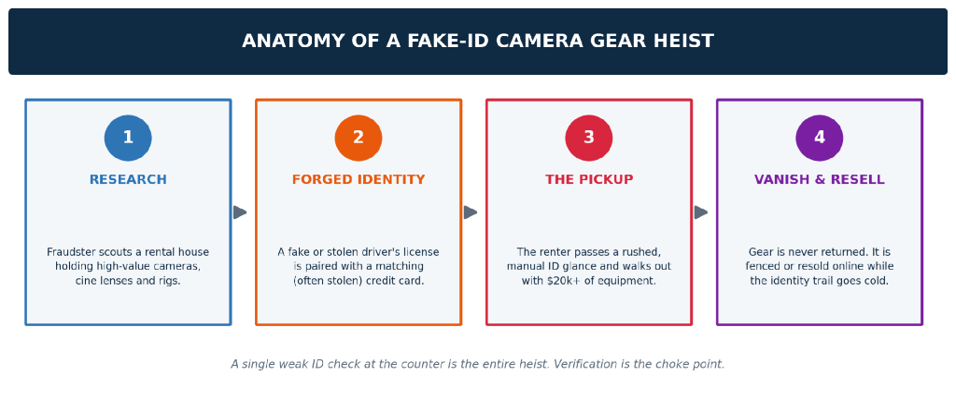
Infographic 1: The four stages of a fake-ID camera gear heist.

This all begins with research. The specific rental properties targeted all possess high-value cameras, cine lenses, and rigs. Each listing is scrutinized. Each rule regarding deposits, operational policies, and the counter’s strictness in identity verification is taken into account. The first sign of a weak verification system is a green light.
Now comes the identity. A fake or stolen driver’s license is conveniently created with a matching credit card, which is usually stolen as well. The stolen card is the rented equipment. Names and addresses are “matched.” Everything is consistent and clean. Upon a quick check, all the information is in order.
Next comes pickup. The confidence and friendliness of our fraudster here go a long way. With a casual attitude, our fraudster rushes through an eyeball-only ID check, signs the agreement, and walks off with $20,000 or more in equipment.
Finally, they vanish. Equipment never returned. Equipment is either quickly fenced or resold online. Because the identity is fabricated, there is no real person to pursue. The entire operation is based on one unverified ID.
Fake IDs used to be clumsy. Today, with the help of generative AI, fake passports, driver’s licenses, and even biometric data can be created with ease. Many criminals augment their use of AI technology to build synthetic identities. This involves using real stolen data, combined with some made-up data, to establish an identity that does not exist but can still pass some basic identity fraud checks. Most of these synthetic identities remain undetected until they are used to commit fraud.
Evidence from the research firm Sumsub revealed that the use of synthetic identity documents in North America skyrocketed by over 300% in the first quarter of 2025. The same period also saw a significant increase in the use of deepfakes to commit fraud. Separately, the number of deepfake files shared online is projected to grow roughly sixteenfold between 2023 and 2025, from about 500,000 to 8 million. These deepfakes also account for approximately 20% of all biometric fraud attempts.
The existing fraud prevention measures for online camera rentals are also adversely affected by these new technologies. These criminals use AI-generated videos to circumvent the so-called “liveness checks,” which fraud prevention systems use to verify the presence of a real human. These measures are no longer effective, as most people are unable to distinguish a high-quality deepfake from reality.
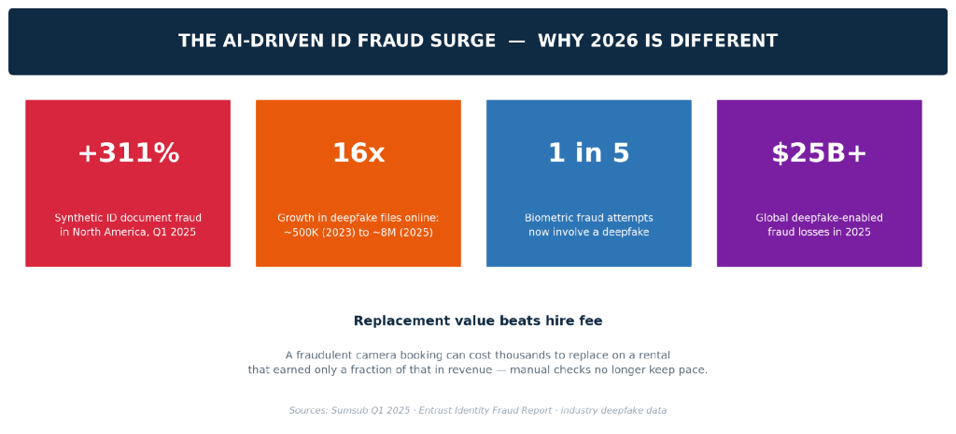
Infographic 2: Why 2026-era ID fraud outpaces manual checks.

Rental fraud includes more than just fraudulent use of rental cameras. It is well documented that Patronscan has incurred extensive, recurring losses across the global rental industry. The typical pattern of fraud involves using a trusted identity, expensive equipment, and disappearing.
| Where | What Happened | Reported Loss |
| Canada (2023) | Heavy equipment fraudulently rented from multiple dealers using stolen identities | ~$837,000 |
| United States (2024) | 25 rental fraud incidents across 11+ Home Depot locations; gear resold online | $400,000+ |
| United Kingdom (2023) | 300% rise in construction machinery fraud in a single quarter | £100M+ sector loss |
Table 2: Documented equipment rental fraud losses across regions.
Camera rental houses are vulnerable to theft. Their equipment is similar to heavy machinery in terms of portability and value. Therefore, specialist rental companies are beginning to consider ID verification as a crucial need.
Strong ID verification addresses the core of the issue while minimizing user friction at the point of confirmation. It employs three tactics. First, document verification checks the authenticity of the ID. Modern scanners perform multiple forensic analyses of the ID’s fonts and design elements, as well as holographic images and the data elements of the barcode or chip. If an ID document passes the eye test but is a fake, it will fail the forensic analysis and be returned with a “FAILED” message.
Second, database checks and watchlist checks scan the document ID for potentially flagged real identities. Known templates are cross-verified, and comparisons are conducted with historical linked fraud activities and repeat offenders. Third, liveness and biometric checks verify that the ID is authentic and that the person is not a disguise, deepfake, or an image.
Strong ID verification reinforces document fraud prevention. It builds a record by creating a time-stamped report of the transaction with an ID scan. This report is stored along with the rental contact agreement. In the event of missing rental equipment, a report is created for law enforcement and insurance investigators. There is also a notable deterrent effect: when staff runs a live authentication scan, presenting a fake ID becomes a high-risk move for the fraudster, since every attempt is captured on record. This is one of the primary goals of fraud prevention for rental services.
Proven options are available in the market, from countertop scanners to fully automated online checks. The ideal combination depends on whether you conduct rentals in person, online, or both. The following providers are commonly used in the rentals and identity services sectors.
PALIDIN is an identification authentication system designed for point-of-transaction verification. It performs multiple authenticity checks on a physical identification document and searches the global document database. It saves a transaction report for every scan. For rental counters, it is designed to authenticate forensic evidence to detect fraudulent criminals using real data with stolen identification that would otherwise pass through simple data verification.
Patronscan offers anti-fraud ID verification technology that authenticates and cross-examines both sides of government-issued identification and detects counterfeiting. It can identify differences in fonts and spacing that are imperceptible to the human eye, thanks to its deep learning. With its extensive experience in identifying fake identification across various industries, it is well-suited for rental businesses that need a dependable scan-and-verify system at their point of sale.
Tokenworks provides its clients with IDentiFake. This ID scanner completes over 50 forensic tests and analyzes thousands of real IDs and passports. This product scans licenses, completes all required paperwork, manages customer records, and tracks rentals. The fact that Adorama uses this product to prevent theft shows that its usage is relevant to rental camera businesses. Adorama is an NYC-based camera retailer and rental house. Including this client example adds further relevance and appeal to the camera rental business.
Online booking now has automated document verification with Stripe Identity. Customers must upload their IDs through the booking flow. Stripe performs real-time checks on document authenticity. Each rental channel can set its own verification requirements, so new customers can be properly vetted, while trusted customers are fast-tracked. Stripe Identity works great for online camera rental businesses.
Fraud Fighter Inc. produces advanced systems for multi-layered counterfeit protection, including document scanners that incorporate proprietary ultraviolet technology and isolation systems to expose and process UV-secured anti-counterfeiting features embedded in identification and travel documentation. Their product line creates an affordable “base layer” of in-person document verification systems. The scanners capture and store digital images of the documents in a proprietary digital vault for potential use in an investigation and prosecution.
POY Verify employs a privacy-centric, biometric approach to services for online platforms. By using on-device liveness detection, it avoids collecting personal information and instead confronts automated programs, deepfakes, and artificial/synthetic identities. For online camera rental marketplaces concerned about the potential for AI-facilitated fraud, it is part of a new generation of human-verification technologies.
| Verification Method | What It Catches | Best For |
| Document authentication (ID scan) | Fake and altered physical IDs | In-person rental counters |
| UV / security-feature scanning | Counterfeit licenses and cards | Low-cost base layer at the counter |
| Database & watchlist cross-check | Stolen data, repeat offenders | Catching valid-looking but flagged IDs |
| Biometric & liveness check | Deepfakes, masks, photo spoofs | Online and high-value bookings |
| Automated online verification | Remote fake and synthetic IDs | Web-based rental platforms |
Table 3: Matching verification methods to rental risks.
All tools have limits and will never stop every single threat. Defense in depth means that, even after overcoming an initial layer, a fraudster will still face additional layers. A robust system will first deploy document authentication to detect counterfeit IDs, then follow up with cross-checks against databases and watchlists, and further layer biometric and liveness checks to thwart deepfake technology. In addition to these layers, imposing a financial cost will deter most fraudsters and will be supplemented by GPS and tracking technology to enable asset recovery if fraudsters manage to leave with controlled equipment.
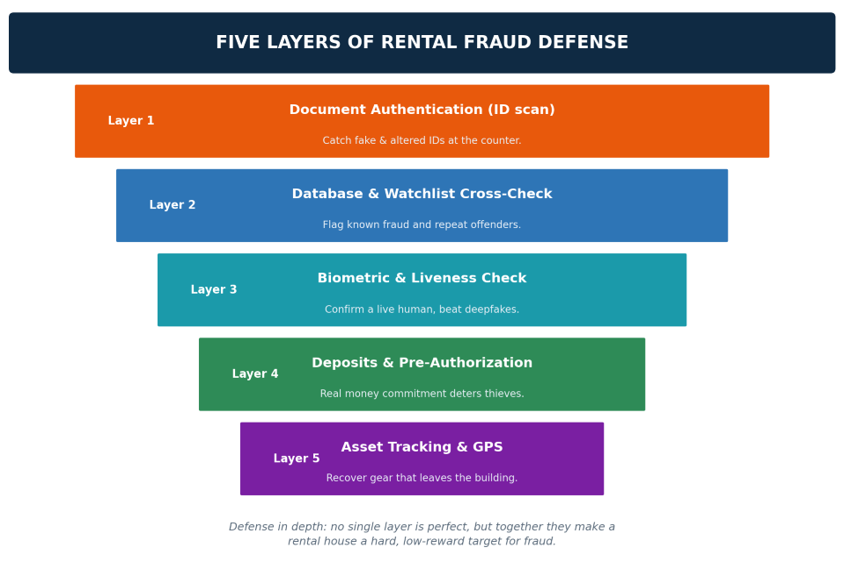
Infographic 3: A layered defense makes a rental house a hard, low-reward target.
All of this is anchored by two important human elements. First, signed rental agreements provide you with binding contracts if a renter decides to keep the equipment. Second, the right staff makes the technology function. Employees who understand how to interpret a validation result, manage a negative scan with composure, and implement the company’s standard procedure transform a technology system from a wasteful investment that collects dust to an effective system that mitigates equipment loss.
Make verification an absolute requirement for all high-value items. Consider any rental exceeding a specific threshold for a replacement value a required scan, with no exceptions for expedited or friendly service. First-time renters are especially important to this requirement, as they pose the highest risk of fraud. Each scan must be accompanied by a payment method that matches the name on the verified ID.
Ensure complete documentation for the signed transaction. In the event that you need to provide information to the police or an insurance adjuster, be prepared with a complete transaction form, signed agreement, and case documentation/report. Find out how your insurance works with voluntary parting, as it may determine the reason for a loss. Also, arrange verification training to keep staff informed about the latest techniques for spotting verification fraud.
Effective verification systems should avoid unnecessarily burdening honest customers with friction. Proportionate friction is the goal. A few seconds are added when legitimate consumers are asked to complete a quick ID scan at pick-up. A scan protects the business and the consumer and is accepted without objection in the vast majority of cases. For rentals completed online, adopt channel- and customer-type-specific verification systems to streamline the process when welcoming new consumer accounts. Established trade accounts that have built trust should be afforded a faster verification process. This balance will help keep fraud at bay and keep your preferred customers happy and loyal.
The use of fraudulently obtained fake IDs to rent equipment and then steal the equipment is a uniquely designed crime. The technology exists that can create high-quality fake IDs. The only thing needed to rent gear is one unverified person at a rental counter. Camera gear is small, easy to steal, and easy to sell online, making it an attractive target for thieves. There are effective countermeasures.
The thieves will bypass your rental house and move on to easier targets if you implement multi-layered ID verification, document verification, biometric liveness checks, an equipment rental deposit, and electronic equipment tracking, along with your trained staff. One bad rental can cost you a month’s profit. Having a reliable equipment rental verification system is essential in the equipment rental business. It is your most affordable insurance.
This is a type of fraud in which an individual uses a fake, stolen, or synthetic identity to rent high-value equipment and then fails to return it. The individual fraudulently appears to be a legitimate customer by completing the required paperwork. Because of this, insurance companies may classify the loss as a voluntary parting and therefore may not cover it. The best defense against this type of fraud is strong identity verification at the time of equipment rental.
Yes. Modern ID authentication systems can perform forensic examinations beyond the capabilities of the human eye, including fonts, layout, holograms, UV features, and encoded data. Many amazingly sophisticated counterfeits that can successfully pass a clerk’s inspection will fail an automated scan. For the best protection against AI-generated and synthetic identities, document authentication should be coupled with biometric and liveness verification.
Remote confirmation is a must with online rentals. Customers should upload and verify a government-issued ID before confirming a booking and dispatching gear. Biometric liveness checks should be added to mitigate deepfakes and confirm a human is present. Verification should be configurable by channel: apply tougher checks for first-time customers and lighter verification for trusted trade accounts.
Many industries experience significant economic loss attributed to fraudulent rentals. In the events industry, this economic loss can exceed $10,000 per incident, and rental companies often have little to no recourse against the fraudulent renter. When faced with this financial risk, the price for an ID scanner and/or online verification for rental requests is justified. The ID verification system also helps prevent fraud by dissuading fraudulent renters from completing the rental process.