
Posted: July 02, 2026
It is true that losing a customer is an unfortunate reality that just about every business owner will face at some point. But nothing comes close to the painful, stinging effect of a double booking. The crew shows up to find the trailer gone, the job site stalled, and, an hour later, a one-star review posted for the entire community to see.
Most owners fail to realize that double bookings usually aren’t caused by booking errors. The real cause is a late return. A unit is sent out, but it comes back a day late, and the system still shows it as available, so you book it again. Now there are two unhappy customers, and one of them is served.
Our goal is to eliminate this problem. We will consolidate late returns, current inventory, and the smart equipment rental late-return fee into a single system. With this system in place, the goal of keeping every unit honest, every booking clean, and your reviews positive is achieved. This is part of our rental operations cluster, and it matches well with the extensive guides on pricing, fleet utilization, and customer retention.

Most owners consider double bookings to be the result of careless scheduling. This is not usually the case. They result from deceptive inventory.
Your scheduling system shows that a generator is available on Friday. A customer books it. The generator is still with the customer, who has not returned it. The system was not aware of this. On Friday, the generator is still on the job site.
Delayed returns cause the problem. When equipment is returned late, actual availability and recorded availability diverge. This gap is where double bookings are found. This gap is the reason for multiple bookings, the longer it gets.
Manual tracking makes the gap worse. Whiteboards, spreadsheets, and memory cannot help you keep up with a busy rental counter. One missed update generates a unit that does not exist, and that unit gets booked.
Surely, one small delay will not be the end of the world. Just one extra day for one unit. But that one late unit has the potential to ruin multiple bookings that follow it.
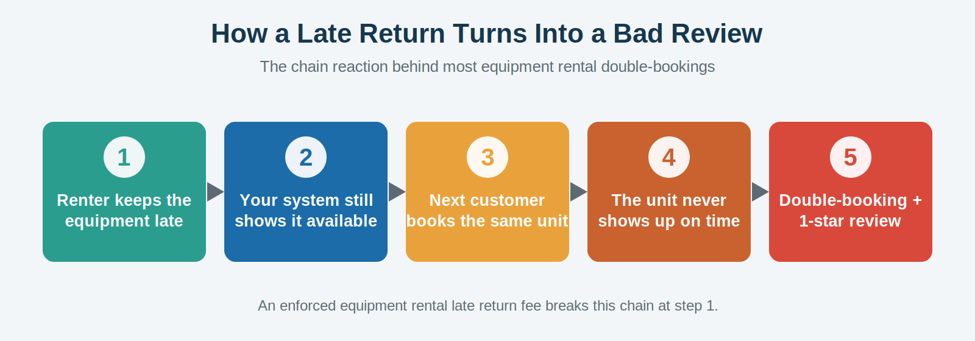
Infographic: the chain reaction behind most equipment rental double-bookings.
Imagine this scenario. A customer keeps a skid steer longer than expected. Your system still shows the skid steer as available. A second customer books the skid steer. The first customer never returns it. You go into damage control. You make a last-minute apology. You offer a discount. None of this really helps. The damage is done.
This is the main reason late returns and negative reviews go hand in hand. The affected customer is not a rule breaker. The affected customer is not the one who will receive the negative review. The negative review will be directed to your business.
This is why an equipment rental late return fee is important. It helps customers keep their rental equipment return schedule on time because late returns incur late-return fees. When your returns stay on schedule, your inventory is accurate. And an accurate inventory almost never double-books.

The nominal cost of a lost rental agreement is rarely the primary concern. The cost to goodwill and reputation is higher. Rebuilding goodwill and reputation is a slow and expensive endeavor.
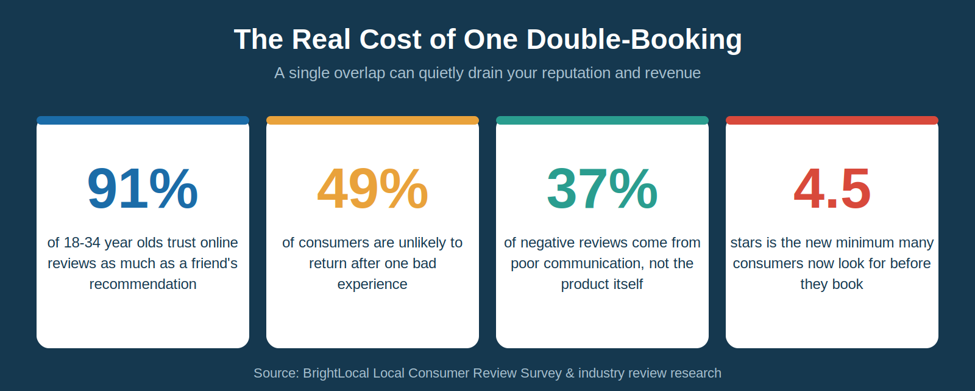
Infographic: A single overlap can quietly drain both your reputation and your revenue.
Now, reviews have the weight of recommendations. BrightLocal’s Local Consumer Review Survey found that many consumers aged 18-34 came to trust online reviews as much as recommendations from acquaintances. This same research found that the booking decision is based on the most recent and highest-rated review.
Negative reviews often result in a loss of repeat customers. Poor service is often the cause of negative reviews, and service-related issues (as opposed to product-related ones) account for the majority of them. A double-booking communicates the most severe service-related failure, because it is a broken promise on the most important day.
A double-booking means the business is losing the rental, future bookings from that customer, and future bookings from the lost customer’s social network. The loss of trust from reading that review later is also incurred. This is very damaging for a small rental business.
This is one example that shows that the impact of a single overlap is much greater than you think.
| Cost type | What it actually looks like |
| Immediate revenue | The rental you cannot fulfill, plus refunds, credits, or discounts to keep the peace. |
| Recovery scramble | Staff time, frantic phone calls, emergency sub-rentals, and rush logistics. |
| Lost repeat business | A frustrated customer who quietly never books with you again. |
| Reputation damage | A public review that warns off dozens of future renters before they ever call. |
| Search visibility | Lower star ratings that drag down your local search rankings over time. |
Each row adds up. Together, they turn a one-day delay into a long-term loss.
If late returns create issues, precise availability resolves them. The base is real-time inventory. It really shows what’s available, what’s not, and what’s out right now.
Here is how it differs. Manual tracking updates when someone remembers to do it. Real-time tracking updates when a unit moves. The status goes out and stays out until it’s back. There is no lag time, so there is no false availability or overlap.
| Factor | Manual tracking | Real-time inventory |
| Availability accuracy | Updated from memory and often stale | Updated instantly on every move |
| Double-booking risk | High: phantom units get booked | Low; the calendar matches reality |
| Late return visibility | Easy to miss for hours or days | Flagged the moment a unit is overdue |
| Overtime billing | Calculated by hand and often skipped | Triggered automatically |
| Staff workload | Constant manual chasing | Mostly hands-off and automated |
| Customer experience | Surprise scheduling conflicts | Reliable, predictable bookings |
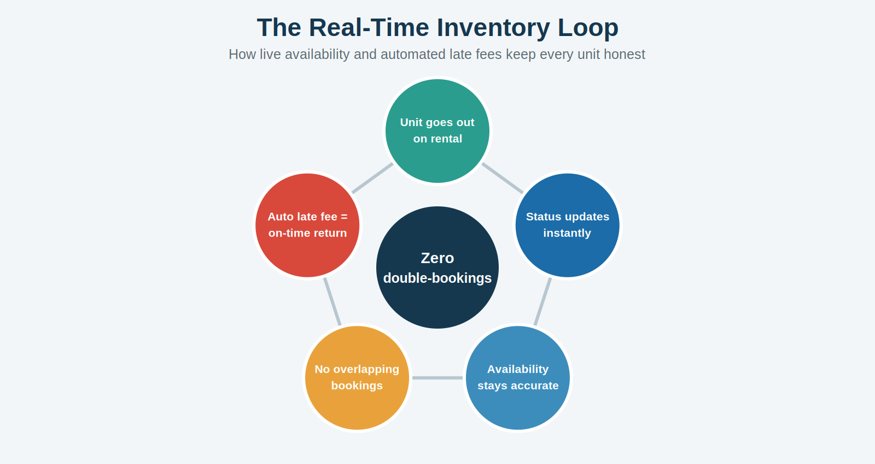
Infographic: How live availability and automated late fees keep every unit honest.
Central to this system is the loop. A unit goes out, and the status updates in real time. Availability is accurate. No overlapping bookings can occur, and an automated late fee ensures the return is on time. After the return is received, the cycle repeats at the same level of cleanliness.

This is the intersection of policy and technology. A thoughtfully crafted equipment rental late return fee does two jobs at once. It safeguards your revenue. And, just as critically, it safeguards your schedule.
When renters understand the cost of overtime, most return equipment on schedule. This leads to a harmonious correspondence of your actual and recorded available equipment. This correspondence eliminates the possibility of double bookings.
Charge customers rental overtime, and they understand that the equipment is needed by the next customer. Your charge makes it clear to the customer that equipment rental time extensions will no longer be tolerated. This fee terminates each customer’s equipment return time extension.
The fee must be applied consistently. A rental return charge that is never applied teaches customers that equipment return times do not need to be observed. A charge that is applied consistently teaches customers that equipment return times must be observed. With services that provide rental equipment return time extension tracking, rental return charges can be applied consistently.
Policies concerning late fees should aim to be reliable, just, and, most importantly, visible to the renters. The late-fee rules should be made clear to renters before the contract is signed, not after they have defaulted.
The due date, and the determination of the late return should be clearly stated, repeated, and highlighted in the contract. If a late fee policy is clear, disputes can almost be eliminated.
The most effective late fee policies are simple. Many rental companies determine late return fees using the same structure as the daily rental rate. The fees are then scaled based on the delay in returning the rental item. A brief delay in returning the item may incur a fractional-day fee, while a lengthy delay would incur a full day’s rental fee.
| Time past due | Typical overtime charge | Why it works |
| 0 to 2 hours (grace) | No charge | A goodwill buffer for traffic and loading |
| 2 to 12 hours late | 50% of the daily rate | Covers partial-day disruption |
| 12 to 24 hours late | 100% of the daily rate | Reflects one fully lost rental day |
| Each additional day | Full daily rate per day | Protects the bookings stacked behind it |
| No-show return | Daily rate plus recovery process | Triggers follow-up and a possible deposit claim |
Adjust these figures as necessary for your region, goods, and services. The American Rental Association has extensive resources to assist you with policies, Safety, and guidance for running your day-to-day operations.
Most importantly, be fair. Having a small grace window is an example of goodwill. If you communicate your policies and/or the reasons for your decisions to your customers, they will respect you and your business. If you consistently enforce your policies, your customers will see that you run a business that is both fair and trustworthy.
Manual fee collection fails for one simple reason. People are busy. A clerk forgets to check the overdue list. A regular gets a pass. A fee gets waived to dodge an awkward conversation. Soon, the policy means nothing.
Automated late fees fix this. The system tracks every due date. It flags overdue units in real time. It calculates the charge. And it can bill the card on file or notify the renter on its own. No awkward calls. No missed charges.
This system ensures there are no uncomfortable conversations, no late fees left uncharged, and no favoritism.
This automation is also extremely useful for manual fee collection. It protects your schedule by ensuring that each unit is due. The system can also place a hold on a reservation or block it entirely. This protects against an extremely frustrating double-booking for a customer reporting an issue.
Automated late fees give a subtle push in the right direction. When a renter receives a reminder, the system is not threatening to charge them; it is simply sending a nudge, which, when used consistently, can help change behavior.
The recommended solutions tend to work best when implemented by a single system. Real-time inventory, due-date tracking, and automated late fees should all be managed together. Several rental management applications are designed specifically to address this. Below are some applications worth knowing about.
Booqable offers rental management solutions for small to medium-sized rental enterprises. It combines features of online order management, booking, and availability, all in real time, on one platform. Since updates to availability occur due to changes to orders, they also help prevent double bookings.
EZRentOut is a web-based rental system offering modular inventory, order, and payment management. It includes due-date and recurring billing functions to automate the calculation of rental overtime charges, eliminating the need for manual charge determination at the rental counter.
Point of Rental Software has established itself as a valuable partner of equipment and event rental businesses of all sizes. Its systems support a busy rental counter concerned with inventory, scheduling, and operations. It helps keep recorded availability aligned with the actual inventory in the yard.
When you assess different systems, go beyond the feature lists. Ask one question. Does this system keep my availability honest and my late fees automatic? If so, you likely have a system that will eliminate the dreaded double bookings that lead to your worst customer reviews.
You don’t need a full software rollout to begin fixing the leaks. Start by auditing availability against reality. Walk the yard. Check what is physically present against what your system says is available. Each discrepancy will create a future double booking.
Then, draft a consistent late fee policy that your rental business employees can easily implement to the letter. Draft a grace period. Determine and state the late fee. Include it on the rental agreement and verbalize it during the rental agreement pickup. Then, enforce the policy with no exceptions.
Then, work towards real-time updates. A shared system is a significant improvement over a tracking board. The purpose is to have real-time updates, not perfect software. Enable automated late fees if your software supports it. The system will mark rental units overdue and apply rental overtime charges. This will drastically reduce the oversights with enforcement.
Work through these steps in order, and your inventory will become accurate. This will also eliminate double bookings and the negative reviews that often follow.
Double bookings are not a problem with scheduling. They are a problem with late returns masquerading as a scheduling problem. Address the late returns, and the double bookings disappear.
The solution is simple. Using real-time inventory ensures your availability is never inaccurate. Implement a late-return fee for your rental equipment to ensure customers return it by the due date. Lastly, configure your late return fee to be charged automatically every time.
Providing the above solutions will ensure your equipment is returned on time, your schedule is unbooked, and your customers are happy. Furthermore, your reviews will improve, and a good review is so important in this industry that it will mean the difference between slow and steady growth.
There is no absolutely correct answer. The majority of rental companies correlate the fee with their daily rate. One of the more traditional methods is to charge a portion of the daily rate for minor delays or the full daily rate for delays of more than half a day. Make sure it is high enough to shield the reservations that follow that unit, but reasonable enough for clients to understand and accept. The fee must be clearly stated prior to the rental.
Automated late fees help address overdue units and the conflicts they create. As units become overdue, automated late fees will flag overdue units and temporarily block and/or hold conflicting reservations. Since the system operates in real time, it ensures that the next customer is not booked onto gear that has not returned. The late fee encourages renters to return units on time, which helps keep the actual and recorded availability in sync.
Not if you do it the right way. Customers tend to be less bothered by fees that are communicated to them. They tend to be more bothered by unexpected fees. Having a definitive late fee policy, along with a short grace period, and following through on it actually builds trust. Customers understand that you take your time seriously and that you value each and every customer. A majority of customers value and are bothered by a business that lacks a fair and efficient policy.
Yes. Approach the issue methodically. Verify the discrepancy in your physical inventory against your records. Communicate a well-defined late-fee policy to your team so they can adhere to it consistently. Replace your whiteboard with any currently utilized, shared, real-time system. A number of cost-effective, small operator-friendly, core inventory management systems include real-time inventory, automated late fees with small investments, so small operators can afford inventory management.