

Posted: July 03, 2026
You know the drama. The asset was due back at noon. As of now, it’s 4 p.m., the bay is empty, and the next customer is already loading their truck to go. Someone on your team has to answer the call, go ahead and dial, then tell the customer that yes, late returns on rentals come with a fee, and no, it’s not up for negotiation. We know it ain’t fun. We know it’s awkward. We know it takes time, and it usually ends with giving the customer a discount just to keep the peace.
But there’s some good news! You don’t HAVE to make that call. With some policy automation, rental overtime charges can apply themselves, and all of this can happen before you even have to call the customer. The good news is that a policy for late-return rental fees can be set up in this document, and the awkward, uncomfortable part of the fee calls can be handled by the software!
A client incurs a late-return equipment rental fee when they return rented equipment after the agreed-upon time. This may also be referred to as an overtime charge, overdue fee, or off-rent penalty. While the terms may differ, the reason for the fee is the same. The purpose of the fee is to cover the actual cost of a late return and motivate the customer to return the equipment on time.
The actual cost of a late return is greater than a client may expect. For example, when a customer returns a generator, scissor lift, or party tent late, it is not just about losing a couple of hours of rental income. There is the potential of losing the next booking as well. This may also result in staff being paid to track down the equipment. Most importantly, this may result in disappointing another customer who was expecting to receive that equipment. Recovering value and protecting customers on the wait list are the purposes of late-return fees.
Most rental operators fail to appreciate the hidden cost of late returns. It’s not a single, large number. Late returns cost small amounts that can be difficult to identify. They lead to a number of small, idle costs. They cause a cleaning to be done in a fit of haste. They cause a booking to be shifted or lost. When these costs are multiplied by a busy season, the cost of late returns can be quite high.
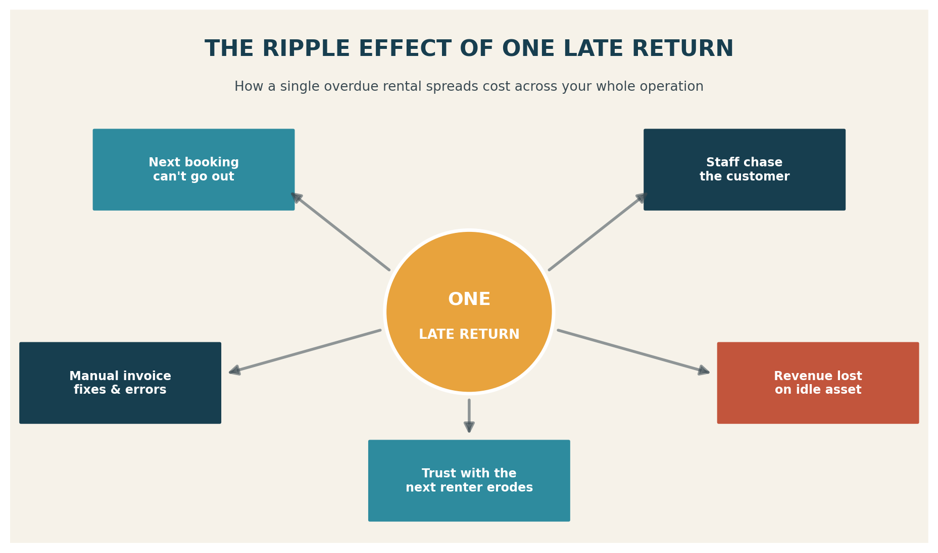
Infographic: one late return spreads cost across your entire operation.
The clearest example of a loss is idle inventory. An asset that remains in a customer’s garage is never earning for the business. Each hour that the asset is late is a rental charge that is never realized and, in addition, prevents revenue from future bookings. A late return that has already been rescheduled for tomorrow requires a cancellation and refund, as well as a replacement booking that may not be available.
Employees are also indirectly impacted by late returns. Employees will be less available to assist new customers and will instead focus on managing the return of overdue inventory. Late returns also erode the business’s ability to meet its commitments to the next customer. Each late return is another instance of the complex rental booking system’s failure, which has a number of unpredictable, incomplete, and inconsistent elements.
The complexity of the rental return process is one reason late returns so often go unrecorded. And when they go untracked, it quietly signals to customers that the deadline is flexible, which costs the business revenue.
The notion of charging a fee becomes problematic. Your front-desk employees prefer to avoid a possibly hostile interaction with the customer and thus waive the charge. This same scenario occurs multiple times. A fee that is charged on paper but not enforced is not a policy. It is a suggestion.
Creating inconsistency is also a result of the phone call. One customer is charged, while another, who may be a little more agreeable or assertive, is not. Inconsistency is problematic. It appears unjust to those who actually pay and may even lead to legal problems due to arbitrary enforcement. The answer is not a more rigid employee. The answer is to completely eliminate the situation that creates the moment of confrontation.

Before automating any aspect of your rental business, you need a clear late fee policy. Automation will strictly adhere to the rules you provide. Rules that are poorly defined will yield poor results.
A well-thought-out policy will be written, outline clear terms, and be concise enough to fit in a sentence. A well-thought-out late fee policy will define the terms of lateness, the fee amount, and how the fee is assessed. The policy will be designed to be perceived as fair, while also being firm and uncompromising. Most importantly, the late fee policy will be communicated and signed by the customer in the rental agreement prior to the customer leaving your business.
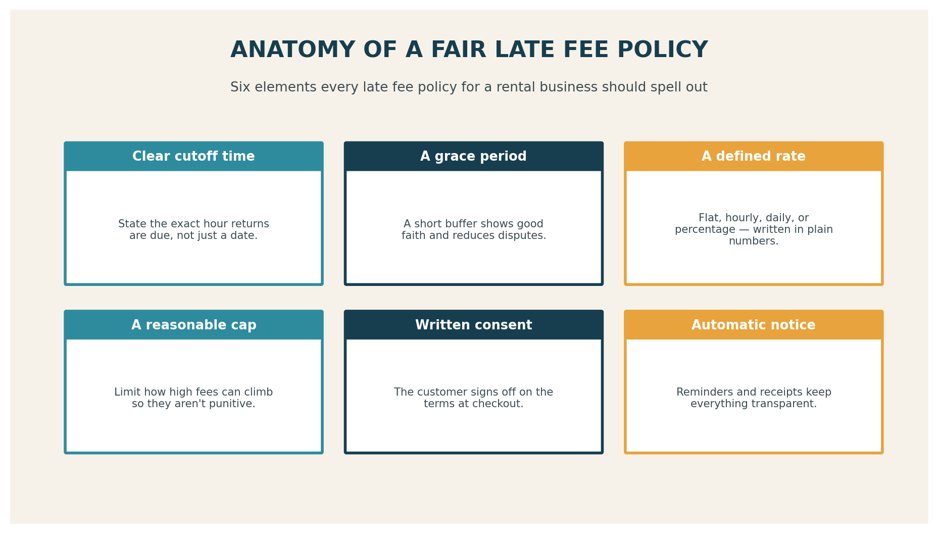
Infographic: The six building blocks of a fair late fee policy.
The arrangement of a fee is as important as the fee itself. There is no absolute answer here. The most practical option is contingent on the specifics of the item you are renting, the rental duration, and your customer’s perception of time. The four most common pricing structures for rental businesses are compared in the table below.
| Fee structure | How it works | Best for | Watch out for |
| Flat fee | One set charge applies the moment an item is late. | Quick, low-cost items and walk-up rentals. | Can feel harsh for a five-minute overage. |
| Hourly overtime | A per-hour rate accrues after a set cutoff time. | Same-day and short-term equipment rentals. | Track the clock precisely to avoid disputes. |
| Daily overage | A per-day rate, often the daily rate or a multiple of it. | Multi-day tools, vehicles, and heavy equipment. | Define exactly when a new day begins. |
| Percentage | A percentage of the rental value per late period. | High-value assets and longer contracts. | Cap it so the total never feels punitive. |
Table 1: Four common ways rental businesses structure overtime charges.
For overdue gear, MCS Rental Software is another option worth a look, spanning automated reminders through to adjustable extensions for legitimate delays.
Automating late fees streamlines your policy by removing the manual step. While a person may consider subjective factors when deciding whether to charge a customer, an automated system applies the rule without bias when the situation arises. There is no waiting and no underlying considerations. No customer service call.
The mechanics are quite straightforward. The customer checks out an item, and a record of the return time is established. A grace period is created. Prior to the expiration of the grace period, the system may send a text or email reminder. If the item is not returned, a fee is charged and recorded with an explanation of the charge. The charge is communicated to the customer with a document.
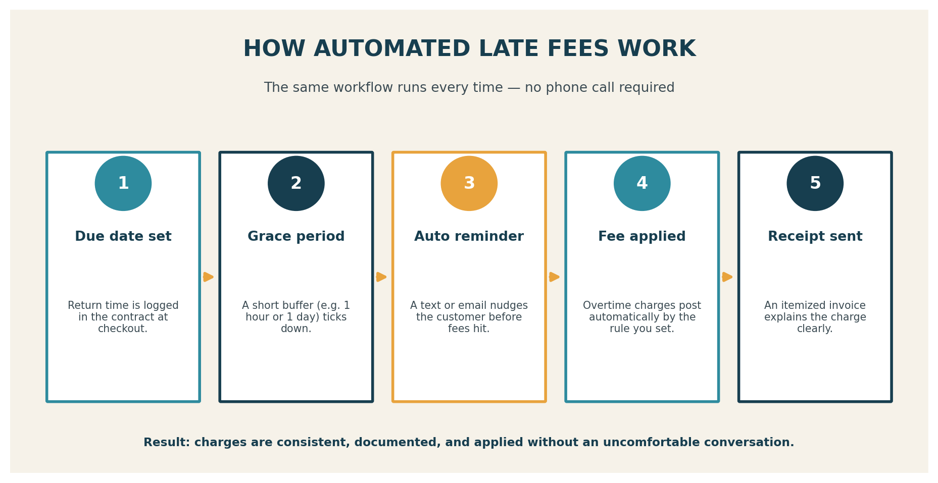
Infographic: the five-step automated late fee workflow.
This alteration dramatically changes how emotionally engaged clients become with the fee collection process. A courtesy reminder feels like a courtesy. An automatic charge with an itemized bill feels like a policy. Neither feels like an accusation. EZRentOut is an example of rental software in which operators set a late fee for each asset, and the software automatically updates the fee every minute, day, or week after the asset is returned. The charge accrues while staff continue with their tasks for the day.

Custom software is not a necessity to automate rental overtime charges. Numerous conventional rental management systems include late fee features. Your best option depends on your business’s scale and inventory, as well as your allotted budget. Here are three options to consider.
EZRentOut is a comprehensive tool for equipment and vehicle rental companies to manage their rental operations in a cloud-hosted environment. It can set late-fee rates for individual assets. Once an order reaches its expected return date, the asset’s field turns red, and a late fee begins accruing. Billing for the late fee is based on the exact period between the expected and actual return dates to ensure accuracy and defend the business against disputes.
Point of Rental has earned the trust of everyone in the rental business, from the single store owner to the titans of fleet rental. Its systems can untangle the billing complexities of rental business workflows and handle overtime, meter, and repeat-charge billing within a single connected system. Overdue charges are tracked alongside the rental contract and are not neglected in a separate spreadsheet.
Booqable provides an online booking solution for small and medium-sized rental companies. It features a customer storefront and supporting office tools, including deposit and rental period management. Effectively, it allows operators to publish automated, professional, and time-efficient business solutions.
While evaluating different options, test the edge cases. Many rental platforms show their true value when handling late returns, partial returns, or damage fees. If you only see the software in a staged rental situation, where customers return items on time, you are likely to miss much of the value the software provides when returns are late by 3 days or more.
Turning on automation is the simple tactical lift. Thoughtful implementation is the strategic play to delight customers. Be precise about your cutoff time. “Due Tuesday” is vague and flexible. “Due Tuesday at 5:00 p.m.” is more concrete and inflexible. More precision about your deadline means fewer misunderstandings and, therefore, less time spent explaining your pricing.
You should also consider a grace period as part of your pricing strategy. It is thoughtful to allow an hour or less for same-day rentals and a day or less for longer-term rentals. This accounts for delays beyond the customer’s control, including unexpected traffic and longer-than-anticipated delays at job sites. A reasonable grace period is also worth building in, since many customers expect one and it absorbs genuinely out-of-their-control delays. The key is to keep that window clearly bounded rather than open-ended.
A defined grace window prevents the kind of open-ended leniency that erodes revenue and invites disputes. Sensible limits protect both your revenue and your customer relationships. The pricing sample schedule reflects a typical mixed-fleet pricing strategy.
| Equipment type | Standard rate | Grace period | Overtime charge | Cap |
| Power tools | $40 / day | 2 hours | $8 / hour | $40 / day |
| Mini excavator | $280 / day | 1 hour | $35 / hour | $280 / day |
| Party tent (20×20) | $250 / weekend | 12 hours | $60 / day | $250 / event |
| Box truck | $90 / day | 30 minutes | $15 / hour | $90 / day |
Table 2: An illustrative overtime fee schedule. Set your own figures based on local market rates and costs.
Implementing an unexpected fair fee will almost always result in a one-star review. Automation will eliminate the uncomfortable call, but communication is still your responsibility, and automation makes communication much easier.
You want to document the policy and get a checkout acknowledgment. You want to include it on the receipt. You want to remind the customer before they miss the deadline. When the fee posts, send the customer an itemized invoice detailing the fee, due time, return time, and rate. Most customers will accept the fee after seeing the math. The sticking point for most late fees is the lack of transparency.
The legality of late fees is a gray area due to differences across locations and contracts. Most jurisdictions apply a “reasonableness” standard. Courts do not view punitive fees favorably. A fee that far exceeds the value of the item or service is likely to be rejected.
One of the reasons a written agreement is necessary is that a late fee cannot be enforced without a contract. A late fee must be included in the contract and communicated to the customer. Automation provides protection through consistency. It is highly unlikely that a customer would feel that a rule applied to them alone when it applies to all customers. For specific limitations and notification requirements for your jurisdiction, consult a local attorney, as this article is not legal counsel.
Automating how you assess and collect fees changes the numbers in two ways. First, charges that used to be waived are applied consistently, so more of what you are owed is actually collected. Second, the reminders that come with automation reduce late returns in the first place, which means fewer fees to chase and better asset availability. Either way, the shift is toward more reliable collection with far less staff effort.
| What changes | Manual, phone-call approach | Automated approach |
| Who enforces the fee | A staff member, case by case | The system, every time |
| Consistency | Varies with mood and customer | Identical for everyone |
| Staff time per late return | 15–30 minutes of calls and notes | Close to zero |
| Customer experience | A defensive phone call | A clear reminder and receipt |
| Fees actually collected | Often waived to avoid conflict | Applied exactly as written |
| On-time returns | No proactive nudge | Reminders reduce lateness |
Table 3: Manual enforcement versus automated late fees, side by side.
The pattern is consistent. Less friction, more follow-through, and a team that spends its energy on service instead of collections.
Late returns are an inevitable aspect of the business. It is a reality that equipment is returned after the scheduled time, in part due to employees’ busy schedules. However, the strategy your business can adopt is how to deal with late clients. A business can adopt a late-return equipment policy, but it is only effective when enforced. Consistency in enforcing the late-return equipment policy is achieved when the discomfort of talking to clients is removed from the equation.
Automation needs a concrete policy to operate with. A late return fee policy enforced through automation will apply overtime charges to rentals in the same way each time. The customer is notified of the charge before it is applied, a reasonable charge is levied during the rental period, and an invoice is sent after the charge is applied. This increases the business’s revenue, ensures equipment is returned on time, and means the staff at the rental business no longer has to answer the dreaded phone call. The software is set to the business’s preferences, and the policy is enforced without awkward conversations, so the revenue reconciles cleanly on the books.
There is no single amount for this fee; it is more accurate to view it as a refund of your actual loss rather than a penalty to your customer. Many operators charge an overtime penalty equal to the normal gear charge, or a gear rental multiplier, for gear used on the same day. This total is further controlled by a reasonable cap. Whatever system you choose, apply it consistently, and be sure to write it in the contract.
For the most part, a disclosed and agreed-upon fee is required across rental and leasing practices before it can be enforced. There can be no ‘surprise’ late fee for a customer if there is no late-fee clause in the contract. Suggested solutions: a late-fee policy should be added to the rental agreement; customer acknowledgment should be requested at checkout. Then you can justify the late fee.
After an item is checked out, the expected return time is recorded in the system. A countdown occurs, and a reminder is sent. When the grace period ends, if the item is still checked out, the software applies the predetermined overage fee and sends a detailed receipt. The software handles contacting the customer. The fee is the same, documented, and directly related to the contract.
When handled correctly, systems like these have the reverse effect of what is intended. Impromptu charges annoy people, but automated charges in the system will not. Automation will remind and send the customer itemized tickets. Customers will have a heads-up and understand how the charge was calculated. Many customers prefer a transparent system to an uncomfortable phone call. Fairness is also consistency – everyone has to abide by the same rules.