niche SEO strategies

Niche SEO Strategies for Small Businesses That Deliver Fast Results 

Small businesses in saturated markets are often faced with cutthroat competition online. With the advent of websites offering countless products and each one fighting tooth and nail for every click, it has become really hard to rank in the top spot (or even rank at all). 

If you are a small business, it becomes tougher as you are also competing with large businesses backed by teams of marketing professionals. Still, it’s not like you don’t stand a chance here. With a tailored niche SEO strategy, you can make a significant impact and, along the way, can potentially save up to 61% on marketing costs.  

Why Niche SEO Strategies Are Critical for Small Businesses? 

best seo strategy for small businesses

Search Engine Optimization, or SEO, is one of the most viable ways for a small business to get noticed online. It’s a significantly better and cheaper option than PPC ads. SEO is valuable in the long-term as well; it’s a digital asset that won’t stop working when you stop paying. On average, PPC ads can cost a business $5,000 to $10,000 per month, while average SEO can cost as little as $500 monthly, and it’s sustainable.  

Why SEO matters the most is because it lets even a startup rank alongside (or above) an industry giant when executed well. Targeting a niche is the most efficient way to achieve better, faster SEO results. When you find a niche to focus on, high-intent keywords and content that others may have missed.   

Smart and Result-Driven Niche SEO Strategies for Small Businesses 

SEO strategy for your business

1. Focus on Long-Tail, Low-Competition Keywords 

To quickly get SEO traction, you can target long-tail keywords as they are less competitive. A long-tail keyword indicates a specific intent. A single term like “Plumber” can be very competitive, but “emergency plumber in Newark 24/7” is a long-tail search that may be lower in search volume, though it can signal a ready-to-convert customer.  

Conduct keyword research that focuses on your specific products or services, and add local qualifiers or niche descriptors. You can use tools like Google Keyword Planner or Ahrefs. These tools can help you find the opportunities quickly. Search and prioritize keywords that are relevant to your offerings but aren’t dominated by major players in the market. These terms can be specific, but they can help you rank quickly.  

Here’s how to find niche long-tail and low competition keywords and implement them: 

  • Make a list of the products and services you offer. Write down the core problem you are solving with those products/services.  
  • Open a keyword research tool and search for the exact phrases people search for online that are related to your offerings.  
  • Look for specific search terms with strong intent that may prompt a quick action from the user to buy or inquire. It could be “best vegan bakery in Denver” or “Downtown Newark retail spaces for lease.” 
  • Build a landing page or a blog post around these long-tail keywords.  

2. Optimize Your Google Business Profile for Local Visibility 

If you serve a local area, having a Google Business Profile can help generate immediate interest in your business. It’s free and takes a few minutes to optimize your GBP. Setting your Google Business Profile puts you in the Google Maps and local search results. It showcases your business address, your working hours, customer reviews, and contact options directly on the page.  

So, if someone searches for a ‘local Thai restaurant near me’ and you happen to rank for that keyword, your GBP profile will appear on the right side of the screen with all your information, alongside other results on the left. 

You can claim your profile from business.google.com/add or by searching your business on Google Maps and then selecting “Claim this business.” The following process requires the submission of crucial details to verify your business by verifying your business number and email, and then submitting the “management proof.” You can claim the profile if it’s wrongfully claimed by someone else by submitting the proof.  

During the setup, optimize your Google Business Profile, you should add updated photos of your business, add the correct business category, update the correct opening hours, contact information, and a detailed description of your services with keywords added naturally. The more “complete” your profile, the better. 

Bonus tip: You can encourage your customers to write honest reviews on your Google profile. You can do that by sharing QRs or reminding them via email. You must further engage by responding professionally (even to some critical ones).  

Try to solve the problems rather than deflecting or arguing with someone, as it causes a worse impact. Reviews build trust, and 17% of SEO experts claim that it is the most important ranking factor for the local map pack. Google’s own guidelines advise businesses to remind happy customers to post reviews and to reply to them as a way to build credibility.  

3. Leverage Niche Directories and Citations 

Directory websites like Yelp, Zillow, Yellow Pages, Angi, and TripAdvisor, among many other industry-specific listings sites, often rank at the top in search results for local services. If your business is not listed in a popular directory that’s relevant to your niche, then you are missing out on second-hand search traffic and visits.  

Getting your business listed in these directories is usually as simple as creating your Google Business Profile, if not simpler. Even if your website doesn’t have a prominent ranking, customers would still be able to find you through these high-ranking intermediary sites. 

You can start by searching on Google “[your services] in [city]” and note which directory sites appear on the top results. Filter out the ones that are not related to your niche. Sign up and create a complete profile. Again, try to add as much information as you can with the keywords integrated in the content naturally. Include contact information, website link (important), location, and information about your business. Many of these directories add a backlink to your website, which is beneficial for SEO.  

4. Fix Technical Issues and Improve Site Speed 

Low performance, 404 errors, broken backlinks, and poor mobile usability, among many others, are all technical SEO issues that can harm your website’s ranking and increase the bounce rate. You can identify these issues by auditing your website using multiple tools like Google Search Console, Screaming Frog, Ahrefs Webmaster Tools, etc. After identifying these issues, you can remove all these negative factors hindering your site’s ranking one by one.  

Website speed is one of the most common issues that can dip your ranking because 83% of users expect a page to load in 3 seconds or less before “backing out.” So, Google thinks your website might not be fulfilling what the users actually want. To fix website performance, you can: 

  • Compress or resize all large image files 
  • “Clean” the website’s CSS and JavaScript code 
  • Enable browser caching 
  • Remove unnecessary 301 or 302 redirects  
  • Optimize responsiveness for every website page for mobile, tablet, and computer/laptop 

If your website is small, then it shouldn’t take more than a few days (and that’s a stretch). If your website is complex, with hundreds of pages, you may require professional help, and it will take at least a few weeks to be fully optimized.  

Apart from these issues, fixing broken links should be on your priority list as well. Run a complete website audit and filter out all 404 errors, broken internal links, missing meta titles or descriptions, and duplicate content. Clean these errors by reinstating 404 links, fixing broken links, adding missing meta tags, and removing duplicate content. 

5. Create Targeted Content that Satisfies User Intent 

Content is what actually captures specific user queries and converts them into customers. You should have a dedicated page or posts on your website for all the top services and topics your customers are searching online. The content should be clean, thorough, and filled with valuable information (with naturally integrated high-intent keywords) that users are actually looking for. If people are searching for a particular service you offer but you haven’t made a page about it, you’re unlikely to rank. Google will instead show a page that directly addresses that service.  

Fill these pages with detailed information related to the search query/keyword, and answers that niche customers care about. This is where you can outshine larger competitors. You can tailor your content to your niche audience’s precise questions. Research what matters to your potential customers. This could be specific brand names, particular features, local considerations, or uncommon use cases.  

Then, include that info prominently on your pages, such as listing all the brands you service, the exact neighborhoods you cover, or specialized expertise you have. So, when someone searches for those niche details, your site is the one that directly addresses their query, increasing your relevance in Google’s eyes and leading to faster rankings for those specific searches. And don’t forget to look for content gaps in your niche that you can fill. If your competitors have overlooked certain sub-topics or questions, create high-quality content on those.  

Conclusion 

In the end, all of these strategies depend on your focus and execution. They are white-hat SEO strategies that will build a solid foundation for your SEO efforts. Every action is focused on reaching your ideal customers efficiently. This focus is what delivers faster results. Stay data-driven and keep refining your approach as you see what works. Over time, the quick wins will compound into sustained growth.  

Frequently Asked Questions 

What is niche SEO, and how is it different from regular SEO? 

Niche SEO targets a specific group, service, or location instead of trying to rank for general terms. Here, small businesses target long-tail and intent-driven searches that are easier to rank for and more likely to convert into customers. 

How long does it take to see results from niche SEO? 

Many small businesses can see early improvements within a few weeks. Especially when targeting low-competition keywords and optimizing local profiles. Strong, consistent results typically build over a few months as content, technical fixes, and backlinks begin to work together. 

Do small businesses really need SEO if they already use paid ads? 

Yes, absolutely. Paid ads stop generating traffic once you stop spending, while SEO continues to bring organic traffic over time. It’s beneficial in the long run.  

What are the most important niche SEO actions for quick results? 

Targeting long-tail keywords, optimizing your Google Business Profile, listing your business in niche directories, fixing technical website issues, and creating targeted service pages can deliver faster results than broad, competitive SEO tactics. 

Can I handle niche SEO myself or should I hire a professional? 

Basic steps like keyword research, content creation, and Google Business Profile optimization can be done in-house. However, if your website has technical issues, hundreds of pages, or strong competition, working with an SEO professional can speed up results and prevent costly mistakes. 

Fundraising Strategies

Maximize Donations: 7 Tech-Savvy Fundraising Strategies for Nonprofits

Most sectors today are taking significant technological leaps to optimize their workflows and streamline their processes; nonprofits should, too. If you run a nonprofit and are finding ways to make your organization more tech-savvy, these 7 fundraising strategies below will help you.

Tech-Savvy Fundraising Strategies For Nonprofits To Maximize Donations

1. Centralize Your Organization’s Workflow in a Donor Management System

Centralize Your Organization’s Workflow

If you are still juggling donors’ data in spreadsheets, you are missing out on a lot. A customer relationship management (CRM) system made specifically for nonprofits is the most important tool for tech-savvy fundraising. Today’s cloud-based software helps you store your complete donor database and access it in real time.

This donor database contains invaluable information that can help fundraising appeals be more effective and personal, but not without a system. With donation management software, you can create donor profiles, which include contact info, donation history, event attendance, affiliations, interests, and past interactions.

You can segment this data into groups based on common traits such as average gift size, location, preferred giving channel, preferred payment method, etc., and customize your outreach accordingly. Donor management software not only streamlines day-to-day manual operations but also helps nonprofits channel their focus and resources, backed by data.

2. Embrace Mobile Giving and Text-to-Donate Tools

In North America, 45% of online donations are made via mobile devices, and 53% of all nonprofit website visits are on mobile. The Text-to-Donate tool helps achieve an open rate of up to 99%, with 90% of users reading messages within the first three minutes. These statistics show that today, more and more donors prefer mobile devices. Desktops remain prevalent, but we can’t ignore a large, growing base of mobile device users.

You must test the mobile responsiveness of the entire website and its forms. It should be easy to navigate and have a smooth sign-up process. If the forms are hard to locate or difficult to complete on a mobile device, donors may abandon the process. Keep the forms short and limit required fields to what’s necessary at first contact; you can gather more information later in the donation process.

You can also add standard donation amounts (e.g., $50, $100, $200, $500) or custom options so users can quickly check the preferred amount (or customize). Adding recurring payments is beneficial at this stage for donors who want to make continued contributions.

Text-to-Donate is another tool for targeting mobile users. With this tool, a supporter can send a keyword such as “GIVE” and/or a donation amount to your number, triggering an immediate automated reply with a confirmation or a secure link to process and confirm the donation. If the user is donating for the first time via text, they’ll be asked to provide basic details such as name and payment information. Once confirmed, the details are submitted, and the donation is processed and confirmed by text.

The entire process takes only 2-3 minutes and is straightforward if the donor chooses to donate directly, without consultation or hassle. Text-to-Donate is popular among younger users, who prefer mobile devices for most transactions.

Nonprofits can set up a Text-to-Donation campaign code or keyword by partnering with a text-giving software provider. Once set, nonprofits can market it on social channels, highlighting the campaign’s number and keyword. Text-to-Donation has proven effective for launching campaigns. The Red Cross’s “Text HAITI” campaign is one popular example. After the 2010 earthquake, this Text-to-Donation campaign helped raised million through small donations.

3. Leverage Social Media Campaigns to Boost Donations

Leverage Social Media Campaigns

Facebook and Instagram have 3 billion monthly active users (MAU); X has 561 million. Social media campaigns are among the most effective ways to build a cohesive community and drive donations.

These channels can help nonprofits reach an untapped audience from diverse places, backgrounds, and cultures. With a social media campaign, you do more than just ask for money; you tell a story, ignite conversations between different groups, and encourage supporters to share content.

To leverage social media campaigns effectively, here are some strategies to follow:

  • You must develop a cohesive brand and hashtag so supporters can rally around a common theme. (And, yes, hashtags are still relevant for social media campaigns in 2026).
  • Offer custom Facebook profile frames and Snapchat filters to boost visibility.
  • Throughout the campaign, you must post regularly on social media. You can post updates on specific cases, celebrate milestones, and publicly thank or shout out to top fundraisers or donors.
  • Prompt the followers to share and spread the word. Give them shareable content like infographics, testimonials, or a real funding story that they can post on their own profiles. User-generated content greatly amplifies your reach.
  • Include social sharing buttons on your donation pages or emails, and consider adding a prewritten message or tag to make it seamless for donors to share their support.

You should plan to add bite-sized videos to your content plan. Nonprofits often create short videos highlighting their mission or showing donor impact, then encourage supporters to share. Video content is more impactful than written content or a graphic – it creates a sense of one-on-one conversation, which inspires more donations.

4. Utilize Data Analytics to Drive Decisions

A successful fundraising campaign is about analyzing and optimizing it based on data. You have a wealth of data at your disposal. From donor demographics to giving patterns, email open rates, website traffic, and even preferred payment options, you can get an insight into every element of your campaign.

Before any campaign, you should set clear goals and key performance indicators that will define the success of the campaign. Popular nonprofit KPIs include:

  • Total Dollars Raised
  • Average Donation Size
  • Donor Acquisition Rate
  • Donor Retention Rate
  • Event Attendance
  • Number of Peer-to-Peer Fundraisers

You should review these reports in short intervals by downloading the latest ones from CRM, the fundraising platform, and marketing tools to see how donors are engaging. Monitor which channels pulls most donations. Use the findings to reallocate resources to high-performing tactics and to discontinue underperforming tactics.

5. Host Virtual Fundraising Events

Host Virtual Fundraising Events

In recent years, especially since the COVID-19 pandemic, virtual events have become a cornerstone of fundraising. These online events allow you to reach an audience far beyond your borders, all at a fraction of the cost of in-person galas. A virtual event is more feasible; you don’t have to worry about last-minute venue cancellation, travel logistics, or capacity limits. Plus, with more people joining, your donor pool expands.

Common examples of virtual events:

  • Online auctions
  • Live-streamed concerts or rallies
  • Virtual galas
  • Web-based peer-to-peer campaigns
  • Crowdfunding telethons

Another popular approach is to livestream your event. If you’re holding an in-person fundraiser, consider streaming parts of it on Facebook Live, YouTube, or Zoom so supporters who can’t attend in person can still engage and donate online. During the livestream, encourage virtual attendees to comment and ask questions, and have your team respond in real time to keep the audience involved.

You can include on-screen donation links or text-to-give instructions so viewers can contribute seamlessly. If you see a lot of success with a livestreamed event, you might even add fully digital events to your calendar in the future.

The intricacies of a virtual event are quite different from those of a physical event. To keep everything balanced and avoid last-minute hiccups, follow these tips:

  • Build an agenda that includes interactive elements (Q&As, polls, donor shout-outs).
  • Test your technology beforehand to avoid glitches during the live event.
  • Choose the right platform. It could be a webinar tool, a streaming service, or a specialized virtual event platform, but ensure it can securely process online donations.
  • Engage the audience with compelling content, such as a live testimonial from someone your organization helped or a behind-the-scenes tour.
  • And don’t forget post-event follow-up: send a thank-you email to all attendees (with highlights or a recap video) and invite them to stay involved.
  • Just like an in-person event, a prompt thank-you and summary can turn one-time participants into long-term supporters.

6. Encourage Peer-to-Peer Fundraising

P2P fundraising is a strategy where you encourage your supporters to create their own mini campaigns that they can share with their close ones to solicit donations on behalf of your nonprofit organization. This web of connections multiplies your reach and helps you get into the networks that you couldn’t have tapped otherwise.

Nonprofits can select a central campaign or an event to launch an online platform for existing supporters, enabling them to create a personal funding page. These pages often include each fundraiser’s story (“why I care about this cause”), a fundraising goal, and a tracker. Your supporters then reach out via email and social media to ask their contacts to donate to their personal pages.

A campaign manager’s role here is to equip the volunteers with the right tools. Offer branded graphics, template posts or emails, a clear hashtag to unify the campaign, and regular updates on progress. Shareable images and talking points will make it easy for them to advocate for it on social media and beyond.

7. Automate and Personalize Your Email Outreach

Automate and Personalize Your Email Outreach

Email still is one of the most effective marketing channels for nonprofit fundraising and donor communications. That’s why nonprofits should automate and use personalization tools to maximize the overall impact.

Sending the right message at the right time without manual intervention helps you maintain consistent donor engagement and frees up staff time. Many donor CRM systems or email marketing platforms allow you to create automated email series and templates. Automation also covers scheduled communications such as monthly newsletters, event invitations, and membership renewal reminders.

Begin by segmenting your email list. Rather than sending generic blasts, group donors by relevant criteria (age, location, past giving history, program interest, etc.) so you can craft messages that resonate with each segment. Many modern email tools integrate with your CRM to pull these segments automatically and even merge in personal details (like name, donation amount, or past activities) to customize each message. Aim for a donor-centric tone – use “you” more than “we” in your writing, showing donors the role they play in your mission. Also, keep the reading level accessible (around 6th-8th grade) to ensure clarity and impact.

Conclusion

Fundraising today is not only about collecting the cash, but it’s more about the value you offer to the donors. Technologically, the world is moving at a rapid pace; therefore, it’s essential for nonprofits to keep up. Integrating new technology creates greater value and a broader scope for the cause.

GameStop Store Closure

GameStop Plans to Shut Nearly 500 U.S. Stores as Part of Retail Optimization Strategy

In another wave of store closures, GameStop plans to close hundreds of its U.S. stores this month. According to reports, approximately 430 to 470 stores will close as part of the “retail optimization” push. Stores in Illinois, Ohio, Kansas, New York, Connecticut, Kentucky, and Minnesota, among others, may be a part of this move.

Key Takeaways
  • After closing almost 1000 stores worldwide last year, GameStop is planning to shut around 470 stores across 40+ states this month.
  • This January wave could remove about 1 in 5 U.S. stores.
  • In Q3, collectibles sales hit 31.2% year-over-year as GameStop leans into higher-margin categories.

GameStop Accelerates Store Closures as Physical Retail Shrinks

Store Closures

GameStop is starting this year with a fresh wave of store closures. Media reports indicate that the number of stores the company plans to close this month ranges from 430 to 470 across more than 40 states. Reports of store closures made headlines just before the end of its FY2025 financial year (on January 31, 2026). Reportedly, the company has already informed the regulators that it expects to close a “significant number of stores” during that fiscal year.

There are no official reports coming in from GameStop about the store closure, so most of the counts are compiled from the company’s store locator and local signage. As mentioned, this wasn’t the first move to “tidy up” underperforming stores; it’s been a few years in the making, though the pace of closures is increasing.

This “review” is ongoing, with closures identified based on factors such as market conditions and individual store performance.

The Shift to Digital Is Forcing a Smaller Store Footprint

Today, game sales are shifting from physical retail to digital channels, with users increasingly opting for digital downloads, subscriptions, and streaming. A network of small-format game stores made sense when the physical discs were the default. Now, it’s hard to justify a network of physical game stores when consumers can get more than what they care for on their console dashboard.

GameStop’s new strategy is to focus more on categories that still benefit from browsing, impulse buying, and in-person services, such as collectibles and trading-card-adjacent products. It plans to maintain trade-ins and pre-owned inventory cycles to support margins. In Q3 fiscal 2025, collectibles rose to 31.2% of net sales (up from 19.9% a year earlier).

In its annual report, the company highlighted a collaboration with PSA (Professional Sports Authenticator) that offers autograph authentication and trading-card grading through select GameStop stores.

Earnings, Cost Cuts, and Investor Expectations Behind the GameStop Store Closure

GameStop

In Q3 ended November 1, 2025, GameStop reported net sales of $821.0 million (down from $860.3 million a year earlier). The operating income reported was $41.3 million, and net income was $77.1 million. Store closures will help reduce costs by lowering lease costs, labor hours, and inventory levels in low-traffic locations.

There’s also an incentives narrative alongside the operational one. On January 7, GameStop disclosed a long-term, performance-based stock option award for CEO Ryan Cohen. It was a 171.5 million options priced at $20.66 that only vest if GameStop hits aggressive milestones, including a $100 billion market capitalization and $10 billion in cumulative EBITDA. According to reports, shareholders are expected to vote on the plan at a special meeting in March or April 2026.

From a commercial real estate credit perspective, the wave may be more nuisance than crisis: Trepp found GameStop tenancy exposure in 25 active CMBS loans (29 properties) and characterized the closures as more of a “leasing event” than a widespread loan-performance issue.

Complete List of GameStop Store Closures in 2026

While there is currently no official list of store closures from GameStop, we have compiled this list based on multiple reports and GameStop’s Store Locator tool. You can confirm if your local shop is on the store list here; stores marked for closure will appear as “Closed.”

Site / CenterStreet Address
River Ridge | Birmingham, AL4507 Riverview Pkwy
Hartselle Plaza | Hartselle, AL1199 Highway 31 NW
Airport Boulevard Center | Mobile, AL3691 Airport Blvd
Gateway Commons | Opelika, AL3000 Pepperell Pkwy
Troy Plaza | Troy, AL1410 Highway 231 S
Eagle Mountain Center | Batesville, AR17 Eagle Mountain Blvd
Mabelvale Plaza | Little Rock, AR10215 Mabelvale Plaza Drive
Service Road West Memphis | West Memphis, AR65 S. Service Road
Bullhead City Shopping Center | Bullhead City, AZ2840 Highway 95
Woodlands Village | Flagstaff, AZ2700 S. Woodlands Village
Shops at Lake Havasu | Lake Havasu, AZ5601 Highway 95 N
Superstition Springs Mall | Mesa, AZ6555 E. Southern Avenue
Desert Sky Esplanade | Phoenix, AZ7515 W. Encanto Boulevard
Happy Valley Towne Center | Phoenix, AZ2501 W. Happy Valley Road
Maryvale Plaza | Phoenix, AZ5215 W. Indian School Road
Village Plaza | Phoenix, AZ12611 N. Tatum Boulevard
Campbell Plaza | Tucson, AZ2910 N. Campbell Avenue
Eastpointe Marketplace | Tucson, AZ6970 E. 22nd Street
Willow Creek S/C | Auburn, CA2799 Grass Valley Highway
Panama Ln Bakersfield | Bakersfield, CA2200 Panama Lane
Bell Gardens Marketplace | Bell, CA6939 Eastern Avenue
Topanga Plaza Mall | Canoga Park, CA6600 Topanga Canyon Boulevard
Brown Ranch Market | Capitola, CA2555 Clares Street
Coachella Gateway | Coachella, CA49255 Grapefruit Boulevard
Gateway Towne Center | Compton, CA200 Towne Center Drive
Corona Crossing | Corona, CA2620 Tuscany Street
Venice and Overland | Culver City, CA3855 Overland Avenue
Davis Second Street | Davis, CA4625 2nd Street
BridgeCourt Emeryville | Emeryville, CA3980 Hollis Street
Escondido Promenade | Escondido, CA1250 Auto Park Way
First and Shields | Fresno, CA3235 N. 1st Street
Manhattan and Crenshaw | Gardena, CA15900 Crenshaw Boulevard
Pacheco Pass | Gilroy, CA890 Renz Lane
Skywest Commons | Hayward, CA1159 W. A Street
Century Boulevard West | Inglewood, CA3550 W. Century Boulevard
Marketplace at Hollywood Park | Inglewood, CA3351 W. Century Boulevard
Eastside Town Center | Lancaster, CA44421 20th St E.
Lemon Grove Shopping Center | Lemon Grove, CA7048 Broadway
Vintner Square | Livermore, CA1418 First Street
Madera Commons | Madera, CA2180 W. Cleveland Avenue
Mission Viejo Mall | Mission Viejo, CA236 The Shops At Mission Viejo
Las Plumas Plaza | Oroville, CA1124 Oro Dam Boulevard
South Sunrise Way | Palm Springs, CA425 S. Sunrise Way
The Marketplace Palmdale | Palmdale, CA39450 10th Street W
Washington Square | Petaluma, CA365 S. McDowell Boulevard
Pleasant Hill Shopping Center | Pleasant Hill, CA2360 Monument Boulevard
Stoneridge Mall | Pleasanton, CA1384 Stoneridge Mall Road
Porterville Marketplace | Porterville, CA1276 W. Henderson Avenue
Woodside Central | Redwood City, CA2527 El Camino Real
Rohnert Plaza | Rohnert Park, CA4645 Redwood Drive
Folsom Boulevard | Sacramento, CA1420 65th Street
Meadowview and Freeport | Sacramento, CA1441 Meadowview Road
Tanforan | San Bruno, CA1150 El Camino Real
Loma Square | San Diego, CA3357 Rosecrans Street
Workman Street | San Fernando, CA801 S. Workman Street
Westgate Mall | San Jose, CA1546 Saratoga Avenue
Fashion Faire Place | San Leandro, CA15100 Hesperian Boulevard
Park Plaza | San Pedro, CA980 N. Western Avenue
Gateway Plaza | Santa Fe Springs, CA10635 Carmenita Road
Santa Rosa Plaza Mall | Santa Rosa, CA1029 Santa Rosa Plaza
Garden Vineyard | Selma, CA3352 Floral Avenue
Spring Valley Shopping Center | Spring Valley, CA8626 Jamacha Boulevard
Lower Sacramento Center | Stockton, CA7910 Lower Sacramento Road
Patomac Plaza | Van Nuys, CA6800 Balboa Boulevard
Pacific View Ventura Mall | Ventura, CA3301 E. Main Street
Main Street Watsonville | Watsonville, CA1441 Main Street
Yolo Polo Plaza | Woodland, CA1780 E. Main Street
Yuba City Marketplace | Yuba City, CA1070 Harter Parkway
Hoffman Heights | Aurora, CO757 Peoria Street
Quincy Place Shops | Aurora, CO16891 E. Quincy Avenue
Flatiron Crossing Mall | Broomfield, CO1 W. Flatiron Crossing Drive
The Citadel Mall | Colorado Springs, CO750 Citadel Drive
Front Range Village | Fort Collins, CO2842 Council Tree Avenue
Magnolia Street Site | Fort Collins, CO1275 E. Magnolia Street
Denver Avenue Location | Loveland, CO1389 Denver Avenue
Enfield Square Mall | Enfield, CT90 Elm Street
Crossroads at Lisbon | Lisbon, CT193 River Road
Newington Shopping Center | Newington, CT2997 Berlin Turnpike
Stratford Square | Stratford, CT411 Barnum Avenue
Brass Mills Mall | Waterbury, CT495 Union Street
Governors Square | Bear, DE1015 Governors Place
Dover Mall Food Court | Dover, DE3084 Dover Mall
Kirkwood Plaza | Wilmington, DE4345 Kirkwood Highway
Clearwater Mall | Clearwater, FL2723 Gulf to Bay Boulevard
Maplewood Plaza | Coral Springs, FL1158 N. University Drive
Gibbs Plaza | Deland, FL1697 N. Woodland Boulevard
Shoppes of East Deltona | Deltona, FL121 Howland Boulevard
Island Palm Shoppes | Destin, FL16055 Emerald Coast Parkway
Cypress Woods | Fort Myers, FL9390 6 Mile Cypress Parkway
Gulf Coast Town Center | Fort Myers, FL10021 Gulf Center Drive
Lem Turner Road | Jacksonville, FL12001 Lem Turner Road
Lantana Plaza | Lake Worth, FL5780 S. Jog Road
US Highway 441 Leesburg | Leesburg, FL10300 US Highway 441
Lakewood Shopping Center | Margate, FL5499 W. Atlantic Boulevard
Aventura Mall EB Games | Miami, FL19575 Biscayne Boulevard
Plantation Crossing | Middleburg, FL1545 Branan Field Road
Church Avenue Location | Mulberry, FL6751 N. Church Avenue
Market Center | Naples, FL9960 Business Circle
Ocoee Commons | Ocoee, FL10576 W. Colonial Drive
Lake Fredrica Shopping Center | Orlando, FL3916 S. Semoran Boulevard
Palatka Center | Palatka, FL850 S. Moody Road
Creighton Commons | Pensacola, FL2620 Creighton Road
US Highway 19 North | Port Richey, FL8605 US Highway 19 N.
Seminole Center | Sanford, FL3715 S. Orlando Drive
Lakeshore Mall | Sebring, FL901 US 27 North
178th Place Site | Summerfield, FL11275 SE 178th Place
Sawgrass Mills Mall | Sunrise, FL12801 W. Sunrise Boulevard
Citrus Park Shopping Center | Tampa, FL8502 Citrus Park Drive
North Point Mall | Alpharetta, GA1198 North Point Circle
Chamblee Village | Atlanta, GA1841 Chamblee Tucker Road
Howell Mill Corridor | Atlanta, GA1801 Howell Mill Road NW
Lenox Square Mall | Atlanta, GA3393 Peachtree Road NE
Southpointe Plaza | Augusta, GA3209 Deans Bridge Road
Shops at Main Street | Cartersville, GA455 Cherokee Place
Peachtree Mall | Columbus, GA3131 Manchester Expressway
Cumming Marketplace | Cumming, GA1060 Market Place Boulevard
Dublin Commons | Dublin, GA2421 Highway 80 West
Hartwell Station | Hartwell, GA115 Walmart Drive
Bill Gardner Parkway | Locust Grove, GA4959 Bill Gardner Way
McDonough Square | McDonough, GA1144 Highway 20 W.
Pharrs Village | Snellville, GA1830 Scenic Highway N
Stone Mountain Festival | Stone Mountain, GA1925 Rockbridge Road
Cofer Crossing | Tucker, GA4363 Lawrenceville Highway
East Franklin Road | Nampa, ID5681 E. Franklin Road
Plaza at Post Falls | Post Falls, ID710 N. Cecil Road
Rohlwing Road | Addison, IL1074 N. Rohlwing Road
Alton Corners | Alton, IL317 Homer Adams Parkway
Cermak and Western | Chicago, IL2336 W. Cermak Road
Gateway Center | Chicago, IL1751 W. Howard Street
Cicero Marketplace | Cicero, IL3017 S. Cicero Avenue
Decatur Marketplace | Decatur, IL4641 E. Maryland Street
Northland Plaza | Dekalb, IL2564 Sycamore Road
Randall Square | Geneva, IL1492 S. Randall Road
Quarry Outlot | Hodgkins, IL9404 Joliet Road
Park Palace Plaza | Homewood, IL17925 Halsted Street
Jefferson Street Site | Joliet, IL2410 W. Jefferson Street
Town Center West | McHenry, IL2445 N. Richmond Road
New Lenox Retail Center | New Lenox, IL2344 E. Lincoln Highway
Lakeview Plaza | Orland Park, IL15864 S. LaGrange Road
Mallard Creek Shopping Center | Round Lake Beach, IL716 E. Rollins Road
Joliet Commons | Shorewood, IL1530 IL Route 59
South Elgin Commons | South Elgin, IL478 Randall Road
Tinley Park Plaza | Tinley Park, IL16205 Harlem Avenue
Clay Terrace | Carmel, IN14405 Clay Terrace Boulevard
Evansville Pavilion | Evansville, IN6401 E. Lloyd Expressway
Greenfield Crossing | Greenfield, IN1905 Melody Lane
College Park | Indianapolis, IN3269 W. 86th Street
North Street Location | Kendallville, IN2517 E. North Street
80th Avenue Site | Merrillville, IN2623 E. 80th Avenue
Calumet Center | Munster, IN7971 Calumet Avenue
South State Road 3 | New Castle, IN3187 S. State Road 3
High Pointe Drive | Newburgh, IN8680 High Pointe Drive
Town and Country | Noblesville, IN16763 Clover Road
Street Johns Square | Saint John, IN9939 Wicker Avenue
Erskine Village | South Bend, IN1290 E. Ireland Road
Honey Creek Mall | Terre Haute, IN3401 S. U.S. Highway 41
Southdale Des Moines | Des Moines, IA5126 SE 14th Street
Highway 1W Site | Iowa City, IA1011 Highway 1W
Crossroads Mini | Waterloo, IA1515 Flammang Drive
Shawnee Station | Shawnee Mission, KS16310 W. 65th Street
Wanamaker Shopping Center | Topeka, KS1725 SW Wanamaker Road
29th and Rock | Wichita, KS3000 N. Rock Road
Village Green Center | Alexandria, KY6807 Alexandria Pike
Shops at Berea | Berea, KY222 Brenwood Street
Campbellsville Bypass | Campbellsville, KY726 Campbellsville Bypass
Danville Manor | Danville, KY1560 Hustonville Road
Florence Mall | Florence, KY2028 Florence Mall
Woodland Plaza | Harlan, KY2370 S. U.S. Highway 421
Daniel Boone Plaza | Hazard, KY82 Daniel Boone Plaza
Fort Campbell Boulevard | Hopkinsville, KY4156 Fort Campbell Boulevard
Bypass North Site | Lawrenceburg, KY1004 Bypass N.
Southland Terrace | Louisville, KY3925 7th Street Road
Kroger Center | Morehead, KY252 Kroger Circle
Main Street Nicholasville | Nicholasville, KY1020 N. Main Street
Kentucky Oaks Mall | Paducah, KY5101 Hinkleville Road
Mayo Plaza | Paintsville, KY431 N. Mayo Trail
O’Neal Lane Shopping Center | Baton Rouge, LA2060 O’Neal Lane
Sugarcrest Center | Broussard, LA219 Saint Nazaire Road
River Chase | Covington, LA69240 Highway 21
Odd Fellows Road Site | Crowley, LA725 Odd Fellows Road
Southland Mall | Houma, LA5953 W. Park Avenue
Belle Terre Plaza | La Place, LA150 Belle Terre Boulevard
Leesville Plaza | Leesville, LA2414 S. 5th Street
Pecanland Mall | Monroe, LA4700 Milhaven Road
Bayou Vista Plaza | Morgan City, LA1079 Highway 90 E
New Iberia Shopping Center | New Iberia, LA1002 Jefferson Terrace Boulevard
Saint Andrew Street | New Orleans, LA520 Saint Andrew Street
Eagle Plaza | Ruston, LA1407 Eagle Drive
Sulphur Plaza | Sulphur, LA541 N. Cities Service Highway
Topsham Crossing | Topsham, ME127 Topsham Fair Mall Road
Parkside Shopping Center | Baltimore, MD5114 Sinclair Lane
Perring Plaza | Baltimore, MD1991 E. Joppa Road
Street Johns Plaza | Ellicott City, MD9159 Baltimore National Pike
Middlesex Center | Essex, MD1228 Eastern Boulevard
Village at Waugh Chapel | Gambrills, MD2626 Chapel Lake Drive
The Commons | Salisbury, MD2717 N. Salisbury Boulevard
Severna Park Marketplace | Severna Park, MD543 Ritchie Highway
Town Mall | Westminster, MD400 N. Center Street
Coolidge Corners | Brookline, MA271 Harvard Street
Shops at Chestnut Hill | Chestnut Hill, MA199 Boylston Street
Heritage Park Plaza | East Longmeadow, MA428 N. Main Street
Mountain Farms | Hadley, MA325 Russell Street
Holyoke at Ingleside | Holyoke, MA50 Holyoke Street
Lunenburg Crossing | Lunenburg, MA317 Massachusetts Avenue
Broadway Plaza | Malden, MA44 Broadway
Merrimac Plaza | Methuen, MA184 Haverhill Street
Dartmouth Town Center | North Dartmouth, MA400 State Road
Shaws Plaza | Raynham, MA300 New State Highway
R.K. Plaza | Stoughton, MA1334 Park Street
Waltham Gateway | Waltham, MA1019 Trapelo Road
Westfield Shops | Westfield, MA431 E. Main Street
Cranbrook Village | Ann Arbor, MI878 W. Eisenhower Parkway
Gaines Marketplace | Caledonia, MI1825 Marketplace Drive SE
Crossroads Village | Canton, MI47160 Michigan Avenue
Chesterfield Commons | Chesterfield, MI34830 23 Mile Road
Clinton Pointe | Clinton Township, MI33822 S. Gratiot Avenue
Commerce Marketplace | Commerce Township, MI1721 Haggerty Highway
Grand Blanc Town Center | Grand Blanc, MI6309 Dort Highway
Woodland Mall | Kentwood, MI3169 28th Street SE
Delta Plaza | Lansing, MI5451 W. Saginaw Highway
Eastwood Town Center | Lansing, MI2908 Town Center Boulevard
Marketplace at Delta | Lansing, MI619 N. Marketplace Boulevard
Northville Village Center | Northville, MI17945 Haggerty Road
Riverwood Crossing | Owosso, MI1565 E. Main Street
Hampton Village Center | Rochester Hills, MI2781 S. Rochester Road
Shelby Creek | Shelby Township, MI12185 23 Mile Road
Centerville Road | Sturgis, MI69823 S. Centerville Road
Midtown Square | Troy, MI1333 Coolidge Highway
Jolly Lane Shopping Center | Brooklyn Park, MN7655 Jolly Lane
Owatonna Commons | Owatonna, MN1100 W. Frontage Road
Rochester Crossing | Rochester, MN3780 Marketplace Drive NW
Shoppes at Poppes Ferry | Biloxi, MS2404 Pass Road
Hammett Crossing | Clinton, MS1011 Hampstead Boulevard
Corinth Commons | Corinth, MS2201 Virginia Lane
South Rivers Market | Greenville, MS1831 Highway 1 S.
Grenada Plaza | Grenada, MS1550 Jameson Drive
Pearl River Plaza | Picayune, MS230 Frontage Road
Vicksburg Plaza | Vicksburg, MS2301 Iowa Avenue
Heritage Place | Creve Coeur, MO12589 Olive Boulevard
Independence Commons | Independence, MO19130 E. 39th Street S
Market Place Shopping Center | Independence, MO4201 S. Noland Road
Plaza on the Boulevard | Jennings, MO8025 W. Florissant Avenue
West Port Landing | Kansas City, MO906 Westport Road
Lebanon Marketplace | Lebanon, MO1810 S. Jefferson Avenue
Maplewood Commons | Maplewood, MO1821 Maplewood Commons Drive
Raytown Gregory Square | Raytown, MO9203 E. State Route 350
Street Joseph Plaza | Street Joseph, MO3302 S. Belt Highway
Shoppes at North Plaza | Street Joseph, MO5301 N. Belt Highway
South County Center | Street Louis, MO134 S. County Center Way
South Pointe Center | Sikeston, MO1213 S. Main Street
Market Pointe Shopping Center | Papillion, NE8540 S. 71st Plaza
Fallon Plaza | Fallon, NV2163 W. Williams Avenue
Rainbow Plaza | Las Vegas, NV947 S. Rainbow Road
Tropicana and I-25 | Las Vegas, NV5130 S. Fort Apache Road
Claremont Market | Claremont, NH367 Washington Street
Fort Eddy Plaza | Concord, NH44 Fort Eddy Road
Epping Crossing | Epping, NH25 Fresh River Road
Lake Shore Road Site | Gilford, NH1458 Lake Shore Road
Stateline Plaza | Plaistow, NH4 Plaistow Road
Rockingham Mall | Salem, NH92 Cluff Crossing Road
Tri City Plaza | Somersworth, NH176 Tri City Plaza
Upper Valley Shopping Center | West Lebanon, NH250 Plainfield Road
South Cove Commons | Bayonne, NJ205 Lefante Way
Deptford Landing | Deptford, NJ2000 Clements Bridge Road
Newark Shopping Center | Newark, NJ786 Broad Street
Tonelle Avenue Site | North Bergen, NJ2100 88th Street
Rockaway TownSquare | Rockaway, NJ301 Mount Hope Avenue
Evesham Avenue Location | Somerdale, NJ711 Evesham Avenue
Ocean Heights | Somers Point, NJ15 Bethel Road
Amsterdam Commons | Amsterdam, NY4930 State Highway 30
Westchester Shopping Center | Bronx, NY1030 Westchester Avenue
Bensonhurst Shopping Center | Brooklyn, NY6713 18th Avenue
Bensonhurst | Brooklyn, NY2141 86th Street
Fulton Street and Flatbush | Brooklyn, NY465 Fulton Street
Gateway Center | Brooklyn, NY470 Gateway Drive
Pitkin Avenue Site | Brooklyn, NY1622 Pitkin Avenue
University Plaza | Buffalo, NY3500 Main Street
Transit Losson Wegmans Center | Depew, NY4960 Transit Road
Johnson Road Location | Evans Mills, NY26445 Johnson Road
EFK Plaza | Herkimer, NY320 E. State Street
Fairview Avenue Site | Hudson, NY424 Fairview Avenue
Meadows Square | Ithaca, NY324 Elmira Road
Jamaica Avenue Location | Jamaica, NY163-08 Jamaica Avenue
Johnstown Mall | Johnstown, NY222 N. Camrie Avenue
Transit Road Location | Lockport, NY5716 S. Transit Road
Galleria at Crystal Run | Middletown, NY1 N. Galleria Drive
Monticello Mall | Monticello, NY36 Thompson Square Mall
Champlain Centre Mall | Plattsburgh, NY60 Smithfield Boulevard
44 Plaza Shopping Center | Poughkeepsie, NY47 Burnett Boulevard
South Road Location | Poughkeepsie, NY2001 South Road
Myrtle Avenue Site | Ridgewood, NY5720 Myrtle Avenue
Eastridge Plaza | Rochester, NY705 E. Ridge Road
Five Towns Shopping Center | Rosedale, NY25301 Rockaway Boulevard
Green Acres Mall | Valley Stream, NY1120 Green Acres Mall
Victor Crossing | Victor, NY400 Commerce Drive
Webster Square | Webster, NY950 Ridge Road
Palisades Center Mall | West Nyack, NY4322 Palisades Center Drive
The Westchester | White Plains, NY125 Westchester Avenue
Cross County Center | Yonkers, NY3 Xavier Drive
Albermarle Shopping Center | Albermarle, NC723 Leonard Avenue
Holly Hills Mall | Burlington, NC309 Huffman Mill Road
The Galleria | Charlotte, NC1824 Galleria Boulevard
Village at Whitehall | Charlotte, NC8951 S. Tryon Street
Wilkinson Crossing | Charlotte, NC3220 Wilkinson Boulevard
New Hope Commons | Durham, NC5408 New Hope Commons Drive
South Square | Durham, NC3415 Westgate Drive
Samarth Plaza | Gastonia, NC117 N. Myrtle School Road
Four Seasons Town Center | Greensboro, NC311 Four Seasons Town Center
Shoppes at Wendover Village | Greensboro, NC4203 W. Wendover Avenue
Cooper Creek Drive | Mocksville, NC191 Cooper Creek Drive
Monroe Mall | Monroe, NC2115 W. Roosevelt Boulevard
US 19 Location | Murphy, NC2320 US 19
New Bern Commons | Raleigh, NC4531 New Bern Avenue
Triangle Town Center Mall | Raleigh, NC5959 Triangle Town Boulevard
Mayfaire Town Center | Wilmington, NC6858 Main Street
Pamlico Plaza | Wilmington, NC560 Pamlico Plaza
Central Marketplace | Fargo, ND1801 45th Street S
Bellefontaine Square | Bellefontaine, OH2228 S. Main Street
Main Street Bryan | Bryan, OH1243 S. Main Street
Cambridge Shopping Center | Cambridge, OH61267 Southgate Road
Canton Centre Mall | Canton, OH4328 Tuscarawas Street W
Carousel Plaza | Canton, OH3016 Atlantic Boulevard NE
Meadowlands Town Center | Chardon, OH255 Meadowlands Drive
North Bridge Street | Chillicothe, OH950 N. Bridge Street
Severence Town Center | Cleveland Heights, OH3582 Mayfield Road
Graceland Shopping Center | Columbus, OH5057 N. High Street
Sawmill Square | Dublin, OH7646 Sawmill Road
Bridgewater Falls | Fairfield Township, OH3417 Princeton Road
Westgate Shopping Center | Fairview Park, OH3101 Westgate
Sulphur Grove | Huber Heights, OH7746 Brandt Pike
Lakewood Marketplace | Lakewood, OH14869 Detroit Avenue
Rivers Edge Marietta | Marietta, OH227 Captain D. Seeley MIA Drive
Colemans Crossing | Marysville, OH653 Colemans Crossing
Michigan Street Location | Sidney, OH2260 Michigan Street
Monroe Street Market | Toledo, OH5333 Monroe Street
Troy Towne Center | Troy, OH1847 W. Main Street
Airport Highway Site | Wauseon, OH482 Airport Highway
Waco Avenue Site | Glenpool, OK12154 S. Waco Avenue
Belle Isle Station | Oklahoma City, OK1841 Belle Isle Boulevard
Silver Springs Point | Oklahoma City, OK7640 NW Expressway
Cimmeron Plaza | Sand Springs, OK430 W. Wekiwa Road
Corvallis Market Center | Corvallis, OR1580 NW 9th Street
Hermiston Plaza | Hermiston, OR892 S. Highway 395
Chippewa Town Center | Beaver Falls, PA200 Chippewa Town Center
Creekside Plaza | Collingdale, PA1207 MacDade Boulevard
William Penn Plaza | Easton, PA3087 William Penn Highway
Douglass Town Center | Gilbertsville, PA173 Holly Road
Paxton Town Center | Harrisburg, PA5125 Jonestown Road
Union Square | Harrisburg, PA3875 Union Deposit Road
Hazel Marketplace | Hazle Township, PA741 Airport Road
Southtowne Plaza | Indiana, PA3100 Oakland Avenue
Carbon Plaza | Lehighton, PA1241 Blakeslee Boulevard Drive E
Silver Springs Commons | Mechanicsburg, PA6520 Carlisle Pike
Brodhead Road Site | Monaca, PA3942 Brodhead Road
Union Square | New Castle, PA2519 W. State Street
Mayfair Shopping Center | Philadelphia, PA6420 Frankford Avenue
Montour Church Plaza | Pittsburgh, PA312 McHolme Drive
Trainers Corner | Quakertown, PA210 N. West End Boulevard
Exeter Commons | Reading, PA4611 Perkiomen Avenue
Crossroads Plaza | Richboro, PA800 Bustleton Pike
Susquehanna Valley | Selinsgrove, PA1 Susquehanna Valley Mall Drive
Shippen Towne Center | Shippensburg, PA210 S. Conestoga Drive
Marple Cross Roads | Springfield, PA400 S. State Road
Center Point Place | Warminster, PA892 W. Street Road
West Goshen Town Center | West Chester, PA1115 W. Chester Pike
Willow Grove Park Mall | Willow Grove, PA2500 W. Moreland Road
Berkshire Mall | Wyomissing, PA1665 State Hill Road
Killian Road Supercenter | Columbia, SC327 Killian Road
Shoppes at Woodhill | Columbia, SC6080 Garners Ferry Road
White Horse Commons | Greenville, SC6134 White Horse Road
Retail Row Hartsville | Hartsville, SC1211 Retail Row
University Shops | Lancaster, SC933 Lancaster Bypass W
Moncks Corner Location | Moncks Corner, SC505 Highway 52
Knox Avenue Site | North Augusta, SC1229 Knox Avenue
North Rivers Town Center | North Charleston, SC7250 Rivers Avenue
Shoppes at Centre Pointe | North Charleston, SC4950 Centre Pointe Drive
North Road Plaza | Orangeburg, SC2843 North Road
Rock Hill Galleria | Rock Hill, SC2391 Dave Lyle Boulevard
Applewood Shopping Center | Seneca, SC290 Applewood Center Place
Spartanburg Corners | Spartanburg, SC200 Dawn Redwood Drive
Riverpoint Shopping Center | Clarksville, TN2351 Madison Street
Germantown Parkway Site | Cordova, TN465 N. Germantown Parkway
Cool Springs Mall | Franklin, TN1800 Galleria Boulevard
Shops in Greeneville | Greeneville, TN3793 E. Andrew Johnson Highway
H.G. Hill Center | Hermitage, TN4469 Lebanon Pike
South Highland Avenue | Jackson, TN2103 S. Highland Avenue
Shoppes on West Mark | Johnson City, TN3101 W. Market Street
Lawrenceburg Shopping Center | Lawrenceburg, TN2136 N. Locust Avenue
Franklin Center | Lenoir City, TN875 Highway 321 N.
Park Cosmorama | Memphis, TN5043 Park Avenue
College Central | Murfreesboro, TN2866 S. Rutherford Road
Jackson Downs Shopping Center | Nashville, TN3133 Lebanon Pike
Riverboat Plaza | Savannah, TN1800 Wayne Road
Main Street Shelbyville | Shelbyville, TN1854 N. Main Street
Service Road West Memphis | West Memphis, TN650 S. Service Road
The Village at Allen | Allen, TX170 E. Stacy Road
Little School Road Shops | Arlington, TX1245 N. Little School Road
Ben White Payload Center | Austin, TX500 E. Ben White Boulevard
Lake June Plaza | Balch Springs, TX12209 Lake June Road
Menger Crossing | Boerne, TX1375 S. Main Street
Lakeline Plaza | Cedar Park, TX11066 Pecan Park Boulevard
Conroe Center | Conroe, TX1231 N. Loop 336 W
Padre Island Drive | Corpus Christi, TX1805 S. Padre Island Drive
Corsicana Marketplace | Corsicana, TX3811 W. Highway 31
Glen Oaks Crossing | Dallas, TX4787 Vista Wood Boulevard
Alameda Town Center | El Paso, TX9411 Alameda Avenue
Fountains at Farah | El Paso, TX8889 Gateway West Boulevard
Clifford Retail | Fort Worth, TX301 Clifford Center Drive
Ridgewood Village | Garland, TX2930 S. 1st Street
Beechnut Street Site | Houston, TX10100 Beechnut Street
Bellaire Gessner Center | Houston, TX8880 Bellaire Boulevard
Market at Uvalde | Houston, TX13706 East Freeway
Market Square | Houston, TX13341 Westheimer Road
Oxford Plaza | Houston, TX10407 North Freeway
Royal Oaks | Houston, TX11807 Westheimer Road
Wayside Shopping Center | Houston, TX900 S. Wayside Drive
Ravenwood Village | Huntsville, TX245 Interstate 45 N
MacArthur Park | Irving, TX7601 N. MacArthur Boulevard
Lake Jackson Shopping Center | Lake Jackson, TX121 Highway 332 W
LaMarque Crossing | La Marque, TX6408 Interstate 45
Laredo Crossing Shopping Center | Laredo, TX4415 S. Zapata Highway
Bandera Road Location | Leon Valley, TX5601 Bandera Road
7th Street Site | Lubbock, TX1803 7th Street
Westwood Village | Magnolia, TX33020 FM 2978 Road
Mansfield Crossing | Mansfield, TX1301 E. Debbie Lane
Highland Lakes | Marble Falls, TX2400 US Highway 281
Lake Forest Crossing | McKinney, TX4100 S. Lake Forest Drive
Town East Mall | Mesquite, TX2050 Town East Mall
Shary Plaza | Mission, TX808 S. Shary Road
Palmhurst Shopping Center | Palmhurst, TX4416 N. Conway Avenue
Paris Corners | Paris, TX3842 Lamar Avenue
Cross Pointe Shopping Center | Saginaw, TX1453 N. Saginaw Boulevard
Alamo Quarry Market | San Antonio, TX255 E. Basse Road
Blanco Road Site | San Antonio, TX7117 Blanco Road
Huebner Oaks Center | San Antonio, TX11745 W. Interstate 10
Northwoods Phase III | San Antonio, TX1742 N. Loop 1604 E
Walzem Plaza | San Antonio, TX5366 Walzem Road
Stephenville Shopping Center | Stephenville, TX2811 W. Washington Street
Sulphur Springs Corners | Sulphur Springs, TX1707 S. Broadway Street
Terrell Corner | Terrell, TX1888 W. Moore Avenue
State Highway 64 Site | Tyler, TX3842 State Highway 64 W
Watauga Town Crossing | Watauga, TX8004 Denton Highway
Centerville Marketplace | Centerville, UT621 W. Marketplace Drive
Rutland Plaza | Rutland, VT144 Shopping Plaza Road
Maple Tree Place | Williston, VT31 Hawthorne Street
Kingstowne Towne Center | Alexandria, VA5965 Kingstowne Towne Center
South Riding Market Square | Chantilly, VA25050 Riding Plaza
Dulles Town Center | Dulles, VA21100 Dulles Town Circle
Staple Mill Road Site | Henrico, VA9085 Staple Mill Road
Consumer Row Location | King George, VA16418 Consumer Row
Broad and Bowe Center | Richmond, VA1500 W. Broad Street
Northpark Shopping Center | Richmond, VA8131 Brook Road
Shops at Stratford Hill | Richmond, VA7017 Forest Hill Avenue
Shops at Tri Rivers | South Boston, VA3459 Old Halifax Road
Dulles 28 Centre | Sterling, VA22000 Dulles Retail Plaza
Parkway Plaza | Virginia Beach, VA869 Lynnhaven Parkway
Cedar Valley Shopping Center | Williamsburg, VA810 E. Rochambeau Drive
Smoketown Station | Woodbridge, VA13277 Worth Avenue
Downtown Bothell | Bothell, WA18827 Bothell Way NE
Meadowbrook Plaza | College Place, WA1605 SE Meadowbrook Boulevard
Federal Way Marketplace | Federal Way, WA34512 16th Avenue S
Canyon Lakes Center | Kennewick, WA4008 W. 27th Avenue
Totem Lake | Kirkland, WA12525 Totem Lake Boulevard NE
Lakewood Town Center | Lakewood, WA5605 Lakewood Towne Center Boulevard SW
165th Street Crossing | Lynnwood, WA1402 164th Street SW
Bear Creek Village | Redmond, WA17128 Redmond Way
Westgate South | Tacoma, WA2315 N. Pearl Street
Meadowbrook Mall | Bridgeport, WV2399 Meadowbrook Mall
Hurricane Marketplace | Hurricane, WV270 Progress Way
Fountain Place | Logan, WV131 Prosperity Lane
Shoppers World | Morgantown, WV250 Retail Circle
Milwaukee Road Shopping Center | Beloit, WI2787 Milwaukee Road
Valley View Mall | La Crosse, WI3800 State Road 16
Midtown Center | Milwaukee, WI4131 N. 56th Street

Conclusion

While the closures will affect customers, employees, and landlords in specific markets, they are consistent with GameStop’s multi-year effort to cut fixed costs and stabilize profitability. How effective this strategy proves will depend on whether the remaining stores can generate enough value to justify their role in a market where physical game retail is no longer central.

Samsung-Ingenico-Talus partnership

Samsung, Ingenico, and Talus Partner to Advance Mobile Payment Solutions

According to a press release issued on January 12, 2026, Samsung Electronics America, Inc., Ingenico, and Talus have partnered to offer advanced mobile payment solutions for businesses in the North American market.

The Samsung-Ingenico-Talus partnership will integrate key technological capabilities from all three companies, eliminating the need for dedicated payment hardware to accept card and digital wallet payments “wherever business happens.” It will combine Ingenico’s SoftPOS tap-to-pay technology with the Talus mobile app, enabling NFC-capable Samsung devices to serve as secure payment terminals for businesses.

Key Takeaways
  • Samsung, Ingenico, and Talus have formed a partnership to launch a mobile business operating solution. Targeting North American businesses, this launch will offer secure contactless payments on NFC-enabled Samsung mobile devices. It will eliminate the need for dedicated payment hardware.
  • Ingenico’s SoftPOS tap-to-pay capabilities within the Talus mobile app will convert Samsung smartphones and tablets into full payment terminals. It will allow businesses to accept card and digital wallet payments wherever they operate.
  • The platform will offer not only payment solutions but also additional business tools, including inventory management, customer management, real-time insights, and more, all in a single interface.
  • It follows industry security standards, including PCI MPoC and the Tap-to-Phone framework.

Samsung-Ingenico-Talus partnership: The Scope of the New Solution

Advance Mobile Payment Solutions

Today, accepting payments from “anywhere” requires additional setup, hardware, and add-on costs. While it does facilitate payment acceptance, those “extras” can feel more like a burden for businesses looking for a simple, straightforward payment tool.

The new partnership between Samsung, Ingenico, and Talus was formed to address the issues merchants face. Their new mobile business operating solution removes these frictions by turning something most businesses already have in their hands, a mobile device, into a secure, fully-featured way to take payments and run day-to-day operations.

The solution eliminates the need for you to rely on dedicated point-of-sale terminals. It uses Ingenico’s SoftPOS (software point-of-sale) tap-to-pay functionality inside the Talus mobile app to transform (NFC-compatible) Samsung devices into payment terminals. This means businesses can now accept contactless card taps and digital wallets without incurring hundreds or thousands of dollars in additional costs for specialized payment hardware.

In fact, according to a recent report, 71% of merchants believe that SoftPOS will entirely replace traditional systems. The same report suggests that in 2022, only 6 million US merchants used SoftPOS; that number is forecast to climb to over 34 million by 2027.

More Than Just a “Mobile Payments Solution”

Mobile Payments Solution

What makes this more than just a “mobile payments solution” is the intent to package payments into an end-to-end mobile business operating layer. In addition to accepting payments, merchants receive features such as inventory and customer management, real-time insights, and more. It’s important, as most small and mid-sized businesses don’t just struggle with payments – they also struggle with the fragmentation around payments.

Payment acceptance is just one aspect of business operations. Reconciliation, inventory management, monitoring repeat customer patterns, and evaluating performance across locations add complexity. A mobile solution that combines these workflows on a single device can reduce tool sprawl and shrink the time between transaction and decision-making.

This solution will resolve these issues by combining the tools needed to manage operations and payments into a single mobile system. Even with a streamlined onboarding process, Samsung, Ingenico, and Talus promise onboarding in minutes and transparent pricing “from day one.” And since there’s no extra hardware, there’s no extra setup processes as well, which also means no extra logistics and no extra hardware upkeep costs.

It also changes the economics of expansion. Adding a new lane, a new associate, a new temporary sales point, or a seasonal location becomes far less capital-intensive when acceptance can be handled by devices already in circulation.

The solution aims to remove all bottlenecks that hinder business operations, including raising tickets, researching new terminals, negotiating with ISOs and processors, ordering devices, waiting for shipping, and training staff afterward.

SoftPOS Technology & Security

Security and compliance are two crucial aspects that can determine whether mobile acceptance scales or stalls. SoftPOS works only when strict security standards, such as PCI MPoC (Mobile Payments on COTS) and Tap-to-Phone security frameworks (including risk teams’ requirements, acquirer requirements, and card brand rules), are met. It’s designed to deliver secure contactless transactions.

Ingenico’s Scott Spencer noted that software-based payments scale only when security is integrated from the start.

The Roles and Technology of Samsung and Talus

Technology of Samsung

Samsung’s role is foundational due to its extensive mobile hardware footprint. Merchants can use familiar technology, including Samsung Galaxy tablets and smartphones. The press release also noted that Samsung Knox would serve as the security layer to protect the user experience. The new system ensures zero disruption to business workflows, allowing businesses to run on devices they already use.

Talus, meanwhile, provides the merchant enablement layer, the app experience, payment orchestration, and the support businesses need to operate a ‘mobile POS’ at scale. The rollout will cover Talus’ full-service provider (FSP) services and 24/7 U.S.-based customer support. Merchants and channel partners can continue operating with support during weekend breakdowns.

Looking at the broader market, it’s trending toward embedded payments and tools rather than separate systems. Talus will offer payment processing plus software for day-to-day operations with integrated AI across functions. Talus will also offer APIs for end-to-end acquiring-as-a-service (AaaS) solutions. Merchants not familiar with advanced tech, or even APIs for that matter, will enable faster product iteration, better integrations, and smoother experiences for both staff and customers using this infrastructure.

Scale, Flexibility, and Real-World Adoption Drive the Case for Mobile Acceptance

We can realistically expect this partnership to secure meaningful distribution in the market, given Talus’s already large market footprint. Talus currently serves 22,000 merchants in North America, processing 65 million transactions (approximately $12 billion in annual charge volume).

Talus already knows the market dynamics, and they know mobile acceptance solutions don’t win on product alone; they win on deployment, support, pricing models, risk management, and alignment with the chaotic reality of how merchants really operate in the real world.

Seeing this from a merchant’s point of view, they’ll have the flexibility to accept payments in-store or on the move with a single device. This flexibility goes a long way, helping SMEs and large businesses (specifically salespeople and field workers) close more sales by providing quotes and accepting payments on the spot.

Conclusion

The trio (Samsung, Ingenico, and Talus) is poised to give businesses a way to extend acceptance wherever their work takes place. This easy-to-use SoftPOS solution offers payment acceptance credibility (with Ingenico), a trusted device ecosystem with enterprise security (with Samsung), and an application and merchant services layer (with Talus).

Together, they enable businesses to accept secure contactless payments and manage operations with NFC-enabled Samsung devices, without relying on dedicated payment hardware.

Frequently Asked Questions

  1. What is SoftPOS, and how does this new mobile payment solution use it?

    SoftPOS, or Software Point of Sale, is a technology that enables businesses to accept payments via a mobile device using contactless card readers. Samsung, Ingenico, and Talus partnered to offer an embedded solution that uses Talus’ app, Ingenico’s SoftPOS software, and Samsung’s NFC-enabled devices to accept tap payments.

  2. Do merchants need any special hardware or add-ons for this system?

    No, you will not need any additional hardware beyond an NFC-enabled Samsung device. The merchant simply installs the Talus mobile app on an NFC-enabled Samsung phone or tablet, and the device becomes a fully functional POS.

  3. Is it secure to accept card payments on a phone?

    The solution is secure by design. Ingenico’s SoftPOS technology is PCI MPoC certified, meaning it has passed rigorous testing to securely handle card data on mobile devices. Samsung’s Knox security platform further protects the device by isolating payment data. All contactless EMV transactions also include built-in security (dynamic cryptograms for each tap).

  4. What features does this “mobile business operating solution” include?

    Mobile payment processing capabilities (including contactless payment acceptance via card or digital wallets)
    Inventory management (including tracking stock levels and sales)
    Customer management/CRM (storing customer profiles or purchase history),
    Real-time sales analytics

Invoicing Hacks

Speed Up Your Cash Flow: 7 Invoicing Hacks to Get Paid Faster

Late payments can quickly choke a small business’s cash flow. Surveys find that over half of small firms have significant unpaid invoices (averaging roughly $17K each), and about 60% of businesses report cash problems due to slow-paying customers.

Every week an invoice sits unpaid, you lose vital revenue. Fortunately, a few practical invoicing hacks can reverse this trend and help you get paid faster.

7 Best Invoicing Hacks To Speed Up Cash Flow

1. Set Clear, Short Payment Terms

Short Payment Terms

Don’t let invoices drag out by default. You must set a clear, short deadline, such as “Net 15” (payment due in 15 days), instead of more relaxed terms like Net 30 or 60, because shorter terms can significantly speed up cash collection. Make sure these payment terms are included in your contract and displayed prominently at the top of every invoice, such as “Payment due within 15 days” in bold, and communicate them clearly before you begin the work so there’s no confusion later.

To reinforce expectations, list your payment terms consistently across proposals, contracts, and invoices, since a visible due date leaves no room for doubt. It also helps to remind clients at the start of a project about your billing schedule. You can let them know, “We’ll invoice you upon delivery, due 15 days later.” At the same time, align your customer payment terms with your own vendor obligations, because if you pay suppliers in 30 days but give customers 60 days, you create a cash flow gap that can strain your business.

And when you set shorter terms and stick to them, you create a natural sense of urgency without confrontation. Clients simply understand when payment is due, and your cash comes in sooner.

2. Offer Early Payment Incentives

Reward clients for paying quickly by offering a small early-payment incentive, such as a “2/10 Net 30” discount, which gives them 2% off if they pay within 10 days instead of the usual 30 days. Even a modest discount like this can shorten the payment cycle and improve cash flow, since you’re trading a little margin for faster access to cash, which often ends up being worth it.

To make it more effective, highlight the savings clearly on the invoice (“2% discount if paid by June 11, 2026”) so clients immediately see the benefit, and always pair the offer with a specific deadline like “Pay by [10 days after invoice] to save 2%,” because vague language reduces urgency.

Keep the discount modest, typically in the 1 to 2% range, so you don’t erode profitability more than necessary. These “carrot” offers make paying on time feel like a reward, and many businesses find that the small discount is repaid many times over through smoother, faster cash flow, while also signaling that you genuinely value prompt payment.

3. Enforce Late Payment Penalties

Late Payment Penalties

Along with the carrot, use a gentle “stick” to deter tardy payments. Add a late fee (typically 1-2% per month) to overdue balances. Be sure this policy is stated in your agreement and on the invoice. You can say, “Past due invoices incur 1.5% monthly interest.” This way, clients know a cost will be applied if they don’t pay by the deadline.

Put it in writing by including a concise late fee clause on every invoice. It should appear automatically (e.g., on your invoice template), so it never surprises the client. An important thing is stay firm to your rules – decide ahead of time whether you’ll actually charge the fee. Customers notice whether a late invoice suddenly incurs a fee. Consistent application (or a transparent waiver) maintains trust.

You can also optionally add a grace period; some businesses allow a short buffer (a few days’ grace) after the due date before applying fees. This is a courtesy for mailing/banking delays, but after that, the fee applies automatically.

You often won’t need to collect huge penalties; just mentioning the policy usually prompts payment. A reminder like: “Invoice #123 is 5 days past due; per our terms, a late fee will apply.” often spurs clients to pay immediately to avoid the extra charge. This approach is a professional nudge.

4. Provide Easy Online Payment Options

Make paying as effortless as possible. Include a large “Pay Now” button or link on emailed invoices and accept all convenient payment methods (credit cards, ACH/e-checks, PayPal, digital wallets, etc.). When a client can click a link and pay in seconds, delays drop dramatically.

Studies show that invoicing systems with online payments yield much faster collections. In other words, if your customer can pay as they shop online, you’ll see funds in your account far sooner.

  • Clickable links: Send invoices by email (PDF or web link) with a secure payment link or QR code. Clients simply click and pay.
  • Offer many methods: List all accepted payment types. Some clients prefer cards (for ease or rewards), others prefer ACH or digital wallets. Accommodating their choice removes excuses.
  • Handle fees smartly: Credit card processors charge ~2-3%, but ACH/e-checks often cost a flat fee (~$1). You can offer, say, a 1-2% discount for ACH/check payments to cover the difference. Some businesses also note “credit card fee waived if paid by ACH.” The bottom line: reducing friction usually pays for itself.

Treat invoice payment like any online purchase, quick and digital. Your client will appreciate the convenience, and you’ll get paid much faster than waiting on mail.

5. Automate Invoice Reminders

Invoice Reminders

Honest clients may just forget an invoice. Automate friendly reminder emails so you don’t have to chase each one manually. Schedule a reminder 5 days before the due date (“just checking in…”), one on the due date, and follow-ups 7 and 14 days past due.

Automated reminders have been shown to dramatically reduce the number of overdue invoices. In one case, scheduled reminders via QuickBooks and Zapier reduced late invoices by 40%. Personalized, timely reminders also drive faster payments.

Use a courteous tone, personalize the message (use their name, reference the invoice), and stay polite. Most clients respond quickly to such notes, for example:

Hi [Name], hope you’re well! This is a friendly reminder that Invoice #123 ($1,200) is due on June 11, 2026. Please let me know if you have any questions.

Also, be mindful and set a clear reminder schedule so invoices don’t slip through the cracks. Common touchpoints include a reminder a few days before the due date, another on the due date itself, followed by notices at 7 days late and 14 days late, with the cadence adjusted to match your business’s tone and client relationships.

Take advantage of engagement tracking in invoicing tools, which often show when an invoice has been opened; if you notice it’s been viewed but not paid, that’s a good cue to follow up with a brief personal call or note. This way you save time and maintain consistency, stepping in personally only for stubborn cases, an approach that makes the entire collections process far more efficient.

6. Invoice Promptly and Require Deposits

Time is money, so send invoices immediately when work is delivered or milestones are met, not just at month-end, because the sooner you bill, the sooner you can reasonably expect payment. If you delay invoicing until the project is fully finished or the end of the month, you’re essentially giving the client an interest-free loan on your work.

Invoice right away by emailing the bill as soon as a product ships or a project phase wraps up, since prompt billing keeps the transaction fresh in the client’s mind and reduces excuses for delay. For large or long-term engagements, require an upfront deposit, commonly 20-50%, before starting work and/or at key milestones, which brings in cash early and signals the client’s commitment.

You can also stay consistent by invoicing on a fixed routine (for example, every Friday) so billing never gets pushed back by a busy schedule. Collecting a deposit or down payment aligns incentives: clients who have already paid a portion are typically more motivated to pay the balance promptly to complete the project, and if someone resists a deposit, treat it as a red flag that may require tighter terms or full upfront payment before moving forward.

7. Track and Tackle Late Payments Proactively

Speed Up Cash Flow

Even with these measures, some invoices will get overdue. The key is a proactive accounts receivable process. Keep an up-to-date aging report (invoices 0-30 days overdue, 30-60, etc.) and review it weekly. Whenever an invoice turns late, start following up immediately rather than waiting.

  • Structured follow-up:

For example, if an invoice is 3 days late, send a reminder. 10 days later, make a phone call. By 30 days late, send a firm email or letter (perhaps copying a manager). Each step can increase in urgency.

  • Stay professional: Maintain a polite tone. For instance:

Hello [Name], I’m following up on Invoice #123 for $X – it’s now 10 days past due. Please let us know if there are any issues on our end.

If payment is still not received, send a firmer note: “Invoice #123 is now 30 days overdue; if we do not receive payment by June 11, 2026, we will unfortunately have to pause further services.”

  • Pause work if needed:

Don’t be afraid to halt service or future deliverables when payments are extremely late. Telling the client, “We’ll resume work once the account is up to date,” often prompts payment.

Staying on top of receivables turns your unpaid invoices from a hidden liability into a managed process. Diligent follow-up dramatically improves your cash flow and keeps small issues from becoming big losses. And if a client truly refuses to pay after all efforts, at least you have documentation (which helps if collections or legal action become necessary).

Conclusion

Getting paid faster is less about chasing customers and more about setting the right systems from the start. Clear payment terms, timely invoicing, simple payment options, and consistent follow-ups create structure and accountability for clients. When these seven invoicing practices work together, late payments are reduced, cash flow becomes predictable, and you spend less time managing receivables and more time running your business.

Frequently Asked Questions

  1. My customers are good people, do I really need strict terms or late fees?

    Yes. Even honest customers can slip up if there’s no clear rule. A written late-fee policy (even if you rarely enforce it) signals that prompt payment matters. Most clients will pay on time to avoid a fee. You can always waive a fee as a courtesy for a valued client, but having the policy up front gives you leverage.

  2. What’s the best way to accept credit card or online payments without paying huge fees?

    Credit card processors charge fees (around 2-3%), but getting paid quickly usually outweighs those costs. To minimize fees, choose a low-rate processor and encourage cheaper options like ACH/e-check (typically a flat fee of ~$1). You might offer a small discount for ACH/check payments, or note that a fee applies for credit card payments. Some clients will even agree to cover the fee themselves.

  3. How do I politely remind a customer who hasn’t paid, without upsetting them?

    A friendly nudge is often enough. For example: “Hi [Name], hope you’re doing well. This is a reminder that Invoice #123 ($X) was due yesterday. Please let me know if you have any questions.” This kind of note is helpful, not accusatory. Most clients will realize it slipped their mind and pay promptly. The key is to stay professional and factual.

  4. My business has many long-term clients. Should I enforce shorter terms on them?

    You can tailor terms for loyal clients, but don’t be too lenient. Even longtime customers can have cash-flow issues of their own. A good approach is to require partial upfront payments on large jobs or to offer Net 30 with a small early-pay discount for trusted clients. In many cases, loyal customers will understand once you explain it as protecting your ongoing partnership.

  5. What if a customer just refuses to pay or keeps stalling?

    First, find out why. Is there a dispute? If so, resolve it quickly. If not, be firm but professional. Send a final demand referencing your invoice and terms. Give a clear deadline and explain next steps (such as pausing service or collections) if they don’t pay. Document every contact. If the customer still won’t pay, you may have to write off the debt or involve a collections agency. Often, it’s best to stop working with a chronically late client; the time and stress aren’t worth a small unpaid bill.

PayPal and Perplexity Partnership

PayPal + Perplexity: Shoppers Can Now Checkout in an AI Search – Here’s How

Perplexity has introduced a new AI-driven shopping experience for U.S. customers, aiming to turn conversational search into the future of ecommerce. The PayPal and Perplexity Partnership platform, unlike keyword-based platforms, lets users shop through natural, intent-based conversations, making it easier to discover, compare, and purchase products. PayPal is built in for frictionless checkout without leaving the chat.

The feature is now live on desktop and mobile web, with iOS and Android apps expected to follow in the coming weeks.

Key Takeaways
  • The integration shows how commerce is shifting closer to the decision moment, with payment occurring inside the same interface where questions are asked and answered.
  • Instead of navigating menus and specs, shoppers refine choices through dialogue, which better reflects how people actually think through purchases.
  • PayPal’s role goes beyond processing transactions; it provides identity, protection, and familiarity that make in-chat purchasing viable at scale.
  • By keeping merchants as the merchant of record, the model supports AI-led discovery without absorbing ownership of fulfillment or customer relationships.

PayPal and Perplexity Partnership Pushes Checkout Into AI Search

conversational search

Perplexity’s new AI shopping experience is a timely example of how online commerce is evolving from “search and click” into “ask, understand, and act.” Instead of forcing shoppers to translate what they want into keywords, open multiple tabs, and bounce between product pages, Perplexity is positioning conversational search as a more natural way to explore products, while PayPal’s embedded checkout removes one of the biggest points of friction in the buying journey, which is the moment a user leaves discovery to complete payment.

The rollout reshapes shopping into a single, uninterrupted flow – from “find → click → compare → abandon cart” into a single, continuous thread.

The launch matters because traditional eCommerce search is optimized for speed when a shopper already knows exactly what they want, but it struggles when the shopper is still discovering, choosing the right winter jacket for a specific commute, comparing options for a small kitchen, or figuring out which “boots” match an earlier idea without restarting the entire search.

Perplexity is explicitly designed to bridge that gap by tracking user intent, remembering preferences, and maintaining context across follow-up questions so the experience feels more like a conversation than a transaction funnel. Instead of treating each query as a blank slate, it carries the thread forward, so a short follow-up like “What about boots?” can continue from the previous context rather than forcing a new search.

This is also where the experience becomes quietly persuasive for both consumers and brands: the interface isn’t built to keep people scrolling, it’s built to help them decide. Perplexity surfaces structured product cards rather than endless grids, highlighting essential details like specifications, contextual fit, and reviews so shoppers can evaluate options faster and with less effort. It’s a decision-support mindset, especially useful for high-consideration categories like furniture, home accessories, or performance wear, where the “right choice” depends on constraints and preferences rather than popularity alone.

The standout differentiator, though, is the checkout process. Perplexity integrates PayPal directly into the conversational flow, allowing purchases to be completed within the same window without breaking the momentum that moves people from interest to intent. That seemingly simple change targets a costly reality of online retail: cart abandonment often occurs at the handoff between product selection and payment, when users encounter login prompts, unfamiliar checkout screens, or distractions.

In Perplexity’s model, shoppers can check out and continue browsing within the same thread, keeping attention anchored and making the experience feel continuous rather than fragmented.

Just as important, this approach is designed to be merchant-friendly rather than platform-dominant. Perplexity emphasizes that retailers remain the merchant of record, which means merchants retain customer visibility, returns management, and the ability to build loyalty over time, key concerns whenever a new intermediary sits between brand and buyer. In other words, the assistant may guide discovery, but the retailer still owns the transaction relationship where it matters operationally and commercially.

The rollout also reflects a clear strategic timeline. In May 2025, Perplexity and PayPal announced a partnership to power “agentic commerce” on Perplexity Pro, with the plan that U.S. consumers would be able to check out instantly using PayPal or Venmo when asking Perplexity to find products, book travel, or purchase tickets. That announcement made the philosophy explicit: Perplexity wants to be the place people make decisions, and PayPal wants to make those decisions instantly actionable.

Perplexity CEO Aravind Srinivas described the relationship as trust-led, noting that PayPal is a natural partner because both companies place a high priority on trust in AI-driven experiences. PayPal CEO Alex Chriss characterized the partnership as a shift in how conversational interfaces support commerce, arguing that it enables transactions to happen directly within chat, with security and ease designed to support purchasing at the moment a decision is made.

By November 2025, Perplexity brought that concept to life with a dedicated AI-powered shopping experience for U.S. users, available on desktop and mobile web, with iOS and Android app releases planned shortly after. That distribution strategy is significant because it signals intent to scale: shopping behavior is mobile-heavy, and an in-chat checkout experience only becomes truly mainstream when it’s frictionless across devices.

For consumers, the value is straightforward: fewer tabs, fewer resets, and less mental load. The assistant helps narrow choices based on what matters to the shopper rather than forcing the shopper to manually filter through generic lists. For merchants, the promise is equally compelling: higher-intent traffic that has already been shaped by a discovery conversation, paired with a payment flow that reduces checkout dropout risk.

Perplexity itself underscores the expectation that shoppers who engage in an AI-driven discovery flow may convert at higher rates than shoppers who use traditional search-driven browsing, precisely because the assistant clarifies fit before the shopper ever reaches the payment step.

About PayPal

About PayPal

PayPal is a global financial technology company that enables individuals and businesses to send, receive, and manage payments securely through digital platforms. Founded in 1998, PayPal operates a two-sided network that connects merchants and consumers across more than 200 markets, supporting online, mobile, and in-store transactions.

Its services include digital wallets, peer-to-peer transfers, merchant payment processing, and cross-border payments, with a focus on security, fraud prevention, and ease of use. By providing scalable payment solutions and integrating with major e-commerce platforms, PayPal plays a central role in modern digital commerce and financial services.

About Perplexity

About Perplexity

Perplexity is an artificial intelligence company that provides an AI-powered answer engine that delivers clear, sourced responses to user questions in real time. Founded in 2022, Perplexity combines large language models with live web search to produce concise, fact-based outputs while citing original sources for transparency.

Its platform supports research, learning, and decision-making across topics by prioritizing accuracy, speed, and usability. Perplexity is used by individuals and organizations seeking a reliable alternative to traditional search through conversational, research-oriented AI tools.

Conclusion

This is a preview of what modern commerce looks like when AI moves beyond recommendations and into real execution. The moment discovery and purchasing occur in a single, uninterrupted conversation, “shopping” stops being a series of disconnected screens and becomes a guided decision journey.

Perplexity is betting that the best shopping assistant is one that understands intent and context; PayPal is betting that the best way to power that assistant is with a trusted checkout layer people already know. Together, they’re not just adding convenience; they’re redefining how digital retail can feel when the interface is built around human conversation rather than search mechanics.

Frequently Asked Questions

  1. Is this available outside the U.S.?

    No. The shopping and in-chat checkout experience currently launches only for U.S. users.

  2. Do shoppers need a Perplexity Pro subscription to buy products?

    No. The shopping experience is available to general users; Pro is tied to advanced features, not basic purchasing.

  3. Can users pay with methods other than PayPal or Venmo?

    At launch, PayPal and Venmo are the supported payment methods within the chat-based checkout flow.

  4. Does Perplexity handle shipping or returns?

    No. Retailers manage fulfillment, shipping, returns, and post-purchase support directly.

  5. Is this meant to replace traditional ecommerce sites?

    Not directly. It functions as a new discovery and decision layer that can send high-intent purchases into existing retail operations.

Instant Grocery Checkout

Shopping by Chat: Instacart’s New ChatGPT App Enables Instant Grocery Checkout

One of the leading grocery technology companies in North America, Instacart, has partnered with OpenAI, a leading AI company. The partnership introduces a new shopping experience in ChatGPT that lets users order groceries online without leaving the AI assistant.

The feature is now available, making Instacart the first grocery service and the first app of any kind to offer a full shopping journey with Instant grocery Checkout inside OpenAI’s ChatGPT. The integration lets customers create a cart and pay right inside a conversation, with delivery handled through Instacart’s existing network.

Key Takeaways
  • Instacart is the first grocery company to launch a fully integrated app within ChatGPT. It lets users search, add items to a cart, and check out without leaving the conversation.
  • This is the first ChatGPT app to support end-to-end checkout, including secure payment, inside the chat experience. It reduces friction and time spent switching apps or tabs.
  • Users can move from meal planning or recipe ideas straight to ordering groceries, with AI helping translate intent into a ready-to-review cart from nearby stores.
  • The experience is powered by Instacart’s live inventory, pricing, and fulfillment network, ensuring recommendations reflect what is actually available locally.
  • This launch positions Instacart as a core partner for AI platforms.

Instacart Introduces In-Chat Grocery Checkout

In-Chat Grocery Checkout

Instacart’s launch of a full shopping experience inside OpenAI’s ChatGPT marks a practical milestone in conversational commerce. It connects the “thinking” part of shopping (deciding what to cook, what to buy, and what fits your preferences) with the “doing” part (building a cart, paying, and scheduling delivery) inside a single interface. Announced on December 8, 2025, Instacart said it is the first grocery partner to launch an app on ChatGPT and the first to provide an embedded, end-to-end shopping and Instant Checkout experience within a ChatGPT conversation.

The announcement is notable not because consumers were unable to shop online before, but because the last mile of most AI-assisted shopping flows typically required context switching. Users could ask an AI tool for meal ideas or a grocery list, but they still had to jump into a separate retailer app or website to locate items, reconcile substitutions, and pay. Instacart’s integration reduces that friction by turning natural language intent into a cart that can be reviewed and purchased without leaving ChatGPT, supporting grocery shopping across more than 1,800 retailers through Instacart’s network.

A user begins a prompt directly in ChatGPT by calling the service, such as, “Instacart, can you help me shop for apple pie ingredients?” ChatGPT can then surface the Instacart app within the conversation. On first use, the customer installs the app by signing into their Instacart account. After sign-in, the app identifies relevant items available from local retailers and assembles a “ready-to-review” cart using OpenAI models. Once the user confirms the selections, they can pay in the Instacart app via ChatGPT using Instant Checkout, without needing to switch tabs; the order is then fulfilled through Instacart’s shopper and delivery network.

Two elements are doing most of the work here: real-time local commerce infrastructure and a transaction layer designed for conversational interfaces. Instacart’s role is the first part. Grocery is not a simple category to digitize because it requires reconciling what a person wants with what a store actually has in stock. Instacart’s announcement emphasizes the complexity, large catalogs, variant-heavy items (brand, flavor, dietary needs), and constantly shifting availability and pricing. It positions Instacart’s value as being able to map user requests to accurate, locally available products rather than “generic” suggestions.
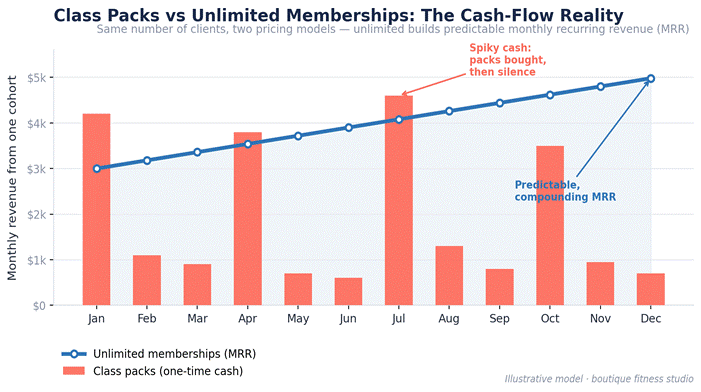
The second part is Instant Checkout, which is powered by OpenAI’s Agentic Commerce Protocol. Instacart says it is the first app in ChatGPT’s app ecosystem to offer checkout directly inside ChatGPT, with a familiar credit-card flow available at launch and support for digital wallets such as Apple Pay and Google Pay planned for the weeks following the announcement. Stripe powers the transaction layer, enabling payments to occur “within the conversation.”

This is where the launch becomes more than a convenience feature; it shows a shift in how digital shopping journeys may be structured. Historically, eCommerce has been built around browsing and filtering. Users narrow a large catalog down to a handful of options using menus, sorting rules, and keyword search. Conversational commerce flips that flow. Users start with the outcome (“I want to make something warm and high-protein in under 30 minutes”) rather than the product taxonomy, and the system translates that intent into purchasable items. The Instacart implementation keeps the user in control by requiring sign-in and presenting a cart for review, rather than auto-purchasing.

Both companies expressed this move as a step toward turning everyday conversation into completed tasks, and their quotes help clarify the intended scope. Instacart CTO Anirban Kundu framed the launch as a real-time support layer for everyday grocery shopping, noting that the Agentic Commerce Protocol enables intelligent assistance for the practical task of feeding a household.

OpenAI’s Nick Turley, VP and Head of ChatGPT, focused on removing friction, highlighting that users can move from meal planning to checkout within a single conversation. Taken together, and without the marketing language, the message is clear: conversational tools deliver greater value when they can complete a transaction, not just provide guidance.

The Infrastructure Behind Conversational Grocery Shopping and Instant Grocery Checkout

Conversational Grocery Shopping

Instacart said the ChatGPT app experience with Instant Checkout was available on desktop and mobile web at the time of the announcement, while the Instacart ChatGPT app was available on iOS and Android, with Instant Checkout scheduled to reach those native platforms “in the coming weeks.” The release also notes a platform requirement on iOS: users should update to the latest version of ChatGPT to enable Instant Checkout on Apple devices. These constraints signal that the experience is being introduced incrementally, which is typical for payment-adjacent product launches where reliability, compliance, and user trust must be tested progressively.

One reason this integration is likely to attract attention is the scale of Instacart’s existing footprint. In describing why it sees itself as a strong “grocery engine” for AI interfaces, the company highlighted that it works with more than 1,800 retailers and nearly 100,000 stores, reaching over 98% of households in North America. It also noted that its catalog covers more than 2 billion product instances across its network, supported by real-time availability and pricing data. For consumers, those numbers translate into a practical benefit: the conversation can be mapped to what is actually purchasable nearby rather than what seems reasonable in theory.

Instacart also described personalization as a differentiator, emphasizing that the system can account for specifics such as “no pulp orange juice” or “gluten-free pasta,” using more than a decade of data from prior orders and shopping habits to tailor recommendations. The goal is to make conversational shopping feel less like a generic chatbot interaction and more like a continuation of the user’s existing preferences in the Instacart ecosystem. Whether this level of personalization feels helpful or intrusive will vary by user, but it is an important reminder that successful AI shopping is often less about “intelligence” and more about access to consistent, high-quality behavioral and inventory data.

How Consumer AI Use Is Shaping Checkout Design

From a consumer behavior perspective, the timing is the key player here. Shoppers are increasingly using generative AI as a decision aid. The integration arrives as consumers grow more comfortable with generative AI to guide purchases, as half of the surveyed consumers used generative AI at least once for Black Friday shopping, and these common uses included finding discount codes, tracking prices, comparing options, generating gift ideas, and understanding product features.

Those behaviors reflect a key pattern: people ask AI to reduce cognitive effort (research and comparison), and the next step is reducing operational effort (actually purchasing). Instacart’s launch focuses on the second half of that equation.

It’s also worth noting that OpenAI’s own framing of Instant Checkout and the Agentic Commerce Protocol centers on trust and user control. OpenAI has described the protocol as a foundation for “agentic commerce” and explains that users explicitly confirm each step before any action is taken, with secure payment handling and minimal data sharing for order completion.

Instacart’s release echoes this “seamless and secure” positioning, which is especially relevant in grocery because purchase frequency is high, baskets can be large, and the consequences of a wrong order can be immediate (missed ingredients, dietary mismatch, or wasted spend).

Beyond the immediate user experience, the integration also signals a competitive dynamic in platform access. Instacart explicitly stated its belief that consumers should be able to shop in the way that works best for them, directly in Instacart, through retailer properties, via embedded partner experiences, or with an AI agent.

Instamart serves as a bridge between AI-driven inspiration and real-world fulfillment, partnering with major AI companies such as OpenAI, Google, and Microsoft. Positioning itself as a “last-mile commerce layer” that can plug into whichever consumer interface becomes dominant.

OpenAI’s partnership write-up adds context on how long this relationship has been developing. It notes that Instacart was an early contributor to OpenAI’s Operator research preview and that Instacart uses OpenAI APIs alongside its own systems to help customers save time, find inspiration, and make food-related decisions through recommendations. OpenAI also says Instacart uses ChatGPT Enterprise internally and uses Codex for an internal coding agent. These details help explain why Instacart could move quickly into a high-trust surface like in-chat payments: the collaboration is not brand-new, and the organizations have already established working norms around data, reliability expectations, and product iteration.

For retailers and brands, the professional question is less “Is this cool?” and more “What does this change structurally?” If conversational interfaces absorb more of the shopping journey, product discovery could shift away from traditional search result pages toward AI-curated recommendations strongly shaped by user intent and past behavior.

That creates opportunities for better relevance, but it also raises questions about visibility, fairness in ranking, and how promotions or sponsored listings might eventually work in agentic commerce environments. While Instacart’s announcement focuses on consumer convenience and checkout enablement, the longer-term impact may be measured by how shopping behavior changes when the interface prioritizes conversation over catalogs.

For consumers, the value proposition is straightforward when described without hype: fewer steps between deciding and ordering, plus a cart that reflects local availability rather than idealized recipes. For Instacart, the integration is a way to meet users where meal decisions increasingly begin, especially for time-constrained households trying to turn vague preferences into fast, workable plans.

And for OpenAI, it demonstrates a concrete example of how a general-purpose assistant can connect to real services and complete a high-frequency task, while keeping the user in control of the transaction.

About Instacart

About Instacart

Image source

Instacart (Maplebear Inc., d/b/a Instacart) is a U.S.-based grocery technology company headquartered in San Francisco that operates an online marketplace enabling customers to shop from participating retailers for same-day delivery or pickup via its website and mobile app, with orders fulfilled by personal shoppers.

Founded in 2012 by Apoorva Mehta, Max Mullen, and Brandon Leonardo, the company partners with 1,800+ retail banners across 100,000+ locations in the U.S. and Canada and also runs a fast-growing retail media business through Instacart Ads, helping brands reach high-intent shoppers on the platform. Instacart went public in September 2023 and trades on the Nasdaq under the ticker CART. As of 2025, Instacart is led by CEO Chris Rogers, with Fidji Simo serving as Chair of the Board.

About OpenAI

About OpenAI

Image source

OpenAI is a San Francisco–based AI research and deployment company whose stated mission is to ensure that artificial general intelligence (AGI) benefits all of humanity. Founded in 2015 as a nonprofit, OpenAI created a for-profit subsidiary in 2019 to help scale its research and real-world deployment while remaining under the nonprofit’s governance and control.

In October 2025, it updated its structure with the nonprofit now named the OpenAI Foundation and the operating business organized as OpenAI Group PBC (a public benefit corporation). OpenAI builds widely used AI systems, including ChatGPT and Sora, and is led by CEO Sam Altman.

Conclusion

As more companies experiment with embedded commerce experiences inside AI platforms, the differentiator will likely be execution quality: accuracy of item selection, transparency of substitutions and pricing, payment reliability, and the ability to recover gracefully when something changes (out-of-stocks, delivery windows, or retailer differences).

Instacart’s launch in ChatGPT is an early indicator of where the industry is going, but it also sets a high bar: conversational shopping only feels useful when it consistently results in correct, timely fulfillment. The next phase of “AI shopping” will be judged less by novelty and more by whether it reliably handles the unglamorous realities of retail at scale.

Frequently Asked Questions

  1. How do I use Instacart’s ChatGPT integration?

    Enable the Instacart plugin in ChatGPT, then ask for help planning a meal or shopping list. The AI builds a cart from local stores, lets you make changes, and sends you to Instacart checkout without leaving the chat.

  2. What’s different from using the Instacart app or website?

    Instead of searching item by item, you can start with a goal, such as a recipe or meal idea. ChatGPT helps plan, select ingredients, and add them to your cart in a single conversation.

  3. Is it safe to check out through ChatGPT?

    Yes. Payments are handled by Instacart using Stripe’s secure checkout. ChatGPT does not see your card details; it only passes approved order information using secure tokens.

  4. What can the Instacart ChatGPT app do, and what can it not do?

    It can suggest recipes, recommend products, build carts, and place grocery orders. It does not handle non-Instacart services or complex tasks outside of grocery and retail items.

  5. What does this mean for the future of shopping?

    It shows a shift toward conversational, AI-driven shopping where planning and buying happen together. More retailers are likely to integrate with AI assistants as this model grows.

Qlarifi

BNPL Evolution: Socure’s Qlarifi Acquisition Aims to Make Buy Now Pay Later Safer

The buy now, pay later (BNPL) boom is entering a new phase of maturity – and with that, growth comes a pressing need for better credit risk and fraud prevention infrastructure. BNPL has quickly grown into one of the fastest-scaling consumer credit products globally, now accounting for nearly 6% of U.S. e-commerce spending and expected to surpass $700 billion in global transaction value by 2028. Yet this rapid rise has exposed gaps in the financial system.

Many BNPL loans go unreported to traditional credit bureaus, leaving lenders blind to a consumer’s overall BNPL debt burden. BNPL obligations often become “phantom debt” hidden from view, leading consumers to overextend themselves beyond what other lenders or credit reports reveal. Socure’s recent acquisition of Qlarifi aims to create the industry’s first unified platform for BNPL credit scoring, identity verification, and fraud prevention.

The Rapid Rise of BNPL and Its Growing Pains

Rise of BNPL

BNPL services – which let shoppers split purchases into interest-free installments – have exploded in popularity in recent years. Consumers have flocked to BNPL for its convenience and zero-interest appeal, driving more than 20% annual growth in BNPL usage in markets like the U.S. By some estimates, BNPL already makes up nearly one in every sixteen online retail transactions in the U.S., and global BNPL spending is on pace to top $700 billion by 2028.

However, BNPL’s breakneck growth has come with significant growing pains. Unlike traditional credit products, BNPL plans are typically not fully captured in consumers’ credit reports or FICO scores. In fact, many BNPL providers have no obligation to report these short-term installment loans to credit bureaus, and until recently, most chose not to. This lack of reporting means a shopper could rack up multiple BNPL debts with different services, yet each lender sees only its own slice of the picture.

Other creditors – and even the consumers themselves – may not realize the true extent of their obligations until bills come due. Because most BNPL loans aren’t reported to bureaus, they can become “phantom debt” that flies under the radar. The result is a heightened risk of overextension: some buyers end up borrowing more than they can realistically repay by taking on many small installment plans across various apps.

Another consequence of BNPL’s light oversight is first-party fraud. With minimal credit checks and quick online approvals, BNPL has been vulnerable to abuse by malicious actors or indebted consumers. First-party fraud refers to instances in which the buyer commits fraud – for example, obtaining goods via BNPL with no intention of paying, or using multiple identities to circumvent limits. BNPL providers have reported that loan stacking (opening numerous BNPL loans concurrently across different platforms) and deliberate defaults have led to mounting losses in some cases.

Merchants, too, can face higher fraud-related chargebacks under BNPL if these risks aren’t managed. All of this has raised alarms because BNPL’s traditional selling point was that default rates were low, but cracks begin to show when the economy or consumer finances tighten.

Crucially, legacy credit infrastructure has not kept up with the BNPL phenomenon. Conventional credit scoring and reporting systems were never designed for the high-frequency, small-dollar, instantaneous lending decisions that BNPL entails. Credit bureaus have struggled to ingest and interpret the flurry of micro-loans and BNPL transactions, which often use different data formats and shorter durations than typical loans.

As a result, the underlying infrastructure to support responsible BNPL lending has lagged behind its popularity. Lenders lack real-time visibility into a borrower’s aggregate BNPL exposure across providers, and positive BNPL repayment history doesn’t easily translate into credit-building for consumers. Recognizing these shortcomings, regulators and consumer advocates have put pressure on the industry to improve oversight. Regulators in multiple countries have signaled that BNPL firms must implement stronger credit checks, clearer disclosures, and data-sharing practices to prevent consumer harm.

In the U.S., for example, regulators have clarified that many BNPL loans fall under existing credit card rules, meaning providers must offer dispute rights and other protections akin to those in traditional credit. In the U.K. and elsewhere, authorities are exploring new rules to ensure lenders assess affordability and report BNPL loans in some fashion.

Socure’s Vision: Marrying Identity Verification with Credit Risk Data

Identity Verification

Socure is a leading digital identity verification and fraud prevention company that has made its name helping financial institutions confirm who their customers are in real time. Founded in 2012 and based in New York, Socure provides an AI-driven platform that leverages machine learning and massive data (online and offline) to verify identities with high accuracy. It helps banks, fintechs, and online merchants automatically approve legitimate customers quickly while flagging identity thieves or suspicious applicants.

The company’s Socure ID+ product and its Identity Graph engine analyze thousands of data points to assess whether an identity is real and whether the person behind a transaction is who they claim to be. Socure has over 2,000 clients, including top banks, card issuers, and fintech firms, making it a major player in the fraud prevention and KYC (Know Your Customer) space.

In recent years, Socure has expanded its mission beyond verifying identities at account opening. It’s pushing into broader “risk decisioning” – essentially using data and AI to make automated judgments about fraud risk and creditworthiness. Socure’s platform, which includes a risk-decision engine called RiskOS, is part of this evolution.

Socure acquired the AI risk decisioning startup Effectiv in 2024, signaling its intent to expand into credit risk and compliance decision-making. The ultimate goal for Socure is to become a full-stack decisioning platform that spans identity verification, fraud prevention, anti-money-laundering checks, and credit underwriting.

Against this backdrop, the BNPL sector presented a natural next frontier for Socure. BNPL providers were facing identity-related fraud (such as synthetic identities or repeat offenders using multiple accounts), and they were facing credit risk issues (like loan stacking and overextended borrowers) – a combination of problems that straddles Socure’s expertise in fraud detection and the broader domain of credit risk analytics.

Socure’s founder and CEO, Johnny Ayers, has said that BNPL has outgrown legacy systems that were never built to support innovative lending products. He emphasizes that lenders need real-time visibility to lower fraud and credit risk, while regulators are calling for greater transparency. Socure saw an opportunity to bring BNPL into the modern risk management fold by uniting identity and credit data into a single solution.

Qlarifi – A BNPL-Focused Credit Database Built by Industry Insiders

BNPL-Focused Credit Database

To address BNPL’s unique challenges, a specialized approach was needed – and that’s where Qlarifi comes in. Qlarifi is a fintech startup (founded in 2023 and based in the UK) that built one of the first real-time BNPL consumer credit databases. Notably, Qlarifi was founded by veterans from BNPL giants Klarna and Zip, people deeply familiar with the inner workings and pain points of the buy-now-pay-later model. Having witnessed how borrowers could juggle multiple BNPL plans across different providers, the Qlarifi team set out to create a consolidated view of BNPL usage that any lender could tap into.

Qlarifi serves as a central repository of BNPL repayment behavior. It aggregates data on consumers’ BNPL transactions and outstanding installment plans across participating BNPL services. By tracking a shopper’s BNPL activity in real time (across many providers), Qlarifi can provide an underwriting risk score or report that reflects that person’s total BNPL exposure and payment history. Say a customer has four active BNPL loans across various apps, a lender checking Qlarifi’s database would see the combined debt and whether the customer has been paying on schedule. This information would traditionally not be visible to any single BNPL provider or to credit bureaus in a timely manner.

According to the company, Qlarifi was designed to give BNPL lenders the insight needed to safely expand services for trusted customers while pinpointing high-risk behavior such as loan stacking and fraud. It helps answer questions like: Is this applicant trying to take out more BNPL loans than they can handle? Has this person defaulted on other BNPL plans recently? Is someone opening multiple BNPL accounts under slightly different identities?

By flagging these scenarios, Qlarifi’s data enables lenders to make more informed underwriting decisions and avoid extending credit to overextended or risky borrowers. It also helps protect consumers from themselves – preventing well-meaning shoppers from accidentally overextending by hopping between BNPL services to get more credit.

Qlarifi’s approach essentially fills the void of a “BNPL credit bureau.” In fact, industry observers have called it the first serious attempt at a purpose-built credit bureau tailored to BNPL’s small-ticket, instant loans. By mid-2025, Qlarifi had launched its platform (after raising a £1.4 million pre-seed round) and was already piloting it with several BNPL providers in Europe. Those pilot programs demonstrated the efficacy of sharing BNPL repayment data among lenders: participating providers could spot when a user had multiple buy-now-pay-later plans and could adjust their lending decisions accordingly.

Early results indicated that such data sharing can indeed reduce default rates and fraud incidents. As Qlarifi co-founder and CEO Alex Naughton explained, the company was created to address a clear pain point: the absence of infrastructure that prevents consumers from overextending themselves across multiple BNPL providers.

The First Unified BNPL Credit & Fraud Platform: Why the Socure–Qlarifi Deal Matters

Socure–Qlarifi Deal

In December 2025, Socure announced it had acquired Qlarifi for an undisclosed sum, with the goal of creating a unified system that combines identity verification, fraud detection, and BNPL credit scoring. It’s a combination that could redefine risk management for BNPL providers.

At a high level, it will tie Qlarifi’s real-time BNPL repayment data directly into Socure’s Identity Graph and RiskOS decisioning engine. This means when a consumer applies for a pay-later plan at checkout, the lender can (with one integrated service call) simultaneously:

  • Verify the customer’s identity – Confirming they are a real person and not a fraudster or banned user, by using Socure’s AI-based identity verification and device/behavioral analytics.
  • Check the customer’s BNPL credit exposure – Query Qlarifi’s database to view the person’s current outstanding BNPL loans, recent BNPL repayment history, and any risk flags (e.g., multiple active loans or past delinquencies).
  • Assess fraud and credit risk in real time – Using Socure’s RiskOS, the combined data is analyzed to produce an instant decision or score. Good customers with manageable BNPL debt and a verified identity can be approved in seconds. Risky profiles – say, someone who already has several unpaid BNPL plans or whose identity mismatches known records – can be flagged or declined just as fast.

This unified approach addresses the blind spots that existed when identity and credit data were siloed. Previously, a BNPL lender might verify an applicant’s identity but still have no clue how many other BNPL debts they had. Or conversely, a lender might use rudimentary credit checks but not catch if the identity itself was manipulated.

Now, by linking identity and BNPL-specific credit signals, the lender gets a holistic risk view of the applicant across the BNPL ecosystem.

According to Socure, this combined platform can have a dramatic impact on fraud and losses. By spotting issues such as loan stacking, overextension, and first-party fraud across providers in real time, the system is expected to significantly reduce bad debt. In fact, Socure claims that integrating Qlarifi’s data will allow BNPL lenders and merchants to reduce first-party fraud losses by up to 70%. It suggests that a large portion of current BNPL fraud losses stems from borrowers exploiting the lack of cross-platform visibility.

If true, a 70% reduction would not only save providers money, but also deter would-be fraudsters once they realize this networked visibility exists. Importantly, it’s not just about fraud: the unified system should also reduce credit losses (defaults) by preventing over-lending to consumers who already have multiple outstanding plans. For consumers, this could translate to fewer instances of getting approved for more installments than they can juggle, thereby avoiding financial distress.

Another benefit is speed and cost. BNPL is all about instant decisions at the point of sale – any risk management solution for this space must operate in milliseconds. Socure’s API-driven platform is built for real-time checks, and Qlarifi’s data is updated in real time as well. The vision is that, even with an extra layer of cross-provider credit checks, BNPL apps won’t sacrifice their quick, seamless user experience. Lenders can say “yes” to good customers faster and with more confidence because fewer manual reviews and less uncertainty are involved.

Meanwhile, truly risky applicants can be screened out before a loan is ever approved, rather than the lender discovering issues after the fact. Socure also noted that by automating these checks and using a consortium model (many lenders contributing data), the platform can reduce the operational costs of credit scoring and fraud detection for BNPL providers. Smaller or newer BNPL players, who might not have sophisticated in-house risk analytics, can essentially plug into Socure-Qlarifi’s “risk brain” to get instant fraud screening and credit insights for applicants.

From an industry perspective, the Socure-Qlarifi deal signals a shift towards collective risk management. It’s creating something akin to a BNPL credit bureau + fraud consortium in one. Each lender that joins the platform contributes data (with appropriate privacy safeguards) and, in return, gains a fuller picture of consumer risk across the network. This kind of shared intelligence is common in areas like credit cards (credit bureaus) and bank fraud (shared blacklists, fraud consortiums), but it’s new to BNPL.

Trusted BNPL users who always pay on time might benefit, as their positive history will be visible, potentially earning them access to larger purchase approvals or better terms over time. Meanwhile, the serial BNPL abusers will find it harder to game the system since all providers they apply to will see the same red flags.

Toward a More Responsible BNPL Future

Responsible BNPL is gaining attention as scrutiny of the sector increases. The idea is simple: a product built on easy, fast credit now needs controls similar to traditional lending to remain viable. The Socure–Qlarifi initiative supports this shift by adding shared visibility across BNPL providers, helping prevent consumers from taking on excessive debt while meeting regulator and consumer advocate expectations.

For consumers, this means stronger protection and clearer limits. Lenders can see existing BNPL obligations and missed payments before approving new plans, reducing the risk of debt piling up across multiple providers. It also creates a path for people with little or no credit history to build a positive record through responsible BNPL use.

Regulators also benefit from improved transparency. A unified view of BNPL exposure allows clearer reporting on borrower behavior, defaults, and overall risk, addressing long-standing concerns about hidden aggregate debt. This proactive approach may help BNPL avoid the reputational issues faced by other high-risk credit products.

BNPL providers gain commercially as well. Better risk controls reduce fraud and losses, which is critical in a low-margin model. Shared infrastructure also simplifies compliance and lowers the cost of meeting tighter credit standards, making responsible BNPL easier to offer at scale. Together, these changes point to a more mature phase for the industry, where BNPL operates as a regulated, integrated part of consumer credit rather than a standalone alternative.

Conclusion

The acquisition of Qlarifi by Socure signals a shift in the BNPL industryis evolution. After a long period of rapid expansion, BNPL providers are now facing the obligations that come with operating at scale as lenders. By pairing Qlarifi’s BNPL-focused credit data with Socure’s identity verification and fraud prevention technology, the combined platform points toward a higher bar for risk management and accountability. Lenders gain clearer insight into a borrower’s overall obligations and repayment behavior, supporting more disciplined credit decisions. At the same time, consumers benefit from added safeguards against taking on debt they cannot afford and from clearer pathways to building credit through responsible BNPL use.

The deal also helps close a trust gap that has drawn attention from regulators. It demonstrates that fintech innovation can extend beyond user experience to include the underlying systems that support transparency and risk controls. This moment may come to be seen as when BNPL matured, moving away from fragmented data and unchecked growth toward shared infrastructure and stronger oversight. If Socure’s Qlarifi-based solution delivers measurable reductions in fraud and defaults, it could serve as a benchmark for the rest of the market. Other providers may follow with similar partnerships, and regulators may gain greater confidence in BNPL’s role within the broader financial system.

Frequently Asked Questions

Who are Socure and Qlarifi?

Socure provides digital identity verification and fraud prevention for banks and fintechs. Qlarifi is a BNPL-focused startup that analyzes a shopper’s buy-now-pay-later activity to assess credit risk and repayment behavior.

Why did Socure acquire Qlarifi?

The acquisition fills a gap in BNPL risk management by combining identity verification with BNPL-specific credit insights. Together, they help BNPL providers assess both who the customer is and whether they can responsibly take on another installment plan.

How does the combined platform reduce BNPL fraud and defaults?

It checks identity, reviews BNPL repayment history, and flags overextension in real time. Providers can then approve, limit, or decline transactions based on a fuller risk picture, reducing first-party fraud and missed payments.

What does this mean for consumers using BNPL?

Approvals may include slightly stronger checks, especially for users with many active BNPL plans. Responsible customers should see little change, while overextended users may face limits that help prevent debt buildup.

Is this part of a broader shift in the BNPL industry?

Yes. BNPL is moving toward more responsible lending with better underwriting, increased reporting, and regulatory readiness. The deal reflects a push for sustainability as the sector matures.

Fifth Third Commercial Card

Big Bank + Fintech: Fifth Third Taps Brex to Power New AI-Driven Commercial Card

Fifth Third Bank has partnered with Brex to launch a new commercial card that gives the bank’s commercial banking clients direct access to Brex’s intelligent finance platform. Through the Fifth Third Commercial Card powered by Brex, clients can issue corporate cards, automate expense management, enable real-time payments, and leverage AI-powered agents to reduce manual review while strengthening spend control, the companies announced in a December 9th 2025, press release.

Built on Brex Embedded payments infrastructure, the card will become Fifth Third’s default commercial card solution for its commercial banking clients.

Key Takeaways
  • By making the Brex-powered card the default solution for commercial clients, Fifth Third is shifting a foundational banking function onto an external platform rather than running it as a standalone in-house product.
  • The value proposition centers on reducing manual finance work, expense review, reconciliation, and controls. By embedding automation directly into spend workflows, rather than layering reporting tools on top of traditional cards.
  • Access to a meaningful share of U.S. commercial banking clients through Fifth Third gives Brex a faster path to adoption than selling company by company, while keeping the bank as the primary client relationship.
  • Instead of rebuilding legacy card and payables systems internally, Fifth Third is relying on embedded fintech infrastructure. It shows a model that other regional and national banks may follow to stay competitive.

Fifth Third Commercial Card with Brex Signals a Shift in How Banks Deliver Corporate Card Programs

Fifth Third Commercial Card

Corporate card programs are becoming less about the plastic and more about the operating system behind spend. Fifth Third Bank’s new partnership with Brex is a clear example of that shift. On December 9, 2025, the two companies announced the Fifth Third Commercial Card powered by Brex, giving Fifth Third’s commercial banking clients access to Brex’s finance platform for card issuance, expense workflows, and payments.

For many mid-market and enterprise finance teams, the pain points are familiar – employees spend across dozens of categories and geographies, receipts arrive late (or not at all), approvals happen over email, and month-end reconciliation becomes a recurring scramble. Traditional card programs often deliver basic reporting, but they can fall short on automated policy enforcement, real-time controls, and clean data flowing into accounting systems. Fifth Third’s approach here is to offer a card program coupled with tooling that aims to reduce the manual work that typically sits around business spend.

The practical change for Fifth Third commercial clients is that they can issue corporate cards, automate expense management, and make real-time payments within the Brex platform, alongside AI agents designed to reduce manual review and help enforce spending controls. Rather than treating expense review as a fully after-the-fact process, the intent is to address common issues earlier in the workflow through tighter rules, faster categorization, and automated approval routing.

The partnership is also meaningful from a product architecture standpoint. The new offering is built on Brex Embedded payments infrastructure and is expected to become the default commercial card solution for Fifth Third’s commercial banking clients. That signals a broader industry trend: banks increasingly rely on fintech partners to modernize commercial card and payables capabilities without undertaking multi-year rebuilds of legacy platforms.

Tim Spence, Chairman, CEO, and President of Fifth Third Bank, said the partnership reflects a shift in what businesses need from financial platforms: not just payment processing, but tools that support operational efficiency and growth. He noted that combining Fifth Third’s banking capabilities with Brex’s AI-based technology is intended to simplify complex workflows, improve control and visibility, and help companies scale more effectively, including across global operations.

Pedro Franceschi, CEO of Brex, said Fifth Third shares Brex’s view that businesses increasingly expect financial tools to be proactive and intelligent, not purely transactional. He added that the partnership expands Brex’s reach to a meaningful portion of the U.S. commercial banking market and enables broader delivery of automated, AI-enabled finance capabilities. Together, the companies aim to provide commercial teams with faster processing, more consistent expense management, and tighter integration with the bank relationship clients already rely on.

In day-to-day terms, organizations evaluating a program like this should focus less on the headline “AI” and more on what it changes operationally. The value typically shows up in a few places:

  • Fewer hours spent chasing receipts, coding expenses, and correcting submissions
  • Clearer policy controls at the point of spend (limits, merchant restrictions, approval routing)
  • Faster month-end close due to cleaner, more complete transaction data
  • Better visibility for finance leaders into spend patterns and anomalies as they happen

There are also second-order effects worth paying attention to. When expenses are categorized consistently and matched to documentation earlier, finance teams can spend more time on analysis and forecasting rather than transactional clean-up. And when rules are enforced systematically, compliance becomes less dependent on individual reviewers remembering policy details under time pressure.

It’s also notable that Fifth Third’s corporate card program, which had been operated in-house, will be powered by Brex under this arrangement. This is an important reminder that partnerships like this are not just product launches; they can represent a foundational shift in how a bank runs a core commercial offering.

Bridgit Chayt, Head of Commercial Payments at Fifth Third, said the partnership brings together Fifth Third’s banking capabilities and Brex’s AI-enabled technology to streamline commercial finance operations. She emphasized that the combined platform is designed to automate routine workflows, improve real-time visibility into spending, and reduce manual work that often slows finance teams. The goal is to give businesses faster insight, stronger controls, and tools that can support growth across regions, allowing teams to spend more time on decision-making rather than reconciliation.

Art Levy, Chief Business Officer at Brex, said the partnership expands access to Brex’s AI-native finance tools for a broader set of commercial businesses. He noted that features such as automated spend controls, real-time reporting, and AI-assisted receipt capture and accounting are intended to reduce administrative effort and help finance teams close books more quickly. Together, the companies aim to support tens of thousands of businesses with more efficient, reliable spend and expense management connected to an established banking relationship.

For clients, the right questions now are pragmatic.

How well does the workflow integrate with current accounting and ERP tools?

What approval structures can be mapped directly into the platform without workarounds?

What data controls and audit trails are available, especially if AI-driven automation is part of the review process?

And what will change for employees submitting expenses on day one?

About Fifth Third

About Fifth Third

Fifth Third Bancorp is a U.S.-based financial services company headquartered in Cincinnati, Ohio, providing a broad range of banking solutions to consumers, businesses, and government clients through its branch network and digital channels. The bank’s capabilities span retail and commercial banking, lending, treasury and cash management, payments, commercial card programs, and wealth and asset management, with a focus on supporting middle-market and larger enterprises through financing, liquidity management, and operational banking services.

Fifth Third is a regulated U.S. bank publicly traded under the ticker FITB, combining core banking services with continued investment in technology and partnerships to enhance the customer experience and modernize commercial finance.

About Brex

About Brex

Brex is a U.S.-based financial technology company founded in 2017 that provides corporate cards and software to help businesses manage spending, expenses, and payments. Its platform typically includes tools for issuing cards, automating expense reporting and approvals, managing bills and reimbursements, and connecting spend data to accounting workflows, with additional capabilities such as travel and cash management products offered through partner institutions.

Brex operates as a fintech (not a bank) and is used by a range of companies looking to reduce manual finance work, improve real-time visibility into spend, and strengthen controls across teams and locations.

Conclusion

Taken together, Fifth Third’s partnership with Brex reflects where commercial cards are headed: spend management as an integrated finance function, not a standalone payment method.

For organizations that feel stuck between legacy card programs and piecemeal expense tools, this embedded model offers a path to consolidate controls, simplify operations, and improve financial visibility without asking the finance team to work harder just to keep up.

Frequently Asked Questions

  1. What are Fifth Third and Brex doing together?

    Fifth Third is launching a new commercial credit card program powered by Brex’s technology. The card will be Fifth Third–branded but run on Brex’s card issuance and spend management platform.

  2. What new capabilities will Fifth Third’s business clients get?

    Clients will gain virtual cards, real-time spend controls, and built-in expense management with automated receipt matching and categorization. Finance teams can track spending instantly and streamline close and reporting.

  3. Why did Fifth Third partner with Brex instead of building in-house?

    Partnering lets Fifth Third deliver a modern solution much faster than building from scratch. Brex already has proven technology, while Fifth Third brings scale, trust, and banking relationships.

  4. What does this partnership mean for Brex?

    It gives Brex access to a large base of traditional commercial banking clients and validates its embedded finance strategy. Brex expands distribution while earning revenue behind the scenes.

  5. Is this part of a larger banking trend?

    Yes. More banks are partnering with fintechs to quickly modernize their products. This deal reflects a broader shift toward bank–fintech collaboration and embedded financial technology.

NMI Business Capital

Embedded Lending Takes Off: Inside NMI’s New “Business Capital” for Merchants

In recent years, embedded finance – the integration of financial services into non‐financial software – has exploded. Platforms that serve small businesses now routinely bake in loans, payments, banking, and insurance tools. This trend is putting SMBs at the forefront of the financial landscape by giving merchants instant access to credit as part of their day-to-day operations.

Small merchants prefer one-stop solutions rather than juggling banks, money apps, and spreadsheets. In fact, a study finds that 88% of U.S. small businesses report regular cash flow disruptions. With so many Main Street firms living hand-to-mouth, offering loans directly in the software they already use is a powerful idea.

Many small merchants could benefit from built-in financing offers like the NMI Business Capital, right in the software they use to manage sales and payments.

Why NMI’s Move Matters

NMI

Image source

NMI – a leading provider of embedded payments infrastructure (often white‑labelled by banks, ISOs, and software platforms) – has now stepped into lending with its NMI Business Capital program. Launched in late 2025, Business Capital lets NMI’s partners (banks, ISOs, SaaS providers, payment facilitators, etc.) embed pre‑approved working‑capital loans into their merchant portals.

A merchant logging into their NMI-powered dashboard will see a simple loan offer based on their recent sales. The key promise is speed and simplicity, with no lengthy applications or credit checks to bog down the process.

By integrating funding into the existing payments portal, NMI aims to let merchants close their financing gap without switching systems. As NMI Chief Growth Officer Peter Galvin explains, with 88% of small businesses reporting ongoing cash flow disruptions, access to funding is more important than ever. Embedded funding within the platforms merchants already use removes much of the friction and administrative burden associated with traditional lending. Instead of forcing a merchant to leave the platform and hunt for a bank loan (which could take weeks), Business Capital surfaces an offer automatically as part of their daily routine. The merchant clicks “Accept,” and funds arrive in 1–2 business days.

NMI’s approach means partners do almost no extra work or take on any additional risk. The lending engine – powered by fintech partner Parafin and backed by Celtic Bank – handles underwriting, compliance, and servicing. The partner (whether it’s an ISO, a bank, or a SaaS provider) simply toggles the feature on in their NMI portal.
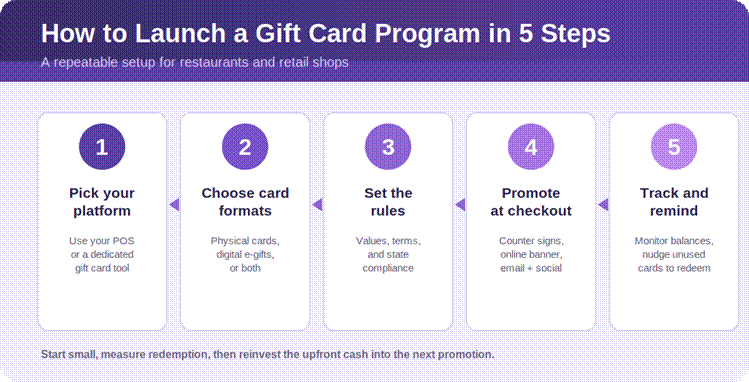
The platform even provides analytics on adoption and loan performance. In return, partners earn a share of each loan’s fixed fee – creating a new revenue stream without added cost or complexity.

How NMI Business Capital Works

How NMI Business Capital Works

Image source

NMI Business Capital is built directly into the NMI Merchant Portal, the interface merchants already use to review transactions, settlements, and reports. When the feature is active, the portal runs a brief eligibility check on a scheduled basis or whenever requested. If a merchant qualifies, a tailored funding offer appears, such as “Borrow up to $10,000 today.” The offer is powered by Parafin’s lending platform, which reviews historical processing data and risk signals without pulling personal credit. The merchant can accept or decline with a single click. After acceptance, funds are usually deposited into the merchant’s bank account within one to two business days.

Repayment is automatic and straightforward. Each day, a fixed percentage of the merchant’s card sales is applied to the outstanding balance, similar to Square’s financing programs. Because payments adjust with sales volume, merchants repay more during strong periods and less during slower ones, which helps manage cash flow.

Pricing is simple and transparent. There is a single upfront fee based on the loan amount, with no compounding interest, late fees, or added charges. The total repayment amount is set at the start, while daily payments vary based on revenue.

For partners, a key advantage is that all loans are issued by Celtic Bank. This keeps the product fully regulated and FDIC-backed without requiring the partner to act as a lender or manage credit decisions. NMI handles the on-platform experience, while Parafin operates behind the scenes. To partners, it functions as another software feature; to merchants, it feels like funding that is part of their existing payment system.

Key Facts of NMI Business Capital

Key Facts of NMI Business Capital
  • Quick, pre-approved offers: NMI’s partners can show instant loan offers based on the merchant’s sales history. No lengthy credit checks or paperwork.
  • Fast funding: Once accepted, funds arrive in 1–2 business days.
  • Flat-fee pricing: A single, up-front fee (charged at closing) replaces traditional interest. NMI stresses that there is no compounding interest, hidden charges, or late fees.
  • Automatic repayment: Daily sales flows handle repayments. A fixed % of each day’s card receipts is swept into the loan until the loan is paid off.
  • No risk or work for partners: Loans are underwritten and serviced entirely by Parafin/Celtic Bank; partners simply toggle on the feature.
  • Embedded into portals: The loan interface appears inside the merchant’s existing dashboard – no separate apps. NMI calls it “funding built right into the platforms merchants already use”.

These features reflect best practices from earlier embedded lending programs. In fact, platforms like Stripe, Square (Block), Shopify, Toast, etc. have long used exactly this model: they offer merchant cash advances or term loans repaid via daily sales.

The infrastructure is proven – payment processors see the sales, and they simply divert a percentage to recoup the advance. NMI is now giving that capability to any ISO or software provider connected to its platform.

Benefits for Merchants and Partners

Benefits for Merchants and Partners

For merchants, the biggest advantage is access and speed. Many small businesses have been reluctant or slow to seek bank financing – often because of paperwork, long approval times, and inflexible terms. Embedding a loan offer in their day‑to‑day system changes the game. A merchant doesn’t have to stop operations to fill out forms; instead, a small business owner can tap a button during end-of-day reconciliation and see an instant decision.

This “one-click capital” approach happens right when cash flow is being reviewed – a moment when merchants are most open to funding. And because the repayment flexes with sales, businesses are not overburdened during slow periods.
Plus, the transparent fee structure avoids many pitfalls of payday-style loans. Merchants know upfront exactly how much they will pay (the fee), and there are no surprises. The absence of compounding interest and late penalties further protects business owners from runaway debt in case of delays. In sum, Business Capital aims to keep financing fast, fair, and frictionless for the end customer.

For platform partners (ISOs, PayFacs, vertical SaaS companies, etc.), Business Capital is a value-add with little downside. It deepens the merchant relationship: a platform that provides both payments and capital becomes harder to leave.

The revenue comes from sharing the fixed fee on each loan. Unlike card processing fees (which largely cover costs), loan fees are nearly pure profit for the partner, boosting margins. One industry analyst even points out that integrated merchant financing can triple pay‑fac gross margins while cutting churn – if done seamlessly.

Crucially, partners incur no lending risk. All underwriting and compliance is outsourced to Parafin/Celtic. NMI’s platform merely channels the loan – it never holds the debt. The partner doesn’t need to expand its balance sheet or navigate banking regulations. This “no-lift” model is an attractive alternative to traditional co-branded loans, where an ISO might need to conduct manual reviews or assume liability. With Business Capital, the platform’s IT team integrates once, and lending is done.

Embedded lending meets merchants where they need it. According to a survey, 88% of U.S. SMBs regularly experience cash flow disruptions. Having financing offers built into the payments interface helps stabilize those swings.

How This Fits the Broader Trend

NMI’s entry into embedded lending is part of a larger industry shift. Major payment companies have been layering credit onto their platforms for years. Square (Block) pioneered this in 2014 with Square Loans, and has since advanced tens of billions in small-business funding. Shopify Capital (launched in 2016) likewise funds merchant advances using its payment and e-commerce data. Stripe Capital (for Stripe’s sellers) and PayPal Working Capital are other examples. These programs all share the same DNA: underwriting based on transaction data and repayment via revenue share.
What’s notable is that embedded lending is still in early innings. The addressable market for embedded lending could be $48 billion in annual revenue, of which only a small fraction has been captured so far. SMBs themselves want it – nearly 70% say they’d prefer their software or payments provider to offer loans. Yet historically, many banks and fintechs have failed to deliver fast, seamless products. NMI’s new program reflects the recognition that the future of SMB finance lives inside the apps they already trust.

By partnering with Parafin, NMI is effectively turning its entire reseller network into a lending channel. Those merchants might now get a loan offer while reviewing yesterday’s sales, just as easily as they could see yesterday’s deposits.

In the short term, NMI’s Business Capital may primarily benefit its existing customers (ISOs and SaaS vendors who already use NMI). But the long-term implication is broader: it signals that payment gateways are no longer just pass-through utilities. They’re becoming full-featured commerce platforms. And by embedding lending, they’re offering SMBs a one-stop shop for both selling and growing.
Conclusion

NMI’s Business Capital underscores how pervasive embedded finance has become in the SMB ecosystem. By letting merchants get quick loans with no extra forms or credit checks, directly in the same portal where they view sales, NMI aims to alleviate the very cash-flow worries that plague small businesses.

At the same time, it lets payment software providers unlock a new revenue source, without taking on lending headaches. This win‑win comes at a time when 88% of merchants could use it most. In short, funding is finally being woven into the commerce fabric, meeting merchants exactly when and where they need it.

Frequently Asked Questions

  1. What is NMI Business Capital?

    NMI Business Capital is an embedded financing feature within the NMI platform that enables payment providers to offer pre-approved working capital to their merchants. Offers are based on processing history and appear directly in the merchant dashboard.

  2. How do merchants receive and repay the funding?

    Merchants accept a pre-approved offer online and typically receive funds within a day. Repayment occurs automatically as a small percentage of daily card sales until a fixed total is repaid.

  3. Who provides the capital and assumes the risk?

    NMI does not lend the money itself. The funding and credit risk are handled by a lending partner, while NMI enables the experience and repayment through its payments platform.

  4. Why is embedded financing helpful for small businesses?

    It provides fast access to cash with minimal paperwork and flexible repayment tied to sales volume. This makes it easier for merchants to manage cash flow without traditional loan hurdles.

  5. How does this compare to Square Capital or Stripe Capital?

    The structure is similar, but NMI makes this model available to many payment providers and ISVs. It allows them to offer Square- or Stripe-style funding without building their own lending programs.