
A mop, a few bottles of solution, and a reliable car. That is how most cleaning businesses actually begin. No fancy office. No huge loan. Just a willingness to work hard and a plan that makes sense.
The growth of the cleaning services market offers an opportunity to new entrepreneurs. Predictions indicate the global market will exceed $482 billion by 2026, with growth of 7.5% each year. The U.S. market is estimated to exceed $100 billion, with over 1 million small businesses serving it. The fragmented nature of the market is an advantage to new businesses. There are no large, monopolistic companies in the market. There is potential for growth in a new, well-managed cleaning business.
This guide provides the essential steps to start a cleaning business. It outlines selecting a market niche, securing the appropriate licenses, bonding and insurance, estimating the cost for starting a business, purchasing equipment, the pricing of services, and marketing to your initial customer base.

Cleaning is resistant to recession. When cleaning businesses started during a recession, it revealed that the cleaning industry is resistant to recession. When households got dual incomes, cleaning businesses had increased demand. Offices returning to in-person work only increased demand for cleaning services. Increased hygiene awareness has customers reaching for services that provide reliable help.
Starting cleaning services falls under the category of low-startup-cost businesses. There are no machinery, staff or workspace costs like most small businesses. There are solo owners who have succeeded from cleaning a few homes a week. Most owners have only employed staff and improved resources with their profits. Low costs are the reason many new cleaning businesses get established.

Think about who you want to clean for before you buy anything. This will help you decide how much you would charge, what you would use to clean, how much insurance you’d want to cover, and how you would promote your business.
If you clean homes and apartments, you will do smaller, more informal jobs and likely will not need to buy many supplies to start. Customers want to build a trusting relationship and appreciate a consistent, personalized service. The best advertising for your business, at this stage, will be a satisfied customer spreading the word. This is why residential cleaning (especially as a one- or two-person team) is a great way to get started.
Commercial cleaning refers to cleaning contracts with offices, retail establishments, medical facilities, and other business properties. Compared to residential cleaning contracts, commercial cleaning contracts are larger and often repeat. Some contracts last a year or longer. Given the size and scope of commercial cleaning contracts, clients expect to see more before signing. Clients generally request proof of insurance, employee background checks, and formal proposals. Many clients have multiple locations. The biggest benefit of commercial cleaning contracts is smoothing out the seasonal fluctuations of residential cleaning contracts. A few large commercial cleaning contracts can offset the loss of many small residential cleaning contracts.
Most cleaning business owners diversify and run both residential and commercial cleaning divisions under one business. However, it is a good business strategy to have cleaning contracts with residential clients before expanding into commercial clients.
Merry Maids developed their brand as a residential cleaning franchise around their regular home-cleaning visits and an easy-to-understand pricing structure. As such, they are a useful example of how a residential cleaning business can scale through franchising and develop a loyal repeat customer base.
ServiceMaster Clean primarily serves commercial accounts, such as offices and healthcare facilities, and also performs restoration work. By examining how these businesses structure their commercial contracts, you can draft your own proposals as you begin targeting corporate clients.
Starting a cleaning business shouldn’t feel overwhelming, and there’s no reason a plan should be lengthy. A plan should focus primarily on the potential services you plan to offer to customers, who the potential customers are, what you will charge, what local competition looks like, and what you need financially on a monthly basis to cover your expenses. Think of a goal for your business for the first year in terms of how much revenue you hope to generate. Use that goal to determine the minimum number of cleaning jobs you would need to book each week to achieve your revenue goal. Simply having a business plan will help you determine the range of what customers may have to pay for your services, enabling you to run a sustainable cleaning business without spending capital.
Most cleaning companies begin as either a sole proprietorship or an LLC (limited liability company). If you plan to start a service business cleaning for clients, it’s safer to invest some extra money in forming an LLC, since the company structure protects you if clients sue your business over any accidents that may occur on the job.
When you are ready to start your cleaning business, the next step is to research how to obtain a business license for cleaning services in your area. Each state, and often each city, has its own rules, so the regulations for a cleaning service in Texas will be different from those in California. Most cities require a general business license and may have a separate license for a home-based or door-to-door service. If you plan to hire workers and want to get a business account, you will also need to get an Employer Identification Number (EIN), which is issued by the IRS.
There is no debating the importance of this step. Not only do bonding and insuring your business cover your employees and clients, but, more often than not, they will win you business over your competitors.
General Liability Insurance covers you for injuries and/or damage to a client’s property that may occur while you conduct business. A surety bond will cover your client if one of your employees steals from them or causes damage to their property that insurance will not cover. Should you decide to staff your business, you will be required to have Workers’ Compensation Insurance. Advertising yourself as “bonded and insured” will make your business appear more trustworthy to potential clients, especially those who have never met you.
Insureon is a one-stop shop for small business owners shopping for general liability, bonding, or workers’ compensation insurance. Insureon lets business owners compare quotes from multiple insurance carriers. Cleaning business owners appreciate insurance tools like Insureon because they can get coverage quickly without having to call agents individually.
NEXT Insurance provides digital insurance policies for small service businesses, such as cleaning businesses. They provide same-day digital proof of insurance, which is useful. When a potential client needs proof of insurance before signing a contract, some insurance providers can take days to provide this. NEXT Insurance solves this problem with fast documentation.
Low overhead is one of the major benefits of this industry. The total cost to start a cleaning business usually ranges from $1,850 to $12,600. This depends on what type of cleaning business you start, whether you choose to purchase a vehicle, and how much equipment you need at the start. Solo residential cleaners usually have the lowest costs, as they clean from their personal vehicles. A branded commercial cleaning van and a small crew will mean the highest start-up costs in the industry.
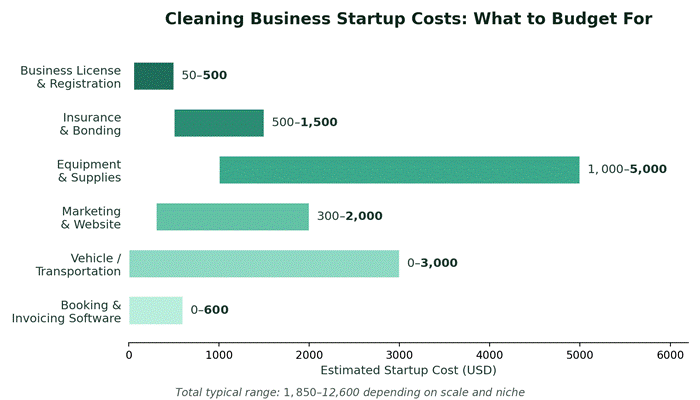
Figure 1: A typical breakdown of cleaning business startup costs by category.
Leave some cash buffer outside of what you set aside for your initial setup. Many new owners underestimate how long it takes to fully book a schedule, so plan for two to three months of expenses before you expect to depend on earnings from the business for your full-time income.
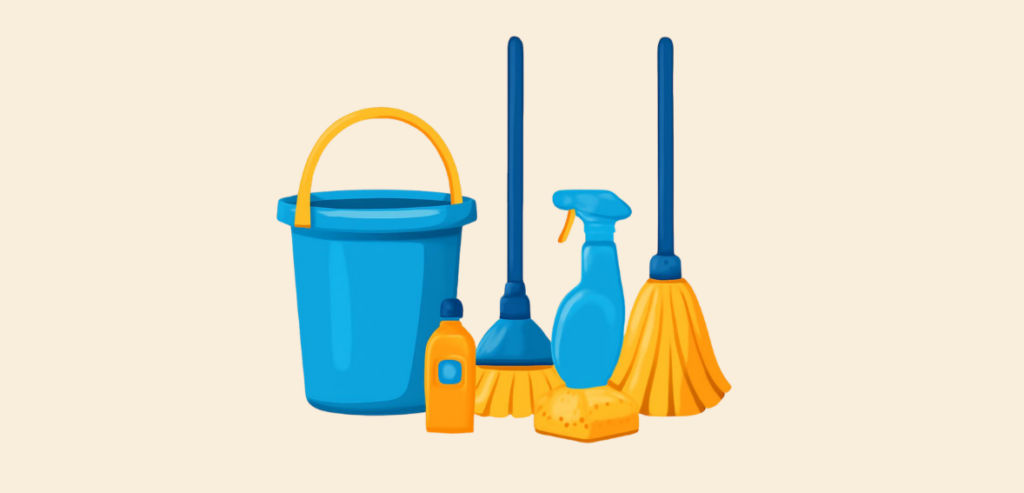
Equipment lists vary by niche. If you provide residential cleaning services, you’ll be packing a vacuum, mop and bucket, microfiber cloths, a glass cleaner, all-purpose cleaner, caddy, trash bags, and rubber gloves. If you provide commercial cleaning services, you’ll be packing a vacuum, mop, and bucket, plus additional industrial equipment and supplies, such as a commercial vacuum, buffers, and health-code-compliant disinfectants and other cleaning supplies.
Serving new clientele as a cleaning business can mean a monetary loss at the start, to get the equipment and supplies you need. For that reason, cleaning business owners usually start with commercial equipment and supplies of the lowest quality and replace them with higher-quality, more durable equipment and supplies as their clientele and cleaning contracts expand. Starting a cleaning business is a capital investment in many one-off cleaning contracts you’ll initially have to serve to get your cleaning contracts. Those cleaning contracts can also mean an upfront cost to cover cleaning supplies and equipment.
ProTeam builds fast, durable, commercial-grade backpack vacuums for cleaning large office and retail spaces. The cleaning companies that grow and secure commercial contracts usually rely on this equipment, which withstands heavy daily use, to standardize their crews.
Bissell is an accessible brand for residential cleaning, especially for purchasing vacuums and carpet cleaners. Many beginners for solo residential cleaning prefer Bissell since it’s reliable and budget-friendly. Later, they will invest in commercial cleaning tools.
Many new business owners have issues with pricing. If you set low prices, you will end up working long hours for little reward. If you set prices too high, you won’t be able to book clients until you develop a reputation.
The first pricing model is hourly pricing. This model works best for new business owners who are unsure about the duration of different jobs. Pricing a job at a flat rate that is based on the size of the job and the number of rooms is a more evolved pricing model that several residential cleaners adopt because it prizes job efficiency and is more straightforward for the clients. The per-square-foot pricing model is the preferred model for most commercial contracts because facility managers are accustomed to comparing bids on that pricing model.
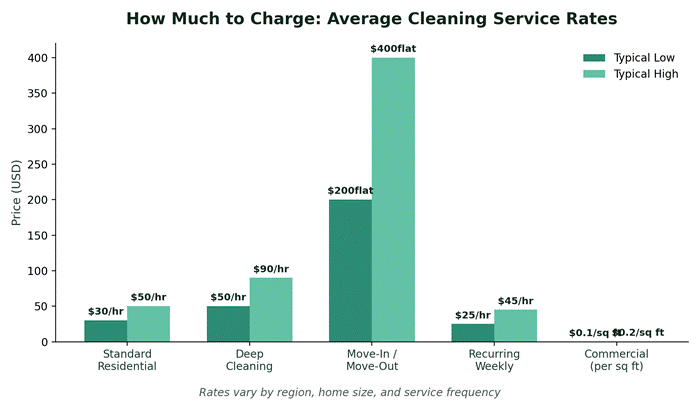
Figure 2: Typical U.S. cleaning service rates by job type in 2026.
To learn how to price cleaning services, you first need to learn to calculate your true cost per hour. Determine your supplies, gas, and insurance costs, and make sure to include your labor cost before you set a price. Calculate your costs this way before pricing a job to ensure the job will result in a profit. Always have a recurring revenue strategy that includes, for example, a small discount for clients who have agreed to a recurring weekly or biweekly cleaning schedule. Although this discount may seem like a lost income opportunity, some cleaning clients, who could remain with you for a year or more, may ultimately bring you more job revenue than several one-time clients combined.

The significance of your first ten clients far surpasses any subsequent clients, as your first ten clients will provide you with testimonials, word of mouth marketing, and positive case studies. Once you open your business, ensure that you notify your entire personal and professional network. Additionally, inform your former coworkers, family, and friends, and offer them a discount on cleaning services in exchange for a review of your cleaning service.
Most customers looking for local businesses use Google Maps to find them. Therefore, it is essential that you verify your Google Business Profile and that you upload all important information, including your business hours, service area, and real photos. Be sure to encourage all of your clients to leave you a review. Your reviews will advertise your business more efficiently than any ad when a customer is searching for a local cleaning business. You may also consider a basic, responsive website that includes an online booking form and your business services. This is important because the majority of home service bookings are now conducted online.
While you cultivate organic reviews, lead-generation platforms will help fill your calendar faster.
Thumbtack connects homeowners seeking services with service providers seeking job opportunities, including cleaning services. New cleaning businesses use Thumbtack to help them get their first few jobs while building their marketing and services in the industry.
Angi (formerly Angie’s List) is a home service marketplace where users can view ratings and request quotes from local cleaning services. Opportunities to list a cleaning business on Angi are helping cleaning businesses receive inbound leads in homeowner markets, where reviewing business comparisons prior to booking is the norm.
The initial period of bookings will have the greatest impact on your business. Punctuality and good communication skills are crucial, and if a client is ever dissatisfied, you should rectify the situation immediately. Each happy client is a potential new client, and there will be an increased likelihood of new clients as that happy client refers acquaintances to you. It is a known fact that a referred client will always be a better client than a cold client.
With an increase in bookings, you will have to recruit more staff, and you should train new employees to your standard to ensure that the work being carried out remains to a certain level. Using bookings on a fixed schedule will help you improve the structure and efficiency of the business. As the business continues to grow, the residential aspect will evolve into a larger, more integrated part of the commercial cleaning business once insurance and bonding are acquired.
There isn’t a lot that needs to be done to register a cleaning business. Decide if you want to perform residential or commercial cleaning. Apply for your business and cleaning licenses. Get insured. Factor in the costs of starting your business. Buy equipment. Set your prices and use actual numbers to avoid guesswork. Advertise. You can stop when people start referring others to you.
No formal education is needed to start a successful cleaning business, and no significant capital is required. You need to consistently show up and always do your best work. This guide will help you be the best cleaning business on the market and will help you make a profit all in the first year.
Starting a cleaning business typically costs between $1,850 and $12,600. This covers licenses, insurance, bonding, basic equipment, and marketing. Because the solo residential cleaning business model relies on personal transportation, start-up costs can be on the lower end of the spectrum.
While not all clients will require you to be bonded and insured, you may want to consider it anyway. No commercial client will sign a contract with a cleaning provider that offers no proof of insurance. Likewise, many residential cleaning clients will look for providers that advertise they are bonded and insured, as these signify professionalism and help protect their property.
To know what to charge, first evaluate your operating costs and profit margin. This includes a time value for you, as well as the cost of equipment, insurance, supplies, etc. It is common for beginners to charge hourly to gauge the time required to complete each job and later switch to fixed pricing. This can be done on a per-job basis or on a square-foot basis when they feel confident enough.
Starting a residential cleaning business has fewer barriers to entry, including lower insurance costs and smaller start-up requirements. While commercial cleaning offers higher per-contract payments and more predictable & consistent income, the higher insurance costs, pre-contract staffing, and administrative work required can be a hindrance. Many business owners start with residential contracts and, once the business is more established, take on commercial contracts.