

One gym owner went online to vent. He had signed with a well-known billing company because every gym he had ever joined seemed to use it. The pitch sounded fair. Then the statements started arriving. After every add-on, recovery charge, and vaguely named “program fee,” the processor was quietly taking close to 10% of his gross revenue. For a business that runs on margins of 10% to 30%, that gap is the difference between making payroll and locking the doors.
His mistake was common. Most gym owners never read every line of a merchant statement, so they overpay month after month without noticing. The good news is that gym payment processing is one of the few costs you can actually shrink without touching your prices. This guide shows you how to reduce gym processing fees with clear, practical steps you can start this week.

The fitness sector has one of the most intricate billing models among service sectors. In one customer relationship, the fitness sector billing model can include a monthly charge, an annual charge, a sign-up charge, a merchandise sale (including supplements), a class or pack charge, a membership freeze, or a freeze-related charge. Card networks have a reputation of examining a recurring charge/billing relationship due to the higher probability of customer disputes and chargebacks. Given the complexity of the fitness sector’s charging model, billing services have a significant opportunity to charge additional fees.
The billing model’s complexity, as well as owner preferences, contribute to the remaining differences in charging models for the same processor. After a while, the “headline” rate and the actual rate split. A processor can advertise a super rate, only to recoup the margin through additional fees such as statement fees, batch fees, recovery fees, and others. The true rate, relative to the quote, is the rate investors should focus on for potential savings.
Each card transaction involves three cost layers, and you can only negotiate one. The largest of these layers is interchange. Since Visa and Mastercard set interchange fees and the layer is paid to the member’s card issuing bank, it is non-negotiable, even with a change in payment processor. Assessment fees are the flat fees charged by Visa and Mastercard for all merchants to operate their network. The layer where you have the most control is the processor markup. The processor markup is the fee your provider charges for processing the transaction. Most instances of overpayment occur in this layer.
| Fee layer | Who sets it | Who keeps it | Typical 2026 range | Negotiable? |
| Interchange | Visa / Mastercard | Card-issuing bank | 1.15% – 3.15% + fixed | No |
| Assessments | Visa / Mastercard | Card network | ~0.13% – 0.15% | No |
| Processor markup | Your processor | Your processor | 0.10% – 1.50% + fees | Yes |
Combine these numbers, and the majority of small and medium-sized businesses find themselves between 2.2% and 3.5% per transaction. For a gym, every 0.1% adds up over the thousands of repeat transactions in a year. That’s exactly why the factors below are so important.
You cannot reduce a cost you have never quantified. Before you negotiate, deregulate, or detour your processes, compute your true cost. Get your latest monthly statement. Add each fee. Don’t ignore the per-transaction fee. Account for the monthly account fee, the batch fee, the statement fee, the PCI fee, declined-payment fees, recovery and program fees, etc. Now take that total and divide it by the total dollar amount you processed in that month. That will give you the true cost you pay expressed as a percentage.
As a generalization, you can feel comfortable if your effective rate is approximately 2.5% or lower. If it is above 3%, you are most likely overpaying, and you should seek an opportunity to negotiate a better deal. The owner of the business in the first story paid close to 10%, which is lethal to a business in the fitness industry. The chart below illustrates a healthy 2.5% rate and shows where the money goes, giving you a visual of what “good” looks like.
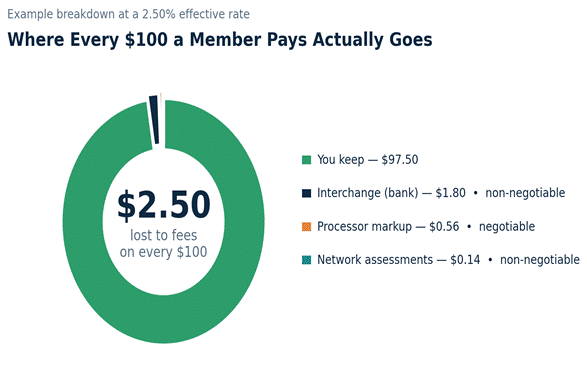
Most of every payment stays with the gym — but fees still add up across thousands of charges.
Once you know your effective rate, the pricing model is typically the most significant structural optimization you can achieve. Processors set prices in three ways, and these methods vary in fairness. With flat-rate pricing, a single blended rate is charged (typically 2.9% + $0.30) per transaction, regardless of card class. It is the most convenient pricing method, but it results in the inequitable practice of overcharging for cheaper cards to cover the cost of the expensive cards.
Tiered pricing classifies transactions into “qualified,” “mid-qualified,” and “non-qualified” tiers. Again, the definitions are intentionally vague so that most of your transactions fall into the more expensive tiers. With interchange-plus pricing, the processor passes through the actual network cost and adds a clearly defined markup, thereby making the distinction between the bank charge and the processor charge explicit.
| Pricing model | How it works | Transparency | Best for |
| Flat-rate | One blended rate on every card | Medium – simple but you overpay on low-cost cards | Very small or new gyms |
| Tiered | Cards sorted into qualified / non-qualified buckets | Low – vague buckets hide downgrades | Almost no one (avoid) |
| Interchange-plus | True cost + one fixed markup | High – every line is visible | Most gyms, especially recurring billing |
For nearly every gym billing recurring memberships, interchange-plus is the model to ask for by name. It is widely available, even to smaller merchants, and it makes the next steps far easier because you can finally read your own statement.
Interchange-plus should be requested by name in nearly every gym billing for recurring memberships. It is widely available even to smaller businesses and makes the next steps much easier because you can finally understand your own statement.
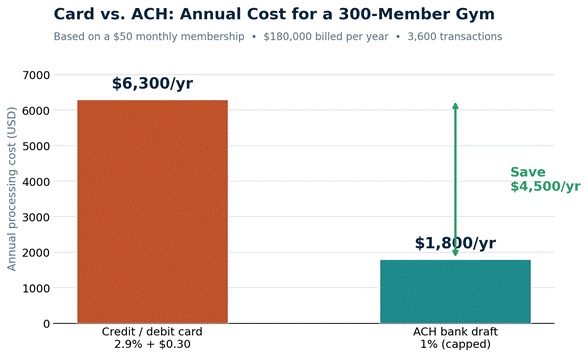
Moving recurring dues from cards to ACH can save a mid-sized gym thousands of dollars a year.
Making ACH the default option in the sign-up process is obviously the best choice; this does not have to be an inconvenience to members, either. This can be done quickly by offering members a small $2-$3 monthly discount for paying by bank draft. ACH will be to your benefit as you will keep more of the payments, while members feel as if they have saved money. ACH bank drafts in the United States are governed by NACHA. Nacha drafts the rules of the network, and you can learn about the bank draft system and the regulation and authorization of bank drafts by visiting Nacha’s site.

It is becoming more commonplace and accepted to pass card costs to members. Since services like restaurants, salons, and ecommerce stores charge service fees and post them on their bills, members won’t be surprised to see a service fee on their gym membership. There are three legitimate ways to recover card costs, and the distinctions are material, not superficial. A surcharge means gym members pay more when a gym charges a fee for credit card transactions. A cash discount means members pay less when the gym charges using a cash or bank draft transaction. Dual pricing shows members both the card cost and the cash cost, giving them a choice.
| Method | How it works | Where it is legal | Key rule to remember |
| Surcharge | A fee is added on top for credit cards | Most states (banned in a few) | Capped at 3% (Visa); never on debit |
| Cash discount | Discount for cash/debit payers | All 50 states | Must show the card price first |
| Dual pricing | Both prices are shown side by side | All 50 states | Customer picks at checkout |
It is important to be knowledgeable about the legal requirements regarding your business. Connecticut, Massachusetts, Maine, and Puerto Rico will have bans on surcharging up to 2026. California has a rule on the display of surcharging fees. In Colorado, surcharging is permitted but is limited to a 2% maximum. All states permit cash discounts and dual pricing. Therefore, most new gyms use cash discounts and dual pricing systems.
Clear signage and a line item on the receipt are required for both options. A 30-day advance notice to your processor is required before a surcharge is implemented, and surcharging debit cards is prohibited. Visa’s small-business guides on its regulations and fees explain the requirements for the card networks. Surcharging is a new and rapidly evolving business practice; always check local requirements to ensure a surcharge can be legally applied.
Reducing fees is only a part of solving the problem. Failed payments are a silent source of revenue loss for a gym. Money you never collect is just as damaging as money you pay a processor. These are some of the most common yet avoidable revenue losses: expired payment cards, low card balances resulting in payment failures, or failed payments due to account changes. Three solutions, when combined, result in the recovery of the majority of this lost revenue. An account updater service handles expired or reissued cards, ensuring a member’s payment doesn’t lapse when their card is replaced.
A well-designed dunning workflow will reissue the payment and then send the member a link to complete the payment themselves. Finally, a scheduled, automated pre-bill reminder a few days before the charge date will avoid surprises and angry phone calls. These solutions, used in combination, increase the number of active memberships, which, even prior to making any changes to your fee schedule, will lower the cost per dollar collected.

Your billing system can either preserve or erode your profit margins. The answers to two questions will clarify which it will be. First, do you have a merchant account to negotiate your custom rates and leave if needed? Second, do you have your member payment data, or will you have to start collecting payments again if you change providers? If a system restricts either of those, you have no more negotiation power to decrease your costs. The systems below have distinct approaches to these issues. We named them to help you identify what to look for.
Cloud Gym Manager
Cloud Gym Manager pairs full gym management with transparent interchange-plus billing. And because it’s free, it never locks you in or hides features behind a paywall. With Cloud Gym Manager, you get all the features that you usually expect from a premium gym management software, plus you keep your own merchant account and member payment data, so you stay free to negotiate rates or switch anytime.
It’s the best “free” solution that includes advanced pre-loaded features like no-code automations, built-in email & SMS marketing, physical & digital gift cards, in-app messaging, waiver & contract e-sign, workout tracking & AI planning, and more.
Gymdesk is different from many gym management software platforms. Gymdesk has billing software built into its management software, which simplifies gym management by letting you work with one integrated system or, alternatively, by allowing the billing software to integrate with the payment processor of your choosing. As for Gymdesk’s in-house billing software, it offers rates of about 2.9% for credit card payments, 3.5% for American Express, $0.30 per transaction, and about 1% for ACH transfers, with no unsubstantiated markups.
When you use a different payment processor than Gymdesk, you own that payment processor. Therefore, when you switch software providers, you are not locked into Gymdesk’s billing software, which is an important consideration when choosing payment processing software.
EBizCharge considers itself payment processing… software for gyms that integrates with your existing gym and accounting software. Designed to complement your management systems, EBizCharge simplifies credit, debit, and ACH payment processing through a single dashboard. The software automates processes for recurring membership billing and revenue reconciliation, and integrates with QuickBooks and other systems. It offers a surcharging program for gyms that would like to charge their members for card processing fees. EBizCharge also offers PCI-compliant tokenization, which keeps your gym’s card data out of your systems and reduces your liability.
Wodify is well established within CrossFit and boutique studios, simplifying fee pass-throughs for owners. By toggling a single switch, owners can add a processing fee (with a customizable label) to relevant transactions. Additionally, owners can set restrictions on the processing fee and apply it only when fees fall outside specific value limits. The authors suggest that “protect margins without raising prices” is the general claim under which owners can rest easy knowing that Wodify will provide them the means to have better coaches, gear, and classes.
Costs cannot be permanently reduced. As costs decrease, fees increase, and the market begins to consolidate. The beginning of 2026 saw the merger of two of the largest data processors. There is minimal motivation for pricing competition under a concentrated market. Although some networks are lowering interchange fees, several processors are implementing new fees and line items to preserve their margins. This is why an audit is justified.
An audit is worth it, so do it every three months. Look for recovery fees, extra fees, and new “program” fees. After one year, use three to five interchange-plus processors to negotiate fees. When a business has consistent processing volume, the markup is especially negotiable. If there is a contract, calculate the early-termination fee against the amount saved. The savings will most likely exceed the cost of the fee in a few months. There are caps on most debit card transactions at larger banks, as explained in the Federal Reserve’s Regulation II overview.
To help you organize the levers in order of difficulty and payoff, the preliminary measurements and structures take the least amount of effort. Following those, ACH and fee pass-through will take more effort to implement.
| Lever | Effort | Typical impact on fees |
| Calculate your effective rate | Low – one statement | Reveals where you stand |
| Move to interchange-plus pricing | Medium – may switch provider | High – cuts hidden markup |
| Default new members to ACH | Low – setup + a small discount | High on recurring dues |
| Pass fees via cash discount/surcharge | Medium – signage + compliance | Can offset most card costs |
| Reduce failed payments | Low – enable automations | Recovers lost revenue |
| Audit and renegotiate quarterly | Low – recurring habit | Protects savings over time |
Payment processing shouldn’t take a hidden 10% of your revenue. You can recover revenue related to your effective rate through transparent interchange-plus pricing. Value your dues at the time of ACH payment. Where legally permissible, transfer the cost of card payments to members. Bill back the cost of card payments to members. Revenue lost to failed payments is recoverable. None of this will require an increase to your membership fees.
Cultivating the habit of auditing your payment processing quarterly will improve your control over merchant and member data processing. Processing fees will never be a burden to your gym again, allowing you to reduce them and invest directly in the community, coaches, and equipment that will contribute most to your gym’s growth.
Look for an effective rate of about 2.5% or lower. If your effective rate is 3% or more, you probably have outdated pricing, hidden fees, or a flat-rate plan that an interchange-plus price plan could improve.
In most places, yes, with a surcharge, cash discount, or dual-pricing program, if disclosed properly. There are a few states with outright bans on surcharging; however, cash discount programs are permissible nationwide. Always verify your local rules first.
In an ACH transfer, money is sent straight from one bank account to another. ACH transfers typically have a small flat fee per transfer. For predictable, recurring charges, the flat fee is much lower than the fixed fee plus percentage fee typically associated with credit card transactions.