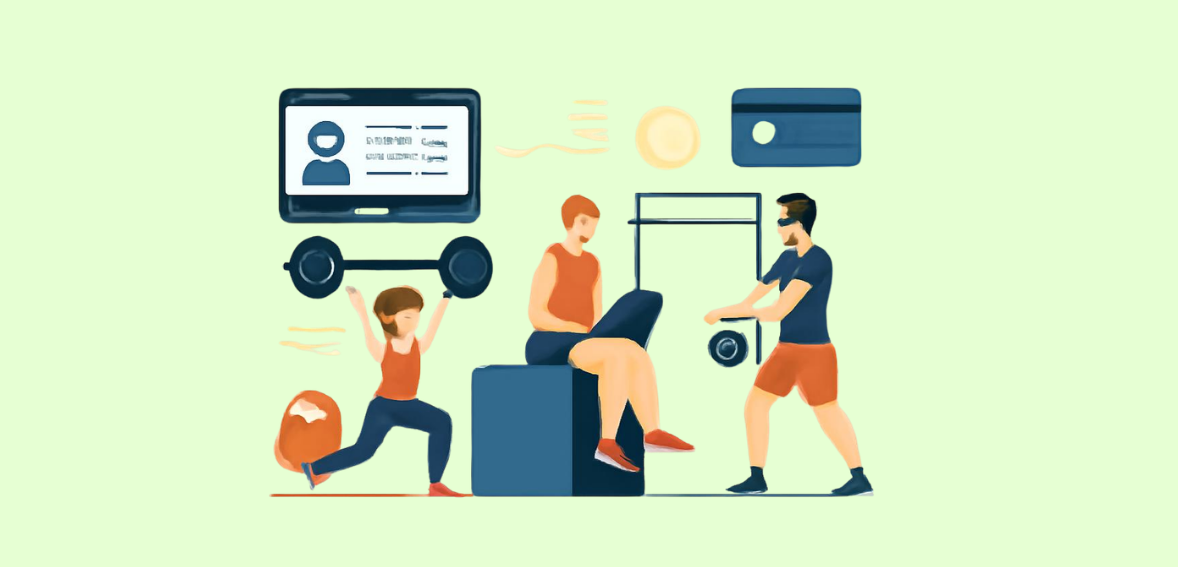
It is the first of the month. You open your billing dashboard expecting a clean run of payments. Instead, you find a column of declined cards. Some members switched banks. A few cards expired. One athlete swears they updated their details, but they did not. Multiply that by a busy roster, and your front desk spends the week making awkward phone calls instead of coaching.
This payment-failure phenomenon is the silent tax that almost every CrossFit box experiences. Recurring revenue is the lifeblood of a business, and while pay-per-class box workouts grab attention, effective CrossFit box management software with a smart payment solution takes the stress out of the start of the month. The right system takes care of class bookings, WOD tracking, payment processing with scheduled payment recovery, and minimizes the hassle of failed payment recovery. This guide is part of our CrossFit box management series and is focused on the core of the system: software, payment processing, and the payment-failure recovery workflow.

Your CrossFit affiliate operates differently from a salon or a big-box gym. Your software should be customized to your box’s logic. Since class sizes are capped, be sure to include real-time reservations and auto-waitlist functionality. Your software also should include easy drop-in payments and digital waiver signing (without creating a membership) for your athletes on the go. Be sure your software allows your athletes to track their scores and PRs, view the leaderboard, and allows coaches to create the WOD and check attendance.
General-purpose tools cover only a fraction of your needs, leaving you to address the rest. CrossFit gym management software, unlike these general-purpose tools, offers membership, scheduling, workouts, retail, and recurring billing functionality, all within one system. When it comes to money, that’s the most important part. If your gym membership billing software integrates booking, attendance, and payment, it can respond to actual member behavior.
Recurring billing is designed to create consistent revenue. Unfortunately, over the course of a normal month, a meaningful share of recurring charges simply won’t go through — for most fitness businesses, somewhere between 7 and 12 percent. Sometimes the customer’s card expires; sometimes it is near the end of their pay period, and the account isn’t sufficiently funded; sometimes their bank replaces the card and flags your charge as fraud. All of these problems can and should be resolved. If they aren’t, the failures prompt members to cancel their subscriptions.
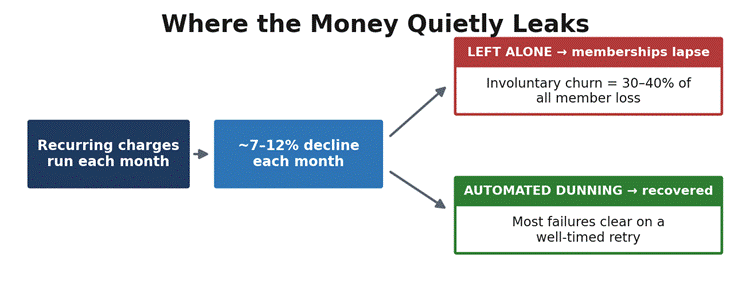
The hidden revenue leak that automated dunning is built to close.
Industry benchmarks from sources such as IHRSA and ClubIntel suggest that the average monthly payment failure rate for fitness enterprises is between 7 and 12 percent. High-cost-per-visit boutique studios likely score closer to 7 percent, whereas the low-cost, high-volume gyms likely score closer to 12 percent. Payment failures also fluctuate with the seasons. January and September are payment-stable months because members are engaged with the service or have recently been. Payment failures are often higher in the summer months as spending habits shift toward vacation. Involuntary churn — members lost due to payment failures rather than a voluntary decision to leave the studio — accounts for an estimated 30 to 40 percent of total membership loss.
That loss scales with your membership. The larger your fitness studio, the more money you lose to uncollected payments each month, and the more cumbersome the manual payment collection process becomes. The table below shows the cost of payment failures for fitness studios of various sizes, using conservative assumptions drawn from industry standards.
| Active members | Est. monthly failures | At-risk revenue/month* | Annual revenue at risk* |
| 100 | 8–12 charges | $1,200–$1,800 | ≈ $18,000 |
| 250 | 20–30 charges | $3,000–$4,500 | ≈ $45,000 |
| 500 | 40–60 charges | $6,000–$9,000 | ≈ $90,000 |
*Illustrative figures based on a $150 average monthly membership and a 10 percent failure rate. Your real numbers depend on pricing and payment mix. The point stands at any size: a few declined cards a week is a serious revenue line, not a rounding error.
Dunning refers to the systematic follow-up process initiated when a payment is unsuccessful. Rather than having an employee discover the declined payment days later, your gym membership billing software executes a pre-planned series of attempts to charge the payment again, sends reminders, and provides self-service options to the member. This process continues until either the payment is successfully charged or a decision is made. Effectively executed, dunning feels like an automated system message, rather than a call from a debt collection agency. This customer-service tone is the most important aspect of the payment recovery process.
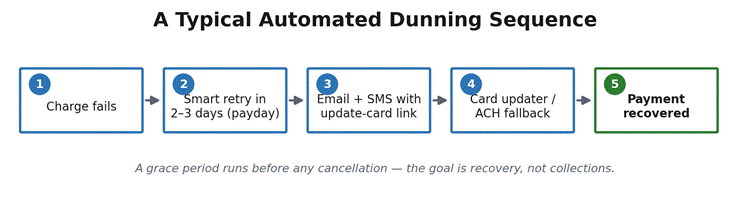
A typical automated dunning sequence inside modern CrossFit billing software.
Here is how that automated sequence typically unfolds. The system retries the card about 2–3 days after the first withdrawal attempt fails. It also takes advantage of timing by scheduling the retries around member paydays, when it is reasonable to assume the account would have the funds. An email and SMS message are sent to the member, each containing an update-card link. That link embedded in the SMS message is the critical element. It matters most that the front desk doesn’t have to be called, as members with the link are shown to update their card info significantly faster.
One technology that enables automated recovery of card payments is the card account updater, and it’s a bit of a concealed star. Payment processors like Stripe and Square work with the card networks to automatically update a member’s stored card details when their bank replaces the card. It operates on the principle that the member need not take any action for the transaction to complete. Stripe also provides documentation on its retry logic for revenue recovery, and most other CrossFit payment solutions provide similar integrations. Naturally, the majority of payment failures resolve without any problem.
Dunning is typically understood as the period from 14 to 45 days after a failed member payment. The aim of dunning is to recover the full payment while preserving the member relationship. It is commonly understood that after 60 to 90 days, collections will set in, and payment recovery will be achieved only at the cost of losing trust. A successful payment recovery system aims to recover well within the dunning window.
Many boxes still chase failed payments by hand. Manual follow-up typically recovers only about half of the lost charges, mostly because front-desk staff are juggling other responsibilities, and the rest is left to the member to call in and sort out. And as a declined charge ages, the odds of recovering it fall. Automated dunning changes that outcome: a well-configured system works the failed payments for you, and — layered with smart retries and a self-service card-update link — recovers the large majority of them, commonly in the 70 to 85 percent range.
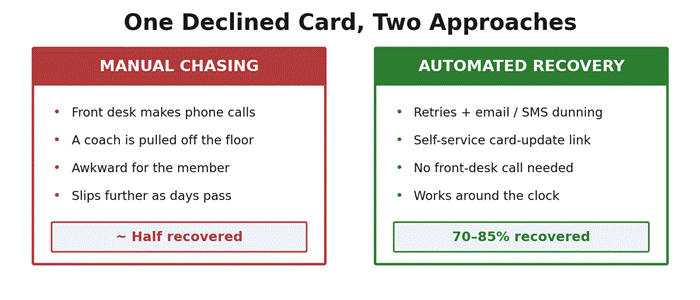
The same declined card was handled in two very different ways.
The manual method’s concealed expense goes beyond lost revenue. It is valued employee time and member satisfaction. Each individual collection call removes a coach from the floor and unnecessarily puts a member in a challenging situation. With automated recovery, the uncomfortable situation is entirely eliminated, allowing your employees to perform their purpose.

There are billing systems that don’t model how your box charges members, so they won’t work for you. Monthly, annual prepays, class packs, drop-ins, and family plans are just a few examples of the memberships you manage. The following table lists the features that matter most and how each one helps you protect your revenue.
| Feature | Why it matters for your box |
| Automated recurring billing | Charges every membership on schedule and sends receipts without any manual work. |
| Smart retry logic | Re-attempted declined cards at optimal times to recover failures automatically. |
| Dunning notifications | Sends branded email and SMS reminders with a one-tap card-update link. |
| Card account updater | Pulls a member’s replacement card number from the bank to stop expiry failures. |
| Self-service updates | Let members fix billing details from their phone; no front-desk conversation needed. |
| ACH / bank transfer option | Gives members a stable alternative when card billing keeps failing. |
| Flexible plans & freezes | Handles prorating, sign-up fees, pauses, and cancellations without spreadsheets. |
| Reporting dashboards | Shows revenue, churn, and recovery rate so you can spot problems early. |
There is no platform that is universally the best. There is, however, a best platform for you based on your requirements — box size, budget, and priorities. Some tools prioritize WOD depth, some prioritize growth and retention, and a few simply try to stay out of your way. The brands listed below are the ones affiliates most commonly choose today. Because pricing and features change frequently, use the notes below as a starting point and confirm the most accurate, current information directly with the vendor.
In this competitive landscape, Cloud Gym Manager takes a different approach. It is an unusually inclusive tool for managing fitness facilities, combining cloud access, gym management, membership management, and fitness business tools on a single dashboard — tracking members, managing classes, handling payments, and producing the business reports you need. It integrates with Host Merchant Services, allowing gyms to use cloud-based business tools at no software cost while maintaining preferred payment-processing rates.
For billing, Cloud Gym Manager helps manage cash flow, subscriptions, and payments, and it can send renewal-reminder payment links to members to prompt timely payments and keep memberships active. It offers web-based, iOS, and Android access, plus an online store to sell supplements and apparel. Because there is no limit on user accounts, it tends to suit cost-sensitive gyms and boutique studios better than tiered services — making it a strong fit for CrossFit gyms, multi-discipline gyms, and martial-arts gyms.
PushPress was created with gym owners’ needs in mind and takes pride in that. Its Core product includes the essentials — automated billing, scheduling, member management, attendance, retail, and analytics — plus a member and staff app. PushPress even offers a free tier for booking and payments; you cover the payment processor fees and can upgrade to paid tiers as your gym grows. It also offers strong automated billing and failed-payment recovery, making it a great option for affiliates that want a modern platform.
Wodify is a leading platform in the CrossFit market. It has a solid WOD builder, benchmark tracking, leaderboards, and athlete and coach apps; the workout layer and its integration are strong. It also includes member management and automated billing. Complexity and price are the main trade-offs — there is an upfront cost per site, a branded Wodify app costs extra, and standard payouts are slower — but you get more functionality at the higher tiers. Boxes focused on competition and leaderboards may find the added complexity worthwhile.
Zen Planner is an excellent all-in-one solution for community-centered organizations, the kind of clients who value software that specializes in their world first. It combines engagement, attendance tracking, automated scheduling, and billing with flexible built-in payment recovery. Its pricing typically starts at an entry-level tier and scales with your membership count. If your differentiators are community and culture, and you want dependable billing at an honest price without an enterprise-level bill, Zen Planner is a strong answer.
Mindbody provides an extensive enterprise solution that integrates large-scale services and can move customers through the ClassPass funnel to your location. Everything you need for large-scale bookings, payments, marketing, and reporting is included. As a community-first box, there are some legitimate trade-offs to weigh: longer implementation times, premium support and service that cost the most at the top tier, and a marketplace that can surface your community to competing facilities. It is most fitting for larger operations, franchises, or multi-format facilities that pair CrossFit with other services.
SugarWOD doesn’t position itself as a comprehensive management tool. Many gyms treat it as a workout-programming and community layer integrated alongside their systems. Optimized for large communities and priced to support unlimited members, it is reasonably priced. If your management tool has little or no WOD tracking, SugarWOD fills that gap: your athletes get a seamless platform to log scores and compete, while the management tool handles billing.
A comparison of fit, billing strength, and core entry cost is provided below. You are encouraged to check with each provider for the most recent pricing before deciding.
| Platform | Best for | Billing & failed payment recovery | Typical entry price* |
| Cloud Gym Manager | Cost-conscious & multi-disciplinary boxes | Centralized billing, payment links & reminders | Free software |
| PushPress | Modern all-round box management | Strong automated billing & recovery | Free starter tier |
| Wodify | WOD-first, leaderboard-driven boxes | Automated billing; payouts vary by tier | Paid plans |
| Zen Planner | Community-focused affiliates | Recurring billing with built-in recovery | From ~$99/mo |
| Mindbody | Larger / multi-format facilities | Robust billing at enterprise scale | Higher tiers |
| SugarWOD | WOD programming companion | Not a billing platform (pair with one) | From ~$26/mo |
*Pricing and tiers as understood in mid-2026 and subject to change. Always verify the vendor’s current pricing page.
Software provides the tools; you build the workflow. Start by minimizing disruption before anything breaks. Reduce uncertainty for new clients by including a clear billing clause in your membership agreement — when a member knows up front that a card might be declined and what happens next, a decline stops being a surprise. Use card-expiration reminders to head off failures before they occur.
Adaptive billing should be your first line of defense when a charge fails. Significantly reduce the chance of revenue loss by scheduling a retry for the customer’s pay date, sending an update reminder, and including a link to an account updater. The dunning process can continue even without a working card on file by offering an ACH transfer as an alternative. Resist the temptation to cut the dunning process short, as that is one of the most common contributors to a reduced recovery rate.
Once those steps are in place, allow a reasonable grace period before canceling a membership or pausing billable services. The dunning process is typically 30–45 days in length. Be aware of the laws and codes governing service cancellation in your jurisdiction — most notably in California, Illinois, and New York. This is not legal advice; be sure to check the regional laws that apply to your business. For reference, CrossFit maintains a suite of resources for affiliate locations.
Prioritize features over limitations when matching tools to your community. If workouts of the day (WODs) and leaderboards dominate your community, factor in the expense of that added depth. If your community spans more than one discipline, a free, all-in-one platform is often your best-value alternative. If your community is more concerned with growth, marketing, and location, factor in the cost of tools to support those workflows.
Marketing and billing should always be on your list, no matter what your community looks like. If a community of CrossFit enthusiasts drifts away because declined cards are quietly draining your revenue, no flashy app will save you. Take advantage of free trials to run through your payment-failure and recovery scenarios. The best management software is the one your community hardly notices, because it simply gets the payments done.
Running a CrossFit box is a people business built on a subscription model, and your software and payment systems are the foundation of that model. When scheduling, member management, and recurring billing live in the same system, your team spends less time on administrative tasks and more time coaching.
Automated dunning recovers the payments you would otherwise lose, protecting the recurring revenue that keeps the business open. Choose a system that fits your box, automate your payment-recovery workflow, and you won’t have to chase declines by hand.
Dunning is a process of automatic follow-ups after a failed payment. Your gym membership billing program retries the payment at set intervals, sends email and SMS notifications with an update link, and automatically updates the payment method for expired cards. The goal is to recover the payment quickly while maintaining a positive relationship with the member — well before an account is ever sent to a collection agency.
Pricing varies considerably. On the lower end, Cloud Gym Manager, for example, provides free software with payment processing included; on the higher end, some platforms start around $99 per month and move into enterprise pricing from there. Most boxes likely pay between $100 and $250 per month for a complete management platform. Since pricing, tiers, and add-ons are dynamic, always verify with the vendor.
Yes, though setup matters. Manual follow-up typically recovers only about half of failed transactions, and that figure drops the longer a charge goes unaddressed. Automated dunning works within hours, retries on a smart schedule, and provides the member with a self-service update link, so the best-configured systems recover the vast majority of failed transactions — commonly 70 to 85 percent.
Not necessarily. Several all-in-one platforms, like PushPress, Wodify, and Zen Planner, integrate workout tracking with billing and scheduling. Some boxes still prefer a dedicated programming app, like SugarWOD, for the athlete experience, and pair it with a management platform that handles billing. Both approaches are fine; what matters is that you have solid billing and failed-payment recovery, whichever route you choose.