
Today’s consumers increasingly seek flexibility and convenience in their lending experiences. As they interact with a lending partner, they expect a seamless journey across multiple platforms, whether it’s in-person at a branch, through mobile banking, at an ATM, via phone or messaging apps, with a virtual assistant, or by email with their advisor.
In a complex and competitive environment, merchants must cultivate a loyal customer base by offering varied lending channels that cater to the convenience of every borrower. This is crucial for lenders aiming to expand their client base. Omnichannel and Multichannel Lending are two similar yet distinct approaches in this sector. We will explore the differences between multichannel and omnichannel lending, discuss how businesses can implement these strategies, and explore additional key aspects.

Multichannel lending is a traditional strategy where a business owner concentrates on individual transactions. This method involves separate processes where banks and lenders offer customers experiences through distinct channels that operate independently – meaning that each channel – websites, mobile apps, email, social media, telephone, and in-person visits – is focused on its specific point-of-contact and operational goals, giving customers the flexibility to choose their preferred method of interaction at different stages of the lending process.
The primary benefit of multichannel lending lies in its capacity to broaden reach and increase visibility, enabling financial institutions to address the varied preferences and needs of customers. While this approach allows lenders to interact with customers in their preferred channels, it can also lead to a disjointed experience as each channel operates independently.
Overall, multichannel lending forms a crucial component of a larger strategy that aims to engage customers where they are by providing multiple access points to financial services. This approach is especially vital in today’s rapidly evolving digital marketplace.
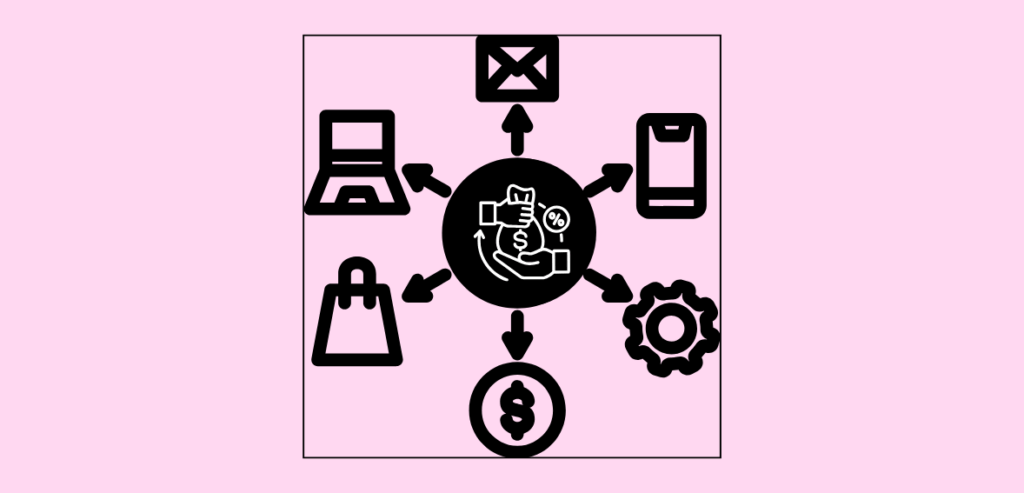
Unlike a multichannel approach, where each channel operates independently, omnichannel lending integrates various channels, such as online platforms, mobile apps, physical branches, and call centers, into a single, unified system. This strategy enhances customer interactions by providing a seamless experience across all touchpoints, saving time and offering valuable insights.
Omnichannel lending prioritizes the borrower, catering to their needs with a seamless, unified, and personalized approach. It allows borrowers to access their information through any connected channel, facilitating meaningful interactions throughout the lending process.
Furthermore, this approach allows lenders to gather extensive data from all interactions, providing insights into customer behaviors and preferences. This data helps design financial products and services that are more customized to individual needs. Omnichannel lending meets modern consumer expectations for quick and efficient services that are accessible via multiple channels that suit them.
Overall, omnichannel lending signifies a move towards more integrated and customer-focused financial services, ensuring that every online or offline interaction is interconnected and managed consistently.
Multichannel and omnichannel lending strategies are differentiated primarily by how they manage customer interactions, data integration, and the consistency of the customer experience.
Omnichannel should not be seen as a contradiction to a multichannel strategy but as its evolution. A multichannel approach combines various communication channels, such as online, phone, email, or in-person, to reach customers in the way they prefer. This results in a unified system where the channels communicate with each other, sharing insights and knowledge and guiding customers through the entire consumer lifecycle, including application, approval, onboarding, fund disbursement, payments, reporting, cross-marketing, and more.
Sometimes, customers can start an online application but may need additional consultation to choose the best lending products suitable for them or may require in-person guidance to navigate the application and documentation process. Lenders should be able to seamlessly access the client’s online application at their branch to carry that forward to completion without disruption. Having all these multichannel access points seamlessly communicate with each other is Omnichannel.
Lenders that remain stuck in a multichannel-only approach risk delivering a fragmented customer experience where each touchpoint – branch, mobile app, call center, email – operates in isolation, forcing borrowers to repeat information, re-verify identity, or reconcile conflicting messages. That disjointedness erodes trust, increases drop-offs on complex journeys like loan applications, and makes it hard to build the kind of seamless continuity today’s customers expect; research shows that unintegrated channel strategies frustrate users and damage brand perception because context is lost between interactions.
Without a unified view, customer profiles remain incomplete, limiting personalization and making it challenging to recognize behavior patterns or lifetime value gaps that suppress effective cross-selling and targeted refinancing or renewal offers.
The result is inconsistent service and brand perception: experiences vary depending on the channel and the agent, undermining loyalty and reducing the efficacy of marketing and retention efforts. Omnichannel-benchmarked organizations consistently outperform multichannel peers in loyalty and engagement because they deliver coherent, personalized journeys that reinforce trust and reduce friction.
Staying multichannel-only also means missed strategic revenue opportunities – without integrated data and orchestration, lenders cannot reliably surface the right offer at the right time, leading to lower cross-sell conversion rates and higher cost-to-serve as redundant touchpoints proliferate.

Today, customers in numerous industries, whether retail, banking, hospitality or even healthcare, look to interact with businesses and merchants via multiple channels. Consumers looking for a loan may view many different loan types, offering different terms, requiring different covenants, and with varying eligibility criteria from various financial institutions all on their smartphones. Once clear in their strategy, they can shortlist an institution and a loan and apply online or go into the physical branch. Funds can be linked to an online account or a digital wallet for transfers and future payments.
To successfully provide customers with a “hyper-personalized” experience, businesses must carefully implement a multichannel lending strategy that could evolve to omnichannel and invest in technology, human resources, and financial capital. The commitment must be long-term and focused on several strategic areas:
The saying was that your customers don’t see you if you don’t have a website. That advice is now about two decades old. Now, if you don’t have an app or a mobile-friendly website at the very least, your customers don’t even know you exist. Besides, lenders can collect a vast amount of data with mobile apps to auto-fill loan documentation details, thereby adding tremendous convenience to the consumer journey.
Lenders have an excellent opportunity to leverage the level of security built into smartphones today. However, it starts with the lender’s mobile presence.
Building on the earlier point of human interactions in supporting customers, physical branch offices, which customers can visit and experience, are a great way to promote your brand and products. Lenders should understand the various age groups and demographics seeking lending products.
The crux of the multichannel strategy is that there isn’t only one solution that fits all demographics. While digital natives are comfortable with the entire loan application being online, some are more comfortable and value in-person interaction and physical paperwork to sign.
Today, the internet is the primary resource for researching various services. Many potential clients may not even realize your loan business exists without a website. A website serves not just as a marketing tool, but also as an excellent alternative to traditional lending methods.
Banks and lenders often use their websites to demonstrate their services. Typically, a button on the website directs users to a contact page to schedule a consultation for loan applications. However, not all clients may want to engage directly. Many prefer to complete an online application and await approval without further interaction. It’s also beneficial to allow clients to choose their preferred method of communication; integrate options on the site for clients to provide their email or phone number, or send a direct message.
Ensure your website is mobile-responsive to improve the user experience. Customers should be able to apply for services from any device, whether a desktop or a smartphone.
A money lending app is a digital platform that facilitates on-demand borrowing and lending between individuals. It connects borrowers directly with lenders, enabling real-time financial transactions. This app allows financial institutions to maintain close, personalized relationships with individual customers.
Peer-to-peer lending through such apps provides a quick and convenient method of financial support. Developing a specialized app is a wise investment in financial products towards multichannel support, as it automates lending processes, enhances service quality, and potentially increases the volume of loans.
Many consumers realize they need a loan while shopping and want to make immediate purchases. Visiting a bank branch, completing lengthy applications, and waiting for approval isn’t feasible in such moments. Offering POS loans effectively captures these customers.
POS lending is expanding much faster than other comparable financial services. It currently represents one-tenth of all unsecured loans and is expected to continue growing rapidly.
POS lending involves personal loans like BNPL (Buy now, Pay later) specifically designed to finance purchases like PCs, smartphones, and furniture directly at the point of sale. The lender offers financing to consumers precisely when they decide to buy an item, with loans facilitated through online platforms that provide near-instant approval without the need for a traditional application process.
So many of today’s technology solutions rely solely on technology without human touch or intervention. It may make for an efficient operation but not help with customer satisfaction.
Imagine a customer experience where a human answers the phone after the first ring, equipped to answer questions with expertise and compassion. Your business may be able to close a sale on that call or qualify a strong lead. A common complaint among many industries is often poor customer service. A lot needs to be done to set up a successful support operation: product expertise, compassionate staff, and continuous upskilling of staff to be masterful at spotting pain points and capitalizing on those opportunities to showcase value propositions. Although it requires effort and time, it will surely have a significant impact over time.
Many lenders operate with multiple discrete channels – web, branch, call center, email, mobile app – but struggle to make them feel like a single, coherent experience. The shift to omnichannel is both strategic and operational. Below is a phased, practical roadmap lenders can follow, with lender-specific considerations embedded in each step.
Establish a baseline by understanding every customer touchpoint, where silos and friction exist, and how customers actually move across channels.
Key Actions for Lenders:
Without this audit, investments in “integration” may reinforce broken processes. Journey mapping uncovers where context is lost between channels – e.g., a customer who applied online getting asked the same questions in-person – which is a common frustration in financial services.
Eliminate data silos so every interaction across channels draws from the same, up-to-date customer context.
Key Actions for Lenders:
Lenders that unify data can personalize offers (e.g., pre-approved refinancing) and reduce redundant verification steps. This centralization is a core enabler of omnichannel coherence and is cited as foundational in modern transformations.
Break down internal functional silos – risk, underwriting, marketing, branch operations, customer service – so omnichannel execution is owned cross-functionally instead of channel by channel.
Key Actions for Lenders:
Omnichannel success typically fails when teams optimize their siloed channel at the expense of the end-to-end customer journey. Cross-team alignment is repeatedly highlighted as a critical enabler in the literature on shifting from multichannel to omnichannel.
Ensure that every customer interaction – regardless of entry or exit point – is context-aware, consistent, and contributes to a continuous experience.
Key Actions for Lenders:
Integrated touchpoints prevent fragmentation (e.g., a customer getting conflicting information from email vs. branch), which is particularly damaging in trust-sensitive sectors like lending.
Treat omnichannel as a feedback loop – use real-time and cohort analytics to identify gaps, validate assumptions, and evolve the experience.
Key Actions for Lenders:
Omnichannel isn’t a one-time switch; it’s an evolving system. Lenders who monitor holistically can detect compliance risks, optimize cost-to-serve, and adapt to changing borrower expectations.
Multichannel allows businesses to approach their consumer base from multiple convenient channels for them to access their products. But multichannel is a siloed strategy that needs to evolve into an omnichannel solution where the customer journey is a streamlined process without giving the impression that it is a separate interaction. This presents a chance for businesses and lenders to cultivate relationships with their customers as they focus on their future needs.
Lenders can quickly develop the ability to link together all the data into a single repository to build a profile of the customer, to cater to their needs expeditiously, and as time passes and as the relationship grows, serve as a recommendation engine for numerous other lending products and services to be appropriately marketed. Someone who takes out a student loan today may need a credit card or car loan in about four years. They may need a mortgage in ten years.
Technology has raised consumer expectations of how quickly their demands are met at the setting of their choice. Luckily, that same technology is available to businesses to take advantage of to delineate their consumers into different microcosms and plan a multichannel course of action to cater to their needs. With time and effort, lenders can easily evolve that into a unique omnichannel experience, building a pipeline of loyal customers.
Multichannel lending uses separate channels like mobile apps, websites, and branches, each operating independently. Omnichannel lending integrates these channels for a seamless customer experience, allowing customers to switch between channels smoothly without repeating processes or losing information.
Omnichannel lending is superior because it offers a unified customer experience and better operational efficiency. This approach allows for improved data integration, leading to better decision-making and personalized interactions, resulting in higher engagement, conversion rates, and customer loyalty.
Successful omnichannel lending requires integrated technology across channels, centralized customer data, and an infrastructure that supports seamless interactions. Analytical tools help understand customer behavior, and staff training ensures consistent service across all channels.
Challenges include significant investment in technology, overhauling existing processes, and shifting to a collaborative approach. Additionally, maintaining data privacy and security across multiple channels can be complex due to strict data protection regulations.