Posted: July 07, 2026 | Updated: October 06, 2026 at 6:04 PM
You check your delivery app dashboard to see the orders starting to pile up. The weekly payout hits, but it’s lower than you expected since the delivery apps have eaten away much of it with their hidden commission fees. And unfortunately, this has become the norm for most restaurant owners. Sure, third-party delivery apps help your restaurant get more orders, but they come with a hefty price tag that keeps rising.
You’re in luck — getting more orders doesn’t mean you have to sacrifice profit for visibility. The most effective restaurant marketing ideas of the moment don’t mean eliminating delivery apps. It’s about developing separate delivery systems that your customers prefer to use once they’re aware of them. In this article, we aim to empower you with nine easy-to-implement restaurant marketing ideas to increase your first-party online orders, improve customer loyalty, and lower third-party delivery service fees, all while keeping delivery apps to help your restaurant get discovered.
Major delivery platforms typically charge commission rates of 15% to 30% on delivery orders. When factoring in processing fees, advertising, and promotions, the final cost to a restaurant is usually in the 30% to 40% range per order, according to the National Restaurant Association. With most restaurants operating with such tight profit margins, this is typically not a marketing cost, but rather a loss incurred on each order.
The primary concern goes beyond the fees. The concern is ownership. When a customer orders through a delivery app, that app has ownership of and access to the customer’s name, phone number, email, and order history. This prevents the restaurant from sending a customer a birthday offer, a new menu email, etc. Ownership of the app signifies the ownership of the order and the customer’s data. With first-party online ordering, every order placed on the restaurant’s website/app allows the restaurant to retain the customer’s data and order history at no cost per order.
The chart below shows why this is massively important. A delivery app, along with associated fees, eats up over 25% of a restaurant’s order revenue on a typical $30 order, before accounting for food cost, labor, or packaging. A first-party direct order allows the restaurant to keep almost all the order revenue.
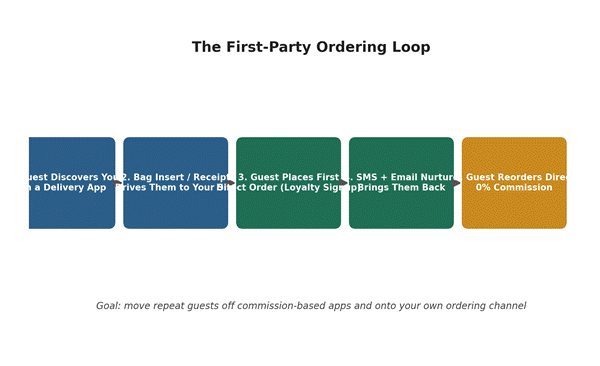
Figure 1: A $30 order through a third-party app vs. a first-party direct order.
The first component of a successful first-party ordering system is a speedy, mobile-optimized ordering page on your restaurant’s website. Platforms like Toast, Square, and ChowNow offer low-cost and even zero-commission online ordering integrations that work with your kitchen printer and POS system. While there’s work to be done, the end goal is to give your patrons the ability to order from your restaurant in the same manner (and with the same convenience) as the online food delivery services, without the extra cost and service charge.
Make it easy to locate your ordering page. Link it on your website’s homepage, in your Instagram bio, in your Google Business Profile, and on every printed menu in your restaurant. Having a system that allows you to take orders for your restaurant in a branded manner is the single best way to implement restaurant marketing focused on long-term revenue. This is because the other marketing ideas on this list are designed to drive traffic to this system.
Working a loyalty program into your website helps you win against the competition of delivery apps. Clients will habitually order from your website to earn rewards. Various loyalty programs allow you to define some rules regarding rewards. Examples of such programs are Fivestars, Punchh, and loyalty modules in Toast or Square. Through such programs, you can double rewards for orders placed on your website or offer a complimentary appetizer after 5 orders placed there.
Your loyalty program should be easy to understand, with no hidden tiers or complicated point systems. Your clients will appreciate the simplicity and clarity of a point for every dollar spent with a thirty-dollar reward, rather than a complex program. Make your loyalty program visible when clients are paying, in the order confirmation, and before your clients choose a delivery app. You want to catch your clients before they go back to third-party delivery out of habit.
Promo texts are opened more than emails. Good news for restaurants: SMS marketing can deliver the best return on investment for independent operators. An SMS marketing system to send text messages about Tuesday specials, limited-time bundles, and loyalty rewards that expire this week can motivate customers to order directly from the restaurant rather than through a food delivery app. Collecting numbers to send targeted text messages is easy with SMS marketing systems (SlickText, Textedly, and modules that build SMS into loyalty systems).
Text marketing systems that do not legally allow customers to opt in or to opt out at any time violate Federal Communications Commission (FCC) rules under the Telephone Consumer Protection Act (TCPA). Building an SMS program revolves around consent from the first day. With that in mind, a marketing system that sends texts about direct orders will outperform social media.
Guests only switch channels for a strong enough reason. A small, visible incentive directly tied to orders can provide the needed nudge. Examples include free delivery for orders placed through the website, a discount code with the delivery order receipt, or a first-order incentive of a complimentary side. All of these suggest that direct orders cost the customer less. Menufy is one of the ordering providers that has built a commission-free ordering platform, allowing restaurants to offer these customer cost incentives while helping them protect their margins.
Incentives should be tracked to see how many guests take advantage of them vs. how many return to the 3rd-party app for their next order. A/B testing can be useful for this, such as testing a free incentive vs a percentage discount. This will help better understand what incentive shifts customer behavior, rather than comparing this to what worked for another restaurant.
Most patrons begin their dining searches on Google, not on food delivery apps. With your Google Business Profile, you can add a direct ordering link, post photos of your menu, add your business hours, and include a click-to-call button. This all happens before potential guests see your competing delivery app listing on the search results page.
If you haven’t already, claim and verify your profile. Then set your first-party ordering link as the primary action button by removing the default third-party app link. Make sure you answer each review, add new photos every month, and post specials every week. This one recommendation often results in some of the highest-order intent at the lowest monetary cost among the recommendations on this list. This is because, as we note, the guest is already searching to buy.
Email may be slower than SMS, but it’s a great medium for the narratives that accompany seasonal menu launches and that help build a connection between the brand and the customer. You can collect emails at the point of your loyalty program signup, at your online ordering checkout, and through a quick newsletter signup form hosted on your website. With automations available in platforms like Mailchimp and Klaviyo, you can send a welcome series and a win-back campaign (targeting inactive customers), and create your monthly newsletters with no additional manual work.
Don’t send generalized messages to your segmented email list to maintain a healthy open rate. A customer who has not ordered in the past 60 days should receive a different message than a customer who orders weekly. A short, personal message with a small reward will typically yield better results than a generalized message sent to the entire list.
Restaurants should hyperlocalize their paid social advertising. Meta Ads Manager lets you create radius campaigns around your business and use your top-selling meal as an ad to send people directly to your ordering page, rather than to a delivery app ordering page you can’t control.
When advertising one location, keep your radius small, about three to five miles, and change the creative every couple of weeks to avoid showing the same people stale ads. With good targeting and creativity, direct order volume can increase significantly on a small budget (as little as $50 a week).
Offering a QR code on table tents, receipts, or window clings provides your guests a quick connection to your digital ordering and loyalty systems even while they are inside your restaurant. Guests ordering from curbside can scan a code from their cars to place their next order. Guests seated on your patio can now browse your full menu online with pictures, rather than reading a laminated menu card sitting in the sun.
This system builds your customer database without requiring your guests to order through a delivery app. Each scan provides you with a dedicated phone number or email address to promote your restaurant and loyalty program. This provides you a relationship with the customer you have never had before.
Many local food accounts are some of the best marketing channels in your city. With just a few thousand engaged followers, food accounts like these really help promote your business. They often send a ton more customers to your business for every dollar you spend than a big-name national ad campaign does. For these accounts, you could even offer a free meal promo in exchange for a post and/or story that pushes customers to your ordering page. Make sure the post links directly to your ordering page, and ask them to include a specific promo code that tracks orders.
Focus on creators who already post about local restaurants, as their audiences (and the creators themselves) are already interested in your area. This creator traffic will bring customers more likely to place repeat orders with your business.
Figure 2: The first-party ordering loop, from app discovery to a commission-free repeat order.
It is pointless to implement these nine strategies if you are not measuring their impact. Each month, note the percentage of total orders coming through your website versus through third-party services. Aim for a few percentage-point improvements each quarter. Account for customer acquisition cost for each channel. A direct customer acquired through an SMS campaign or QR code scan will be less expensive to retain than a customer acquired through a third-party delivery service marketplace fee.
The cost of third-party delivery services will be most evident when you compare the repeat-order rate and customer lifetime value of delivery app users versus program members. The real savings will be found in that gap. Lastly, to keep the focus of your restaurant marketing efforts on your bottom line, calculate the total commissions paid each month and set a goal to reduce that amount by ten percent each quarter. This way, your commission cost will decrease, and the impact of your restaurant marketing efforts will be visible.
Delivery services play an important part in getting customers to restaurants, and they are here to stay. Paying delivery services a full commission on every single order, even from your most loyal customers, is a poor long-term strategy for independent restaurants.
The nine restaurant-marketing strategies detailed in this article, including, but not limited to, a customized, no-commission online ordering system, restaurant loyalty programs, SMS campaigns, QR code menus, and innovative use of your Google Business Profile, all work toward the same goal: owning the customer relationship.
You can retain the customer discovery advantage of delivery services while building a real customer relationship. Start small, using one or two of the strategies this month, and as you see an increase in direct orders, add the other strategies. Building your own commission-free ordering channel requires some upfront investment, but it pays off quickly when your customers discover the easier, cheaper option you offer.
With first-party ordering, guests can place orders directly with you, typically through your website, mobile app, or QR codes. First-party ordering allows you to avoid third-party ordering and delivery services like DoorDash and Uber Eats. As a result, you get the entire order proceeds less the payment processor fee, and you get to keep the order information for future marketing.
Rather than leaving delivery apps, which could hurt new customer acquisition, take the following approach. First, build a branded ordering page and add a small incentive for direct orders. Then, employ SMS and email marketing to incentivize your existing app customers to switch to your ordering channel for repeat orders. This approach gradually minimizes order volume from commission-based delivery apps while still acquiring new customers.
Yes, guests must actively accept the terms before marketing text messages can be sent. Guests must also be given the opportunity to unsubscribe from every text message. Most restaurants receive consent from guests when they check out, sign up for the loyalty program, or scan a QR code with an opt-in checkbox. Protection from complaints and consent rules for texting are satisfied by following these methods.
Most restaurants experience a change in the volume of direct orders within four to eight weeks after consistently promoting ordering pages, loyalty pages, and SMS lists. Guests build the habit of ordering directly over a two- to three-month period. During this time, restaurants see a reduction in commission fees of ten to twenty percent of previous third-party ordering fees.
We keep our restaurant payment articles together in Restaurant Payment Resources; see it for more on first-party ordering.