

Posted: July 08, 2026 | Updated: October 06, 2026 at 5:57 PM
Every fitness studio owner is familiar with January trends. You start to receive an influx of visitors as customers. January is the busiest month for the studios. However, other studios mistakenly believe the busy month is only in January. For the other studios, January is actually the slowest month, since they focus only on half-hearted marketing and holiday-specific social media posts. The January fitness studio rush is not an effort for January. It is actually a Q4 marketing plan.
If you begin preparations for a January marketing campaign during the first week of January, you’re done for. The studios that flourish during resolution season plan marketing campaigns for the last quarter of the year well in advance. They even create a membership waitlist and convert resolution-driven interest into committed memberships long before the first of January.
This system is geared to accomplish exactly that. You have access to an organized system that provides steps to prepare for the busy season ahead of your competitors. Additionally, this system helps to develop a marketing campaign and offers a method to successfully retain members. This system can develop everything you need to reach and exceed your goals for the busy season and create a plan to help your studio thrive all year long.

January is not just busy for gyms; it’s actually the most crucial month of the year. Nearly 12% of all gym sign-ups happen in January. Post December, there is a 28% increase in gym visits. Data compiled by Gymdesk shows that just one month of the year can make or break a gym’s revenue endurance for the rest of the year.
Unfortunately, the data reveals an ugly truth. Roughly 80% of people who signed up in January quit within the following five months, even as January gym sign-ups continue to skyrocket. Regardless of the month of sign-up, half of all new members quit within six months. If gyms treat January as a sales opportunity, they continue to refill the bucket of gym members with a culture that expects high turnover.
The volume of sign-ups in January is almost guaranteed. How a gym leverages that sign-up volume to create an opportunity for a long-term membership contract determines how likely it is to experience the pain of a February cancellation surge versus having a full gym with recurring monthly contracts for the year. That’s the rationale for treating Q4 planning and spring member retention as interdependent — they are actually the same problem.
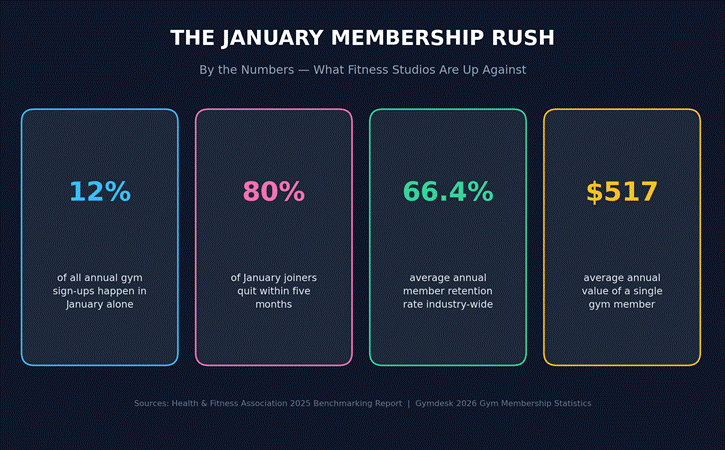
Infographic: The January Membership Rush by the Numbers
It’s best to begin in October. If you wait until December, your launch will coincide with your potential clientele being inundated with competitor discount offers, “New Year, New You” promotional fatigue, and other holiday campaign advertising. If you begin in October, you will have time to streamline your processes and quietly fill a waitlist with no competition. Your competitors will not begin their promotional campaigns until you have already built an engaged waitlist.
October is when you should prepare and audit the previous year. Assess all of your stats and prepare your promotional offer. November is your promotional offer hype month. Begin audience engagement, make social media posts about your offer, and gather email signups. When December rolls around, you open pre-sale spots to boost audience engagement for your offer. After pre-sales, you begin onboarding your new clients to make the offer permanent. You gain new clients to your gym and habits before your competitors even begin their promotional campaigns.
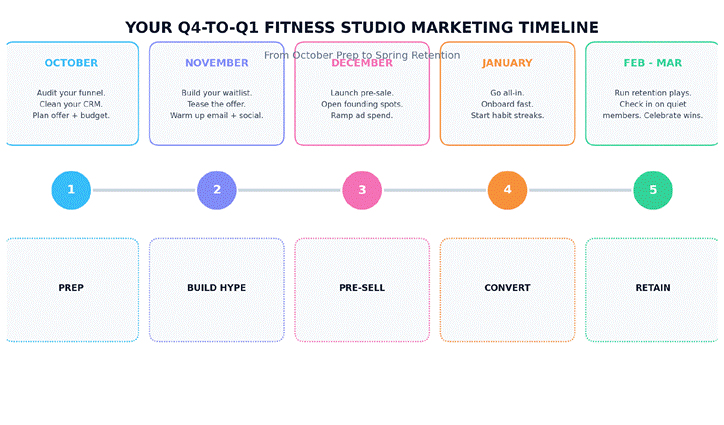
Infographic: Your Q4-to-Q1 Fitness Studio Marketing Timeline

Don’t spend time designing flyers or writing ads till you assess the current situation. Look at the stats from January. How many leads came in? How many came through? How many were still members in June? Doing this accurately by early October is more effective for your Q4 fitness marketing plan than any tactic you can apply.
Because the majority of resolution leads will discover your business through mobile search and/or social media, examine the user experience of your website’s sign-up process on mobile devices. How long does it take for a user to go from saying “I’m interested” to “I’m booking a trial class” If it takes longer than two minutes or three clicks, you’re definitely losing leads that were going to book a class. Also, evaluate your customer service and follow-up. If a lead doesn’t get follow-up in under an hour, it’s safe to assume they have moved on to your competitor’s page.
This audit isn’t fun, but it is critical. It is the foundation for everything else in this article. When you place a fantastic New Year gym promotion in a broken sales funnel, it just means that lots of people fall through the cracks more quickly.
A waitlist is a better tool than a sign-up form. Waitlists generate scarcity and momentum. Joining a waitlist is a small commitment, and small commitments lead to larger ones down the road. Joining a waitlist is the answer to one of the most common questions studio owners have about Q4.
It would be best to start gathering contact information about six to eight weeks before your planned January launch. An easy incentive would be to offer early access or a locked-in founding rate. You can even give a free bonus to the first fifty sign-ups. Put your offer on your website, your email footer, your Instagram bio, or even a physical sign-up sheet at your front desk. Every member of your current audience should hear about your offer, since referrals are more valuable to you than cold traffic.
If someone joins your list, your communication with them should certainly continue! Start building hype for your offer with sneak peeks, but save the details for later. This is a good time to answer some of your audience’s questions and share information about new trainers, classes, and more. You might also consider offering a fun countdown timer for your audience to join in on. Almost like an exclusive offer: VIP access for the first audience to hear about it. Your audience won’t feel like they are seeing an advertisement for the first time.
Mindbody is used by several small studios for its capabilities in automated waitlists, lead tagging, and email campaigns, all of which are available without requiring spreadsheets. The software provides all the follow-up functionality, which is most valued, since small studios likely do not have a marketing team, and the tool will handle follow-ups during busy weeks with walk-ins and holiday schedule adjustments.

Is it better to discount or to add value? Every studio looks for an answer to this same question during resolution season. Most will opt for the price cut. That’s the least creative and therefore the weakest answer to the question.
The unfortunate truth is that massive discounts draw bargain shoppers, and those bargain shoppers mostly cancel after two months. Discounts condition your current members to think your price is way too high, keeping your margins down for years without you noticing.
A New Year gym promotion thoughtfully preserves the integrity of your pricing by offering an add-on healthy meal plan, free gym equipment, a complimentary spot in a highly coveted class, or a “founding member” price that’s reserved for them for life or until the gym membership is canceled. These add-ons let you maintain your standard pricing while still providing a compelling reason to sign up, unlike the studio down the street.
Be strategic when adjusting pricing. Rather than an across-the-board discount, promotional offers like a waived enrollment fee, a free trial, or a “match game” in which a participant can bring a friend are more effective. These promotions reward participants for taking action and generating referrals, rather than sales to discount shoppers. Discounting is not an effective strategy for winning resolution season; rather, winning this “competition” means having the most attractive offer.
An Instagram post will be insufficient to reach your desired January metrics. Membership campaigns are about being where your ideal client is and being familiar to them through repetition. Then, when they are ready, your studio will be the obvious choice to them.
Email campaigns targeting your waitlist still provide one of the highest returns, as does local search. Many New Year’s resolution searches will be on phones using the phrases “gym near me” or “fitness classes this month.” One of the best, most efficient uses of a studio owner’s time is updating and improving the studio’s Google Business Profile. Social media, as Glofox’s annual gym membership statistics report shows, is best as a proof and testimonial platform. Client stories, trainer spotlights, and behind-the-scenes class clips will outperform any promotional graphic.
When your competitors are most active, local ad spend will help you reach potential clients quickly. Word of mouth is your best marketing channel, and referral rewards for your current members will help you actually put that channel to work.
Winning January clients isn’t about which studio spends the most money. It’s about which studio shows up consistently across four or so different marketing efforts.

This is the one Q4 planning element that most miss, and the one that determines whether January results in true profitability. New member retention must be built before day one and should not be an afterthought when someone goes inactive after three weeks.
The importance of the first two weeks after sign-up cannot be overstated, for many reasons that span the entire membership lifecycle. A new member who books a follow-up session, sets a goal, or makes a workout buddy within that time frame is much more likely to still be a member in June. Having an onboarding path that includes check-ins on day three, day seven, and day fourteen is more beneficial to the bottom line than most member acquisition strategies and aligns with Virtuagym’s recommended strategies to help with the January spike. Giving shout-outs for achieving significant milestones (like workouts attended) is helpful and can keep the new member engaged during the weeks when they are most vulnerable to losing motivation.
Community is one of the most underrated retention strategies in the industry. Having workout buddies makes a member much less likely to leave than a member who works out in isolation. Scheduling classes to have the same group of attendees will help foster community more than any other technique.
A member who hasn’t checked in for 10 days isn’t lost yet, but they will be soon if no one on your team sends them a quick, genuine outreach message.
Some common missteps appear in many studios that struggle during resolution season. Most studios wait until January 2 to launch their campaigns and, as a result, lose weeks of search and social traffic to competitors who launched earlier. Another example is leading campaigns with the deepest possible discount, which will result in studios being filled with members who are the least likely to renew. Many studios lose potential customers as a result of negligence with their website. They apply a “good enough” mentality to their website and booking flow and fail to test them before the peak holiday lead sign-up period.
One mistake many studios struggle with most is having a budget zeroed out after the marketing for an acquisition is completed, with no staff time or plan for the period after the new members arrive on day one. A studio membership campaign that ends once a contract is signed is a futile growth strategy that will only repeat the cycle, leaving studios to rebuild their roster from scratch next January.
Most seasons in the fitness industry revolve around rushes, but January is an exception because it’s a reward for preparation. Studios that start their fitness studio January marketing early (like October) and create valuable New Year gym promotions (as opposed to discount-centered ones) coupled with a well-prepared plan to retain members (before the first new member even walks in) earn the ability to turn resolution season marketing into a “full year growth engine”.
Think of this time as the runway to your launch. What you do in the months leading up to that time determines whether the January rush turns into a loyal weekly membership base or you just end up with another month of an overcrowded studio.
Start in October. This gives you about 10 to 12 weeks to review your sign-up funnel, design your offer, and create your pre-sale waitlist. Studios that choose to launch in late December will find themselves in an overcrowded market and will miss the first search traffic and social interest of Q4.
The best kind of promotions are those that provide additional value rather than straight-up lowering the price. Great examples include a locked-in founding-member rate, a bonus service, or a waived enrollment fee for a limited time. These options help maintain your company’s profitability and attract members who are more likely to stay with your organization and less likely to be price-focused members who will most likely leave in the spring.
Design an onboarding system that allows staff to check in on days three, seven, and fourteen. Onboarding should also include shout-outs for completing 5 workouts and a workout schedule designed to help members meet and get to know each other better. The two most reliable long-term retention indicators are community and engagement.
Value-adds are generally the better option in the long run. Steep discounts serve the most price-sensitive customers (who tend not to renew their membership) and train the rest of your customers to expect reductions in your membership pricing. A bonus, guarantee, or founding rate, if used strategically, can be equally effective without affecting pricing for your other customers.
Begin gathering contact information six to eight weeks before your launch. Promote your waitlist with high visibility and offer a small incentive to sign up (the first 50 people receive early-bird access or lock in a lower rate). Rest assured, subscribers will stay engaged with the latest information and will have a sense of exclusivity by the time your New Year gym promotion goes live. Use your website, social bios, email footer, and front desk to promote your waitlist.
For more on planning the January membership rush and other gym and studio payment questions, see Fitness and Gym Payment Resources.