
Posted: July 16, 2026
Imagine that you are at a red light. Someone idling next to you is tapping their phone with a request for payment. They just made a decision about where their money is going. They are not looking for an answer on your website (not that you have one). They are looking at the stars and Google reviews (and maybe the comments) to determine who has the best offer. There are now millions of potential customers, and your Google reviews are the quiet force determining which potential customers you keep and which you lose.
Reviews used to be an optional, fun, good-to-have, “I have customers” advertisement. Now they are the central determining factor of whether an AI recommends your business, whether a potential customer follows an AI recommendation, and whether a business visitor transforms into a customer.
Shoppers read reviews. Local businesses have no choice but to accept that customers for their business can be anyone and everyone. In BrightLocal’s 2026 study, 97% of customers read reviews for the local businesses they are considering. Reviews are paramount, and this guide outlines why reviews are important and how to garner Google reviews in a compliant manner.

A review used to mean one thing. It used to calm one person. Now, it means three things, and that’s what’s complicated the situation for every local business.
The first thing is to search. Google interprets your reviews as a constant sign of trust and activity. Approximately 46% of all Google searches have a local intent, and that number is on the rise. When a user makes a search with a “near me” statement, it is the businesses that have a good review profile that Google is confident in placing in the map pack. Being in the map pack is hugely important. Some industry analysis suggests the local three-pack generates approximately 126% more traffic and 93% more engagements compared to listings that rank fourth to tenth.
The second thing is the AI answer. Consumers are more and more ignoring the traditional search results and are simply asking the AI who to hire. In the last year, the share of consumers using tools like ChatGPT, Gemini and Perplexity for local searches increased from 6% to 45%, making AI the third most popular search method after Google and Facebook. These tools use your Google Business Profile and the reviews as their main information. However, a SOCi review of more than 350,000 local profiles found that ChatGPT suggested only 1.2% of all local businesses. A strong and up-to-date review profile is one of the few ways to break into that exclusive group of suggested businesses.
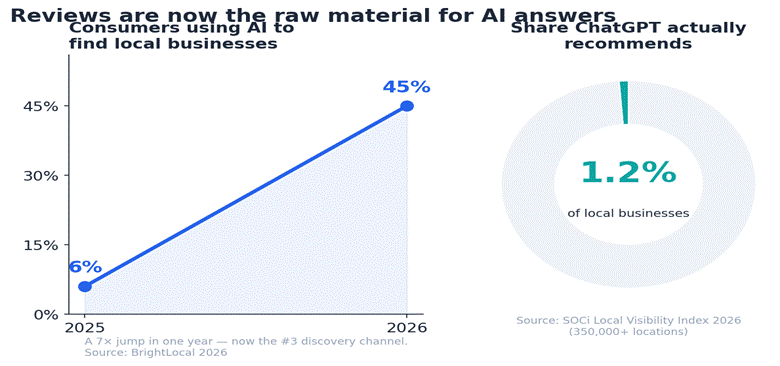
AI-assisted discovery exploded in a year, but only a tiny fraction of businesses earn the recommendation.
The final job is conversion. When potential customers finally locate you, reviews determine whether they will engage. Reviews that exhibit great quality lead to an increase in conversion rates by 15% to 20% and an increase in sales by up to 18%. Positive reviews make a business more attractive to potential customers, and customers are willing to spend up to 31% more at businesses with excellent reviews. The same reasons and logic that aid Google in trusting you the most also assist the skeptical customer in saying yes. To understand more about the impact of AI on the customer discovery process, you may review the Local SEO and AI Overview documents for service businesses.
Owners typically display the positive feedback they receive and think it’s enough. It’s not. A three-year-old review is essentially an empty page. We’ve all seen the “last updated” banner; freshness is the new replacement.
The statistics say it all. Approximately 73% of customers state that they trust reviews posted within the last 30 days. 83% say that the trustworthiness of reviews is directly impacted by how recent the reviews are. A consistent flow of recent reviews, even if they are fewer, is usually preferred over a large pile of reviews that are all aged. This flow is termed review velocity in marketing. It primarily impacts trust and ranking.
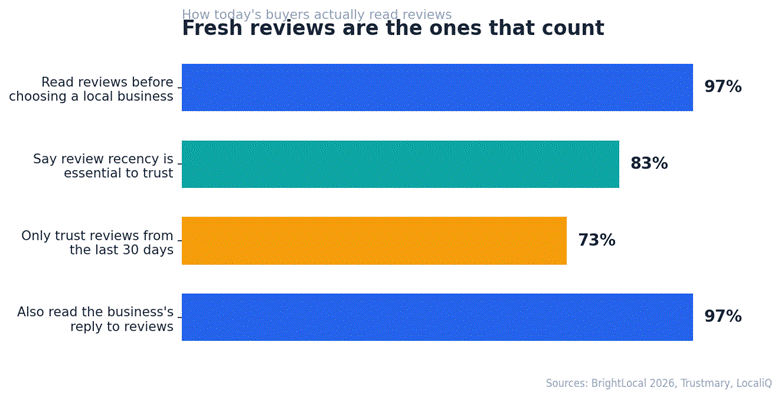
Recency is not a detail. It is the filter buyers apply before they trust a word you say.
It is helpful to know what specific review qualities are impactful. Although Google has never published its review scoring methodology, there does seem to be a consensus across multiple studies. In this case, review quantity shows Google that you are a busy and legitimate business. Review recency shows Google that you are a business that is currently operating and providing a good service. The average score is a quick qualifier, and the range of trust is believed to be approximately 4.2 stars to 4.5 stars, which is enough to instill confidence, while not being so high that it can be considered artificial. Lastly, owner replies demonstrate to Google that you are engaged.
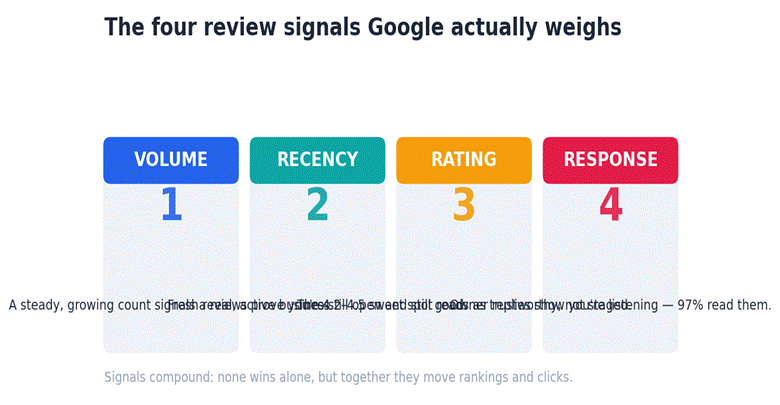
The four review signals compound. None wins alone, but together they lift both rankings and clicks.
There is a ranking payoff hiding in this. One study conducted in 2025 of 3,200 Google Business Profiles found that, although proximity is the most important factor for being in contention for the search results, for the first ten search results, proximity is less important, and review quantity and the relevance of review content become more important. You can’t change the location of your business. You have the opportunity to generate more and higher-quality reviews that naturally mention the services you provide. That is the most important factor in customer reviews and local SEO, and it is the factor you can change.
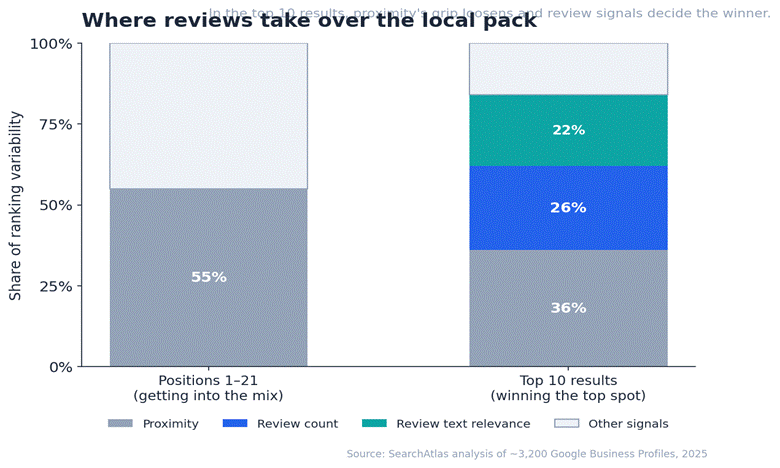
You cannot change your location. You can change your reviews — the signal that decides the top of the pack.

Most reviews go unwritten for a very boring reason. No one begged for one. Customers will submit reviews, but the moment just passes them by. The largest factor for getting more reviews is using a simple request at an optimal time.
Timing is everything. The best time to request a review is during the peak moment of the customer’s good feeling. The moment the stylist spins the chair toward the mirror, or the moment the follow-up text is sent after the repair is done and the customer is happy, or the delivery is done. Request the review while the moment is still fresh.
The request should be short and easy to read and fill out. Good requests are personal and specific enough to request just one action. Here are some requests for a review that you can modify to fit your own voice.
Notice what they have in common. They are warm, they provide an explanation for how and why it helps, and have no pressure for you to be positive. This last point is not just courtesy. It places you within the confines of the rules, which we will cover below.
A happy customer plus an inconvenient review process equals “no review.” Keeping customers happy and motivated to leave reviews should be the primary goal. Reducing the time between agreeing to leave the review and the review being completed is the goal of any business.
Review requests should begin with a short, easy-to-access review link. Google allows businesses to create quick access links and customizable QR codes that businesses can place directly on review request pages. These QR codes can be printed and placed “at the peak of the good feelings,” which experts recommend is at the POS or within the line of sight.
The good feelings do wear off, so ask customers to leave a review before they’ve even left the business. A follow-up request should be sent via text or email within the hour or the same day. Businesses that routinely implement this process, rather than on a whim, have consistently collected reviews. An overview of the system within the solutions pages shows how the request process integrates with other systems.

This is the point at which positive motives become infractions. The regulations are more stringent than the majority of owners believe, and there are consequences. Two entities control the limits: the platform and the regulatory body.
Google is direct and clear. Reviews must come from real experiences. If you incentivize people to review you, change reviews, or remove negative reviews with goods or services, then your reviews are fake and misleading. As such, your profile can get suspended. Google emphasizes that ‘review gating’ is a no-go practice. Review gating is when you pick and choose who reviews you based on how sure you are that they’ll leave good reviews. The safest route, as with all business practices, is complete honesty. Ask for reviews from all your customers, prepare for all outcomes, and engage with every review.
In the U.S., the FTC enforces review transparency and has eliminated most loopholes associated with review incentivizing. Its rule on reviews, in effect since late 2024 and carrying civil penalties, prohibits rewarding positive reviews, since that incentivizes reviewers to write something other than their honest opinion. Soliciting only your happy customers in a way that skews the overall picture is prohibited, and negative reviews cannot be suppressed or delayed while positive ones are published. Reviewers must disclose any material connection, such as a reward, and any incentive that is offered cannot be conditioned on the review being positive. The rule is clear that reviews must be honest, representative, and transparent. The FTC’s material on reviews and endorsements goes into great detail and is worth reviewing before creating a campaign.
The good news is that rules can be followed to the letter with the “steady, honest” review collection process. Not only does collecting honest reviews outperform review collection gimmicks, but it also protects that asset you are working so hard to build.
The hard part about collecting reviews for your business is responding to them. The stakes are higher. Your responses are read by the potential buyers, clients, and users who come to evaluate your offering next. As many as 89% of consumers expect business owners to respond to reviews, 81% expect a response within a week, and 97% of people who read reviews also read the responses to them. A significant number of reviewers have stated that they have not received a response. Close that gap and take advantage of it.
Never respond to positive reviews with a generic “thanks” response. Thank each reviewer personally and go beyond a bare “thank you.” Restate something you are glad they noticed and reinforce your positive service or product. Keep it kind and casual. You are helping future reviewers and likely your past reviewers focus on and notice something about your service or product.
Responding to a negative review is much more difficult, but is not impossible. If you do this well, in the eyes of potential customers or buyers, you are more trustworthy and may even win a customer back. The recommendation you see from Google is to be a calm human. Responding in a polite, non-angry, and human way quickly is key. You should apologize for any faults you truly empathize with, but also explain the true situation. Be personal. Address them by name, and offer to move the conversation to a more private channel. The future reviewers are your primary audience. A generous response will likely serve you more than pages or walls of five-star reviews.
Steady discipline is the core of all serious online reputation management.
Just one caution: you can flag for removal any fake reviews, reviews that violate Google’s content policies, and reviews that are likely extortion, but don’t engage. Save removal for real violations of policies, not for negative reviews.
A five-star review on Google is good. Having a five-star review as a working asset in your marketing is better. The best companies have a review system that they treat as a content library.
Place your strongest reviews in areas where your buyers may be hesitant. Post your strongest reviews on service pages, checkout pages, and landing pages, as 57% of consumers go on to a company’s webpage after seeing a positive review. Use actual customer quotes in social media posts, emails, and marketing collateral. When using a review in a public forum, make sure that the review is unedited and that you have received permission to post it. Be sure to maintain the integrity of the review rather than using a review to create a false representation of the reviews.
Reviews carry a bonus for search engine optimization. Reviews that use natural language and cite a specific service help a business rank for that specific service. A review that complements your gluten-free birthday cakes is quietly also increasing the potential to be a top search result for that topic. This is also a great way to improve the AI answer engines that impact discovery the most. Our answer engine optimization playbook covers this in detail.
Strategy needs a time frame to be effective. What follows is a concise, four-week sprint intending to make the aforementioned activities habitual. This is the momentum that you will only need to create once.
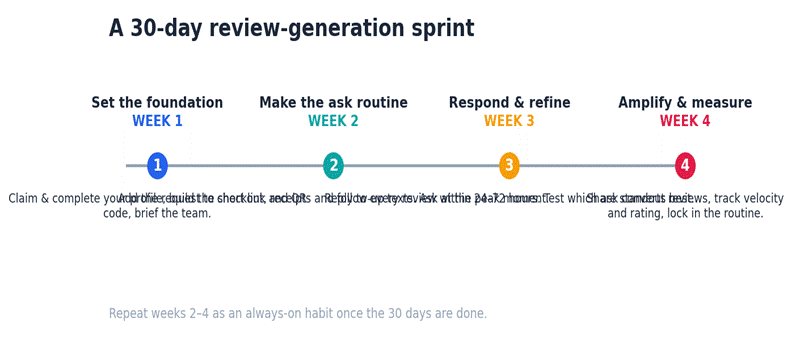
A simple four-week sprint that turns scattered good intentions into a repeatable review engine.
Week one is all about Foundation. Complete your Google Business Profile (GBP) to build trust with potential customers. A completed GBP makes it 2.7 times more likely that a potential customer will perceive your business as legitimate. Generate your review link and QR code. Let your team know what you expect from them by including it in the plan.
The routine request is established in week two. Add the request to the checkout moment. Print the review request QR code on the sales receipt and counter card. Email or text a message to your customer after their experience. The goal is for requests to go out every day without anyone needing to remember them.
Responding and refining is the focus of week three. Respond to new reviews within 24 to 72 hours after the review is posted. Respond warmly to positive reviews and calmly to negative reviews. Consider the various ways you have requested reviews and focus on the timing that receives the most responses.
Amplifying and measuring is the focus of week four. Post great reviews from your customers on your website and social media. Review your review performance by measuring the review velocity, average star rating, and the number of reviews receiving responses. The rhythm established in weeks two to four should be repeated. The target should be 40 to 50 reviews for your business. The businesses that win are the ones that continually ask for customer reviews, not the ones that have a single heroic push.
Google reviews may be the biggest indicator of your business’s success, and you may be underestimating them. They may determine if your business shows on the map, whether your business is named as the answer to a buying question, or if a sale is made. Search technology, AI, and the forces of conversion are here and are only growing more powerful.
One of the most encouraging parts about managing Google reviews is that the work is quite mundane. There are no mind games to play and no rewards to give. Simply, having a full profile, creating a well-timed and simple call-to-action, and replying to all reviews in a timely manner is your best bet. Follow all the rules that Google and the FTC set, and your reviews will pull the most weight when the buying decision is made. Start today. Ask your next happy customer for a review before they walk out the door.
Some owners hesitate to ask for reviews right after a purchase. Asking at that moment is exactly right, and you should reinforce the message with a follow-up text or email. You should complete your Google business profile and respond to the reviews you get. This is the best way to get the reviews you need.
Yes. Google bans gifting reviews in exchange for discounts, freebies, payment, etc., and considers these reviews fake and misleading. They will jeopardize your profile. The FTC adds that you may not tie an incentive to a positive review, and a material connection must be disclosed. The best practice would be to just request honest reviews from everyone and offer nothing.
You want to respond to the reviewer quickly, usually within 1 to 3 days. In your response, maintain your composure and be polite even if the reviewer was the opposite. Never share the customer’s personal details in your response. If there was an error on your part, admit it, express that you understand the error or situation from the reviewer’s perspective, and explain what you can control and what you can’t. Also, include a customized response and if appropriate, offer to take the conversation to another contact medium like email or voice. Always respond with the understanding that future reviewers will be reading what you write.
Yes. Reviews are considered a local ranking input. They comprise 10% or more of local ranking factors and even more of the factors ranking businesses in the map pack. Google considers the volume of reviews, how recent they are, the rating, the keywords in the review, and the owner responses. Among the top local rankings, the count of reviews and the review content have the most weight. This is why, to improve visibility, there needs to be a constant flow of authentic reviews and reviews that are also substantive.
There is no global standard, but a helpful tool for most local categories is about 40 to 50 recent reviews and regular updates to keep your profile fresh. Some categories, like hotels, can have significantly more reviews. The recent reviews count is almost as important as the total count, as many buyers trust reviews only for the past month. It is best to have a consistent stream of reviews rather than a one-time huge review count.