
Posted: July 15, 2026 | Updated: October 06, 2026 at 6:00 PM
Nonprofits cannot view fundraising calendars the way most people do. Nonprofits have odd dates throughout the year that end up representing the performance for an entire year. Donors develop predictable patterns of behavior similar to the ebb and flow of ocean tides. Donors will give on GivingTuesday, will take a break for a few weeks, and then give again on the last day of the year. If your team is prepared for that flow, the season can give your nonprofit the funds to support your mission. However, if your team is not prepared, the funds will flow to other nonprofits that are prepared.
This guide will help smaller nonprofits with smaller teams set up year-end fundraising practices and campaigns for the 6 weeks from GivingTuesday 2026 to New Year’s Eve. Using this guide will tell you what to send, to whom, and what needs to be set up on your donation page before the funds flow in. This plan is set up without a large budget or agency. This plan is set up for 1 to 2 people, with a donor list and a deadline.
The year-end giving phenomenon is not an assumption. It is data-driven. The M+R Benchmarks 2026 revealed that there was a total of 37% of annual online donations made to nonprofits in December. Another 10% of annual online donations were made in the final week of the year. December 31 made up 4% of annual online donations made to nonprofits.
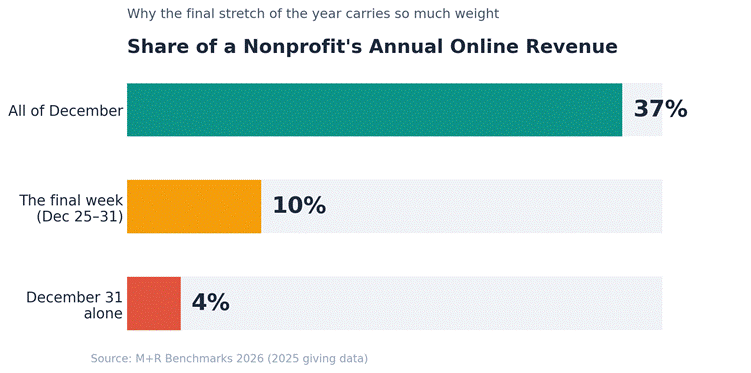
Figure 1. December carries more than a third of a nonprofit’s annual online revenue.
Consider this statistic for a moment: more than a third of all online donations for the year happen in a single month. That number is even larger for some causes. December accounts for nearly half of all online donations for hunger and poverty organizations. A campaign that falters in this crucial month does a lot more than fail to hit a fundraising goal; it hurts a lot of programs that rely on this funding.
There is another reason this time of year is important, and that is the increased competition. Everyone’s email and social media is bombarded with requests for donations. Ad space becomes more expensive with the increased demand. Plans are what help convey a message in the midst of the competition. Several things can help, like timing and the overall layout of the donation page.
The good thing is, this is actually a problem that can be solved. You don’t have to spend more money than the larger organizations that will be your competition for donations. You have to be more prepared and organized than they are. Even a small nonprofit can compete with larger organizations if they plan and spaces out its requests.
The anchor date determines all subsequent dates. GivingTuesday 2026 is on Tuesday, December 1. It is always on the Tuesday that follows Thanksgiving, which in many years lands in late November; this year it falls in December. This year, the date sets a tighter schedule for the campaign. This gives the campaign a greater sense of importance and higher stakes.
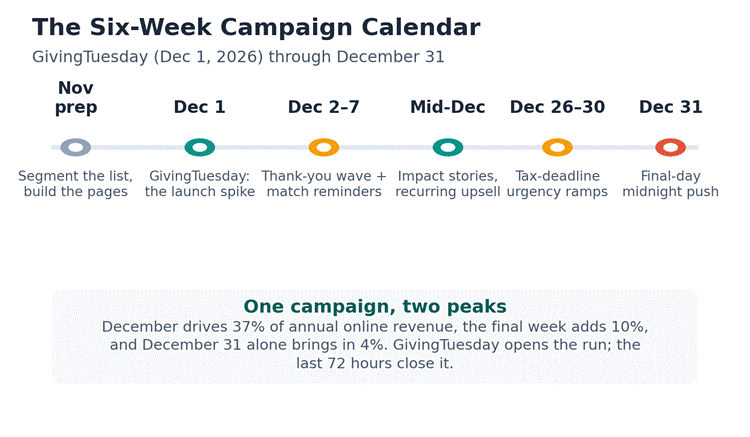
Figure 2. One campaign, two peaks — from the GivingTuesday launch to the final-day push.
The rhythm can be broken into a few distinct phases. Preparation happens in late November. You segment your list, finalize the pages, and load the emails. The rest of December consists of several GivingTuesday spikes, with the first one happening on December 1, and usually resulting in the highest amount of new donors for the year. The few days after, December 2 through 7, should be dedicated to showing gratitude and gently reminding people about the match (if applicable) with no new asks. In mid-December, the story stretch begins. During this time, impact stories and the recurring upsell work their magic. During the period of December 26 through 30, donors start to feel the tax-deadline urgency. The race to the finish line begins on December 31, which is the last day of the year to send out asks (with multiple sends, including one in the final evening hours).
There are two defining peaks. The first is GivingTuesday, and the second is the last three days. The time in between those peaks is used to warm donors for the final push. It also provides the first-time GivingTuesday givers an incentive to give again. The nonprofit fundraising calendar should be viewed as a single arc, rather than several disconnected pieces.

The most common end-of-year blunder is sending a mass email to every donor. This is the equivalent of sending a monthly donor the same email as a donor who gave three years ago and never donated again. Those are two distinctly different donors that require different emails. With segmentation, small teams can create targeted appeals without the need to create 100 email variations.
When you first start to segment, try four groups. Lapsed donors lost the reason to donate and need to be reminded. Send them an appeal that reminds them why they gave in the first place. Donors who give regularly should never receive a solicitation email for a one-time gift; email them a “thank you” email and make the end-of-year gift optional. First-time donors and GivingTuesday donors are new donors, and you should nurture their support over the next two weeks. Mid and Major donors should receive a personal email, call, or a handwritten note.
The incentive is retention. According to the Blackbaud Institute and a GivingTuesday special report, 65% of GivingTuesday donors gave again the next year, as opposed to 52% of the donors who first gave earlier that year. Among the new donors in your records, GivingTuesday donors are notably more likely to give again than other new donors. With segmentation, you can show your appreciation for their support.
The goal is to keep your segmentation system easy. The most basic system can be a simple spreadsheet divided into four tabs rather than a system of one blast email. Simplicity is the name of the game.
Year-end campaigns use multiple channels. Donors read emails, scan texts, scroll social posts, and open mail. You just need to time the messages to be in sync with each channel.
Email is the channel of choice. In 2025, email accounted for roughly 16% of online donations. Email campaigns should be a series, not a single email. An email campaign can include a launch email, a reminder email, a thank-you email, an impact story email, and a group of emails sent on the last two days of the year. Procrastination is a common behavior for donations, so spread out the emails, including an email sent late in the day.
The urgency of a text message helps when an email is not enough. Send a text message alongside the email on GivingTuesday and again on December 31. Text messages should be rare and time-constrained.
Social media is great for goal tracking and creating social proof. A donation goal post coupled with a fundraising thermometer campaign can create great interest for a campaign. Although donations are rarely made directly via social media, it is great for goal campaigns that combine email and text messages.
Direct mail is an important channel to get donations, especially from older and higher-value donors. Fundraising letters combined with a digital nudge reach an audience you might never reach otherwise. A donation is likely when a donor is reached via multiple channels rather than just one.
Two distinct appeals require their respective strategies. Failing to recognize this will diminish the effectiveness of both.
GivingTuesday calls for high-energy appeals that incorporate a sense of urgency and community. This annual event offers participants a 24-hour window to engage with a campaign that will attract new donors. For participants, this means creating messaging that will encourage extremely quick sharing, with an appeal that is matched or goal-focused. GivingTuesday 2025 broke records by raising $4 billion in the US by encouraging 38.1 million participants to engage in what was perceived to be a communal event.
The year-end appeal strikes a different note. It conveys urgency and asks for donations to close out the year. This type of messaging is direct, but still conveys the impact of the gift by framing what will be accomplished by a donor’s gift if it is given before the end of the year. A GivingTuesday appeal builds momentum. The end-of-year appeal asks for closure.
The connection between the two is stewardship. A participant of GivingTuesday will be more likely to make a gift at the end of the year if the participant’s gift is matched, and if they are thanked and shown the impact of their gift. Therefore, the two appeals should be regarded as two bookends to a single campaign as opposed to two separate campaigns.
Some of the biggest year-end gains come from deepening the gifts of those already donating, instead of attracting new donors. There are two methods to achieve this without any additional outreach, both of which utilize the donation form.
The first method is the recurring donor upsell. Sector research consistently shows that the most valuable donors to a nonprofit organization are the donors giving on a monthly basis. Fundraising studies show that these monthly donors had a 71% retention rate as opposed to newer one-time donors who had a 24% retention rate. Additionally, the monthly giving model accounted for 27% of all online giving in 2025. In terms of the impact of a donation form, the monthly giving model should be the default option, as opposed to an afterthought. The prompt to make this a monthly gift converts one-time donations to a sustainable model at the point of commitment. An indication of the demand was GivingTuesday 2025, where one platform saw a 61% increase in monthly donations.
The second lever is employer matching gifts, and the numbers are astonishing. Double the Donation published a report estimating that 4-7 billion dollars of matching gift funds go unclaimed annually. The reason is straightforward. Approximately 78% of donors do not know if their employer matches gifts. However, the impact that matching gifts have on donations is significant.
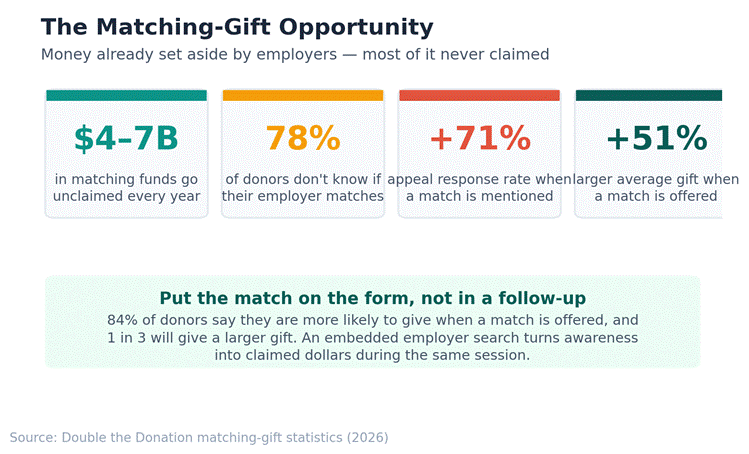
Figure 3. Matching gifts are money employers have already set aside — and mostly never claimed.
Citing a match increases appeal response rates by 71% and increases the average response gift by 51%. Citing a match encourages 84% of donors to give and one-third of donors to give more than they typically would. Essentially, the additional revenue comes from gifts already secured.
The match should be included on the appeal form. Donors typically do not open follow-up emails. The donation form itself should include an embedded employer-search field so donors can check their eligibility on the spot and submit a matching gift request in the same sitting.
A successful campaign tends to leak donors at the last step. Although the campaign has successfully driven awareness, traffic, or engagement for many nonprofits, the donation page is the weakest link, and that’s where the money ultimately needs to be converted. Industry research has found that roughly 87% of people abandon the donation page without donating. That means every point of friction you solve translates into potential revenue.
Mobile is no longer optional. In 2025, 43% of donations were made via mobile. However, mobile pages still appear to be converting at lower rates. Make sure to test your donation page on mobile and make sure the form fields are large, the page load time is fast, and also enable digital wallet giving (Apple Pay, Google Pay). Digital-wallet giving at 2025’s GivingTuesday increased 95% from the previous year, and that’s probably because tapping to pay is a lot easier than typing a card number and expiration date.
Trust signals are important on your donation page. A branded donation form, a charity-rating badge, and a stated impact area will increase your conversions. Processing fee coverage should remain an option, as many donors are happy to cover them. Limit your form to the bare minimum to avoid abandonment, as every added field is an increased opportunity for donors to leave the page.
Receipting readiness protects your relationship with your donor after a gift is made. Donors expect a quick, accurate, automatic tax receipt, especially for year-end donations to be claimed in the spring. Do your best to avoid a mad scramble in January to acknowledge these gifts, as a quick and accurate receipt will reassure the donor.
The campaign doesn’t end on Dec 31. Your actions during the first few weeks of January determine the extent of this year’s achievements, carrying over into next year. New donors are tenuous. Generally, across the sector, new donor retention is roughly 24%, which means that, on average, 3 out of 4 first-time donors do not come back to give again. The average is beaten through your stewardship efforts.
Your first step is to express your thanks and gratitude in a prompt and specific manner. Thank every single donor quickly, and explain the influence their gift will have. A donor from a GivingTuesday campaign, who is appropriately stewarded, has a much higher probability of donating again. One study found that giving thanks to and engaging donors has caused 48% of GivingTuesday donors to donate again before the end of the year.
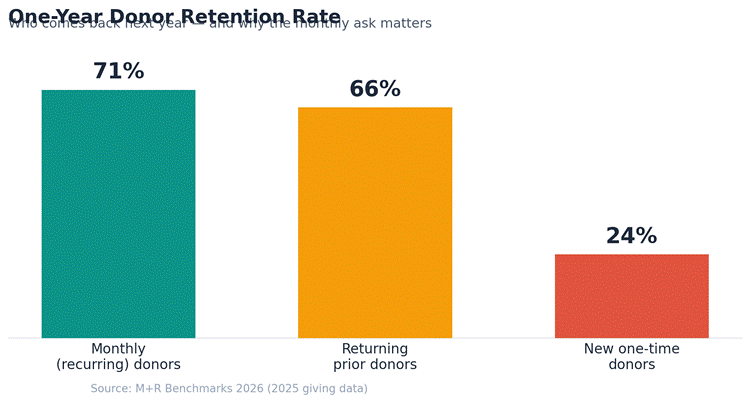
Figure 4. Recurring and returning donors come back at nearly three times the rate of new one-time givers.
Next, get acquainted with your new supporters. Use a quick survey to gather their interests and most effective communication methods, turning unknowns into an engaged audience. Use those interests to segment your audience for this year. Instead of sales-pitching to year-end donors, invite them into your monthly giving program with a kind follow-up email since the recurring donation upsell is effective in January.
And finally, be realistic. Assess what worked well to gain gifts, what segments took action, and where the page lost donors. Those answers will create your plan for next year. A campaign that has been analyzed is a campaign that has improved. Your stewardship doesn’t have to be the polite ending to the season. Instead, it’s the beginning of a new campaign season.
A year-end fundraising strategy doesn’t rely on one big request. It starts in November with planning and launches just after GivingTuesday 2026 on December 1. A year-end campaign goes through the December days and closes in the last hours on December 31. Organizations that succeed aren’t the ones with the biggest budgets. They successfully anticipate the needs of donors and are thoughtful and intentional about every aspect of the campaign.
The things that make the most impact are very doable by small teams. Divide the email list so every email is specific to that small group. Send something through all communication channels so donors can engage through their preferred one. Include matching gifts and the option to give recurring donations on the same form. Make the donation page easy and fast to use with the promise of an instant receipt. Then, enable the new donors from this campaign to be active in the next campaign.
As a rule, December makes up around a third or more of annual giving. If you are caught by surprise, that concentration will be a liability. If you are ready, that concentration of giving will be an opportunity. Build your calendar. The six weeks that will make or break your mission are upon us.
GivingTuesday 2026 will be on December 1, 2026. It occurs on the Tuesday after Thanksgiving (U.S.). This year, Thanksgiving occurs in the latter part of November, so the GivingTuesday campaign will take place entirely in December.
Design work should be completed before the public campaign launch on GivingTuesday. This campaign will run through December 31, and the design work includes segmented pages and draft emails. It is essential to start the design work in September or October to use the time leading up to the campaign to the team’s advantage.
The 2026 edition of the M+R Benchmarks study found that nonprofits receive 37% of their total online donations in December, 10% within the last week, and 4% on the last day of the month. Nonprofits working in the areas of hunger and poverty see even greater levels of concentration.
Make the monthly donation option more prominent on your donation page, and consider placing it in the suggested donation position. One-time year-end donors should be contacted in January with an offer to convert to sustainers. Monthly donors have a much better retention rate than one-time donors, so the offered conversion is a revenue protection measure.
At the least, you’d want a frictionless, fast, mobile-optimized form, a few options to pay with a digital wallet, a recurring gift prompt, a search tool for employer matching donations, trust indicators including a rating badge and branding, and automated tax receipts. The best-performing page is typically the lowest-friction one.
For more on the year-end fundraising calendar and other nonprofit payment questions, see Nonprofit Payment Resources.