

Posted: July 06, 2026 | Updated: July 08, 2026 at 2:58 PM
Type a question into Google these days, and you’ll likely see an AI-generated response right there on the results page. No need to click on a link. Type the same question into ChatGPT, and you’ll see a similar response complete with a brief list of sources. This is the future of search. If your small business isn’t included in these AI responses, you’re losing customers before they even click to visit your website.
This is called answer engine optimization, or AEO. It is predicted to be just as important as traditional SEO, if not more. This playbook outlines what answer engine optimization is, how it differs from search engine optimization, and how a small business can gain visibility in AI search engines this month, even on a small budget.

The practice of answer engine optimization involves creating content on your site that AI can find and identify as the best answer to a particular question. This can be thought of as content structured to be optimized first for machine reading, then for human reading, all while preserving that human quality.
With AI Overviews in Google, ChatGPT, Perplexity, and similar platforms, you won’t get ten blue links anymore. Search engines will sift through the multitude of published content, answer your question, and present the content. If your content is selected, you provided a well-structured answer with supporting details.
The premise is straightforward. Write concise answers to user questions. Support your answer with detail. Elaborate enough for your content to be quoted. If your content is consistently well-structured, AI will cite it because it recognizes it as trustworthy.
Most of the time, questions about AEO versus SEO imply a false dichotomy, but there isn’t one. You can (and should) have both. They optimize for distinct things, but cooperate. With SEO, the goal is to identify the ranked list of results and the resulting traffic that follows that click. With AEO, the goal is to build a system that earns a citation in an AI-generated Answer, regardless of whether the user clicks the citation.
SEO is not dead. Many of the same signals are used to determine if a page is ranking and therefore credible enough to be included in an AI Answer. A considerable number of AI Overview citations come from pages that rank within the upper echelon of Google’s Organic results. The foundational structure of SEO is a must. AEO is that structural addition, and builds on that foundation with organization, explicitness, and updated content that is more approachable for AI systems to quote and lift.
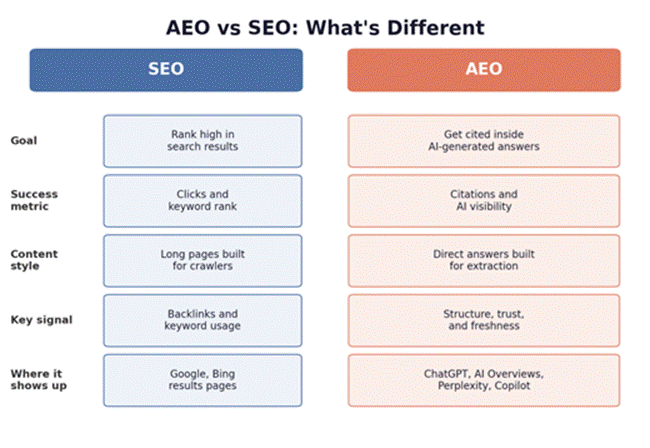
AEO and SEO share a foundation, but they optimize for different outcomes.
AI search for small businesses is not a trend coming; it is already changing the way people search for local service providers, be it a plumber, baker, lawyer, or store. Over half of all searches result in no clicks because the search results provide the information directly. ChatGPT already serves hundreds of millions of users each week, and many are now using it as the best way to get local referrals.
Small businesses are facing challenges and opportunities as a result of the advent of AI. Competing for a citation in an AI-generated answer is probably more challenging than getting an answer on the first page of Google. However, as many businesses are not yet ready to compete for citations, this can be a great competitive advantage. A small business can get ahead of a large competitor that is not ready for answer engines by having a small, well-optimized site with clear, trustworthy information.
For a considerable number of searches, the results generated by Google AI now occupy the space above traditional search results. These results summarize information from multiple web pages, cite them, and provide relevant links to the web pages. Google’s AI systems work in conjunction with Google’s traditional search systems, crawlers, and indexing. Hence, the technical aspects of SEO that you focus on will pay off. It is the ticket to the show.
ChatGPT now has a built-in web search that lets it browse the internet and provide real-time recommendations with citations. Using ChatGPT may help build your business’s online presence. Depending on the quality and clarity of your content, citations and recommendations will vary. ChatGPT also takes into account the presence of quality third-party websites.
Built around citations, Perplexity is an AI answer engine. Every answer is visible with a source link, showing where your content is checked. Since Perplexity favors fresh, updated articles over static, outdated pages, it is very important to update your content regularly. It’s also one of the easiest answer engines to find backing for your content.

Classic SEO is still the main priority for ranking in AI Overviews. If the classic SEO elements in your page are not present, like crawlability, speed, and helpfulness, Google’s AI will not be able to drive traffic to your page since it will not perform well in the organic search. After you have implemented classic SEO, a few extra elements can be a differentiator.
Place a direct and concise answer, ideally 1 to 2 sentences, at the beginning of your webpage before any lengthy introductions. Follow with structured data, schema markup, and provide a description of your webpage, be it a review, business or product, or FAQs, to search engines. Ensure your business info (hours, addresses, services, etc.) is consistently listed across your webpage and listings. Surface-level, quick answers will not be favored by Google’s AI Overviews, as they tend to prefer clear structure and authentic topical depth.
To be cited by ChatGPT, you need to think outside of your website. Like other AI tools, ChatGPT likes external validation. When compared to a self-interested company website, AI perceives mentions of your business on review websites, company directories and online discussion forums to be more reliable.
ChatGPT prefers long-form content and likes depth and authority over marketing. So, be sure to make profiles on review websites related to your business. Examples include Yelp for local businesses, G2 for SaaS businesses, and other trade directories. Be sure to get customer reviews. Each trusted mention of your business name in context preferred by AI means you are deserving to be cited.
OpenAI has published information on its website about how its tools will access your website and perform a search. You can check the documentation for crawlers and bots on their site to verify that your site performs the desired functions.
Generative Engine Optimization (GEO) encompasses a wider range of concepts that answer engine optimization (AEO) is a part of. GEO focuses on your overall presence in the AI ecosystem, including your website, reviews, social mentions, videos, and even how your brand is perceived within AI models. In contrast, AEO focuses on ensuring a specific webpage is referenced for a particular query.
As a small business, you don’t have to fully understand GEO at the onset. Concentrate on AEO fundamentals on your webpages, and as resources allow, work on optimizing reviews, videos, and community mentions. The two disciplines will help build each other over time.
This is a seven-step, high-impact process you can work through this quarter.
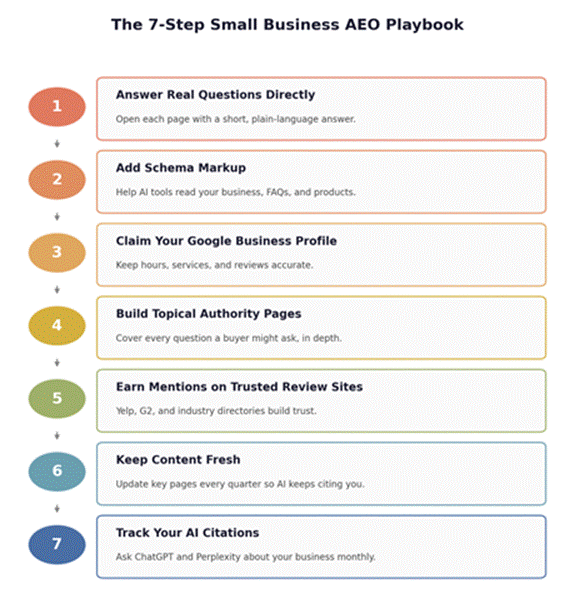
Work through these seven steps in order for the fastest results.
Google Business Profile is one of the most powerful yet least-used tools for local AEO. It is a free listing that populates Google Maps, local search results, and, increasingly, AI Overviews for local searches. With a complete profile and adequate use of categories, pictures, hours, and reviews, Google’s AI has a clear data structure about the business that it can quote.
Companies that let their Google Business Profile rot make it difficult for people and other answer engines to trust them. This week, spend only thirty minutes updating this listing; it might just be the highest-return task in this entire playbook.
Regular analytics tools cannot track AI citations, so answer engine optimization is going to be more manual for the time being. The most straightforward method is free. Regularly question ChatGPT, Perplexity, and Google AI Overview about your customers’ questions. Review the responses to see whether and how your business is mentioned alongside your competitors.
Look at your website analytics for visit sources like chatgpt.com, perplexity.ai, and other AI domains, as more visitors are using these channels. Look at your branded search volume. AI responses that mention your business name prompt a direct search for your business, even if the search was not initiated by a link to your business in the AI response. Several tools to track AI visibility are being created to automate the process you are now doing manually, and they will be worth your time once you see you are gaining traction.

Probably the most obvious mistake is thinking that AEO replaces SEO. In actuality, AEO builds upon SEO frameworks. Ignoring Site Speed, Mobile Usability, and Navigational ease undermines everything, as AI tools are heavily dependent on finding well-optimized, high-ranking webpages.
Another mistake is creating marketing speak in your content and passing it off as an answer. AI tools learn how to retrieve and cite information, not ads. Marketing fluff like “the best service in town” or “the greatest hamburgers in the world” will be ignored. Small businesses, unfortunately, let their Google Business Profiles and online reviews stagnate, to the detriment of their service trust and search engine rankings. Businesses that build their AEO strategy and move on also lose visibility, as AI replaces the need to cite a page that remains unvisited and favors more recent sources.
We live in a new age of search. More and more, customers get their answers via AI before they even land on a website. This trend is not slowing. The most rapidly evolving answer engine optimization (AEO) marketplace gives small businesses a fighting chance to break into the search engine marketplace with a budget that is often much less than that of a standard pay-per-click (PPC) ad. Answer engines like Google rely on a specific set of trusted sources to provide answers to queries.
To effectively implement answer engine optimization, small businesses should provide direct answers to common questions, add structured data, update their Google Business Profile, and create a presence on review sites and directories. If these strategies are implemented with dedication, a business will not just be found in AI search; it will be the answer.
No, answer engine optimization does not eliminate the need for SEO. Many AI answers still rely on classic page-ranking techniques, which favor speed and linking. A good amount of SEO, along with the structural elements of AEO, is needed to rank well in both traditional search results and AI-generated answers.
Due to market and competitive variations, timelines will differ. However, many small businesses begin to see early positive changes a few weeks after implementing some critical website changes. These changes include providing direct answers, implementing schema markups, and improving review signals. The importance of continuously making changes to a business far outweighs the importance of one-time changes.
Not exactly. AEO focuses on the design and organization of web pages, prioritizes content trust, and scales with less reliance on advertising and higher content volume. A small business can outperform larger competitors with well-designed websites, accurate Google Business Profiles, and genuine reviews.
Start with the Google AI Overview. After that, check your Business Profile. Currently, most small businesses will find that Google accounts for most of their search traffic. After that, look at visibility for ChatGPT and Perplexity, as these will be important for the new research-intensive or comparison purchases.
