
Posted: June 18, 2026 | Updated: October 06, 2026 at 5:57 PM
Every summer, membership businesses brace for the same painful pattern. The weather warms up. Members head outdoors, book vacations, and rethink their budgets. Then the cancellation requests start rolling in. For gyms, studios, and subscription brands, summer is the season when hard-won members quietly slip away.
Here is good news. The truth is that most of your members do not want to leave for good. They want a break. That single understanding drives one of the smartest retention tools in the industry, the membership freeze. A clear freeze-or-pause policy gives waffling members an off-ramp that is not the exit door. Instead of losing the relationship, you simply hit pause. When done well, freezes and pauses protect your revenue while giving members a reason to pause rather than cancel. This guide reveals the genius of the membership freeze.

A membership freeze, pause, or hold preserves the contract and locks in the rate while temporarily halting access and billing. A customer’s account simply becomes dormant for the agreed period. A key aspect of a membership freeze is that customers remain members.
Membership freezes, of course, differ from cancellations. When a customer cancels their membership, they end their membership and lose their joining-fee history and any promotional rate. Canceling a membership requires the customer to resubscribe, often at a higher price. A freeze means the billing stops, customers have the ability to pause the membership, and ultimately, customers are automatically reactivated. From the customer’s perspective, a membership freeze is a relaxed way to take a break. For the business, it’s a great way to retain the customer.
The different terms matter, of course. Generally, a freeze means that billing and access are both paused. However, a pause may allow for billing to be stopped while limited digital benefits remain. A hold is typically the same thing as a pause, but is simply another name. The principle behind all of these terms is simply to keep the membership while life gets in the way.

Summer is a churner’s paradise. Travel season ruptures many members’ routines. This is even more pronounced for members with school-aged children, as endless summer days home from school continue to unravel routines. Sunshine lends itself to outdoor workouts over treadmill workouts. Those tighter vacation budgets make it easy to cancel a fitness charge.
Summer slowdowns are not solely anecdotal. It is well known that gym attendance decreases in the summer and that lower attendance is one of the earliest indicators of cancellations across the board. About half of new members quit within their first six months. Industry research typically cites this as the period most members fail to build a habit. Summer only exacerbates a fragile fitness routine.
Members typically request a summer freeze for a handful of predictable reasons:
Recognizing these patterns is the first step. The second is giving members a graceful way to handle them.
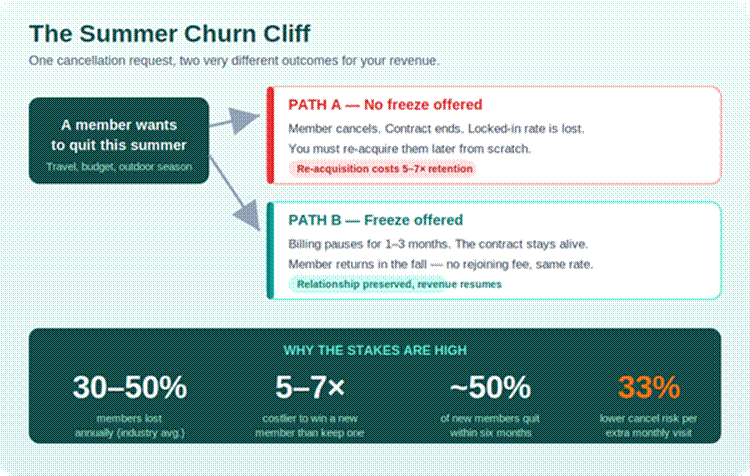
Figure 1: One cancellation request can lead to two very different outcomes.
The underlying mechanisms of the psychology employed here are uncomplicated, yet highly effective. Members who feel they are unable to use the gym during a specific month face two choices: either continue paying for a service they are not using, or cancel their membership. The logical choice seems to be to cancel their membership. A freeze eliminates this dilemma by offering a better option that is neither final (like canceling) nor guilt-inducing (like paying).
A freeze also relies on the member’s inherent aversion to loss that is associated with what they already have. The member’s rate is locked. The member has already avoided the joining fee. Choosing to leave means losing everything and starting all over again. Once a freeze is regarded as a measure to preserve the benefits, members take the freeze, and the relationship survives the summer, and the roster remains intact.
Additionally, there is a psychological benefit to this. Each additional visit a member makes this month reduces their risk of canceling the following month. By keeping members in your system rather than allowing them to cancel their memberships, you maintain the opportunity to re-engage them in the following months. A frozen member is one you will have active in the future, whereas a canceled member is one you have lost and need to win back.
Retention is the metric that matters most. It is core to a successful membership-model business. Most fitness businesses lose 30–50% of members annually. The cost of replacing members is high. Gaining a new member costs 5–7 times as much as retaining a member. The numbers are unforgiving for the business owner who considers cancellations a cost of doing business.
Imagine a studio with 1,000 members that pay $50 a month. If summer causes the cancellation of 80 members who would otherwise have frozen their membership, that is $48,000 in lost revenue over a year. That also doesn’t include the cost of marketing to replace those members. A freeze policy that prevents half of those cancellations pays for itself many times over.
The Harvard Business Review’s analysis of customer retention is a good starting point for understanding the long-term value of retaining the right customer. This principle reaches beyond fitness. Chasing new customers is always more expensive than retaining a paying one.

Members and staff often blur the lines between these terms. A clear comparison removes confusion and helps front-desk teams steer conversations toward the right outcome.
| Feature | Freeze / Hold | Pause | Cancel |
| Billing | Suspended or small hold fee | Reduced or suspended | Stops permanently |
| Access | Paused until reactivation | Limited digital perks may stay | Ends immediately |
| Contract & rate | Preserved | Preserved | Forfeited |
| Joining fee on return | None | None | Often re-charged |
| Reactivation | Automatic on end date | Automatic | Full re-signup required |
| Best for | Temporary breaks | Short, partial breaks | Permanent departures |
Table 1: How freezing, pausing, and canceling compare for members and operators.

An effective freeze policy is transparent, equitable, and user-friendly. Vague policies breed disputes, and excessive fees push members to cancel outright. The best policies are designed to strike a balance between retaining members’ goodwill and supporting the business.
Figure 2: The five building blocks of a freeze policy that actually retains members.
Set Clear Duration Limits
Caps usually range from one to three months. Setting a defined end date helps maintain user engagement and establishes a return point for members. Freezes without an end date tend to become permanent, which is no different than a cancellation. To ensure policy predictability, a number of operators establish an annual cap, such as two freezes per year.
Charge a Small, Fair Hold Fee
Typically, a $5 to $15 monthly charge for freezing a membership is acceptable to cover administrative costs and indicate that the membership is still active. The charge should never seem like a penalty to the member. If the charge for freezing a membership is close to the cost of full membership dues, the member will more than likely just cancel the membership. The charge should be set so that keeping the membership frozen is always preferable to canceling it.
Define Eligibility and Documentation
Clearly define the qualifying terms. Many gyms allow members to freeze their memberships for any reason, as long as it is within the set cap. A freeze that exceeds the cap can be granted without a fee for documented medical or military reasons. Clarity avoids disputes at the front desk and helps staff consistently uphold the policy.
Automate Reactivation
The freeze will be over on its own. Set the membership to automatically restart on the agreed-upon date. Send a reminder prior to the date. One of the best ways to ruin a relationship with a customer is to surprise them with charges. Trust is built when the process and date of reactivation are stable and clear.
Looking at how established brands run their freeze programs offers a useful template. Note that most large chains are franchised, so exact terms vary by location.
Planet Fitness
When a Planet Fitness member needs to freeze their membership, the chain offers an option where, instead of canceling, freezing halts all recurring charges while keeping the account active.
Because all Planet Fitness locations are franchised, pricing, fees, and duration vary, and most locations prefer that members contact or visit their home club to initiate a freeze. Some locations don’t charge for a freeze request; others apply a small fee for the duration of the hold. Although Planet Fitness has, for the most part, used freezes for medical reasons, the overarching principle is that pausing keeps the membership and rate intact, allowing the member to return without rejoining.
Anytime Fitness
Because Anytime Fitness runs on a franchise model, rules about membership freezes are handled at the local level, even when it comes to general trends. Members on a twelve-month plan, for instance, usually have the opportunity to freeze their membership twice, for up to three months each time. The frozen time isn’t lost — it’s added back to the end of the membership term once the freeze ends. A freeze is usually requested at the member’s home club and must be supported by appropriate documentation, such as a letter from the member’s doctor or a copy of the member’s relocation order.
Workout Anytime
Workout Anytime provides members with a simple freeze option for up to 90 days. Both freeze and cancellation requests can be done via the app or at the member’s home club. The self-service option for managing membership holds via the app aligns with the industry trend of reducing friction and demand for front-desk assistance.
| Brand | Typical Freeze Length | Fee Structure | How to Freeze |
| Planet Fitness | Varies by club (often 1–3 months) | Free to small hold fee | Contact or visit home club |
| Anytime Fitness | Up to 3 months, often twice/year | Small admin fee may apply | Home club; docs for medical/move |
| Workout Anytime | Up to 90 days | Varies by club | In-app or home club |
Table 2: Freeze approaches vary by brand and by individual franchise location. Always confirm local terms.
In a freeze program, proper timing and messaging are crucial. Promote the option to freeze memberships before summer — not after your members decide to leave. Use a late-spring email campaign to dispel the notion that leaving is a better option than freezing.
A freeze should always be the first option a team member offers before processing a cancellation. When a member calls to cancel, ask whether they would prefer to pause the membership instead. That one question has prevented cancellations and kept members for longer. Make the freeze option clear on the website, the app, and in the membership agreement.
Frozen members should be treated like leads. While the membership is on hold, send members helpful, light messages, such as the new class schedule, upcoming promotions, or simply that the staff misses them. When a membership is unfrosted, send a message welcoming the member back.
A poorly constructed policy can create a myriad of issues. Ambiguous terminology causes mistrust and can become the basis for disputes. Holds without a defined time limit can result in perpetual membership freezes, essentially creating an unpaid membership. An excessively high hold fee can backfire by encouraging members to cancel their membership. Frustration from a lack of transparency, especially when combined with a cumbersome membership reactivation process, can lead to complaints and chargebacks.
To prevent these issues, a policy should have a consistent application system. First, document your policy. Then apply it consistently across members and staff. Finally, audit your freeze data. Analyzing the frequency and reasons for membership freezes can help you identify patterns and plan season-based policy changes. For this reason, freeze options have become a retention standard across major fitness chains.
You cannot improve what you do not measure. Track a small set of metrics to confirm your freeze policy is actually reducing churn rather than just deferring it.
| Metric | What It Tells You | Why It Matters |
| Cancellation rate | Share of members who cancel in a period | Shows whether freezes are diverting exits |
| Freeze-to-cancel ratio | Freezes chosen vs. cancellations | Reveals how often the off-ramp works |
| Reactivation rate | Share of frozen members who return | Confirms freezes lead to active members |
| Seasonal churn trend | Cancellations broken down by month | Pinpoints the summer cliff to plan for |
| Member lifetime value | Average revenue per member over time | Ties retention directly to revenue |
Table 3: Core metrics for judging whether your freeze policy is working.
Summer cancellations feel inevitable, but they are not. Most members who reach for the cancel button simply need a break, not a breakup. A clear, fair membership freeze policy gives them that break while keeping your revenue and relationship intact. Cap the duration, keep the fee small, automate reactivation, and promote the option before the warm weather hits. Do that, and the policy that once felt like a revenue leak becomes one of your strongest retention tools — the quiet safeguard that carries your membership base through summer and into a stronger fall.
A brief, well-structured freeze protects revenue. A small hold fee can be charged during the pause, and the cost of losing a member is saved (a member is much more expensive to replace, usually 5 to 7 times the cost of retention). The brief dip in dues is almost always better than cancellation.
Typically, operators allow freezes to last 1 to 3 months, with an annual limit of 2 freezes. These policies help maintain member connections and provide a return date in the system. Documented freezes lasting longer than a month can be reserved for medical and military circumstances.
A reasonable monthly charge would be $5 to $15. This small fee helps cover your administrative costs and indicates that the account is still active. To keep as many accounts active as possible, the fee should always be less than the cost of full dues. It should be small enough to reinforce that pausing is cheaper and easier than canceling.
A freeze halts billing and access while maintaining the contract, locked-in rate, and account history, with automated reactivation. A cancellation severs the relationship, usually results in loss of any promotional rate, and requires a full re-sign-up, typically at a higher price, to return.
Fitness and Gym Payment Resources covers membership freezes and pauses alongside membership billing, declines and disputes, all in one place.