
Posted: June 08, 2026 | Updated: June 09, 2026 at 4:28 PM
In the second quarter of the financial year of 2026, Amex made headlines with a historic acquisition. American Express acquired Hypercard. This is not your average tech buyout; it was a strategic move and a milestone in merchant payments worldwide. To understand the depth of this acquisition, you must understand the advent of agentic AI and autonomous finance in the payment landscape. Agentic AI is a type of artificial intelligence software that specializes in certain tasks.
AI, in general, possesses broad intelligence. However, agentic AI, as the name suggests, is an agent; it specializes in a specific field and is highly optimized to autonomously execute multi-step tasks, such as reading receipts, coding, and filing. On the other hand, autonomous finance is a connected topic. It refers to the automation of finance through technologies such as artificial intelligence, which operates silently in the background without requiring human intervention.
Hypercard was a startup founded in 2022. It was backed by revolutionary thought leaders of the modern tech industry, such as Sam Altman. The acquisition of Hypercard by American Express signals a strategic shift towards embedding AI technology across merchant payments and banking systems worldwide. Legacy software simply digitized the billing and the financial aspects of any business. It did not offer any actionable insight within the software that could be used to self-optimize the system and prevent any losses. However, AI can analyze historical data and make accurate predictions about the future. This results in a shift in the SaaS industry towards AI-based services that can make smarter decisions and more accurate predictions.
It also marks an end to reactive finance. Instead of employees analyzing and reporting on quarterly reports and then taking action on them, AI can analyze past data and make statistically better decisions. This acquisition fits a broader trend in which large financial institutions are acquiring AI fintechs to control the entire B2B spend lifecycle.

The current system has multiple points of failure. Month-end close is one of the most agonizing accounting processes finance teams go through each month. They have to verify, categorize, and reconcile all company spending before closing the books. Reconciliation refers to the act of matching the ledger records with the bank account statements to cross-reference and match payments to different accounts. Amex saw this gap in the finance industry; they suffered from it too. To reduce the workload and burden on staff and streamline financial bookkeeping, American Express acquired Hypercard.
Legacy systems such as Concur or Expensify only moved the manual burden from paper to a screen; they did not eliminate manual data entry; rather, they just shifted the medium. In other words, this was mere digitization of the account books. Traditional expense reporting relies on employees. It is highly subjective, depending on the work employees send, their ability to meet deadlines, and whether they actually remember to file expense reports every week. This creates a manual lag. This lag often results in error reporting and finance reconciliation getting delayed.
Legacy tools have another disadvantage — they work on reactive mechanics. They flag a discrepancy or a violation after the money has already been spent. This forces the finance teams into the awkward position of reporting the loss and taking accountability for it. On the other hand, modern AI systems have completely changed the game. They focus on any pattern that could possibly result in a loss and flag it prematurely. This creates an environment for preventive financial management that mitigates losses and fosters a better financial ecosystem.
Controllers have to spend a disproportionate amount of their time chasing receipts from employees. This often creates manual follow-ups that stall the accounting cycle and create friction, often resulting in lags. Also, human data entry is prone to errors, so there is no guarantee of the report’s outcome.

At the heart of this acquisition sits agentic expense management. Generative AI is an all-purpose AI that can answer a wide variety of questions for you. It is most commonly used by everyday consumers for tasks such as searching the internet. However, agentic AI is a niche type of AI that specializes in autonomously making complex decisions within a particular field. For example, an agent that can categorize, consolidate, and reconcile financial data of a company.
With agentic AI, we often hear the term “deterministic workflows” associated with it. These are processes that follow strict, unchanging rules, such as accounting principles. These rules must be followed by the AI agent, unlike the “creative” freedom of a text generator, making its outcome more predictable.
Agentic AI goes beyond chatbots; it is not just a general-purpose chatbot but a specialized digital worker. It can log into systems, extract data, map it to rules, and route it for approval without human prompting. An AI agent can perform multi-step execution. It receives a receipt, uses optical character recognition to read it, matches it to corporate statements, checks it against policies, and then assigns it an appropriate accounting code.
Agentic systems can also understand the user’s context. For example, it knows if the employee is a VP with a $500 dinner allowance or a normal employee with a $50 allowance. When the AI agent encounters a receipt that appears to be an exception, it can autonomously route it to a human supervisor for manual confirmation and interpretation. As finance teams correct the agent’s output, it continuously saves the feedback. An AI agent can continually learn from human user feedback and update its categorization models. This means that the system gets smarter as it encounters more data.
Hypercard was founded in 2022 by Marc Baghadjian and Nikolas Ioannou. When it started, its core focus was autonomous workflows, which earned it substantial backing from heavyweights such as Sam Altman, OpenAI’s CEO, who validated its AI architecture.
Native AI architecture refers to software built around artificial intelligence from the start, rather than an older software platform that integrates AI features to stay relevant in the market. In 2024, Amex discovered Hypercard, and their first collaboration was made. Together, they launched the “Hypercard Rewards American Express card”, which served as a live in-market stress test for Hypercard.
Hypercard’s value lies not just in its slick interface; its real value lies in the backend automation it provides for back-office admin tasks. Its AI engine is specifically designed to handle rigid, high-stakes data requirements of corporate finance. With an agile partner platform, these deliverables get amplified in value. An Agile Partner Platform (APP) is an integration framework by Amex. It allows third-party tech companies to build services directly on top of Amex’s card data.
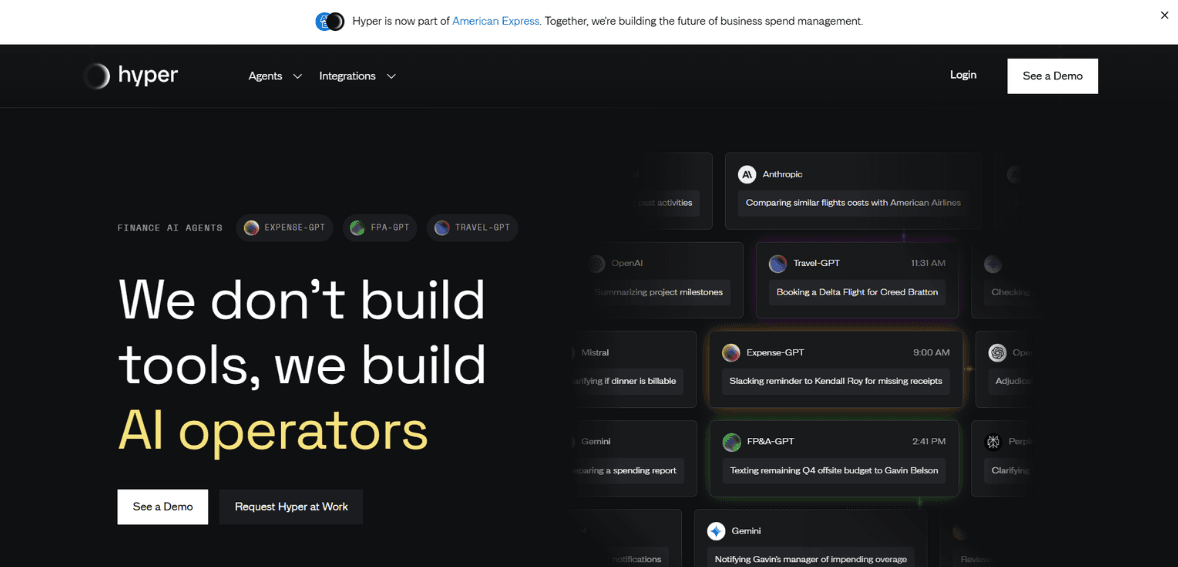
Hyper’s focus was on developing effortless finance. However, their ultimate goal wasn’t just to develop an expense tracker for corporate giants; it was to build an FP&A (Financial Planning & Analysis) agent capable of forecasting financial outcomes. The key applications were forecasting and a corporate travel-planning agent, which would give Amex a roadmap for future AI products.
On top of that, Amex also acquired a specialized engineering team that knows exactly how to build and deploy AI tools that don’t break under stress. This was effectively an acqui-hire.

Amex had a closed-loop payment network. This means that Amex acts as both the card issuer and the payment processor, which gives it direct access to far richer transaction data than open networks do. Amex does not want to limit itself to just facilitating payments. Its ultimate aim is to own the end-to-end corporate finance lifecycle, from initiating payments to balancing the books. They want to manage what happens before and after the swipe, making it harder for companies to switch from Amex to a competitor. It wants to become an embedded finance solution. Embedded finance means the integration of financial services, such as accounting software, directly into a non-financial or primary interface, such as credit cards.
Since Amex operates a closed-loop network, it has access to more granular transaction data than Visa and Mastercard. Feeding this data directly into Hyper’s AI makes automated categorization significantly more accurate. The Hyper deal substantiates this ascent toward dominance in the finance field. It builds directly on Amex’s 2025 acquisition of “Center”, which is expense management software, proving that Amex is systematically assembling an all-in-one corporate finance platform to launch later in 2026.
This acquisition is also aimed at fending off fintechs. B2B fintechs such as Brex and Ramp built their entire businesses by offering software attached to corporate cards. Amex is buying Hyper to beat these agile startups at their own game.
Continuous close is an accounting concept in which books are updated and reconciled in real time rather than compiled at the end of the month. To prevent the burden of updating massive batches, companies often use automated software. On the other hand, accrual is an accounting method in which expenses are recorded when they are incurred. This is not necessarily restricted to when cash leaves the bank and requires accurate visibility into outstanding spending.
AI agents can process expenses as they occur. This means that connecting them to the CFO’s dashboard could update accounts in real time. On the other hand, controllers get their time back. They no longer have to act as debt collectors chasing receipts, because the AI has already sent out the prompts and communication.
Lastly, since the data is carefully categorized, the financial models and budget forecasts are often really accurate.
The Amex-Hypercard deal indicates a shift in the payment landscape. It represents the moment when expense management shifted from a reactive, manual software category to a proactive, invisible feature of the payment network itself. Agentic AI not only saves money; it buys back thousands of hours of human time capital. Within five years, manually filling out account books will become obsolete, making AI reconciliation a survival necessity.
It acquired an agentic expense management software company, gaining its team of AI experts and proprietary tech stack to automate back-end finance.
No, but it will fundamentally change their jobs. AI handles the rote, manual data entry and basic reconciliation, allowing controllers and accountants to focus on strategic analysis, cash flow forecasting, and edge-case exceptions.
If an expense is wrongly categorized, it will be passed to the human supervisor for confirmation. This will be a rare case, as AI can categorize quite efficiently, and the human in the loop would ensure a high level of accuracy.
Credit card companies are acquiring software companies to establish closed-loop networks that control the entire financial cycle for corporates. This is an effort to remain relevant in a market where payment processing is becoming increasingly commoditized.
When an expense occurs, the AI cross-references the transaction against those rules in real-time, instantly approving compliant spending and flagging violations.