
Posted: June 16, 2026 | Updated: October 06, 2026 at 6:04 PM
Picture two coffee shops on the same street. Both serve great espresso. Both have loyal regulars. Only one sells gift cards. By December, that shop has thousands of dollars sitting in its account, a wave of first-time visitors, and a marketing tool that costs almost nothing to run. The other is still wondering why business feels flat. Gift cards for restaurants and retail are among the most overlooked payment options in small businesses. They are easy to launch. They pay for themselves. Yet most owners never turn them on.
This guide breaks down why gift cards work, what they do for your numbers, and how to build a gift card program that actually drives sales. The setup is simpler than you think. The upside is bigger than most owners expect.
The majority of small business owners categorize gift cards as seasonal extras and designate them as a “nice-to-have” for December. This is precisely where the issue lies. Gift cards function as a payment method that allows customers to pay you now, with the value redeemed later. If you think of gift cards in this manner, you would realize that they are not a holiday gimmick but rather an integral part of your business’s cash flow.
Let’s break down the payment process. A customer walks into your business, and, instead of buying a product directly, pays you the cash equivalent of a product in exchange for a gift card. You have now essentially sold a product, and the customer has not consumed a meal, product, or service. The money the customer paid is now fully at your disposal, and the obligation to serve the customer remains a liability for the business. From a cash flow perspective, your customers have just provided you a loan for the equivalent of the product you are obligated to serve at a later date. They have also committed, at no cost to them, to return to your business.
The gift card market has grown significantly, reaching $1.1 trillion in 2025. North America has the largest share of this market, and digital gift cards are significantly outpacing physical gift cards in growth. The majority of customers expect the businesses they frequent to offer gift cards. The only thing you need to think about is whether your business is equipped to provide gift cards, or if you are allowing the demand for gift cards to go to a competing business.
The rationale for a gift card program is indicated by statistics, not speculation. Data show recipients often spend more than the card’s value. A good portion of gift cards go to new customers. Additionally, there are unused gift cards, which also adds revenue. The gift card program summary is in the table below.
| Metric | Typical Figure | Why It Matters for Your Shop |
| SMBs reporting gift cards bring new customers | About 72% | A built-in customer acquisition channel |
| Average extra spend above card value | Around $41 per redemption | Each redemption becomes a larger sale |
| First-time visitors driven by a gift card | Roughly 31% | Gifts introduce your brand to new buyers |
| Breakage (value never redeemed) | About 5% to 15% | Unredeemed balances can become recognized revenue |
| Cards used within one month | Around 76% | Fast redemption means quick repeat visits |
| Gift card share of SMB revenue (direct) | Roughly 1% to 4% | Direct sales understate the true impact |
Table 1. Gift card performance benchmarks for U.S. small businesses (2025-2026 research, rounded for illustration).
Infographic 1. The four levers that make gift cards punch above their weight.
Spending trends like these do not go unnoticed. The National Retail Federation notes that gift cards consistently top consumer holiday wish lists. It is therefore advantageous to implement a small-gift-card program to meet holiday demand.
Gift cards represent an advantageous cash flow mechanism. They let you book revenue in the current accounting period, even if the service is delivered in a future period. The elapsed time gives you the opportunity to fund payroll, purchase inventory, or finance a difficult month. For a company with seasonal sales like a restaurant or boutique, the gift card makes an opportunity that is difficult to replicate with other payment mechanisms.
Gift cards also lead customers to spend more than what is left on the gift card. A customer redeeming a $50 gift card will likely buy the appetizer and dessert. A customer with a $25 gift card will likely buy an item priced at $38 and pay the $13 difference. People tend to view purchases as a smaller out-of-pocket expense when they are partially funded with a gift card. This phenomenon increases your sales volume with each gift card redemption.
The third, and possibly most appealing, benefit is breakage. Gift cards are sometimes forgotten or partially redeemed. The unredeemed value of gift cards is typically between 5% and 15% of total gift card sales. Under U.S. accounting rules, unredeemed gift cards can be recognized as income. The goal is not to wish for customers to forget to use their gift cards. It is known that a successfully managed gift card program drives sales, is profitable, and is very likely to increase sales volume.
Before launching, you need to consider which card aligns best with your business. Closed-loop cards only work at your store, so spending stays within your walls. Because of this, they are ideal for most independent restaurants or retailers. Open-loop cards operate on a card network and can function almost anywhere. They are better suited to gifting platforms and large corporate programs, but will offer little advantage to a business with a single location. The comparison below outlines the trade-offs.
| Feature | Closed-Loop Gift Cards | Open-Loop Gift Cards |
| Where they work | Only at your business | Anywhere the network is accepted |
| Best for | Single shops, restaurants, local retail | Gifting platforms, large corporate rewards |
| Cost to run | Low; often built into your POS | Higher; network and issuance fees |
| Keeps spending with you | Yes | No |
| Drives repeat visits | Strong | Weak |
Table 2. Closed-loop versus open-loop gift cards for SMBs.
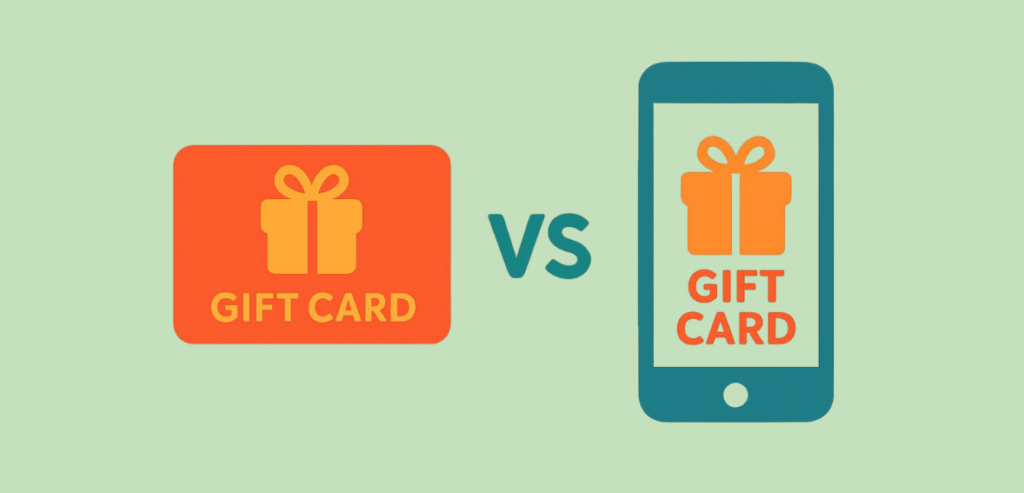
The physical card remains relevant. Customers enjoy having an item to give as a gift. Promotional placement of a branded card at the register is a fun buy and free marketing. However, across most markets, digital gift cards outpace physical gift cards. They offer convenient last-minute, asynchronous purchases. The correct business strategy is not to choose one. It has both and allows the customer to decide.
| Factor | Physical Gift Cards | Digital Gift Cards |
| Upfront cost | Card printing and stock | Minimal; no inventory |
| Delivery | In person or by mail | Instant by email or SMS |
| Impulse buys at checkout | Strong | Limited |
| Online and social selling | Limited | Strong and scalable |
| Best season | In-store holidays | Last-minute and digital gifting |
Table 3. Physical versus digital gift cards at a glance.
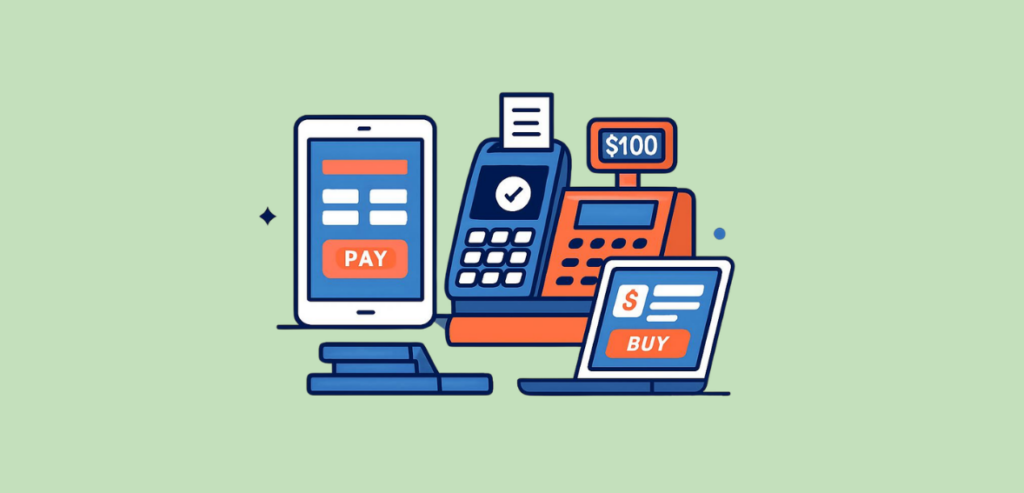
Here’s the bright side. You likely possess the necessary resources to manage your own gift card program. The majority of contemporary point-of-sale systems incorporate gift card functionality, either at no cost or as an inexpensive additional feature. That translates to no additional vendor, no cumbersome integration, and real-time updates at the register and online. Outlined below are three systems that small businesses depend on most, with their gift card configurations described simply.
Square is the primary choice among cafes, food trucks, pop-ups, and small retail businesses for a convenient way to get started. Square’s base plan is free, includes digital gift cards, and lets you order physical ones. There are no long-term agreements. The standard processing fee for card-present transactions is 2.6% plus 15 cents. Gift cards can be sold online and in person, and through social media channels, all from the same dashboard. For an owner wanting to go live this week, Square is the simplest choice.
Because Toast is designed for restaurants, it integrates many of its modules, including its gift cards, directly with dine-in, take-out, and online ordering systems. As a result, it provides a seamless experience for users. Gift cards, loyalty, email, and SMS marketing modules are bundled together in a higher marketing tier, which is quite advantageous if you already operate on Toast hardware and wish to consolidate all services within a single platform. The main disadvantage of this tier is its higher cost and longer setup, which make it more appropriate for a full-service restaurant than for a single coffee cart.
Clover is a hybrid solution. It can handle physical and digital gift cards and even offers loyalty and inventory tools, appealing to more established restaurants and retailers. Gift card capability is included in all tiers, and plans can scale according to your needs. If you have graduated from a more basic system, but don’t want to be restricted to a restaurant-only system, Clover is a great option.
| Platform | Best Fit | Gift Card Setup | Notable Cost Note |
| Square | Cafes, pop-ups, small retail | Free digital cards; physical optional | No contracts; ~2.6% + 10c in person |
| Toast | Full-service restaurants | Bundled with loyalty and marketing | Higher monthly cost; restaurant-only |
| Clover | Growing restaurants and retail | Physical and digital across tiers | Tiered plans; hardware sold separately |
Table 4. POS platforms with built-in gift card programs for SMBs.
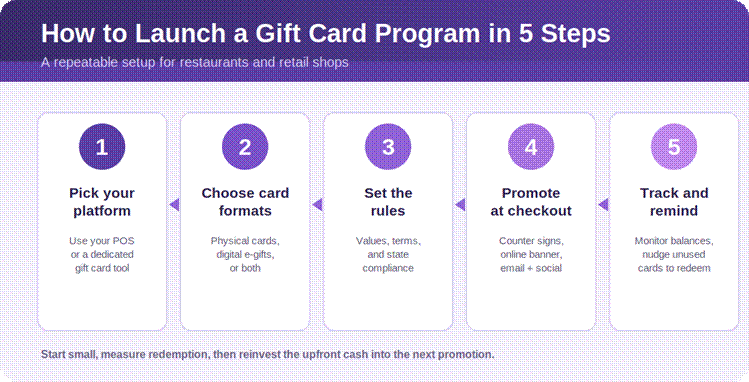
Setting up a gift card program is efficient. First, decide on a program. For most owners, that means enabling a feature on their POS. After that, decide on the card designs. Make sure to cover all customers by offering both physical and digital cards. Then, set your program guidelines by establishing card values, terms, and any other requirements that might apply. Make sure to promote your gift card program and set up dedicated displays at checkout, on your website, and include information in your email and social media marketing. Keep track of your card balances and use reminders to encourage customers to use their gift cards. For the entire flow, refer to the infographic below.
Infographic 2. A repeatable five-step launch for restaurant and retail gift cards.
Gift cards naturally work to restaurants’ advantage. Because dining is a social, routine experience, a gift card purchase almost guarantees a restaurant’s return business, likely with guests. Full-service restaurants even see the greatest increase in spending. Diners apply the card to part of the meal, then add drinks and dessert on top, which lifts the check total. A $75 card purchase often results in a $110 check.
The other advantage is the seasonal increase in sales. Gift card purchases spike during the holidays, Mother’s Day, graduations, anniversaries, etc. Restaurants should strategically place promotional materials to sell gift cards, such as signs at the host stand and check presenters, card promotions on the website’s order page, and a gift card promotional offer in the email. An example of a gift card promotional offer is a $10 card giveaway with the purchase of a $50 gift card, designed to increase sales and bring guests back to the restaurant during a slow week.
Retail gift cards address the most common gifting dilemma – the uncertainty around a recipient’s preferences. Gift cards allow the buyer to select the store, while the recipient chooses the item. This gift can even help businesses by bringing them a new customer, since many gift card recipients visit a store for the first time.
Businesses should take advantage of the benefits of gift cards by using digital gift cards. They are a great option for online and social commerce because they can grow the business with no added cost. Physical gift cards may be available to customers in-store who purchase on the spot. They should be displayed in the store and on the website. Stores that sell gift cards on their website are likely to sell more than stores that hide them.
Gift cards have rules that vary on state and federal levels. Under federal law, gift cards must be valid for at least five years and charge very limited inactivity fees. State laws can expand federal requirements by adding their own packaging rules, disclosure requirements, and unclaimed property laws. Some states can take the long-unredeemed value of a gift card. Gift card sales also affect accounting. Gift card sales are a form of revenue that is not immediately recognized and is recognized when the gift cards are redeemed or when it becomes predictable that they will not be redeemed.
None of this should be a barrier. However, it is recommended to seek professional advice and review consumer protection laws before selling gift cards. A good starting point is the Federal Trade Commission, as it gives a clear summary of gift cards and the associated fraud, which is worth flagging to your own customers.
The largest oversight is a complete lack of program promotion. Owners activate the feature then never bring it up. Cards go unnoticed by cash registers and are hidden under website footers. If customers are unaware that you provide gift cards, they will not buy them. The most important thing you can do is to provide visibility at checkout and online.
The next-largest oversight is failing to account for gift card redemption. An unsold gift card is the first half of a sale. A balance notification is an easy and effective way to bring customers to your store and collect the revenue. The other oversight is that gift cards are provided in only one format. Not providing digital gift cards means missing out on the online and last-minute gift sales. Not providing physical gift cards means missing out on impulse-buy gift sales at the register. Provide both gift card formats, remind customers of their gift card balance, and offer reminders to use the gift cards.
Gift cards for restaurants and retail are not a seasonal gimmick. They are a payment setup that delivers upfront cash, larger average ticket sizes, a steady stream of first-time customers, and a margin cushion against breakage. The tools are likely already inside your point-of-sale system. The cost to start is close to zero. The only thing missing for most small businesses is the decision to switch the feature on and put it in front of customers.
Start small. Offer both physical and digital cards. Make them impossible to miss at checkout and online. Track redemption and send a reminder now and then. Do that, and the underused payment setup becomes one of the hardest-working tools in your business.
Related reading on gift cards: Restaurant Payment Resources.