
Posted: June 11, 2026 | Updated: June 12, 2026 at 1:24 PM
On June 3, 2026, branch-closure filings with the Office of the Comptroller of the Currency surfaced — first reported by Banking Dive — confirming that Fifth Third will shut 81 branches this summer as it digests Comerica. The $10.9 billion all-stock acquisition closed in February 2026, creating the ninth-largest bank in the country with roughly $294 billion in assets. CEO Tim Spence has framed the deal around about $850 million in targeted cost savings — and branch consolidation is where a good chunk of that math gets done.
The bank’s public framing is reassuring and mostly accurate: it is consolidating overlapping locations, and most branches being closed have another Fifth Third within a mile. That answers a consumer’s question — where do I deposit a check now? It does not answer a business owner’s question: whether payroll runs and vendor payments clear without interruption when two banks’ systems are stitched into one. For a small business, the branch closing is the headline; the account conversion behind it is the event that can actually cost you money.
The closures are heavily concentrated in Michigan, where the two banks’ footprints overlapped most. Per the OCC filings reported by Banking Dive and the Detroit News, the 75 Michigan closures break down to 55 former Comerica branches and 20 existing Fifth Third sites, with the remaining six spread across Florida (four), California (one), and Texas (one).
Source: OCC branch-action filings, via Banking Dive & the Detroit News (June 2026).
| DETAIL | FIGURE |
| Total branches closing | 81 |
| Originally Comerica locations | 59 |
| In Michigan (55 ex-Comerica + 20 Fifth Third) | 75 |
| Florida / California / Texas | 4 / 1 / 1 |
| Closures with another Fifth Third within a mile | Most |
| Branch closures | This summer (reported ~September) |
| Full system & brand conversion | Later this year |
Despite the layoffs, Fifth Third’s Michigan net position continues to grow as it incorporates Comerica’s network alongside its own. The bank plans to have 227 financial centers across 39 Michigan counties post-acquisition, with 116 in the five-county Metro Detroit area and 19 in the City of Detroit.
Fifth Third Bank claims its acquisition will provide the City of Detroit with the largest available banking network. While the claim itself is positive, the optimism is tempered by the fact that there will be branch closures during the summer (most are expected to close during September) and the systems and brand conversion will not happen until “later this year.”
Some predict the conversion of customers to Fifth Third Bank to happen the weekend of Labor Day. Nonetheless, the time between “my branch closed” and “my bank accounts closed” will be useful for business owners.
Most account conversions are standard, but there are two reasons this account conversion deserves special consideration. First, when you take the integration of Comerica’s commercial banking division into Fifth Third’s Division, this has become one of the more significant regional bank conversions in recent years. If you’re talking about the size of the job, that’s the area where you will find exceptions. Second, and of greater interest to the business customer, the back office handling the migration is also being closed on the same schedule.
Fifth Third has submitted a state WARN notice announcing the permanent layoff of 502 workers at Comerica’s former Great Lakes Campus in Farmington Hills. The layoffs will occur in phases from July to November of 2026. These layoffs will follow those at Comerica’s Texas locations, bringing the total to over 740 employees. The layoffs won’t stop your payroll from running on their own.
The subtler risk is that the staff who best understand Comerica’s commercial accounts are among those leaving — on the same schedule as the migration itself. The most logical and safest approach would be to build your own safety net rather than to assume the bank’s safety net will be adequate.
“Another branch within a mile” is a geographic term. A business doesn’t run on geography; it runs on the account identity to which everything is wired. When Comerica accounts migrate onto Fifth Third’s systems during the conversion later this year, the pieces that depend on that identity are the ones that can break. Here is the chain that must survive the cutover, roughly ordered by the damage a failure would cause.
Changes to your account numbers will have a ripple effect on your transactions. Write to your bank and ask if the account and routing numbers for your former Comerica bank account will change. Be aware that some Comerica bank accounts were reassigned while others were retained. The answer to your inquiry will tell you how much of this list will pertain to you.
If your business originates ACH payments — vendor disbursements, tax payments, customer debits — those origination files reference your originating account and routing. A single stale field, such as the immediate origin or the company/batch header, can bounce an entire batch, and ACH returns can take days to surface. Once you have the new credentials, send a small test file before you push a full payroll or vendor run through it.
While it is true that no area of accounting can be allowed to make mistakes, payroll is the most critical to get right. Whether payroll is processed in-house or through an external provider, the funding account that is provided must match the converted account.
If payroll is processed by a third party, be it Gusto, ADP, or Paychex, the funding account must be updated in the third party’s portal, not the bank’s. A pre-note must be confirmed to clear prior to the next scheduled pay date. The same principle applies to recurring debits and to autopay setups that are initiated by the customer.
Be prepared to re-enter payees, as saved bill-pay payees do not always migrate correctly. On the card side, your processor makes settlements to a deposit account using the routing and account numbers. If these change and no one addresses them, a day or two of card batches may remain unsettled. If your processor is the bank, a conversion may involve card-processing re-boarding, new terminals, and a new gateway, with card-on-file tokens re-vaulted.
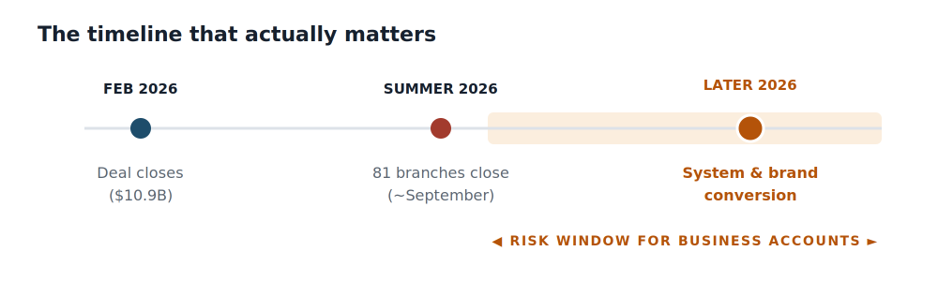
The branch closing is the visible event. The conversion is the quiet one — and it’s where ACH, payroll, and settlement instructions are most exposed.
If you run cash, a branch closure isn’t just an inconvenience — it changes your deposit logistics. A location that closes this summer may have been your deposit drop, and the replacement may not sit on your route.
Three factors influence what a bank should do. The first factor is distance. If your closest branch is 20 minutes away, daily deposit runs take staff time and increase the likelihood that cash sits on-site overnight. The second factor is volume. Once you’re depositing more than a few thousand dollars per day, an intelligent safe that provisionally credits your account, or a remote deposit capture for checks, generally reduces the trips to the bank.
The final factor is the quote for the armored pickup. A route that may have worked for your bank’s location in the past may not work for your bank’s location in the present, as transport companies quote based on stop frequency and distance. Get a quote before the branch closes, rather than after, so that you won’t have to consider the quote during the time the branch is closed.
Once you have a conversion date, run this list against your accounts. The goal is simple: when the systems flip, nothing that touches money should reference stale account information.
| # | VERIFY | WHY IT MATTERS |
| 1 | Routing & account numbers post-conversion | The detail everything else depends on |
| 2 | ACH origination ID & settlement account | Stops rejected vendor/tax batches |
| 3 | Payroll funding account | The one you cannot afford to miss |
| 4 | Recurring debits you originate | Subscriptions and customer autopay |
| 5 | Autopay / bill-pay payees | Saved payees may not migrate cleanly |
| 6 | Merchant deposit & settlement instructions | Where card deposits actually land |
| 7 | Wire instructions shared with customers | Update before they send to old details |
| 8 | Online/mobile banking & entitlements | User roles and approvals can reset |
| 9 | Account signers & authorized users | Re-confirm who can move money |
| 10 | Statements, tax docs & payment history | Download before access changes |
The checklist tells you what to verify; this tells you when to do it. Treat the conversion date as a hard deadline and work backward from it.
60 days out: Have the conversion date confirmed in writing. Inquire if the account and routing numbers will change. Establish a backup operating account at another financial institution. Export the statements, tax documents, and payment history.
30 days out: Your payroll provider, processor, and key vendor funding accounts need to be updated. Autopay and bill-pay payees need to be re-entered. A test ACH file and a small test card batch should be sent using the new details.
Conversion week: When possible, run payroll a day early. Maintain more operating cash on hand than normal to account for any settlement delay. Ensure you have a point of contact at the bank (i.e., a name, not a 1-800 number).
The week after: Reconcile the first full ACH cycle, the first payroll, and the first week of card settlements line by line before you trust the new setup.
Fifth Third asserts that its net pitch yields a positive outcome for its customers after branch conversion. They claim that after conversion, Fifth Third clients and former Comerica clients in Michigan will gain access to approximately 42% and 60% more branches, respectively. Fifth Third also claims that they will offer the most extensive banking network in Detroit. However, looking at the big picture, this offer reflects the industry as a whole.
According to TheStreet, 178 bank branches shuttered during the first months of 2026, and over 10,000 branches closed after 2019. In the last 10 years, the Federal Reserve recorded a 19% reduction of bank branches in the United States. The trend of consolidation continues with regional mergers. This spring, layoffs from PNC’s merger with FirstBank impacted Colorado.
This merger is no different. Comerica was founded in Detroit in 1849. It wasn’t until 2007 that Comerica moved its headquarters to Dallas. By late 2026 or early 2027, Comerica will merge with Fifth Third (which will also include the naming rights to Detroit’s Comerica Park), thus significantly changing the face of banking in Detroit. In reaching this decision, Fifth Third has erased nearly two centuries of Detroit banking by focusing on integrating Comerica into its operations and eliminating the city’s largest banking presence.
The practical lesson isn’t “panic about your branch.” It’s that a closure notice is a re-shop moment — for banking and for processing. (We made a similar case after the CFPB’s Bilt reimbursement order: when the rails shift under you, it’s worth checking who you’re actually tied to.) The owners who come through a conversion unbothered are usually the ones who used it as a prompt to ask whether their current setup is still the best one.
Here’s the section that is missed by most owners in the mad rush: your payments stack doesn’t need to be at the mercy of your bank’s merger calendar. If merchant services are with an independent provider (not a bank), your processing, ACH, and settlement logic remain safe during a bank switch — just reassign the deposit account.
Although simple, this principle increases your flexibility and reduces a bank’s monopoly. With an independent processor, you can settle money at any bank of your choosing. If a bank changes, you change a single field at the processor. Keep your card tokens with a vault provider, and a bank merger/transfer will prevent forced re-entry of your customers’ cards. This principle demonstrates why your bank is not the problem. Your bank is not your single point of failure.
| COMPONENT | IF IT’S TIED TO THE BANK | IF IT’S PORTABLE |
| Card processing & settlement | Re-papered with the bank | Stays — repoint deposit acct |
| ACH origination | Re-onboard, new originator ID | Stays — same provider rails |
| Recurring billing / tokens | At risk of re-vaulting | Stays — tokens preserved |
| Reporting & reconciliation | New portal, new exports | Stays — same dashboard |
That portability is the whole argument for keeping merchant services separate from the deposit relationship — and for understanding the faster-payment rails (FedNow, RTP) that increasingly move money independent of any single branch. When the bank consolidates, the payments stack shouldn’t have to.
Yes — deposits remain FDIC-insured throughout, up to applicable limits. The risk here isn’t your balance; it’s the timing of transactions that depend on account details lining up after the cutover.
They may. Some former Comerica accounts could be reassigned while others carry over. Ask the bank directly, in writing — the answer drives most of the checklist above.
The bank says “later this year,” with branch closures landing this summer (reported around September). Some coverage points to a Labor Day conversion. Don’t rely on the public language — get your specific date confirmed in writing.
No. A closure notice is a natural time to compare banking and merchant services options. If you do switch, sequence it so it doesn’t collide with the conversion itself.