

Posted: June 17, 2026 | Updated: October 06, 2026 at 5:57 PM
Picture two yoga studios on the same street. They have the same rent. They run the same classes. They even share a few instructors. One owner sleeps well at night. The other refreshes the bank balance every morning, praying for a busy weekend. The only real difference between them is how they sell access. One leans on class packs. The other built a base of unlimited memberships.
This sole pricing decision fundamentally determines your studio’s finances, the amount of stress you experience, and the overall worth of your studio when you sell it. Nevertheless, most studio owners rely on instinct or mimic nearby competitors to choose a pricing model. Most studio owners do the incorrect calculations, and as a consequence, they don’t know what to celebrate. This pricing guide aims to simplify revenue calculations for class packs vs unlimited memberships, elaborate on common pricing errors studios make, and explain how to price your studio offering to maximize your income.

Pricing is not a flexible concept. It is the core component of your business model. Your pricing structure directly determines the predictability of your revenue, the consistency of client attendance, and the length of client retention. In the past several years, the boom in boutique fitness has brought record-high participation in health clubs and studios.
In the United States, since the beginning of 2019, there has been an unprecedented 20% increase, bringing the total to a record 77 million members. This rapid expansion has shifted the industry from a pay-per-class business model to one focused on recurring revenue.
The pay-per-class model has the most unpredictable revenue flow. Well-structured memberships have the most predictable revenue flow. The pricing team at Glofox has documented this in their gym pricing guide. As the rest of this article will show, the perception that class packs are the “safest” option is both misleading and incorrect.
A class pack consists of a bundle of pre-purchased sessions. This can include a purchase of five, ten, or twenty classes, which are then redeemed by the buyer over a set period. A studio’s incentive to market class packs comes from the ability to collect a lump sum of money, while each class is sold at a price that is less than the studio’s drop-in class price and greater than the per-class price of an unlimited plan. Buyers feel that packs have low commitment, and studios feel that packs have high cash flow. This is why class packs can be attractive yet problematic.
Unlimited memberships involve fixed, recurring fees, usually at a monthly rate, allowing clients to attend an unlimited number of classes. Because clients pay the same amount whether they attend classes twice a month or twice a week, the studio earns the same regardless of attendance. This idea of membership is very similar to, if not exactly the same as, a subscription to streaming services and software. Although this idea of direct subscription systems trades the excitement of a large one-time purchase, it is for the much more valuable benefit of a recurring purchase.

These miscalculations turn small judgment errors into costly decisions. Short-term losses due to the errors in the calculations below might seem innocuous. In the long term, the errors below will continue to reduce profits and minimize growth. The infographic below will illustrate the key issues succinctly, and then expand on each error in greater detail.
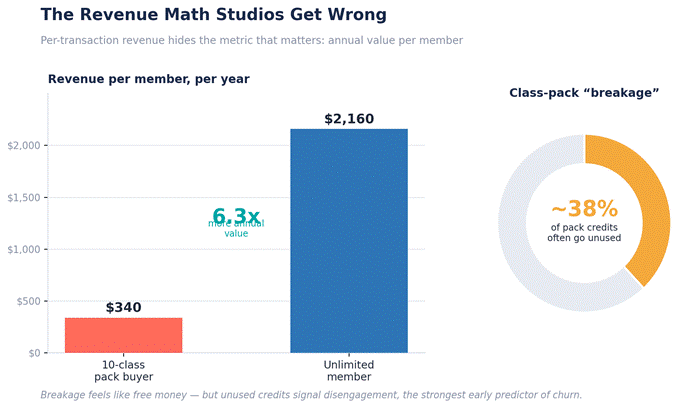
Figure 1. Per-transaction revenue hides the metric that actually drives a studio: annual value per member.
It feels great when a ten-pack sale brings $170 to the till. Your brain likely treats it as a monetary gain. In reality, you’ve only collected a deposit for services not yet rendered. You still have to teach ten classes. You’ve not made a profit; you’ve created a liability. Your client may take months to use the pack. During those months, you won’t have any new income from the client. The cash only came in once, and you’ve spread the revenue thin. Studios that chase these single-transaction sales create feast-or-famine income, making it a monthly gamble to meet payroll and rent.
Breakage refers to unused prepaid credits. Clients can buy packs of 10 credits but use only 6, leaving 4 unused. Clients cannot redeem the credits, which benefits studio owners. Studio owners bank on breakage because it is the most alluring trap. Breakage is not a benefit; it is a warning. Clients with unused credits eventually stop attending, which is the clearest predictor of client cancellation. Clients who are disengaged from the studio are most likely to terminate their membership. Although breakage seems to be a benefit and an increase in profits for studio owners, in reality it is a loss of clients.
This includes all other errors as a subset. Comparisons between pack sales and month-long memberships are under the mistaken belief that the sale with the higher number is the better sale. Such comparisons are invalid. The correct comparisons are per revenue unit per member per year and then per revenue unit per member for the entire potential life of that member.
The perspective changes dramatically when such comparisons are made at the annual level. A member who purchases pack sales twice and then becomes a non-member may generate several hundred dollars in a year, whereas a month-to-month member may generate several thousand dollars. The chart below shows the two revenue streams for the same number of clients over the full year.
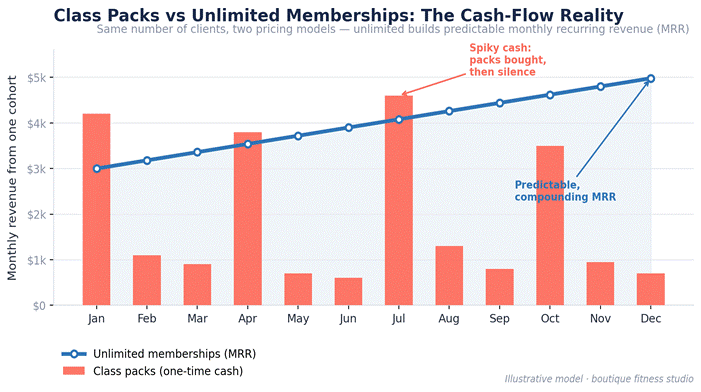
Figure 2. Class packs produce spiky, unpredictable cash. Unlimited memberships build compounding monthly recurring revenue.
Every model serves a purpose. Each model is correct in its own sense. The factors that will change your bottom line differentiate the models that we have presented in the table below. With this, you can select the model that best matches the role.
| Factor | Class Packs | Unlimited Memberships |
| Cash flow | Lumpy and one-time | Predictable and recurring (MRR) |
| Revenue forecasting | Hard to project | Easy to model month over month |
| Client commitment | Low and transactional | High and habit-forming |
| Visit frequency | Often low; easy to lapse | Higher; drives routine and loyalty |
| Churn warning signs | Hard to see until too late | Visible through attendance data |
| Discounting pressure | High; competes on price | Lower; competes on value |
| Best role | Trials, casual users, visitors | Core revenue and community base |
Table 1. How class packs and unlimited memberships compare across key revenue factors.
Member lifetime value (LTV) totals how much revenue an individual member brings before they leave. It is the metric that determines which pricing model wins for a business. Because of its nature, LTV is designed to reward businesses for retaining customers.
It is why the unlimited membership model works the best. The framework is simple. Take your average revenue per member per month, and divide that by the monthly churn rate. For example, a member who pays $180 per month and has a 5 percent monthly churn rate has an LTV of $3,600. That number dwarfs the value of just about any class-pack relationship.
Retention is not a vague, subjective metric to aim for. It is a solid, financial lever to pull. Across industries, a 5 percent increase in customer retention translates to a 25 to 95 percent increase in overall profits. Retention is made even more important when analyzing member visitation frequency. Members who attend the studio at least two times a week have about a 50 percent lower membership cancellation rate than those who attend once a week or less.
According to Zenoti’s guide for studio memberships, improving retention is not just important for studio profitability, but the average studio loses about $25,000 to churn, and it costs about five to seven times more to replace one member than to retain them. The most effective way to reduce churn is to introduce unlimited memberships, which build a habit of frequent studio visits.
| Metric | 10-Class Pack Buyer | Unlimited Member |
| Price point | About $170 per pack | About $180 per month |
| Typical behavior | Buys ~2 packs, then lapses | Stays roughly 12 months |
| Annual revenue | About $340 | About $2,160 |
| Monthly churn | Not tracked; quietly drops off | About 5% |
| Estimated lifetime value | About $340 | $3,600 and up |
Table 2. An illustrative lifetime value comparison. Figures are directional, not exact, and vary by market.
Notice the gap. The pack buyer and the member may pay a similar price per class, yet the value each brings to your studio is incomparable. This is the calculation that many studios misinterpret when they focus mainly on the size of a single sale.
You won’t have to take this on faith. Companies that develop studio software see pricing data for thousands of businesses. Their results are similar, and each platform provides a slightly different take on the message.
Glofox is a management system for gyms and boutique fitness establishments. They have clear preferences in their pricing models: drop-in and pay-as-you-go systems rank lowest on the revenue-predictability scale and should be avoided as your primary source of income. According to Glofox, packs and drop-ins should be used to guide newcomers toward memberships (the core of your income), since the majority of members choose a mid- or upper-tier membership.
Already established as a leader in client retention in the wellness and fitness business segment, Zenoti cites a key industry shift in its reporting. The shift indicates that the fitness industry is moving away from pay-per-class systems and adopting recurring membership systems that are sustainable and scalable in the long run. Zenoti believes that the sign-up process is only a small portion of the work; the goal is retention, which converts memberships to lifetime value. Zenoti ties early attendance and retention to whether members survive past the six-month mark, and this is exactly the behavior that unlimited plans are intended to promote.
ClassPass is a flexible class marketplace that connects users with a wide range of fitness classes. It set an industry standard: users should have easy access to sampling fitness options. For fitness studios, ClassPass is better suited as a marketing tool to help new customers discover the studio, rather than generating direct revenue. ClassPass recommends its partners track the blended rate over time to monitor how the mix of membership, discounts, and breakage influence the profitability of a given class.
Mindbody is among the leading booking and business solutions available to boutique fitness clubs. Operators in the fitness technology sector are being forced to innovate at an unprecedented pace. The fastest-scaling operators in the industry are those who shift their membership mix away from one-and-done package sales and lean towards higher-tier, unlimited, and recurring options. Average revenue per user is higher when a client purchases an unlimited plan than when they purchase a small-class package, and is again higher when they purchase personal training. This trend remains consistent across yoga, Pilates, and cycling studios.
This doesn’t mean class packs should be eliminated completely. The most successful studios do not take a definitive side. Rather, they give each model its own job. Class packs and drop-ins serve as the front door. They offer newcomers, travelers, and people who are not ready to commit yet the opportunity to take classes without signing a long-term contract. When paired with a sense of urgency and a clear call to action, an introductory offer, such as a month of unlimited classes, can convert 25% to 50% of trial users into members.
Once the prospect converts to a member, an unlimited membership functions as the first home of the prospect, as it is the place that the member feels the strongest connection to, and the studio can build and deepen the relationship with the member. It is important to include flexible options that allow members to minimize their membership plans or put them on hold without permanent separation from the studio or the community. The packs serve as the first step in attracting members, and once they have made that initial commitment to a membership, the next step is to increase value with premium offerings.
Understanding numbers and executing with confidence is strong pricing. Start by establishing your unlimited membership as the best value. Price your membership packs such that your clients are mathematically compelled to select the membership. Additionally, construct your membership tiers such that your middle tier is the best margin tier, as consumers have a tendency to select the middle option. Considering the market, a typical boutique unlimited membership in the United States ranges from $110 to $360 a month, with substantially greater value compared to a big-box gym.
Consider metrics that predict the future, not just the ones that flatter the present. Focus on an individual member’s average revenue per membership, membership lifetime value, and their frequency of attendance. A member sliding from four classes a week to one is one of the earliest warning signs of an impending cancellation. Reach out to that member before they cancel. Price increases, such as an annual 3 to 7 percent increase, are well accepted when valued membership offerings are communicated before the increase. Finally, never discount your membership as a desperate attempt to offset slow revenue months. Frequent, deep discounts on memberships train your clients to wait for a deal and reduce the value of your membership offering.
Class packs and unlimited memberships answer two different questions. Packs answer the question of how to get someone through the door. Memberships answer how to keep them, and how to build a business you can forecast, finance, and one day sell. The revenue math studios get wrong is the habit of judging pricing by the size of a single sale instead of the lifetime value of a relationship. Stop counting breakage as a win. Stop comparing one pack to one month. Start measuring revenue per member per year, and the right strategy becomes obvious.
Build your studio on recurring revenue. Use class packs as the welcome mat, not the floor. Track the numbers that predict tomorrow, and your studio will stop gambling on busy weekends and start growing on purpose.
Rarely does a single-modality studio with low capacity use scarcity and a waitlist to sustain a simplified business model. For most studios, packs work best as a trial or an add-on rather than as the core component of the business model.
At a per-class comparison, membership should be the superior choice. Take advantage of the fact that a client has just finished a pack to implement a natural conversion point. An upgrade offer with a waived enrollment fee creates urgency and removes friction when time is limited.
Around 30 to 40 percent of gym members leave annually, compared with about 25 percent for boutique studios. Monthly churn rates can be pushed to below 5 percent in the most successful studios. The first 90 days of a member’s engagement are when cancellations are most likely to occur, so it’s important to focus on customer engagement during that time frame.
It can, especially in a smaller space, if higher frequency clients make your per-visit revenue too low. You can manage this by capping class sizes, smart scheduling, and offering tiered plans that charge more for higher levels of access. For most studios, the benefits of retention far outweigh the costs of capacity.
With class packs versus unlimited memberships on your list, the fitness and gym resources hub has the related guides.
