
Posted: June 12, 2026 | Updated: June 12, 2026 at 3:06 PM
When a federal regulator issues a public statement about a single rewards card, it usually isn’t really about the card. The CFPB Bilt reimbursement order — the Consumer Financial Protection Bureau’s June 2026 direction that Bilt repay customers harmed by a messy switch to a new bank partner — looks small on paper. Around 500 newly identified customers. A handful of overdrafts, late, and insufficient fees. No fine, no consent decree, no courtroom. Yet inside the payments and banking-as-a-service world, the move landed like a flare over a dark field. It lit up exactly where the risk lives in modern finance: not in the apps consumers see, but in the invisible rails that move their money.
Do you offer debit cards, credit products, rent payment services, savings accounts, or even a buy-now-pay-later option? If so, you almost certainly rely on rails. If you want to understand what to expect from the companies that control the rails, look at the Bilt situation. This article will explain what happened and provide context for what a press release implies. We will also explain what is meant by “fintech rails” and provide practical lessons for any business whose product is dependent on a partner bank.

Bilt is a New York-based fintech company known for enabling users to earn points for paying rent, one of the least rewarding yet most frustrating monthly expenses. Until about February 2026, the company was relaunching the Bilt Card with major updates, along with a severance from the Wells Fargo partnership, meaning that rent payments that had previously gone unrewarded would be handled through Bilt. Unfortunately for Bilt, demand for their services exceeded their ability to provide them, resulting in a host of issues, including card declines, frozen cards, and missing statements. The most frustrating issue, payments for rent and mortgage that were deducted from users’ accounts but not sent to the recipients, was also the most damaging.
The fallout caught the notice of regulators and legislators. After meetings with the CFPB, Bilt agreed to reach out to a select number of impacted customers to provide reimbursements for overdraft, late, and insufficient funds fees assessed as a result of the account conversion. According to the Bureau’s statement, Bilt agreed to reimburse fees for over 500 newly identified customers by June 4, 2026, and provided supporting documents to demonstrate that the technical issues related to the case had been resolved. The CFPB stated that it would monitor the Remediation efforts until all impacted customers were reimbursed.
The Agency framed this as a non-punitive, collaborative solution, illustrating the Bureau’s “Enforcement Principles” in action. There was no fine. Bilt stated that the high demand caused “gaps in service that are simply unacceptable to us,” and indicated that they were expanding customer support. Bilt said all remaining issues from the February transition were resolved.
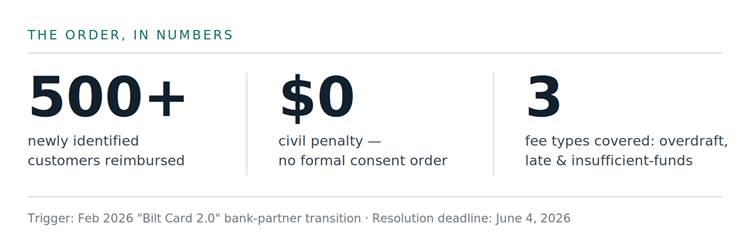
The CFPB Bilt reimbursement order in numbers — the headline figures are modest, which is exactly why the framing matters more.
This first detail should get the attention of nearly every fintech operator: in technical terms, the CFPB does not have direct supervisory jurisdiction over Bilt. There have been no formal enforcement actions in the traditional sense, no consent order with a dollar value attached, and no litigation. Experts in the industry and former bureau staff have indicated that it is not uncommon for the CFPB to meet privately with prominent companies regarding alleged consumer harm, but it is almost unprecedented for the CFPB to publicize such meetings through a press release.
That distinction sums it up. The Bureau opted for influence over authority. It deployed its bully pulpit, including the implicit threat of its “unfair, deceptive, or abusive acts or practices” (UDAAP) powers, which can extend to nonbanks, to persuade a company to provide redress without bringing an enforcement action. That’s much harder for a company to plan around than a more traditional regulatory framework. Regulations demarcate the line that cannot be crossed. A statement of enforcement interest signals that the regulator is prepared to incur reputational harm to draw attention to the case, and that the negative effects of a poor customer experience may receive press coverage long before it results in a monetary penalty.

Fintech rails enable a non-bank entity to provide banking-like services. In the rare case of consumer-facing banks, the brand that consumers engage with operates within a long, intricate supply chain of partnerships that includes a program manager and/or middleware service, a chartered sponsor/partner bank, and payment networks. Though each partner fulfills an essential role, together they comprise a banking service. Consequently, the reward app would not be able to issue a credit card without support from a partner bank, payment networks, and related partnerships.
Every handoff between layers is a seam, and seams are where things tear. You might think Bilt’s change of partners is minor. That’s more like changing the foundation of a building. Most customers won’t see a change in the Bilt brand; however, the issuer, the servicer, and the ledger of record all changed at the same time. This move is arguably the most dangerous in the industry and is the move the CFPB decided to focus on.
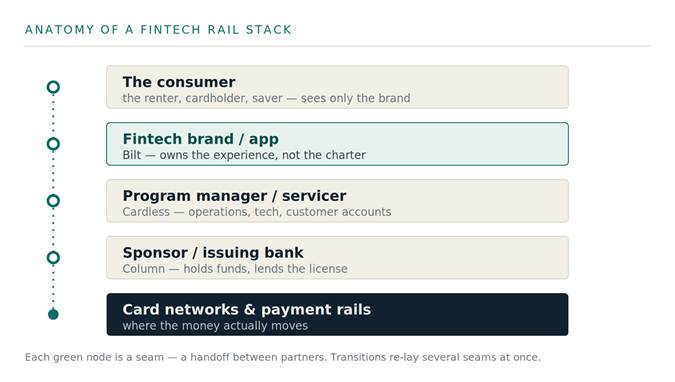
The rail stack: the brand a consumer trusts sits several layers above the bank that holds the money. Bilt’s relaunch changed multiple layers at once.
WHO WAS WHO IN THE BILT TRANSITION
| ROLE ON THE RAILS | PROVIDER | STATUS DURING THE RELAUNCH |
| Consumer brand | Bilt Rewards | Unchanged — the face customers blamed |
| Legacy issuer | Wells Fargo | Exited; partnership ended early |
| New issuing bank | Column | Onboarded for “Bilt Card 2.0” |
| New servicer | Cardless | Took over program operations |
| Regulator | CFPB | Directed redress via public statement |
Some of the friction experienced by customers can be attributed to the sheer number of participants in the process. Customers observed something like ‘finger-pointing’ when, for example, a legacy issuer was winding down its operations, a new issuer was ramping up, and a new servicer was occupying the middle. Each support team could only see their slice of the issue, while the real problem for the customer lived in the gaps. The distribution of responsibility is a design feature of most if not all, fintech solutions, not just a one-off example related to Bilt, and it is precisely this kind of situation that regulators are concerned about.
| WHEN | WHAT HAPPENED |
| February 2026 | The relaunch. Bilt migrates to “Bilt Card 2.0,” moving off Wells Fargo onto a new issuer-and-servicer stack. Demand outpaces the new infrastructure. |
| Feb–Apr 2026 | The complaints. Members report declined cards, vanished statements, slow chatbot support, and rent or mortgage payments debited but delayed or undelivered. |
| Late May 2026 | Washington notices. Senator Elizabeth Warren, ranking member of the Senate Banking Committee, presses Bilt with a detailed letter on consumer harms. |
| June 2, 2026 | The CFPB statement. The Bureau publicly discloses its discussions with Bilt and directs full redress for affected customers. |
| June 4, 2026 | The reimbursements. Bilt reimburses fees for 500-plus newly identified customers; the CFPB says it will keep monitoring. |
The political context behind that timeline matters. You can see the legislative pressure for yourself in Senator Warren’s letter to Bilt on mounting consumer harms, which preceded the Bureau’s move. The CFPB’s intervention did not happen in a vacuum; it came after the harms had already become a public story.
To properly analyze this episode, it is necessary to recognize the unique circumstances involving the CFPB. The Bureau is currently under severe contraction. The acting leadership has terminated numerous past CFPB enforcement actions, rescinded consent orders, and closed investigations. Given this context, the Bilt statement reveals the operating style of the Bureau’s new, smaller version. There will be less traditional litigation, more rapid and publicly visible collaborations, and intense pressure to provide consumer relief that typically falls within the scope of long, complex litigation.
That may sound gentler, and in some respects, it is. However, it is also true that things can happen much more quickly, with a lot more reputational damage. A formal investigation has a long period of confidentiality. A press release does not. For businesses on fintech rails, the practical meaning is that the distance between “a few hundred disgruntled customers” and “your company is mentioned in a public statement by a federal agency” has decreased significantly.
| DIMENSION | TRADITIONAL ENFORCEMENT | THE BILT-STYLE COLLABORATIVE APPROACH |
| Visibility | Confidential until charges or settlement | Public statement, often early |
| Speed | Months to years | Days to weeks |
| Primary cost | Penalties, legal fees | Reputation, trust, customer churn |
| Outcome | Consent order, fines | Voluntary redress, ongoing monitoring |
| What protects you | Legal compliance | Consumer experience + fast remediation |

Some general conclusions can be drawn for those who depend on a partner bank for their product. A key one relates to partner-bank transitions. Arguably, changing your issuer or service provider is the highest risk event in the lifecycle of a fintech product. It should be treated as a regulated migration rather than a marketing relaunch. This should include properly built parallel-run periods and thorough reconciliations between the legacy and new service providers. It should also include a refusal of marketing-driven, user-load-controlling promotional events over a service provider that has yet to be proven capable of carrying the system load.
The second lesson examines where consumer harm actually manifests in the Bilt case. The painful failures were real and included rent and mortgage payments that didn’t go through, as well as a range of overdraft, late-payment, and insufficient-funds fees. Regulators pay close attention to real, measurable, and household-level harm. If the product the consumer interacts with to meet a non-negotiable obligation is on the line between them and rent, salary, loan payments, utility payments, etc., the reliability standard is not “good enough for a rewards app.” It is “good that someone’s housing is not dependent on a chatbot.”
The third lesson involves accountability across the stack. When it comes to the regulator and the victim of the failure, the brand, the servicer, and the bank cannot hide behind a diffusion of responsibility. If the bank is the only brand visible to the customer, it owns the responsibility. Even if the failure occurred on one of the partners’ systems, the partner that owns the customer relationship is responsible for remediation. For the whole stack, the partner that provides a single escalation pathway and offers human support for high-risk failures will have a competitive advantage, whereas the opposite will negatively impact the firm’s financial performance.
Finally, there is the lesson of speed of redress. The reason Bilt’s episode was resolved without a penalty is that the company proactively contacted affected customers and reimbursed them for fees quickly. The new regulatory posture rewards that behavior and punishes its absence. The companies that will weather this environment are the ones that detect harm early, own it publicly, and make customers whole before a senator’s letter or an agency statement forces the issue.
| RISK AREA | WHY IT MATTERS NOW | THE SIGNAL REGULATORS WANT TO SEE |
| Partner-bank transitions | Highest-risk event; re-lays multiple seams at once | Parallel runs, ledger reconciliation, no premature promos |
| Payment reliability | Rent/mortgage/payroll failures cause real household harm | Funds reach the destination, on time, every time |
| Support & escalation | Chatbot-only support fails at the worst moments | Human escalation that sees across the stack |
| Fee cascades | One failure can trigger overdraft + late + NSF fees | Proactive identification and reimbursement |
| Speed of remediation | Public pressure now moves in days, not years | Self-detection and redress before regulators act |
Reading the CFPB Bilt reimbursement order, responding to customer complaints, and returning customer funds to where they belong help explain Bilt’s rough week. The more appropriate reading is the fragility of the model that most of the consumer-fintech industry has adopted. Most consumer fintech companies have established partnerships with other companies to provide complementary services (payments, cloud services, etc.). In this model, most collaborations work well until one of the partnerships is disrupted. The disruption may vary from a partner change to spikes in customer demand to a ledger mismatch. At that moment, Bilt could provide a sophisticated app, but the difference between a customer-friendly app and a regulated financial institution becomes conspicuous to Bilt.
Founders and operators can take away something almost philosophical. Regulators can turn customer service failures into public statements within days. As such, your compliance posture and customer experience are one and the same. Reliability and the rapid, honest resolution of issues must be considered the company’s real product. For those companies, rewards and user interfaces are merely product wrappers. Those companies will be the only ones still standing when the next transition goes south.
It discusses the June 2026 public guidance of the Consumer Financial Protection Bureau as it pertains to Bilt’s obligation to remedy harms caused to customers as a result of Bilt’s decision to change bank partners in February 2026. By June 4, 2026, Bilt will pay back overdraft, late, and insufficient funds fees to more than 500 newly identified customers. Notably, it was not a standard consent order or fine – it was a collaborative resolution published by the Bureau.
“Fintech rails” refers to the layered infrastructure that enables a non-bank company to offer banking-style products. The consumer-facing brand sits atop a program manager or servicer, a chartered sponsor (partner) bank that holds the funds and provides the regulatory license, and the card networks and payment systems. This model is often called banking-as-a-service, or BaaS.
There was no formal enforcement action and no civil penalty. The CFPB does not supervise Bilt directly, but it can reach nonbanks through its unfair, deceptive, or abusive acts and practices authority. Rather than litigating, it publicly pressured Bilt to reimburse its customers, a move Bilt subsequently made.
Changing your partner means switching the issuer, servicer, and ledger of record under a product that consumers currently use. The demand for the relaunch outstripped the new infrastructure, resulting in declined transactions and missing statements. Most seriously, customers experienced delays or failures in the debiting of rent and mortgage payments.
Consider partner-bank transitions to be high-risk regulated migrations rather than relaunches. When you are the conduit between the consumer and the contractual obligation, such as rent or payroll, ensure the payment assurance is non-negotiable. We expect you to take full ownership of remediation across the stack, rather than allowing it to spread across partners. Be speedy to provide redress. Under the current posture, the public can become pressured within days, and proactive reimbursement is what prevents the problem from becoming an enforcement action.
It is somewhat difficult to characterize what the agency is doing. The agency has somewhat limited its scope and has withdrawn from some of its more traditional enforcement actions. However, the Bilt episode shows the agency is willing to use rapid, public, and collaborative pressure to secure consumer redress. For businesses, the risk of litigation may reduce, but the risk to reputation will increase and arrive more quickly.